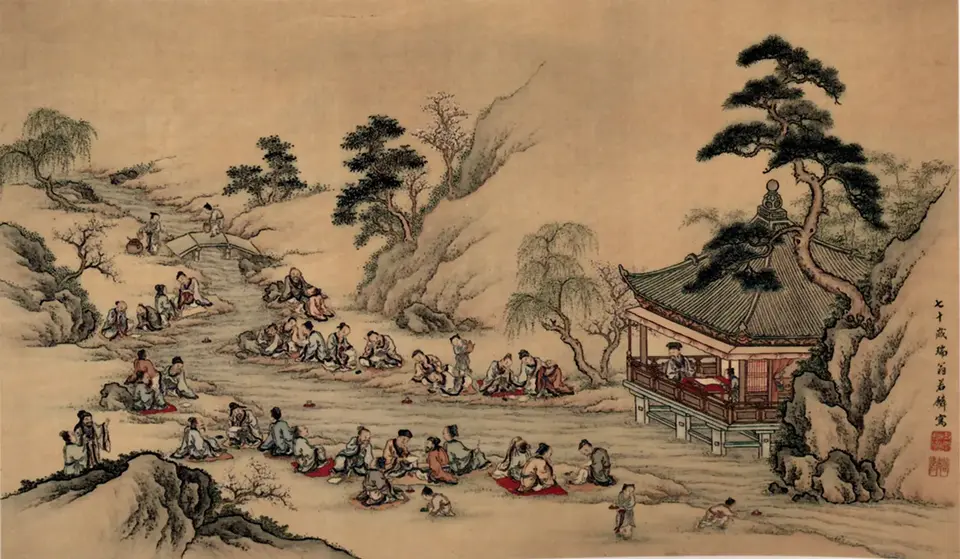
PROFILE
Sun Chuo (孙绰, 314–371), courtesy name Xinggong (兴公), was a native of Zhongdu County, Taiyuan Commandery (southwest of modern Pingyao County, Shanxi Province). He was an illustrious writer, prominent statesman, and foremost master of the School of Metaphysical Poetry (Xuanxueshi) during the Eastern Jin dynasty, inheriting the noble title Marquis of Changle. Descended from the prominent Taiyuan Sun lineage, his high ancestor Sun Zi served as a paramount minister in Cao Wei, while his grandfather Sun Chu was a celebrated Western Jin writer. Following the Disaster of Yongjia at the end of the Western Jin, Sun Chuo fled south across the Yangtze with his family, settling in Kuaiji and roaming the scenic mountains and streams for over a decade, authoring the Rhapsody on Fulfilling My Original Aspiration (Suichu Fu) to express his reclusive ideals. Entering the civil service, he held appointments including Collator-Author, Magistrate of Zhang'an, Erudite of the National University, Senior Clerk to Right Army General Wang Xizhi, Administrator of Yongjia, and Cavalier Attendant-in-Ordinary concurrently Editorial Director, ultimately rising to Chamberlain for Law Enforcement (Tingwei).
In Chinese literary history, Sun Chuo holds a towering position. Celebrated alongside Xu Xun as "Sun and Xu," he was universally acclaimed as the supreme literary authority of his era. He pioneered the integration of Daoist metaphysical philosophy, Buddhist voidness doctrines, and the verdant natural beauty of Jiangnan. His rhapsodic masterpiece, the Rhapsody on Mount Tiantai (You Tiantai Shan Fu), was praised for its dazzling diction, inspiring his proud boast that "when cast to the ground, it will surely ring like gold and stone," giving birth to the classic Chinese idiom "striking the ground with ringing metallic tones" (zhedi yousheng). In epigraphic writing, Sun Chuo stood without peer in the Six Dynasties; funerary stelae for eminent statesmen including Wang Dao, Yu Liang, Wen Qiao, and Huan Wen were exclusively composed by him. In 353, he participated in the legendary Orchid Pavilion Gathering hosted by Wang Xizhi, contributing two poems and authoring the Postface to the Orchid Pavilion Gathering. In 362, when Grand Marshal Huan Wen proposed relocating the imperial capital to Luoyang to consolidate despotic control, Sun Chuo boldly submitted the Memorial Admonishing Against Moving the Capital to Luoyang, articulating the supreme necessity of preserving the Jiangnan home front and preventing a disastrous national rupture. Philosophically, his treatises Yudao Lun and Daoxian Lun harmonized Confucianism, Daoism, and Buddhism, pioneering medieval cultural integration.
- Courtesy Name
- Xinggong (兴公)
- Dynasty
- Eastern Jin
- Ancestral Home
- Zhongdu, Taiyuan (southwest of modern Pingyao, Shanxi Province)
- Date of Birth
- 314 (2nd year of the Jianxing era, Western Jin)
- Date of Death
- 371 (6th year of the Taihe era, Eastern Jin)
- Age at Death
- 58
- Nobility Title
- Marquis of Changle
- Highest Office
- Chamberlain for Law Enforcement, Cavalier Attendant-in-Ordinary concurrently Editorial Director
- Key Offices
- Collator-Author, Magistrate of Zhang'an, Erudite of the National University, Senior Clerk to the General of the Right Army, Administrator of Yongjia, Cavalier Attendant-in-Ordinary concurrently Editorial Director, Chamberlain for Law Enforcement
- Primary Identity
- Renowned Eastern Jin writer, leading representative of the School of Metaphysical Poetry, master of literature
BIOGRAPHY
Chronology
- 314 (2nd year of the Jianxing era, Western Jin) | Birth in Taiyuan | Born into the eminent Taiyuan Sun lineage, studying classics and showing literary brilliance from childhood.
- c. 325 (3rd year of the Taining era, Eastern Jin) | Fleeing South to Kuaiji | Migrated south following the Disaster of Yongjia, roaming Kuaiji's mountains for over a decade and writing Suichu Fu.
- 341 (7th year of the Xiankang era, Eastern Jin) | Entering Civil Service | Appointed Collator-Author and inherited the title Marquis of Changle; later served in Yu Liang's staff and became Magistrate of Zhang'an.
- 347 (3rd year of the Yonghe era, Eastern Jin) | Administration of Yongjia | Served as Senior Clerk to Wang Xizhi and Administrator of Yongjia, composing the celebrated Rhapsody on Mount Tiantai.
- 353 (9th year of the Yonghe era, Eastern Jin) | The Orchid Pavilion Gathering | Attended the Orchid Pavilion Gathering with his brother Sun Tong and son Sun Si, composing two poems and the Postface to the Orchid Pavilion Gathering.
- 362 (1st year of the Longhe era, Eastern Jin) | Admonition on Capital Relocation | Submitted the landmark memorial blocking Huan Wen's plan to move the capital to Luoyang, safeguarding national stability.
- 365 (1st year of the Taihe era, Eastern Jin) | Editorial Director | Appointed Cavalier Attendant-in-Ordinary concurrently Editorial Director, directing dynastic historiography and composing definitive funeral stelae.
- 371 (6th year of the Taihe era, Eastern Jin) | Passing as Chamberlain | Died in office while serving as Chamberlain for Law Enforcement at age fifty-eight, leaving a collected corpus of fifteen volumes.
Biography
Aristocratic Lineage and Reclusive Youth
Sun Chuo was born in 314 in Zhongdu County, Taiyuan Commandery. The Taiyuan Sun clan was a premier northern aristocratic family; his great-great-grandfather Sun Zi had served as Director of the Imperial Secretariat across three Cao Wei reigns, managing supreme state secrets, while his grandfather Sun Chu was an outspoken literary figure and Senior Judge of the Western Jin. His father, Sun Hong, served as Administrator of Xingyang. Under this rich family tradition, Sun Chuo displayed precocious intellectual agility, reading widely across classical histories and philosophical treatises while mastering the art of literary composition.
During the Western Jin collapse, the turmoil of the War of the Eight Princes was compounded by the Disaster of Yongjia, culminating in the sacking of Luoyang. Amid the devastating northern warfare, the youthful Sun Chuo accompanied his family across the Yangtze River, finding refuge in Shanyin, Kuaiji (modern Shaoxing, Zhejiang Province). Kuaiji offered fertile valleys, misty waterways, and serene mountain peaks. Averse to political entanglements, Sun Chuo spent more than a decade wandering among Kuaiji's lakes and mountains, boating along the Jian Lake and scaling the Tiantai ranges. During this period, he composed the Rhapsody on Fulfilling My Original Aspiration (Suichu Fu), giving eloquent expression to Daoist quietude and the pursuit of spiritual tranquility.
Bureaucratic Appointments in Eastern Zhejiang
As his reputation spread throughout the emigre scholar-gentry in Jiangnan, the Eastern Jin court formally appointed Sun Chuo as Collator-Author in the Palace Library, confirming his inherited title of Marquis of Changle. Soon afterward, the powerful General of Western Campaigns Yu Liang recruited Sun Chuo to his military staff. Finding administrative paperwork unsuited to his contemplative disposition, Sun Chuo was assigned by Yu Liang to serve as Magistrate of Zhang'an in Kuaiji Commandery.
In Zhang'an, Sun Chuo practiced benevolent and lenient governance, ensuring local peace along the coastal frontier. Recalled to the capital of Jiankang as Erudite of the National University, he participated in collating classical texts and instructing elite students. In the early Yonghe era, when the master calligrapher Wang Xizhi assumed office as General of the Right Army and Internal Protector of Kuaiji, he recruited Sun Chuo as his Senior Clerk. The two men formed an intimate friendship, exchanging verses in Kuaiji and enhancing each other's literary stature. Between 348 and 350, Sun Chuo advanced to Administrator of Yongjia, governing modern Wenzhou. During his tenure in Yongjia, inspired by the surrounding peaks and philosophical reflections, he authored his masterpiece, the Rhapsody on Mount Tiantai (You Tiantai Shan Fu).
The Orchid Pavilion Gathering and Prime Ministerial Court
On April 22, 353 (3rd day of the 3rd month of the 9th year of the Yonghe era), Wang Xizhi gathered forty-one prominent scholars—including Xie An, Sun Chuo, Xi Tan, and Xu Xun—at the Orchid Pavilion in Shanyin for the spring purification ritual (xiuxie). Sun Chuo attended accompanied by his elder brother Sun Tong and his son Sun Si. During the gathering, Sun Chuo composed two poems in four-character and five-character meters, combining reflections on natural scenery with profound insights into cosmic transcendence.
When the assembled poems were compiled into the Orchid Pavilion collection, Wang Xizhi composed his immortal Preface to the Orchid Pavilion Gathering, while Sun Chuo was unanimously selected by the company to compose the Postface to the Orchid Pavilion Gathering. Sun Chuo's postface offered a penetrating metaphysical meditation on mortal transient existence and spiritual freedom, complementing Wang Xizhi's preface. Sun Chuo was subsequently summoned to the central court as an Imperial Secretary and Senior Clerk to the General Who Establishes Awe. With Prime Minister Sima Yu (later Emperor Jianwen) enthusiastically sponsoring pure talk (qingtan), Sun Chuo engaged in brilliant philosophical dialogues alongside Xu Xun, earning recognition as the supreme literary arbiter of his generation.
Opposing Huan Wen's Capital Relocation
In 362, Grand Marshal Huan Wen recaptured the ancient imperial capital of Luoyang during a northern expedition. Seeking to exploit this military feat to overshadow the imperial court and seize the throne, Huan Wen formally petitioned the throne to move the capital from Jiankang back to Luoyang, while ordering all northern emigre gentry who had fled south to return to Henan immediately. Backed by veteran armies and immense personal prestige, Huan Wen intimidated the court; ministers from Prime Minister Sima Yu downward were paralyzed with fear, not daring to utter a word of opposition.
In this moment of national crisis, Sun Chuo stepped forward to submit his famous Memorial Admonishing Against Moving the Capital to Luoyang. Sun Chuo argued with unassailable logic that Luoyang was surrounded by devastated, war-torn terrain vulnerable to northern nomad cavalry, while Jiangnan had enjoyed half a century of agricultural and economic stability. Forcing an immediate relocation would mean "abandoning a land of peace to venture into a land of chronic chaos; quitting a place of absolute safety to balance atop stacked eggs." He analyzed logistical transport costs, grain deficits, and civilian morale, exposing the dangerous recklessness of Huan Wen's ambitions. Huan Wen was incensed, but Sun Chuo's memorial galvanized court consensus, forcing the indefinite postponement of the relocation and saving the Eastern Jin regime from premature ruin.
Literary Leadership and Final Years
Following the crisis, Sun Chuo's political and moral standing grew even higher. During the reigns of Emperor Ai and Emperor Fei, he served as Cavalier Attendant-in-Ordinary concurrently Editorial Director, directing the compilation of dynastic history and imperial edicts. During this era, prominent aristocratic families considered the erection of commemorative stelae essential for honoring ancestral merit; stelae for deceased grandees such as Wang Dao, Xi Jian, Yu Liang, Wen Qiao, and Huan Wen were exclusively entrusted to Sun Chuo, whose prose conferred definitive historical judgment.
In his final years, Sun Chuo served as Chamberlain for Law Enforcement, supervising imperial judicial matters. Immersed in Buddhist and Daoist scholarship, he maintained close friendships with eminent monks including Zhi Daolin and Zhu Fashen. Living in tranquil retirement, he dedicated his final days to editing classical texts and philosophical treatises. In 371, Sun Chuo died in office in Jiankang at the age of fifty-eight. His literary corpus originally comprised fifteen volumes, recorded in the dynastic bibliographies of the Book of Sui and Book of Tang, and later preserved in the Ming collection Sun Tingwei Ji.
Major Achievements
Composing the Rhapsody on Mount Tiantai and Ringing Prose
Sun Chuo's foremost literary monument is his Rhapsody on Mount Tiantai (You Tiantai Shan Fu), composed during his tenure as Administrator of Yongjia. In a genre previously dominated by grand descriptions of imperial capitals, royal palaces, and seasonal hunts, Sun Chuo's masterpiece represented the first major rhapsody in Chinese literature dedicated entirely to celebrating a natural sacred mountain, later selected in full for Xiao Tong's Selections of Refined Literature (Wen Xuan).
The rhapsody opens with the proclamation that "Mount Tiantai is the supreme spiritual wonder among all mountains," featuring iconic couplets such as "The morning glow of Red City rises to establish the beacon; cascading waterfalls fly down to delineate the pathways." The text weaves together spatial geography, soaring Daoist transcendence, and Buddhist contemplation. Following its completion, Sun Chuo displayed the text to his friend Fan Rongqi, boasting: "Try casting this work to the ground; it will surely produce the ringing resonance of gold and stone!" This incident gave rise to the enduring Chinese idiom "striking the ground with ringing metallic tones" (zhedi yousheng), establishing Mount Tiantai as the cultural origin of the Eastern Zhejiang Tang Poetry Road and cementing Sun Chuo's renown as an immortal master of Six Dynasties prose.
Leading the School of Metaphysical Poetry as Master of Literature
Sun Chuo stood as the premier representative of the School of Metaphysical Poetry during the mid-Eastern Jin period, grouped alongside recluse Xu Xun as "Sun and Xu" and dominating the southern literary sphere for decades. Following the flight across the Yangtze, emigre scholar-officials retreated from catastrophic realities into Lao-Zhuang metaphysics, creating verse characterized by philosophical exposition.
Although later critics such as Zhong Rong in Poetry Gradings remarked that metaphysical poetry often allowed "philosophical discourse to outweigh poetic phrasing," Sun Chuo's poetry stood apart. Rather than resorting to abstract didacticism, he grounded philosophical musings in the delicate sensory beauty of the Jiangnan landscape. Masterpieces such as Autumn Day ("In the rustling chill of the mid-autumn moon, fierce gusts of wind soar... Chanting aloud beyond the cloud edges, the tranquil chamber clarifies the great void") bridged metaphysical contemplation and natural scenery, preparing the conceptual and stylistic transition toward the mature landscape poetry of Tao Yuanming and Xie Lingyun.
Pioneering Rhapsodic Inscriptions on Six Dynasties Stelae
Sun Chuo was a seminal reformer of epigraphic composition during the medieval era. In an era when aristocratic clans placed supreme importance on ancestral prestige, the demand for funerary stelae reached unprecedented heights. Sun Chuo revolutionized the genre by introducing the opulent diction and balanced parallel phrasing of the rhapsody into stone inscriptions, a technique known as "incorporating rhapsodic methods into stelae."
By blending parallel ornamentation with metaphysical philosophy, he elevated utilitarian epitaphs into grand literary achievements. Although literary critic Liu Xie in The Literary Mind and the Carving of Dragons observed that Sun Chuo's stelae were occasionally burdened by ornate digressions, he acknowledged Sun Chuo as a revered master across Jiangnan whose expansive scholarship commanded universal admiration. Stelae for towering figures including Wang Dao, Yu Liang, and Wen Qiao were composed exclusively by Sun Chuo, shaping the development of Six Dynasties parallel prose.
Blocking Huan Wen's Capital Relocation to Protect Jiangnan
Sun Chuo's courageous remonstrance against Huan Wen's relocation scheme in 362 remains one of the pivotal political actions of the Eastern Jin dynasty. Having recaptured Luoyang, Huan Wen sought to force the emperor and millions of emigre households to relocate to the devastated northern plain, seeking to detach the throne from southern aristocratic influence and clear the path for usurpation. A premature move would have broken Jiangnan's stability and exposed vulnerable populations to nomadic counter-offensives.
In an atmosphere where court ministers dared not speak, Sun Chuo submitted his extensive memorial, Memorial Admonishing Against Moving the Capital to Luoyang. He demonstrated that abandoning the prosperous southern base to settle in chaotic northern ruins was equivalent to "leaving a place of absolute safety to balance atop stacked eggs." Sun Chuo's lucid analysis of logistical realities and national morale persuaded the imperial court to reject the proposal, checking the general's political ascendancy and preserving the territorial sanctuary of the Eastern Jin.
Harmonizing the Three Teachings in Yudao Lun and Daoxian Lun
Sun Chuo was an intellectual pioneer in integrating Confucianism, Daoism, and Buddhism during the early medieval era. As Buddhist Prajna philosophy gained currency among Jiangnan elites, it encountered intense resistance from orthodox Confucian moralists. Sun Chuo studied Buddhist sutras in depth, conversed with eminent monks like Zhi Daolin and Zhu Fashen, and authored the apologetic treatise Yudao Lun (Discourse on Elucidating the Way).
In Yudao Lun, Sun Chuo formulated the proposition that "the Buddha is one who embodies the Dao," demonstrating the fundamental convergence between the teachings of the Duke of Zhou, Confucius, and the Buddha, and arguing that monastic renunciation constituted an act of supreme filial piety by illuminating ancestral virtue. Furthermore, in Daoxian Lun (Discourse on Monks and Worthies), he systematically paired seven eminent monks with the Seven Sages of the Bamboo Grove, comparing Zhi Daolin to Xiang Xiu and Zhu Daoqian to Liu Ling. Sun Chuo's writings dismantled gentry prejudice against Buddhism, accelerating the localization and sinification of Buddhist thought in China.
Relationships
- Sun Chu: Grandfather; celebrated Western Jin scholar and Senior Judge whose literary brilliance and proud character provided Sun Chuo's formative familial inheritance.
- Sun Tong: Elder brother; prominent Eastern Jin scholar who served as Internal Protector of Wuxing and participated alongside Sun Chuo in the Orchid Pavilion Gathering.
- Wang Xizhi: Intimate friend and patron; the Sage of Calligraphy who appointed Sun Chuo as Senior Clerk to the Right Army, co-leading the Orchid Pavilion Gathering and its compiled preface and postface.
- Xu Xun: Literary contemporary; celebrated recluse who shared equal fame with Sun Chuo as the leaders of the School of Metaphysical Poetry.
- Huan Wen: Political adversary and high minister; Grand Marshal whose planned capital relocation to Luoyang was blocked by Sun Chuo's memorial, though Sun later composed Huan Wen's funerary stele.
- Xie An: Close companion; illustrious Eastern Jin statesman with whom Sun Chuo shared youth wandering in Kuaiji and ocean voyages.
- Zhi Daolin: Buddhist companion; eminent monk (Zhi Dun) who maintained an intimate intellectual friendship with Sun Chuo, discussing Buddhist and Daoist philosophy.
Historical Evaluation
- The official appraisal in the Book of Jin (Jinshu) recorded: "Sun Chuo was broadly learned and skilled in composition, living a free and uninhibited life among mountains and streams. Contemporary opinion favored either Xu Xun's lofty detachment or Sun Chuo's brilliant literary talent. His phrasing was ornate and beautiful, ringing like gold and stone when cast to the ground; as the literary master of the Eastern Jin, Sun Chuo was surely the leader!"
- Southern Dynasties literary theorist Liu Xie praised him in The Literary Mind and the Carving of Dragons: "Sun Chuo's Rhapsody on Mount Tiantai displayed singular excellence among mountain-and-water compositions; its elegant diction and glistening style truly rang like gold and stone upon the earth."
- Liang dynasty poetic critic Zhong Rong observed in Poetry Gradings (Shipin): "During the Yonghe era, Daoist philosophy was exalted and empty speculation flourished. The poetry of that period was characterized by philosophical discourse outweighing artistic phrasing, resulting in thin, flavorless compositions. Only with Sun Chuo and Xu Xun did writers truly merit the title of literary masters."
- Tang Chancellor Fang Xuanling reflected in Jinshu: "Master Xinggong displayed shimmering literary elegance, his words ringing out like gold upon the earth. Resolutely submitting memorials to halt the relocation, he deeply understood the realities of state affairs. Encompassing the three teachings within his writings, he stood preeminent among his generation."
Related Entries
- [[Wang Xizhi]]
- [[Preface to the Orchid Pavilion Gathering]]
- [[Xu Xun]]
- [[You Tiantai Shan Fu]]
- [[Huan Wen]]