Imperial Birth
Born on the 10th day of the 10th month in Kaifeng as the eleventh son of Emperor Shenzong.
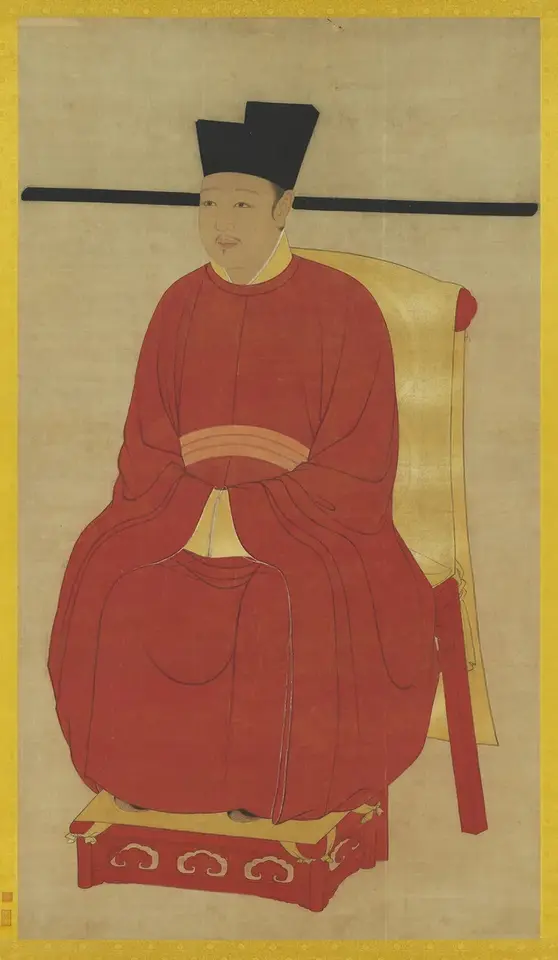
赵佶
Zhao Ji (1082–1135), known posthumously as Emperor Huizong of Song and styled Master of Xuanhe, was the eighth emperor of the Northern Song dynasty and an extraordinary calligrapher and painter. The eleventh son of Emperor Shenzong and younger brother of Emperor Zhezong, he was born to Empress Dowager Qinci (Consort Chen). In January 1100, following Emperor Zhezong's heirless death, Empress Dowager Xiang overruled Grand…
Zhao Ji (1082–1135), known posthumously as Emperor Huizong of Song and styled Master of Xuanhe, was the eighth emperor of the Northern Song dynasty and an extraordinary calligrapher and painter. The eleventh son of Emperor Shenzong and younger brother of Emperor Zhezong, he was born to Empress Dowager Qinci (Consort Chen). In January 1100, following Emperor Zhezong's heirless death, Empress Dowager Xiang overruled Grand Chancellor Zhang Dun's objections and enthroned Zhao Ji. Upon taking the throne, Zhao Ji initially attempted to reconcile factional strife under the reign title Jianzhong Jingguo, but soon fully appointed Cai Jing to enforce the Chongning New Policies, ruthlessly purging the Yuanyou conservative faction and erecting the Yuanyou Partisan Stele. Enticed by Cai Jing's philosophy of boundless indulgence, Zhao Ji embraced Daoism, styled himself the 'Daoist Sovereign Emperor', ordered the catastrophic 'Flower and Stone Network' to seize southeast rarities, and constructed the lavish imperial garden Genyue, sparking widespread rebellions led by Fang La and Song Jiang. In diplomacy and warfare, Zhao Ji rashly entered into the 'Alliance Conducted over the Sea' with the Jurchen Jin dynasty to encircle the Liao dynasty, exposing the military feebleness and inner corruption of the Song state. In the winter of 1125, when Jin armies invaded in force, Zhao Ji abdicated in panic to his heir Zhao Huan (Emperor Qinzong), assuming the title of Retired Emperor and fleeing south. In 1127, Jin forces breached Kaifeng, abducting Huizong, Qinzong, and thousands of imperial clan members to the far north, marking the fall of the Northern Song in the Jingkang Incident. Demoted to the humiliating title 'Duke Hundegong', Zhao Ji endured brutal captivity and psychological torment in remote Wuguo City for eight years before dying in misery in 1135 at the age of fifty-four. His remains were returned and buried at the Yongyou Mausoleum in Shaoxing following the Shaoxing Peace Accord. Renowned as a supreme cultural monarch, Zhao Ji invented the iconic 'Slender Gold' calligraphy, elevated the imperial painting academy to unprecedented heights, and commissioned the landmark catalogues Xuanhe Huapu, Xuanhe Shupu, and Xuanhe Bogutu, leaving an indelible imprint upon Chinese art history.
Born on the 10th day of the 10th month in Kaifeng as the eleventh son of Emperor Shenzong.
Successively created Prince of Suining and Prince of Duan, setting up his private residence outside the palace.
Emperor Zhezong died without an heir; Empress Dowager Xiang overruled Zhang Dun and enthroned Zhao Ji.
Adopted moderate policies to mediate factional rivalries before shifting toward Cai Jing's reform faction.
Appointed Cai Jing as chancellor, initiating the Yuanyou proscription and erecting partisan stele.
Established the Bureau of Supply in Suzhou to plunder rare stones and flora from southeastern provinces.
Began massive construction of the artificial mountain and imperial garden Genyue, draining state treasuries.
Proclaimed himself Daoist Sovereign Emperor, constructing numerous shrines and expanding Daoist hierarchy.
The plundering of southeastern resources incited the catastrophic Fang La rebellion, while Song Jiang rose in the north.
Dispatched envoys across Bohai Sea to ally with Jin founder Aguda for a joint assault against Liao.
Jin launched a two-pronged offensive against Song; Zhao Ji abdicated in panic to Crown Prince Zhao Huan.
Fled south to Zhenjiang during the siege of Kaifeng; returned after Jin retreated and was confined to Longde Palace.
Kaifeng fell to Jurchen invaders; Huizong, Qinzong, and thousands of royals were abducted northward.
Arrived at Shangjing and forced to perform the humiliating sheepskin submission ritual at the Jin ancestral temple.
Transferred to remote Wuguo City in the extreme northeast, enduring squalor and harsh confinement.
Died of exhaustion and illness in a cold earthen cell at Wuguo City on June 4, aged fifty-four; remains returned and interred at Yongyou Mausoleum in 1142.
Zhao Ji was born in the imperial palace of Kaifeng on November 2, 1082 (10th day of the 10th month, Yuanfeng 5), the eleventh son of Emperor Shenzong. In the following year, Shenzong officially conferred upon him the personal name Zhao Ji, appointing him Military Commissioner of Zhenning and Duke of Ningguo. Palace legend recorded that prior to Zhao Ji's birth, Emperor Shenzong visited the Palace Library and admired a portrait of Li Yu, the last ruler of the Southern Tang, marveling at his refined elegance. The court subsequently propagated the romantic myth that Zhao Ji was the spiritual reincarnation of Li Yu.
Upon Emperor Zhezong's accession in 1085, Zhao Ji was elevated to Prince of Suining. In 1096, he was granted the additional title of Military Commissioner of Pingjiang and Zhenjiang, advanced to Prince of Duan, and established his private residence outside the palace precinct. In 1098, he was honored as Grand Pillar of State and reassigned as Military Commissioner of Zhaode and Zhangxin. Living in luxury, the young prince developed passionate interests in equestrian arts, archery, cuju football, theatrical arts, and above all, antiquities, calligraphy, and painting.
During his princely years, Zhao Ji associated closely with prominent artists, literati, and aristocrats, such as Imperial Son-in-law Wang Shen and imperial kinsman Zhao Lingrang. He immersed himself in collecting ancient scrolls, copying masterworks by Huang Tingjian and Xue Ji, and refining his technical brushwork. His artistic refinement earned him wide acclaim among the metropolitan elite, yet his frivolous, impressionable, and pleasure-seeking temperament also became increasingly manifest to observant statesmen.
In January 1100 (Yuanfu 3), the twenty-five-year-old Emperor Zhezong suddenly passed away without leaving an heir. At the critical imperial council convened to choose a successor, Grand Chancellor Zhang Dun forcefully argued according to ritual precedent, insisting that Zhezong's full brother, Prince of Jian Zhao Si, or the eldest surviving brother, Prince of Shen Zhao Bi, should inherit the throne. When Zhao Ji was proposed, Zhang Dun vehemently protested to his face, declaring bluntly: 'The Prince of Duan is frivolous and lacks the gravity to govern the empire!'
However, Empress Dowager Xiang, widow of Emperor Shenzong, held absolute authority. Pointing out that all of Shenzong's sons were born to concubines and noting that Prince of Shen suffered from a severe eye ailment, she firmly championed Zhao Ji, praising his filial piety and gentleness. Backed by key councilors Zeng Bu, Cai Bian, and Xu Jiang, the nineteen-year-old Zhao Ji was formally enthroned. Empress Dowager Xiang presided over military and state affairs behind the curtain, appointing conservative statesman Han Zhongyan as chancellor, dismissing reform leaders Zhang Dun and Cai Bian, and rehabilitating disgraced Yuanyou conservatives.
Zhao Ji designated his first formal regnal year as Jianzhong Jingguo, signaling an imperial intent to harmonize factional animosities between the Yuanyou and Shaosheng factions and bestow tranquility upon the realm. He opened speech channels, solicited candid remonstrances, and attempted to balance ministerial appointments. However, deep-seated partisan hostilities quickly flared into renewed vitriolic attacks, rendering moderate compromise completely futile amid irreconcilable bureaucratic factionalism.
Following Empress Dowager Xiang's death in late 1101, Zhao Ji, liberated from maternal restraint, turned decisively toward the reform agenda. Reform theorist Deng Xunwu submitted a memorial urging the emperor to inherit the transformative policies of Shenzong and Zhezong, fiercely attacking Han Zhongyan and strongly advocating the appointment of Cai Jing, who was living in political retirement at Hangzhou. Persuaded by these arguments, Zhao Ji announced that the forthcoming year would be styled Chongning ('Upholding the Xining Reforms'), formally terminating his policy of political compromise.
Cai Jing was a consummate political opportunist who had previously ingratiated himself with the influential eunuch Tong Guan while Tong was in Hangzhou collecting paintings for the court. Cai Jing's dazzling calligraphic mastery captivated Zhao Ji's artistic sensibilities. In May 1102, Han Zhongyan was stripped of the chancellorship and demoted to a provincial prefecture, followed shortly by the dismissal of Right Chancellor Zeng Bu. Cai Jing ascended to the chancellorship, dominating the executive for three consecutive years and initiating an era of unchecked autocratic power.
Cai Jing instituted systematic proscriptions under the guise of continuing imperial reforms. In 1104 (Chongning 3), Zhao Ji personally inscribed in his Slender Gold calligraphy the infamous 'Yuanyou Partisan Stele', listing three hundred and nine prominent statesmen, including Sima Guang, Wen Yanbo, Su Shi, and Huang Tingjian, as treacherous partisans. Duplicate stelae were erected at palace gates and distributed to every prefecture nationwide. The descendants of proscribed officials were barred from civil office, their writings were burned, and candid political criticism was permanently silenced across the empire.
Upon consolidating his authority, Cai Jing indulged Zhao Ji's desires by preaching the corrupt doctrine of 'Boundless Abundance and Joy' (Feng Heng Yu Da), arguing that a truly prosperous empire must manifest its greatness through peerless pageantry and pleasure. Cai Jing devised numerous extortionate financial levies, inventing the 'Bureau of Regulation Money' (Jingzhi Qian) by slapping surcharges upon wine monopolies, deed registries, and market transactions. These ruthless collections extracted over fifty million strings of cash into imperial vaults, exclusively designated for palatial building sprees.
Under Cai Jing's stewardship, official venality became institutionalized and offices were openly auctioned at set market rates, epitomized by the popular saying: 'Three thousand strings buys an appointment to the Secretarial Academy; five hundred strings secures a vice-prefectural post.' To circumvent deliberative review by the Department of State Affairs, Cai Jing persuaded Zhao Ji to issue arbitrary 'Imperial Brush Edicts', often drafted by favorite eunuchs such as Yang Qiu, effectively bypassing standard administrative oversight and eroding the constitutional foundations of the bureaucracy.
Between the Chongning and Daguan eras, Cai Jing was repeatedly dismissed and reinstated, eventually being honored as Grand Preceptor and Duke of Lu. Alongside his inner cabal—Tong Guan, Wang Fu, Liang Shicheng, Li Yan, and Zhu Mian—Cai Jing monopolized governance for over two decades. The scholar-official elite was reduced to sycophancy, while the agrarian economy deteriorated into profound exhaustion beneath an illusory façade of metropolitan splendor.
In collusion with powerful court eunuchs, Zhao Ji implemented predatory land confiscation schemes across northern China. The eunuch Yang Jian initially established the 'Rice Field Bureau' in Ruzhou, systematically confiscating private property deeds under the pretext of auditing arable lands. State bailiffs traced family land deeds back generations; whenever an owner could not produce centuries-old original titles, the land was arbitrarily declared public domain, and the legitimate owners were forcibly degraded into tenant serfs required to pay exorbitant state rents.
These agencies were later consolidated into the notorious 'Western City Bureau' (Xicheng Suo), which aggressively confiscated all uncultivated marshes, wastelands, and historic embankments across the Yellow River and Huai River basins. Following Yang Jian's death, eunuch Li Yan assumed leadership with even greater brutality, inciting scoundrels to lodge fraudulent claims against fertile private lands, resulting in the wholesale expropriation of entire farming districts such as Lushan County in Henan, while protesting peasants were tortured to death.
The Western City Bureau's extortions devastated rural stability. Even fishing skiffs across the vast Liangshan Marsh were subjected to heavy taxes, with defaulters executed as bandits. Across Henan, Shandong, and Hebei, ruined smallholders abandoned their ancestral plots, sparking chronic rural distress and fueling peasant discontent that erupted into widespread guerrilla uprisings.
Driven by romantic visions of creating an earthly immortal paradise, Zhao Ji established the Bureau of Supply in Suzhou in 1105 (Chongning 4), appointing Zhu Mian to extract exotic plants, porous Taihu limestone rocks, and precious timber from the southeastern provinces under the devastating system known as the 'Flower and Stone Network' (Huashi Gang). Fleets of requisitioned transport barges conveyed immense boulders north along the Grand Canal, demolishing civilian bridges and canal-side dwellings to ensure unimpeded passage.
Zhu Mian's agents terrorized the Jiangnan region. Whenever a civilian residence possessed an unusually scenic rock, miniature tree, or flowering shrub, agents affixed imperial yellow seals upon it, expropriating it without compensation and prosecuting resistant owners for high treason. Tens of thousands of prosperous households across Zhejiang and Jiangsu were driven to complete bankruptcy, while grain transport on the Grand Canal was paralyzed by the requisitioning of cargo vessels.
In 1113 (Zhenghe 3), Zhao Ji commenced the construction of the monumental 'Genyue' imperial garden northeast of the Kaifeng city walls. Hundreds of thousands of corvée laborers were mobilized to excavate artificial lakes, divert the Jinglong River, and pile earth into towering artificial peaks adorned with rare flora and teeming with tens of thousands of exotic birds and animals. There Zhao Ji feasted with favorites, composed verses, and painted, completely detached from the deepening misery of his subjects.
Ruthless extortion eventually triggered large-scale popular uprisings. In October 1120 (Xuanhe 2), Fang La, owner of a lacquer grove at Bangyuandong in Qingxi County, rebelled against the brutal exploitation of the Bureau of Supply. Utilizing Manichaeism (Mingjiao) to organize secret congregations, Fang La executed corrupt local headmen and seized the county seat of Qingxi. Oppressed peasants throughout the southeastern provinces rallied to his banner in droves.
Proclaiming himself Sage Duke and declaring the Yongle era, Fang La swept across Muzhou and Shezhou before capturing Hangzhou, the administrative center of Liangzhe Circuit. The insurrection engulfed fifty-two counties across six prefectures, mobilizing several hundred thousand fighters. In panic, Zhao Ji halted the planned invasion of the Liao dynasty and diverted fifteen thousand elite Western Army troops under the command of Military Commissioner Tong Guan to suppress the southern rebellion.
In early 1121, imperial forces retook Jiangning and Runzhou, lifted the rebel siege of Xiuzhou, and recaptured Hangzhou. Fang La retreated to his mountainous stronghold at Bangyuandong, where imperial units surrounded and annihilated the insurgent core. On April 26, Fang La was captured by junior officer Han Shizhong and later executed in Kaifeng. The conflict cost hundreds of thousands of lives and laid waste to the wealthiest economic centers of the south. Shamelessly, Zhao Ji reinstated the Bureau of Supply immediately after the rebellion was crushed.
Concurrently, Song Jiang launched an insurrection in northern China in 1119 (Xuanhe 1). Leading thirty-six core commanders, Song Jiang rampaged across Shandong and Hebei, outmaneuvering tens of thousands of imperial troops. In 1120, his forces campaigned across Qingzhou, Jizhou, and Yunzhou, marching south through Yizhou and Chuzhou. In February 1121, after suffering an ambush orchestrated by Prefect Zhang Shuye at Haizhou, Song Jiang accepted imperial surrender, laying bare the profound military incompetence of Song garrisons.
While internal rebellions roiled the heartland, Zhao Ji was seduced by frontier general Tong Guan and Liao turncoat Ma Zhi (bestowed the imperial surname and renamed Zhao Liangsi) into attempting to recover the Sixteen Prefectures of Yanyun from the collapsing Liao empire. In 1118 (Zhonghe 1), Ma Zheng crossed the Bohai Sea to open talks, and in 1120 (Xuanhe 2), Song concluded the 'Alliance Conducted over the Sea' with Jin founder Wanyan Aguda.
The treaty stipulated that Song would attack the Liao southern capital of Yanjing while Jin assaulted the central capital of Zhongjing; upon Liao's destruction, Song would redirect its annual tribute payments from Liao to Jin in exchange for the return of Yanyun. However, when Song launched its northern campaign in 1122 under Tong Guan and Liu Yanqing, its elite armies were routed by demoralized Liao remnants. Jin armies subsequently broke through Yanjing without Song assistance, plundering its entire population and wealth.
Displaying utter contempt for Song weakness, Jin compelled Song to pay an additional one million strings of cash annually as 'substitute tax money' before transferring a looted, depopulated Yanjing in 1123, which was reduced to an abandoned wasteland. Song's catastrophic military performance in the Yanyun campaign thoroughly shattered its diplomatic credibility and exposed its vulnerabilities to the aggressive Jurchen leadership.
In late 1125, having conquered the Liao dynasty, the Jin court used Song's shelter of Liao turncoat Zhang Jue as a pretext to launch a massive two-pronged invasion. The western army under Wanyan Zonghan besieged Taiyuan, while the eastern army under Wanyan Zongwang breached Yanjing and drove toward the Yellow River. When news reached Kaifeng in December, Zhao Ji collapsed in terror, desperate to shed the burden of imperial responsibility.
On January 18, 1126 (23rd day of the 12th month, Xuanhe 7), Zhao Ji abdicated the throne to his eldest son Zhao Huan (Emperor Qinzong), assuming the grand title of Daoist Sovereign Retired Emperor and taking up residence in the Longde Palace. Several days later, as Jin cavalry crossed the Yellow River, Zhao Ji fled the capital by boat with Cai You and close courtiers, traveling to the Taiqing Palace in Bozhou before taking refuge in Zhenjiang.
In Kaifeng, Qinzong rallied defenses under Li Gang. Hampered by logistical strain and facing arriving loyalist armies, the Jin forces accepted vast ransoms and the cession of Taiyuan, Zhongshan, and Hejian before withdrawing. Reassured by the retreat, Zhao Ji returned to Kaifeng in April. However, Qinzong viewed his father's return with deep suspicion, disbanded his personal guard, and placed Zhao Ji under virtual house arrest in the Longde Palace.
In August 1126, after resting and reinforcing their forces, Jin armies launched a second full-scale invasion, converging upon the capital. In Kaifeng, Minister of War Sun Fu placed misplaced faith in an eccentric soldier named Guo Jing, who claimed to wield miraculous Daoist and Buddhist martial arts capable of vanquishing invaders through 'Six-Chia Divine Soldiers'. In January 1127 (intercalary 11th month), Guo Jing's charlatans opened the Xuanhua Gate and were slaughtered, allowing Jin assault units to overrun the outer ramparts.
Qinzong's appeals for peace were dismissed. In February 1127, Jin emperors deposed both Huizong and Qinzong to commoner status. In April, Jin armies methodically stripped Kaifeng of all public and private treasures, imperial library collections, ritual regalia, astronomical instruments, and artisans, marching Huizong, Qinzong, royal consorts, princes, and thousands of officials into captivity, an epochal catastrophe known as the 'Jingkang Incident'.
During the agonizing march northward through freezing blizzards, captives suffered relentless cruelty, with Zhao Ji's beloved consort Wang Wanrong seized by Jurchen commanders. In 1128 (Tianhui 6), upon reaching the Jin supreme capital of Shangjing, Huizong and Qinzong were stripped of imperial attire, draped in raw sheepskins, and forced to perform the humiliating submission ritual at the temple of Jin founder Aguda.
Following the submission ritual, Jin ruler Wanyan Sheng bestowed upon Zhao Ji the derogatory title 'Duke Hundegong' and relegated Qinzong to 'Marquis Chonghun', imprisoning them at Hanzhou. In July 1127, Zhao Ji secretly dispatched trusted courtier Cao Xun to flee south to the newly established Southern Song court, entrusting him with an undershirt on which he had wept and inscribed: 'Come swiftly to rescue your parents!' Zhao Ji urged Cao Xun to ensure that Prince Kang (Emperor Gaozong) never forgot the agony of his northern captivity.
In July 1130 (Tianhui 8), fearing Southern Song rescue raids, the Jin moved the two captive monarchs to the desolate frontier outpost of Wuguo City (modern Yilan, Heilongjiang). By then, only one hundred and forty members of their royal retinue remained alive. Confined to cold, damp subterranean dwellings, Zhao Ji endured squalor, hunger, and unrelenting heartbreak. In his misery, he read the biography of Tang minister Li Mi and penned poignant verses: 'All night the west wind shakes the broken door, through the lonely room flickers a dying light; looking back three thousand li toward home, my gaze breaks where no wild geese fly south.'
On June 4, 1135 (21st day of the 4th month, Tianhui 13), physically broken and psychologically exhausted, Zhao Ji passed away in his earthen cell at Wuguo City at the age of fifty-four. Jin records noted that his remains were briefly interred at Guangning. In 1141, seeking diplomatic rapprochement with the Southern Song, Jin Emperor Xizong posthumously elevated Zhao Ji to Prince of Tianshui, removing the derogatory title.
In 1142, under the Treaty of Shaoxing, Gaozong's mother Empress Dowager Wei accompanied Zhao Ji's casket back to the Southern Song, where he was interred at the Yongyou Mausoleum in Shaoxing. In early 1143, he was conferred the elaborate posthumous title Emperor Tishen Heda Junlie Xungong Shengwen Rende Xianci Xianxiao, with the temple name Huizong. His frivolous aestheticism had brought catastrophe upon the empire, closing the illustrious history of the Northern Song in devastation.
Zhao Ji possessed extraordinary, innate artistic genius. In his youth, he immersed himself in the calligraphic traditions of Huang Tingjian, Chu Suiliang, and Xue Yao, drawing particular inspiration from Huang Tingjian's bold, elongated brush movements. Rather than mechanically imitating predecessors, Zhao Ji synthesized these techniques through his remarkable intuition, originating the celebrated 'Slender Gold' (Shoujin Ti) script in his early twenties.
The Slender Gold script is characterized by taut, iron-hard strokes, swift kinetic energy, and delicate lateral knife-like flourishes resembling bamboo fronds and orchid leaves. Each horizontal line terminates in a crisp downward hook, vertical strokes conclude with raised drops, and sweeping strokes emerge like unsheathed blades cutting through space. The internal architecture of each character is taut, spacious, and imbued with airy grace, balancing structural rigidity with rhythmic fluidity to establish an enduring calligraphic school.
Zhao Ji left an extensive corpus of Slender Gold masterpieces. His regular-script Thousand Character Classic exhibits peerless elegance and silver-iron brushwork; his monumental Poem on Fragrant Blossoms displays regal grandeur and sculptural density; while his cursive Thousand Character Classic demonstrates breathtaking momentum. Blending imperial luxury with the intellectual detachment of literati aesthetics, Zhao Ji's calligraphy stands alone in Chinese art history.
In painting, Zhao Ji not only attained masterly personal prowess but elevated the Song Imperial Painting Academy (Hanlin Tuhuayuan) to its historical zenith. He elevated the academy to parity with imperial civil service examinations, establishing six specialized categories and testing candidates with poetic lines such as 'A lonely boat drifts across the deserted ferry' or 'Red blossoms adorn green twigs with subtle spring charm', encouraging lyrical depth over literal representation.
Zhao Ji championed the aesthetic principle of 'Meaning preceding the brush, yet fully realized within the form', demanding rigorous observational fidelity to nature. He mandated that academy painters unite external verisimilitude with internal vitality, strictly rejecting both hollow abstraction and crude mechanical craftsmanship. He personally discovered and mentored timeless masters like Wang Ximeng, Zhang Zeduan, and Li Tang, fostering masterpieces such as A Thousand Li of Rivers and Mountains and Along the River During the Qingming Festival.
Zhao Ji's personal bird-and-flower paintings represent an exquisite pinnacle of imperial academic realism, integrating poetry, calligraphy, painting, and seals into a harmonious unity. Works such as Golden Pheasant and Hibiscus, Auspicious Cranes, and Returning Boats on a Snowy River display refined mineral pigments and consummate balance. Modern ornithological studies have revealed that his rendering of the pheasant in Golden Pheasant and Hibiscus faithfully documents early bird hybridization, confirming his scientific precision in empirical nature observation.
In 1104 (Chongning 3), Zhao Ji formally established the 'School of Painting' (Huaxue), integrating visual arts into the state civil service examination system for the first time in Chinese history. The academy offered six distinct curricula: Buddhist and Daoist themes, figures, landscapes, birds and animals, flowers and bamboo, and architectural structures, drawing artistic talent from across the empire and enabling talented civilian artisans to enter officialdom.
The institution dismantled rigid social barriers, dividing students into 'Scholar Stream' and 'Vocational Stream' with distinct living quarters, rigorous instruction, and periodic examinations. Successful graduates were appointed to imperial ranks such as Instructor, Scholar-Academic, Painter-in-Attendance, and Attendant, receiving salaries and honors exceeding those of other court artisans.
Under imperial patronage, painters enjoyed unprecedented social prestige. Zhao Ji frequently visited studio workshops to critique works and inspire poetic concepts. The academy flourished as a crucible of creative brilliance, establishing the opulent yet refined Northern Song court aesthetic and profoundly influencing southern landscape masters such as Liu Songnian, Li Song, and Xia Gui.
Leveraging imperial authority, Zhao Ji assembled an unprecedented collection of ancient bronzes, jade artifacts, calligraphic masterpieces, and paintings, transforming the Xuanhe palace treasury into the greatest imperial art museum of premodern China. The palace collections encompassed tens of thousands of scrolls, including two thousand seven hundred and eighty-six registered bird-and-flower paintings alone, alongside immense quantities of Shang and Zhou bronze ritual vessels, catalyzing the rise of Chinese epigraphy (Jinshixue).
To classify and evaluate these treasures, Zhao Ji directed teams of scholars over several years to compile monumental art catalogues: the twenty-volume Xuanhe Huapu (Painting Catalogue), the twenty-volume Xuanhe Shupu (Calligraphy Catalogue), and the thirty-volume Xuanhe Bogutu (Antiquities Catalogue). The Xuanhe Bogutu systematically catalogued archaic bronze forms, inscriptions, and functions, laying foundational principles for Chinese archaeological analysis.
The Xuanhe Huapu and Xuanhe Shupu systematically reviewed hundreds of historical painters and calligraphers from antiquity through the Song, establishing definitive aesthetic criteria and codifying classical connoisseurship. Although much of the original palace collection perished during the sack of Kaifeng, these three landmark catalogues remain indispensable cornerstones for studying the evolution of Chinese classical art.
In addition to his colorful, meticulous bird-and-flower compositions, Zhao Ji demonstrated profound mastery in expressive ink-wash painting. Authenticated surviving works, including Autumn Evening by a Pond in the National Palace Museum in Taipei, and Four Birds and Willow and Crows in the Shanghai Museum and Palace Museum, reflect his alternative stylistic voice. Rendered entirely in monochrome ink on paper, these works discard heavy pigments in favor of unadorned spontaneity and natural simplicity.
Western art historians have described Zhao Ji's empirical fidelity as 'magical realism', noting that his compositions create psychological depth and evocative timelessness that captivate viewers. This dual mastery of courtly academic refinement and literati ink spontaneity distinguished him uniquely among imperial patrons, making him the only Chinese monarch universally recognized as a major painter in his own right.
On his authenticated masterworks, Zhao Ji frequently applied his distinctive cipher signature, a stylized monogram that merged the characters 'The First Man Under Heaven' (Tianxia Yiren) into an elegant seal-like motif. His innovative handling of negative space, asymmetric balance, and tonal wash profoundly influenced the aesthetic breakthroughs of the Southern Song landscape masters.
Throughout his reign, Zhao Ji harbored an obsessive infatuation with Daoism, welcoming thaumaturgic charlatans like Lin Lingsu and Wang Zixi into the inner precincts to influence state affairs. Claiming to be the descent of the Divine Sovereign of Long Life, eldest son of the Primordial Heavenly Worthy, Zhao Ji formally assumed the title 'Daoist Sovereign Emperor', merging political autocracy with the supreme leadership of Daoism and requiring court officials to adopt Daoist vestments.
In 1118 (Zhonghe 1), Zhao Ji created twenty-six grades of Daoist ecclesiastical titles and eight ministerial ranks, granting Daoist adepts salaries and privileges equivalent to high civil and military officials. In 1121, he established female Daoist directorates across the three capitals. He expended astronomical sums constructing hundreds of opulent temples, including the Yuqing Jinming Palace, and commissioned the imperial woodblock publication of the comprehensive Daoist canon, Zhenghe Wanshou Daozang.
Zhao Ji went so far as to enforce a forced syncretism of Buddhism into Daoism, ordering Buddhist monasteries converted into Daoist abbeys, Buddhist monks redesignated as 'Virtuous Scholars' (Deshi), Shakyamuni Buddha renamed the 'Great Enlightened Golden Immortal', and bodhisattvas designated as Daoist immortals. This bizarre religious policy alienated millions of subjects, disrupted religious traditions, and symbolized the decay of the late Northern Song court.
Beyond painting and Daoism, Zhao Ji was a peerless master of the Song tea ceremony, particularly the refined art of whipped tea (diancha) and competitive tea-tasting (doucha). He frequently whipped and served whisked tea for close ministers during private palace banquets; Cai Jing recorded in his Taiqinglou Shiyan Ji how the emperor personally prepared whisked tea in the western pavilions, creating frothy white foam resembling milk.
Zhao Ji ordered imperial tea plantations at Beiyuan in Fujian to manufacture exquisite tribute tea cakes bearing evocative names such as 'Yuqing Auspicious Clouds' and 'Soaring Dragon over Auspicious Clouds'. In 1107 (Daguan 1), he authored the landmark treatise Daguan Cha Lun (originally titled Cha Lun). Comprising twenty chapters, the work exhaustively analyzed tea cultivation, plucking, processing, water selection, teaware selection, and the intricate 'Seven-Pouring Whipping Technique'.
The Daguan Cha Lun elevated tea preparation into a philosophical and aesthetic discipline, ranking alongside Lu Yu's Classic of Tea as a foundational text of Chinese tea culture. Zhao Ji's patronage popularized Jianyang oil-spot and hare's-fur glazed bowls, leaving a lasting legacy on the tea traditions of China, Japan, and East Asia.
During his early reign, alongside his pursuit of personal luxury, Zhao Ji enacted innovative public welfare and medical relief institutions. In 1102 (Chongning 1), he decreed the nationwide establishment of 'Anji Fang' (Relief Dispensaries) in every prefecture and county, utilizing temples and official compounds to house, treat, and feed destitute, homeless, and chronically ill patients with state funds.
Zhao Ji instituted a rigorous assessment system for medical monks and civilian physicians operating the dispensaries, introducing 'Patient Case Logs' (Shouli) to document symptoms, treatments, and recovery rates, creating the earliest standardized clinical case management system in Chinese history.
The imperial government also maintained 'Jiyang Yuan' (Asylums for the Aged and Infirmed) to support orphans and disabled paupers, as well as 'Louze Yuan' (Public Cemeteries) to bury impoverished and unclaimed dead. While these charitable institutions later deteriorated into bureaucratic corruption under Cai Jing's fiscal collapse, their initial nationwide implementation marked an important institutional milestone in premodern public healthcare.
Zhao Ji's autocratic enforcement of the Chongning partisan purges inflicted catastrophic damage upon the political health of the Northern Song. The foundational ancestral tradition of 'Governing the realm jointly with scholar-officials' was permanently dismantled by the Partisan Stele. Any official offering upright remonstrance was branded a Yuanyou partisan, stripped of office, exiled to malarial regions, and financially ruined.
Under this intellectual terror, candid debate vanished from the court. Power concentrated in the hands of sycophants and unprincipled flatterers led by Cai Jing, Tong Guan, and Wang Fu. The moral courage that characterized Song Confucian scholars was extinguished, replaced by subservience and deceit.
This systematic silencing of upright voices crippled the state's capacity for strategic self-correction. When the empire confronted existential military crises from Jurchen invasions, the court remained paralyzed by denial and flattery. In the decisive hour, not a single minister could offer viable grand strategy, plunging the dynasty headlong into ruin.
To fund the ceaseless expansion of Genyue, the Yanfu Palace, and imperial luxuries, Zhao Ji permitted Zhu Mian to run the Bureau of Supply for over a decade. Corrupt agents extorted wealthy gentry and humble peasants alike, demolishing homes, ruining ancestral graves, and seizing private property under the pretext of securing rocks and plants, reducing the prosperous Jiangnan heartland to despair.
This relentless extortion sparked the devastating Fang La rebellion in 1120. Roused by indignation against state predation, hundreds of thousands of southeastern peasants joined the insurrection, paralyzing the Grand Canal grain supply. The redeployment of the elite Western Army to suppress the revolt devastated the population and destroyed the empire's main combat reserves.
Although the rebellion was crushed, imperial authority was shattered among southeastern subjects. Zhao Ji's predatory policies alienated the dynasty from its tax base and exhausted its logistical resources, ensuring that when Jin armies swept south, Kaifeng stood isolated, bankrupt, and undefended.
Zhao Ji's gravest geopolitical blunder was his reckless decision to conclude the Alliance Conducted over the Sea. Enticed by Tong Guan and adventurer Zhao Liangsi, Zhao Ji abandoned a century of stable peaceful coexistence with the Liao dynasty in an opportunistic gamble to capture the Sixteen Prefectures of Yanyun with Jurchen assistance.
The ensuing northern campaign exposed the utter decrepitude of the Song military. Song armies were repeatedly repulsed by shattered Liao forces, forcing the Jin to take Yanjing alone. The Jurchens recognized Song weakness, extorted millions in cash, and subsequently turned their triumphant armies southward to destroy the Northern Song.
When the Jurchens invaded in 1125, Zhao Ji panicked, abdicated, and fled south, leaving the defense of the state to his inexperienced son. Subsequent strategic ineptitude and reliance on charlatans led to the fall of Kaifeng in 1127. Zhao Ji's vanity, frivolous incompetence, and geopolitical recklessness ended one hundred and sixty-seven years of Northern Song civilization in humiliation and ruin.
| Relationship Type | Name | Identity and Historical Intersection |
|---|---|---|
| Elder Brother | Zhao Xu (Zhezong) | Emperor Zhezong of Song, sixth son of Shenzong; died without issue, paving the way for Zhao Ji's succession. |
| Imperial Aunt and Kingmaker | Empress Dowager Xiang | Empress Qinsheng Xiansu, widow of Shenzong; overruled councilors to enthrone Zhao Ji upon Zhezong's death. |
| Powerful Chancellor | Cai Jing | Grand Preceptor and Duke of Lu; promoted the doctrine of boundless luxury, erected Partisan Stelae, and dominated court. |
| Eunuch Generalissimo | Tong Guan | Commissioner of Military Affairs; controlled the Western Army and negotiated the disastrous alliance with Jin. |
| Enemy Commander | Wanyan Zongwang | Second Prince of Jin (Wolibu); led eastern Jurchen invasion army, captured Kaifeng, and escorted Zhao Ji into captivity. |
In the History of Song (Song Shi, Volume 35), imperial historian Tuotuo penned a definitive and devastating appraisal of Zhao Ji's tragic reign: 'The cause of Huizong's loss of the empire was not the utter idiocy of Emperor Hui of Jin, nor the bloodthirsty brutality of Sun Hao, nor the treasonous usurpation of Cao Cao or Sima Yi. Rather, relying entirely upon his superficial cleverness and perverse obstinacy, he alienated upright gentlemen and embraced treacherous flatterers. Thereupon Cai Jing, utilizing his deceitful, base cunning, indulged the emperor's arrogance and boundless extravagance. Immersed in nihilistic superstitions, constructing frivolous gardens, and exhausting the people's strength, sovereign and ministers lived in decadent delusion, abandoning affairs of state. When Tong Guan assumed military power, he recklessly engaged in distant warmongering, hastening domestic upheaval. That the state was shattered and the emperor humiliated was the inevitable fruit of his own actions, which cannot be excused by the workings of fate. From antiquity, when monarchs play with trifles they lose their purpose, and when they indulge desires they shatter dynastic order. Rarely have such rulers escaped destruction; Huizong was the most extreme among them, and his fall serves as an eternal warning.' Tuotuo concluded with the famous lament: 'Emperor Huizong was capable in every conceivable craft, yet was incapable of only one thing: being a ruler of men!'
When Emperor Zhezong died and Empress Dowager Xiang proposed enthroning Zhao Ji, Grand Chancellor Zhang Dun offered an unyielding, prophetic remonstrance: 'The Prince of Duan is frivolous and lacks the gravity to govern the empire!' Zhang Dun's acute diagnosis of Zhao Ji's superficial, pleasure-seeking nature tragically foreshadowed the catastrophe of the Jingkang Incident decades later.
Ming philosopher Wang Fuzhi severely denounced Huizong's regime in On the Song Dynasty: 'Huizong was deluded and Cai Jing was villainous; sovereign and minister deceived each other until the foundations of the state were hollowed out. Inviting wolves into the house to seize Yanyun made the destruction of the realm unavoidable.' Qing historian Yu Shenxing similarly observed in Historical Reflections: 'Huizong established academies for calligraphy, painting, and mathematics, fostering cultural treasures that are cherished to this day; yet abandoning statecraft to indulge personal amusements led straight to dynastic collapse. Upright scholars do not value his artistic talents, but mourn the destruction of the nation.'
FIGURES ASSOCIATED WITH THIS DYNASTY