Birth in Suizhou
Born into the prominent Li lineage in Suizhou, Sichuan, exhibiting intellectual brilliance and reading Confucian classics in youth.
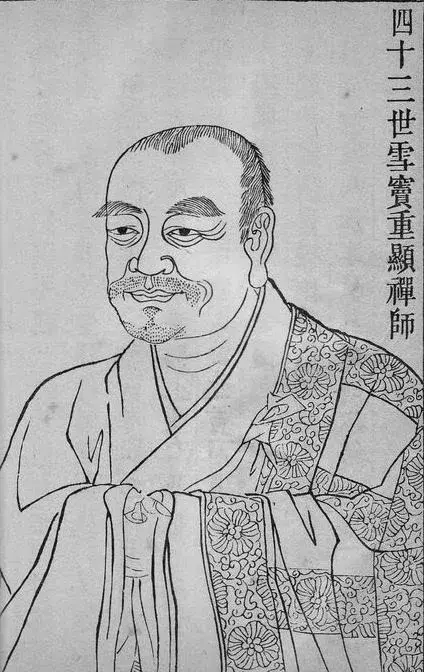
重显
Chongxian (重显), secular surname Li, courtesy name Yinzhi, monastic name Chongxian, commonly known as Xuedou Chongxian, was a native of Suizhou (present-day Chuanshan District, Suining, Sichuan Province). He was an eminent Buddhist master of the early Northern Song Dynasty, the fourth-generation lineage holder and reviving patriarch of the Yunmen school (one of the Five Houses of Chan), and the founding creator of the…
Chongxian (重显), secular surname Li, courtesy name Yinzhi, monastic name Chongxian, commonly known as Xuedou Chongxian, was a native of Suizhou (present-day Chuanshan District, Suining, Sichuan Province). He was an eminent Buddhist master of the early Northern Song Dynasty, the fourth-generation lineage holder and reviving patriarch of the Yunmen school (one of the Five Houses of Chan), and the founding creator of the "Literary Chan" and "ode on ancient cases" (songgu) traditions in Chinese Buddhism. Originating from an elite scholar-gentry clan in Sichuan and deeply versed in Confucian and Buddhist classics, he was tonsured in Yizhou in his youth. After leaving Sichuan, he wandered broadly across renowned monastic mountains, studying under Master Zhimon Guangzuo at Beita Chongsheng Monastery in Fuzhou for five years, attaining complete realization of the Yunmen lineage. In 1023, responding to the earnest invitation of his childhood friend Zeng Hui, the Prefect of Mingzhou, Chongxian took up residence as abbot at Zisheng Chan Temple on Mount Xuedou in Siming. Over the subsequent thirty years, Chongxian enforced monastic regulations, revitalized lineage teachings, and gathered assemblies of thousands of monks, elevating Xuedou Temple into one of the preeminent Chan monasteries in the empire, causing the Yunmen school to flourish across northern and southern China. Gifted with transcendent literary brilliance, Chongxian harmonized profound Chan insight with elegant verse. His compilations Odes on a Hundred Ancient Cases (Songgu Bai Ze) and Appraisals of a Hundred Ancient Cases (Niangu Bai Ze) inaugurated a new era of poetic Chan commentary. His Odes on a Hundred Ancient Cases was later appended with remarks and extensive doctrinal commentary by Yuanwu Keqin to create the celebrated Blue Cliff Record (Biyan Lu), revered as the supreme text of Chan Buddhism. Chongxian was honored by Emperor Renzong of Song, imperial consort Li Zunxu, and Chancellor Jia Changzhao, receiving an imperial purple robe and the posthumous title Master Mingjue. He passed away peacefully while seated in meditation in 1052 at age seventy-three.
Born into the prominent Li lineage in Suizhou, Sichuan, exhibiting intellectual brilliance and reading Confucian classics in youth.
At age twenty-four, took monastic tonsure under Master Renxian at Pu'an Court in Yizhou and studied scriptural treatises at Daci Temple.
Left Sichuan eastward to Fuzhou, placing himself under Master Zhimon Guangzuo of the Yunmen school.
Serving Guangzuo for five years, achieved full enlightenment when struck with a whisk upon asking about freedom from thought.
Traveled to Mount Lu and Jingde Temple in Chizhou, resided at Lingyin Temple, and was invited to lead Cuifeng Temple in Suzhou.
Invited by Zeng Hui, Prefect of Mingzhou, to lead Zisheng Temple on Mount Xuedou, reviving the Yunmen school over thirty years.
Harmonized Chan wisdom with classical poetry, composing the landmark work Odes on a Hundred Ancient Cases.
Following a memorial by imperial consort Li Zunxu, Emperor Renzong bestowed an imperial purple monastic robe upon Chongxian.
Chancellor Jia Changzhao memorialized his monastic virtue, prompting Emperor Renzong to confer the title Master Mingjue.
On the tenth day of the sixth lunar month, bathed, composed a farewell verse, and passed away peacefully at age seventy-three.
In the fifth year of the Taiping Xingguo era (980) under Emperor Taizong, Chongxian was born into an illustrious Li lineage in Suizhou, Sichuan (present-day Chuanshan District, Suining). His family was deeply committed to Confucian scholarship, and Chongxian received rigorous training in classical letters. From early youth, he possessed quick intelligence, easily grasping the central themes of complex treatises. He memorized texts upon a single reading, composed thousands of words with effortless flow, and established an early literary reputation among the scholar-gentry of western Sichuan.
However, observing the transience of life and the instability of the worldly realm, Chongxian refused to pursue standard civil service examinations, turning his aspirations toward the ultimate liberation taught in the Buddhist dharma. In his twenty-fourth year, following the death of his parents, he renounced his ancestral wealth, severed secular attachments, and entered Pu'an Court in Yizhou (modern Chengdu), where he was tonsured by Master Renxian and received full monastic ordination.
Following his ordination, Chongxian moved to Daci Temple in Chengdu to study Tang master Guifeng Zongmi's Commentary on the Scripture of Complete Enlightenment under Master Yuanying. Exploring Buddhist doctrinal philosophies, Chongxian encountered the proposition that "the mind is fundamentally Buddha, yet drifts into delusion when thoughts arise." Confronting this paradox, he directly challenged Yuanying: "If the true mind is fundamentally Buddha, how can delusion arise? From what source does this initial stirring of delusion originate?"
Although Yuanying was thoroughly versed in the Buddhist canon, he found it impossible to provide an ultimate answer through literal exposition. Astonished, Yuanying remarked: "The supreme truth of Chan cannot be circumscribed by conceptual names. Your capacity is expansive and heroic; you are not an ordinary scholastic lecturer. You should travel across the empire to resolve this great doubt!" Affirming this advice, Chongxian shouldered his pack and left Sichuan, determined to visit masters across China.
During the Jingde era of Emperor Zhenzong, Chongxian departed Sichuan through the Yangtze Gorges. Traveling through Jingzhou and Xiangyang, he headed directly to Beita Chongsheng Monastery in Fuzhou (modern Tianmen, Hubei) to study under Master Zhimon Guangzuo, a second-generation master of the Yunmen school descending from Yunmen Wenyan. Guangzuo was famed for his uncompromising discipline and sharp teaching methods. Upon meeting him, Chongxian was struck with profound reverence, serving as his attendant for five full years.
During his fifth year of study under Guangzuo, Chongxian entered the abbot's quarters at nightfall to ask: "When an ancient sage does not give rise to a single thought, how can there be any fault?" This question investigated whether the cessation of all conceptual thought constituted ultimate liberation.
Master Guangzuo offered no theoretical explanation. Instead, he lifted his fly-whisk and asked sternly: "What is this?" As Chongxian hesitated to formulate an answer, Guangzuo struck him squarely across the face with the whisk. Chongxian retreated in deep contemplation, his doubts unresolved.
The following day, Chongxian returned to the abbot's room with the same inquiry. Without a word, Guangzuo struck him again. In that flash of physical impact, Chongxian's intellectual calculations and conceptual attachments collapsed entirely, precipitating a sudden, profound awakening. Overjoyed, he prostrated himself before Guangzuo, who touched his head, confirmed his awakening, and recognized him as an authentic dharma heir of the Yunmen lineage.
Following his awakening, Chongxian traveled across Jiangnan to temper his spiritual realization in seclusion. He visited celebrated masters at Mount Lu, residing at Qixian Temple under Master Lin, with whom he debated the essential teachings of the Nirvana Sutra and Diamond Sutra, earning Lin's praise as a true heir of Yunmen.
He subsequently moved to Jingde Chan Temple in Chizhou (modern Guichi, Anhui), where the monastic community elected him head monk. At Jingde Temple, Chongxian expounded Sengzhao's On the Immateriality of Prajna (Bore Wuzhi Lun) to hundreds of monks, analyzing the concept that prajna wisdom knows without conceptual knowledge. His eloquence spread his renown across the Huai River region.
During the Tianxi era, Chongxian moved to Qiantang (modern Hangzhou), living in quiet retirement at Lingyin Temple. Although living among the monastery's manual laborers, his dignified demeanor stood out. By coincidence, his childhood friend Zeng Hui, who had earned his Jinshi degree and risen to high imperial office, arrived in Zhejiang on an imperial mission.
Visiting Lingyin Temple, Zeng encountered Chongxian. The two friends held an intimate discussion under the bamboo groves. Zeng was astonished to discover that his former schoolmate had become an enlightened Chan master of transcendent vision. Supported by Zeng Hui and local scholar-officials, Chongxian stepped forward in 1022 to assume the abbotship of Cuifeng Temple on Lake Dongting in Wujiang, Suzhou, inaugurating his public teaching career.
At his inaugural sermon at Cuifeng Temple, Chongxian pointed directly to the mind, proclaiming the teaching of "the upward path, untransmitted by the thousand sages," captivating the scholar-officials of Suzhou and establishing an enduring reputation.
In 1023, Chongxian's teaching career reached its pivotal historical phase. Zeng Hui was appointed Prefect of Mingzhou (modern Ningbo, Zhejiang). Upon arrival, seeing that Zisheng Temple on Mount Xuedou was in physical ruins and spiritual decline, Zeng dispatched envoys to invite Chongxian to take charge of the mountain.
The residents of Wujiang were so devoted to Chongxian that they blocked the temple gates to prevent his departure, and the envoys required extensive diplomacy to escort him to Mingzhou. Mount Xuedou was a remote mountain retreat originally founded by Master Yongming Yanshou of the Fayan school, but decades of conflict had left it dilapidated.
Upon arrival, Chongxian embraced the duty of reviving ancestral monastic standards. He reinstated the Baizhang monastic regulations, standardizing daily meditation, manual labor, and liturgical conduct, while clearing overgrown forests and reconstructing temple halls.
Within years, Xuedou Temple was completely transformed. Monks from across the empire gathered day and night, with the permanent community exceeding a thousand practitioners. The "Xuedou monastic wind" resonated across the empire, making Xuedou Temple an equal of Lingyin and Jingshan. Zeng Hui frequently climbed the mountain to seek spiritual guidance, investigating famous gong'ans such as Zhaozhou investigating the old woman of Mount Wutai, with Chongxian's responses becoming celebrated lore.
Chongxian nurtured numerous outstanding disciples, most notably Tianyi Yihuai, who attained deep enlightenment when his carrying pole snapped while hauling water, subsequently spreading the Yunmen school across Jiangnan. Other prominent heirs included Chengtian Chuanzhen and Fulong Faxiang, whose widespread teaching made the Yunmen school the most prominent Chan house of the mid-Song.
Chongxian served as abbot at Xuedou Temple for thirty years. His virtue won the deep respect of the Northern Song imperial court.
Imperial consort Li Zunxu, deeply devoted to Chan Buddhism, memorialized Emperor Renzong in praise of Chongxian's spiritual leadership. Emperor Renzong rewarded Chongxian with a prestigious imperial purple monastic robe. In 1045, Chancellor Jia Changzhao again memorialized the throne on his virtue, prompting Emperor Renzong to confer the honorary title Master Mingjue.
On the tenth day of the sixth lunar month in 1052, Chongxian recognized that his worldly teaching was complete. He bathed, dressed in fresh robes, gathered his monastic assembly, and composed a farewell verse before peacefully passing away in meditation at age seventy-three, having been a monk for forty-nine years. Disciples enshrined his relics in a stupa on Mount Xuedou, with Emperor Renzong's court providing imperial subsidies and granting an official plaque.
Chongxian's foremost contribution to global religious thought was compiling and versifying Odes on a Hundred Ancient Cases (Songgu Bai Ze). Prior to Chongxian, Chan masters occasionally composed verses on awakening, but none had systematically transformed ancestral encounter dialogues into an integrated poetic tradition.
Selecting one hundred essential awakening encounters from centuries of Chan lore—such as Emperor Wu of Liang questioning Bodhidharma, Zhaozhou's cypress tree, Yunmen's exclamation, and Baling's Devadatta—Chongxian composed seven-character quatrains with rich imagery and metaphysical depth.
In the case of Bodhidharma and Emperor Wu, when the emperor asked about the highest holy truth, Bodhidharma replied: "Vast emptiness, nothing holy." When asked who stood before him, he answered: "I do not know." Chongxian versified this encounter with striking poetic balance: "Vast emptiness, holy truth: how could one discern it? Who stands before the throne, still replying 'I do not know.' Thus crossing the river in secret, how could one prevent brambles from growing anew?"
In the case of Zhaozhou's cypress tree, when a monk asked why Bodhidharma came from the west, Zhaozhou pointed to the cypress in the courtyard. Chongxian versified: "White clouds span the valley mouth, moonlight falls into the cold pool. The cypress tree in the courtyard leaves an enduring clarity across a thousand autumns."
In the case of Baling's Devadatta, when asked about Devadatta, Baling replied: "Joining palms in praise, stretching out hands to receive hell." Chongxian praised this fearless liberation: "The old monk of Baling wastes no words, knowing how to let go at the edge of the cliff. Extending hands to receive calamity is no small matter; his fame resounds across a billion worlds."
This pioneering literary practice bridged monastic contemplation and literati aesthetics, establishing the model for Chan gong'an commentary. More than half a century later, Master Yuanwu Keqin of the Linji school adopted Chongxian's hundred cases as his primary text at Jiashan and Zhaojue temples. Yuanwu added introductory pointers (chuishi), interlinear remarks (zhuoyu), and doctrinal commentaries (pingchang), producing the ten-volume masterpiece Blue Cliff Record (Biyan Lu). Chongxian's Songgu Bai Ze serves as the foundational spine and spiritual soul of the entire Blue Cliff Record.
This monumental work shaped the practice of the Linji and Yunmen schools during the Southern Song, profoundly impacting Dahui Zonggao's "keyword Chan" (kanhua chan). Its influence extended internationally; during the Kamakura period, Japanese monks such as Dogen and Eisai carried copies back to Japan, where the Blue Cliff Record and Chongxian's odes became sacred texts of Five Mountains literature and Zen monastic training.
In Chan epistemology, Chongxian formulated the core thesis that "all dharmas are the Buddha dharma," resting upon the Mahayana doctrine of the universal Buddha-nature.
In Buddhist terminology, dharma encompasses all physical phenomena, mental states, linguistic concepts, and cultural doctrines. Chongxian asserted that since all phenomena manifest from the mind, the entire universe is an expression of Buddha-nature. During his sermons, he declared: "All dharmas are the Buddha dharma! If one is confused and undiscriminating, it is not correct contemplation; then all dharmas are not the Buddha dharma. Affixing a name, declaring a right, asserting a wrong: where can you perceive Shakyamuni Buddha?" Striking the ground with his staff, he dismissed the monks, dismantling conceptual debates to reveal non-dual reality.
Chongxian frequently cited Yunmen Wenyan's sayings: "If you do not see it directly, seek a point of entry: countless Buddhas dwell upon your tongue, and the three vehicles of sacred teachings rest beneath your heels; far better to awaken!" He taught that liberation exists beneath one's feet rather than in external searching. He quoted Zhimon Guangzuo's phrase "walking barefoot after wearing out straw sandals" to indicate that self-nature is complete without searching, and "carrying the sun and moon upon the staff" to caution that striving to attain Buddhahood becomes an obstacle to Buddhahood.
In his discourses, he cited the Baozang Lun: "In its activity it takes form; in its stillness it is dark. Transforming heaven and earth, moving freely in all directions." He stressed that everyday worldly labor is itself a sacred place of realization, proclaiming: "Upon the dung heap manifests the sixteen-foot golden body, where the lowly becomes noble; upon the mass of flesh a thousand-fathom cliff stands erect, where brightness turns into darkness."
Chongxian also referenced Linji Yixuan's gong'an of the "True Person of No Rank," reminding students that this luminous presence moves freely through the face, breaking down scholastic divides between purity and defilement, sacred and ordinary.
Chongxian inherited the sharp teaching style of the Yunmen school, remaining vigilant against students becoming trapped in linguistic concepts. He prioritized "the upward path, untransmitted by the thousand sages."
He taught that ultimate reality transcends words and form. At Wanshou Temple in Suzhou, a monk asked: "The upward path is untransmitted by the thousand sages; from where did the Master attain it?" Chongxian responded by pointing out that the Way has no substance and names are provisional designations, cautioning that clinging to dogma prevents realization.
When monks asked the hackneyed question "What is the meaning of the Patriarch coming from the West?", Chongxian varied his responses to cut through specific fixations: replying "ten thousand leagues away" to break spatial attachment, "high mountains and broad seas" to reveal impartial reality, "a mound of bones rising on flat ground" to sever conceptual speculation, and "radiantly clear at midnight, unrevealed at dawn" to point toward subtle truth.
At his Xuedou opening ceremony, Chongxian remarked: "If we meet according to fundamental reality, there is no need to ascend the high seat." Pointing his hand, he said: "Follow my hand and look: countless Buddha lands manifest at once; inspect them closely; if you hesitate, you fall into the present moment!" He opposed formalist monastic rituals, challenging his assembly: "The Buddhas of the three periods speak dreams; the six generations of patriarchs speak dreams; Cuifeng today speaks dreams; is there anyone who dreams along?" When no one answered, he replied: "Overturn the meditation platform!"
In methodology and expression, Chongxian pioneered the "circuitous Chan" (raolu shuochan) teaching style, becoming an essential founder of the Song "Literary Chan" movement.
The Yunmen school was famous for its Three Phrases: "encompassing heaven and earth," "cutting off all streams," and "flowing with the waves." Chongxian recognized that harsh physical shouting was insufficient in the sophisticated literary culture of the Northern Song, requiring a synthesis of Chan insight with refined literati verse.
Advocating "using poetry to illustrate the Way so that every word reveals truth," Chongxian avoided dogmatic answers, employing poetic metaphors to circumvent intellectual knots and disclose truth. This circuitous approach enriched Chinese Buddhism, transforming Chan into an elegant cultural paradigm admired by Song Neo-Confucian philosophers, poets, and artists.
In addition to his Songgu Bai Ze, Chongxian authored Appraisals of a Hundred Ancient Cases (Niangu Bai Ze) and substantial monastic records that established intellectual beacons for the Yunmen school.
In Niangu Bai Ze, Chongxian examined one hundred ancient cases with concise, incisive appraisals, cutting through intellectual obstacles. His spoken teachings were assembled by his disciple Weigai Zhu into the six-volume Recorded Sayings of Chan Master Mingjue (Mingjue Chanshi Yulu). Volume 1 recorded his sermons at Cuifeng Temple in Suzhou; Volume 2 contained his examinations, hymns, and subsequent Xuedou records; Volume 3 compiled his hundred appraisals; and Volumes 4 through 6 assembled thirty years of sermons at Xuedou Temple alongside his poetry collections Zu Ying Ji (two volumes) and Pu Quan Ji. The Annotated Catalog of the Complete Imperial Library (Siku Quanshu Zongmu Tiyao) praised his poetry as expansive, lofty, and natural. Circulated through imperial and private woodblock printings, these texts spread to Goryeo, Japan, and East Asia.
FIGURES ASSOCIATED WITH THIS DYNASTY