Birth in Jingzhao
Born into an elite military household in Duling; exhibited keen martial instinct and mastered divination from youth.
史万岁
Shi Wansui (史万岁, 549–600), was a native of Duling in Jingzhao (modern Xi'an, Shaanxi), and an illustrious military commander of the Sui dynasty, widely acclaimed as one of the Four Great Generals of the Kaihuang era. Born into a prestigious military lineage of the Northern Zhou, his father Shi Jing served as Regional Inspector of Cangzhou before falling in battle. From his youth, Shi Wansui displayed martial brilliance,…
Shi Wansui (史万岁, 549–600), was a native of Duling in Jingzhao (modern Xi'an, Shaanxi), and an illustrious military commander of the Sui dynasty, widely acclaimed as one of the Four Great Generals of the Kaihuang era. Born into a prestigious military lineage of the Northern Zhou, his father Shi Jing served as Regional Inspector of Cangzhou before falling in battle. From his youth, Shi Wansui displayed martial brilliance, mastering horsemanship, archery, and ancient military texts while demonstrating exceptional predictive acumen regarding battlefield fortunes. In 580, when Yuchi Jiong raised a massive revolt against regent Yang Jian, Shi Wansui joined the imperial punitive expedition, fighting with peerless valor as the first warrior to breach enemy ramparts, earning promotion to Senior Grand General. In the early Sui dynasty, Shi Wansui was implicated in the treason plot of Grand General Erzhu Ji and banished to the frontier outpost of Dunhuang as an exile soldier. His supernatural archery and daring scouting probes won the awe of both border guards and nomadic tribes. In 583, when Gokturk invaders confronted the Sui army under Dou Rongding in Liangzhou, the hostile qaghan proposed single combat between champions to decide the confrontation. Shi Wansui galloped forward alone, beheading the foremost Gokturk champion before the assembled armies and triggering the chaotic retreat of the nomadic host, for which he was recalled to court and made General of Chariots and Cavalry. In 589, he participated under Yang Su in the conquest of the southern Chen dynasty, advancing along the Yangtze River to earn the rank of Senior Opening of the Office. In 590, when widespread revolts erupted across Jiangnan under Gao Zhihui, Shi Wansui led an isolated flying detachment across rugged mountains and coastal ridges, marching over a thousand li through more than seven hundred engagements to capture rebel strongholds and restore imperial rule, earning promotion to General of the Left Army Leader. In 597, he commanded an expedition deep into the southwestern jungles of Nanning, subduing over thirty indigenous tribes and capturing chieftain Cuan Wan. In 600, when Dami Qaghan led a grand invasion, the nomads scattered in terror upon discovering that Shi Wansui commanded the opposing army; Shi Wansui gave chase and scored a crushing triumph. However, his military fame incited the bitter jealousy of Prime Minister Yang Su, who falsely slandered him before Emperor Wen. In the eleventh month of that year, when Shi Wansui pleaded passionately in court for the overdue rewards of his frontline soldiers, Emperor Wen ordered him beaten to death on the palace floor in a fit of rage, leaving the empire in universal mourning over his tragic martyrdom.
Born into an elite military household in Duling; exhibited keen martial instinct and mastered divination from youth.
Accompanied his father to the Battle of Mount Mang at age fifteen, accurately predicting the outcome of the clash.
Fought under Wei Xiaokuan to suppress Yuchi Jiong's revolt, leading assault waves and rising to Senior Grand General.
Implicated in the treason of Erzhu Ji and banished to Dunhuang, winning renown through miraculous archery feats.
Rode out alone to decapitate the Gokturk champion before two armies, forcing the invaders to retreat and made Cavalry General.
Followed Yang Su down the Yangtze River during the campaign that unified China, earning promotion to Senior Opening of the Office.
Commanded an isolated vanguard across a thousand li through 700 skirmishes, eradicating Gao Zhihui's rebellion in the south.
Led imperial forces across the southwestern wilderness, pacifying over thirty tribes and ennobled as Pillar of State.
Led forces out of Yanmen; the Gokturks fled upon hearing his name, and he pursued them for over a hundred li to score a rout.
Slandered by Yang Su, he defended his soldiers' rewards at court and was beaten to death in the palace by imperial order.
Shi Wansui belonged to the illustrious Shi clan of Duling in Jingzhao, a family celebrated for producing generals for generations. His father, Shi Jing, was an officer of renowned loyalty and martial virtue who governed Cangzhou under Northern Zhou and died in combat on imperial service. As a youth, Shi Wansui possessed a commanding physique, supreme equestrian archery abilities, and a profound grasp of ancient stratagems and astrological divination. In 564, when Northern Zhou and Northern Qi armies clashed at Mount Mang near Luoyang, the fifteen-year-old Shi Wansui accompanied his father on campaign. Hearing the hurried, irregular rhythm of the war drums, he predicted that the Zhou forces would suffer defeat and advised his father to tighten his perimeter. When the Zhou battle line collapsed, Shi Jing's camp remained completely secure, earning young Shi Wansui universal admiration for his military intuition. Following his father's death, the court granted him the rank of Opening of the Office Equal to the Three Excellencies and allowed him to inherit the title of Duke of Taiping County.
In 580, Yuchi Jiong, the governor of Xiangzhou, rose in rebellion against regent Yang Jian, gathering one hundred thousand rebel soldiers to threaten the capital basin. Yang Jian appointed Wei Xiaokuan as commander-in-chief, with Shi Wansui serving in Liang Shiyan's vanguard corps. At the fierce battles of Wuzhi and the subsequent storming of Ye, Yuchi Jiong's adopted son Yuchi Dun held entrenched defenses along the Qin River. Shi Wansui donned heavy scale armor and brandished a long two-handed blade, charging into the teeth of enemy projectile fire. He was the first to scale the ramparts in every assault, cutting down dozens of rebel officers and revitalizing imperial troop morale. Following the fall of Ye and the execution of Yuchi Jiong, the court awarded Shi Wansui foremost combat honors and promoted him to Senior Grand General.
In 581, the Sui dynasty was founded. Shortly thereafter, Grand General Erzhu Ji was executed for plotting treason in Jinzhou. Having previously associated with Erzhu Ji, Shi Wansui was stripped of his titles and exiled to Dunhuang as a common garrison soldier. Even in the desolate northwestern frontier, his indomitable spirit remained unbowed. The commander of the Dunhuang garrison was a tyrannical officer who treated common conscripts with contempt. One day, Shi Wansui demonstrated his marksmanship before the garrison, aiming at wild geese soaring high in the clouds and shooting several down directly through the eyes. Awestruck by his prowess, the garrison commander apologized and embraced him as a close friend. Shi Wansui frequently rode alone into the deep desert for hundreds of li, capturing nomadic scouts and supply trains, striking such terror into frontier tribes that they dared not approach the border walls.
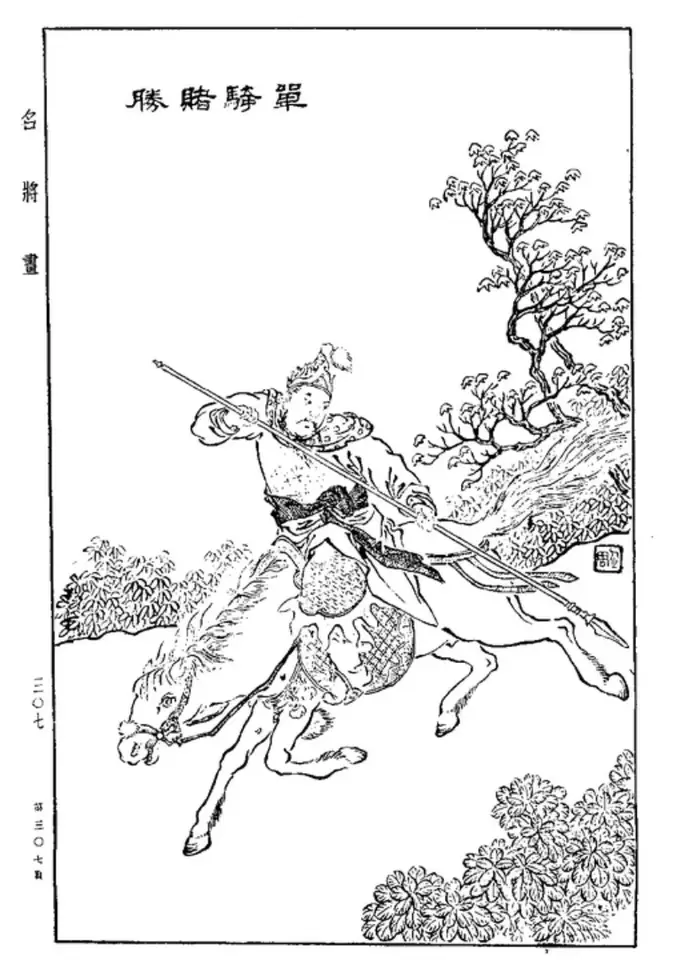
In 583, Dou Rongding, Area Commander of Qinzhou, marched an army of thirty thousand men out of Liangzhou to confront the invading Gokturks. The two armies faced each other across a steep mountain canyon. The Gokturk qaghan, commanding a vastly superior host, dispatched an emissary with a haughty challenge: "If the Sui forces boast champions, let single combat decide the war rather than wasting countless lives!" Dou Rongding called for volunteers among his troops, and Shi Wansui stepped forward from the ranks of exile conscripts. Donning coarse leather armor and holding a heavy lance, Shi Wansui spurred his steed across the canyon floor into the open field between the armies. The Gokturks sent forth their foremost champion. As the horses closed, Shi Wansui let out a deafening roar, drove his lance straight through the enemy champion's throat, leaped down to sever his head, and galloped back to the Sui lines. The sight of this supernatural combat shattered the morale of the Gokturk army, compelling the terrified qaghan to sue for peace. Dou Rongding reported this feat to Emperor Wen, who recalled Shi Wansui to Chang'an, made him Senior Equal in Rank, and appointed him General of Chariots and Cavalry.
In 589, Emperor Wen initiated the grand campaign to conquer the southern Chen dynasty. Shi Wansui served under Chief of the Secretariat Yang Su, commanding naval flotillas down the Yangtze Gorges. He launched rapid amphibious strikes against Badong and Jingmen, smashing enemy water palisades and capturing Chen fleet commanders, earning promotion to Senior Opening of the Office. In 590, powerful gentry clans across Jiangnan launched a coordinated revolt against Sui administrative reforms. Rebel chieftains Gao Zhihui and Shen Xuanlie seized control of dozens of cities and counties. Yang Su tasked Shi Wansui with commanding a detached strike force of two thousand elite troops to advance through the perilous Jinhua mountain paths.
Shi Wansui advanced deep into the dense subtropical jungles without supply trains, relying on captured provisions. For several months, his column remained entirely out of contact with headquarters, leading the imperial court to believe his force had perished. However, applying brilliant mobility and psychological warfare, Shi Wansui traversed more than seven hundred li of mountainous defiles, fought over seven hundred separate skirmishes, destroyed thirty fortified insurgent stockades, and captured Gao Zhihui alive, thoroughly eradicating the rebellion across southern China. Emperor Wen was astounded by his extraordinary triumph and appointed him General of the Left Army Leader. In 597, tribal chieftain Cuan Wan staged a violent insurrection in Nanning (modern Yunnan and Guizhou). Commissioned as Commander-in-Chief of the Mobile Army, Shi Wansui marched along the Qingling route, braved poisonous vapors and treacherous rapids, penetrated ten thousand li into uncharted jungle terrain, subdued over thirty tribal clans, captured Cuan Wan, and carved victory inscriptions onto mountain cliffs before returning to court, where he was elevated to Pillar of State General.
In 600, Dami Qaghan of the Gokturks mobilized hundreds of thousands of nomadic cavalry to ravage the northern marches. Emperor Wen ordered Crown Prince Yang Guang and Yang Su to advance from Lingwu, while Prince of Han Yang Liang and Shi Wansui marched from Mayi. Leading Pillar General Zhang Dinghe through Yanmen Pass, Shi Wansui traversed the northern mountain ranges to locate the enemy's main host. Arrayed on the open plain, Dami Qaghan noticed the impenetrable discipline and fierce aura of the Sui vanguard. He sent scouts forward to shout: "Who is the general commanding the Sui army?" The Sui soldiers responded in unison: "This is General Shi Wansui!" Dami Qaghan asked in disbelief: "Is this the champion who slew our hero at Dunhuang?" When the soldiers shouted affirmative, Dami Qaghan dismounted in terror and ordered an immediate retreat. Seizing the moment, Shi Wansui unleashed his armored cavalry in pursuit, chasing the enemy for over one hundred li, decapitating thousands and routing the nomadic army.
However, Prime Minister Yang Su harbored deep jealousy toward Shi Wansui, fearing that his military renown would eclipse his own authority. Upon returning to court, Yang Su secretly submitted slanderous memorials to Emperor Wen, falsely claiming that the Gokturks had merely come to offer tribute and that Shi Wansui had recklessly initiated hostilities to fabricate battlefield achievements. Suspicious by nature, Emperor Wen withheld the customary rewards from Shi Wansui's officers and soldiers. In the eleventh lunar month, Shi Wansui entered the imperial hall, knelt before the throne, and passionately argued that his men had bled and died on the frontier and deserved their rightful honors. Infuriated by his outspoken defiance, Emperor Wen accused him of insubordination and ordered imperial guards to drag him down the palace steps and beat him to death with clubs. Shi Wansui died at the age of fifty-two. The entire army wept bitter tears at his murder, and foreign tribes lamented his tragic fate. Soon after, when Gokturk raiders penetrated the frontier unchecked, Emperor Wen sighed in bitter regret: "Had Shi Wansui lived, how could these barbarians dare advance so far!"
In 583, as Gokturk hosts pressed against the passes of Liangzhou, the vast nomadic cavalry arrayed across mountain ridges threatened to overrun the imperial defenses. In an arrogant attempt to break Sui morale, the hostile qaghan demanded single combat between designated champions.
Serving as a disgraced exile soldier, Shi Wansui stepped forward alone to take up the challenge. Donning simple armor, he galloped his lone horse into the neutral ground between the massed armies. When the towering nomadic champion charged with couched lance, Shi Wansui timed his evasion perfectly, drove his own lance through the challenger's throat, dismounted in a flash, severed the head, and rode back holding the trophy aloft. The display of martial prowess completely broke the will of the Gokturk army, driving their commanders to sue for peace and cementing Shi Wansui's renown across East Asia.
In 590, widespread rebellion erupted across Jiangnan in response to the promulgation of the Five Teachings by the Sui court. The insurgent leaders Gao Zhihui and Shen Xuanlie mobilized thousands of followers, blocking river routes with timber and stone palisades and using rugged mountain geography to repulse imperial forces.
Given command of a detached force of only two thousand men, Shi Wansui bypassed fortified bottlenecks and marched directly into the trackless wilderness of the southern mountains. For months, his detachment operated behind enemy lines without logistical resupply. Over seven hundred separate engagements, he applied incendiary attacks against river palisades, scaled sheer cliffs to launch night surprises, and methodically reduced thirty insurgent fortresses. His relentless pressure forced Gao Zhihui into unconditional capture, pacifying the southeastern territory and demonstrating masterclass operational agility.
In 597, the indigenous leader Cuan Wan allied with tribal confederacies in Nanning to sever imperial communication routes across the southwest. The region was notoriously perilous, riddled with steep ravines, malarial swamps, and hostile indigenous settlements that had historically repulsed outside invaders.
Assuming command of the punitive expedition, Shi Wansui enforced iron march discipline, cutting roads through virgin forests and throwing bridges across torrential rivers. Facing tribesmen fighting from cliffside stockades, he employed feints, night ambushes, and pincer envelopments to shatter resistance. Over a campaign extending thousands of li across Yunnan and Guizhou, he reduced more than thirty tribal clans, took Cuan Wan captive, and established monumental stone tablets commemorating imperial authority. This campaign integrated the southwestern frontiers firmly into the Sui imperial domain.
FIGURES ASSOCIATED WITH THIS DYNASTY