Birth | Born in the state of Wey as a descendant of the ruling house and a member of the Gongsun lineage
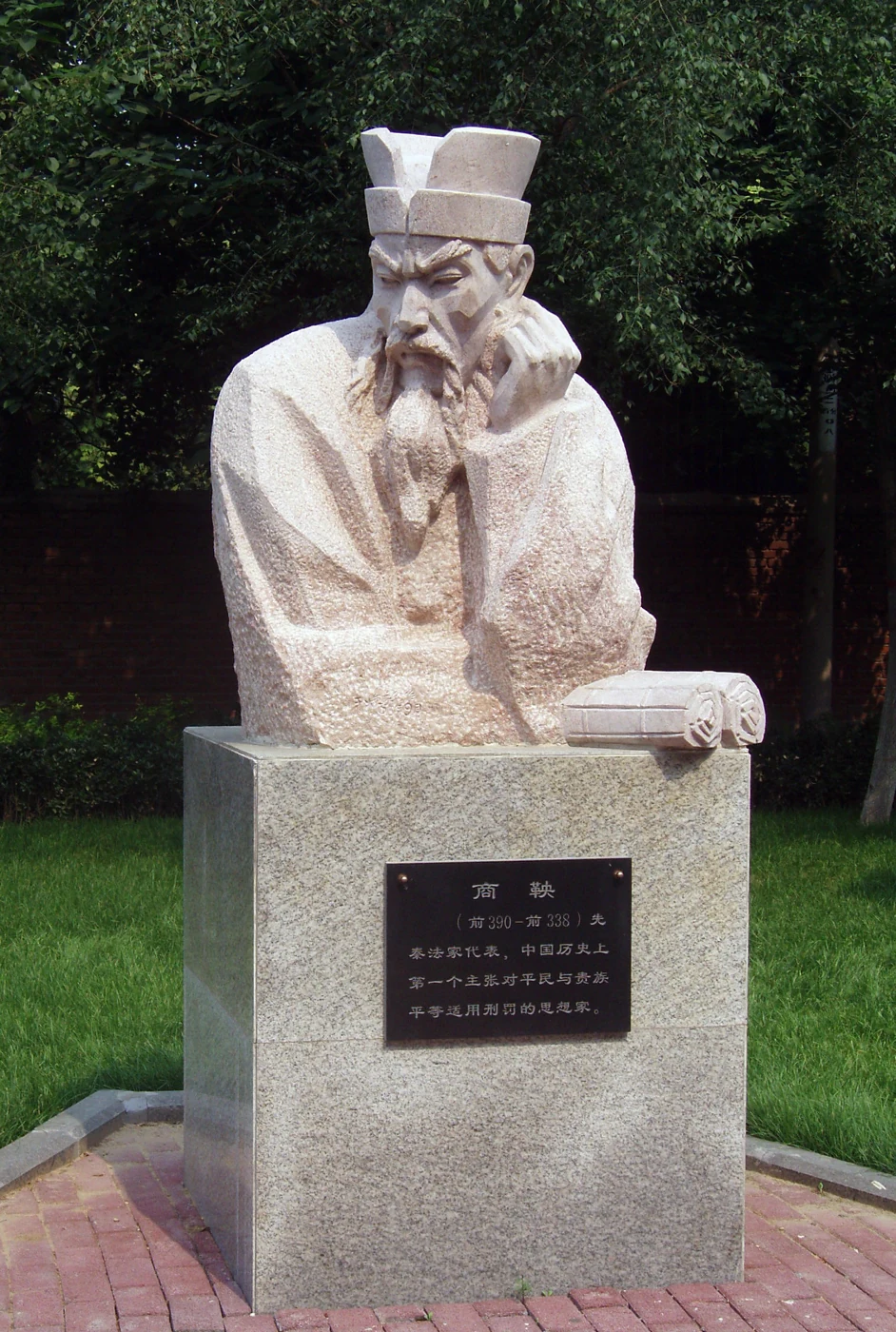
390 BCE–338 BCE
Politicianreformermilitary commanderleading Legalist figure
Shang Yang
商鞅
Shang Yang (c. 390–338 BCE), personal name Yang, of the Gongsun lineage and a native of the state of Wey, was therefore also known as Wei Yang or Gongsun Yang. He was a prominent politician, reformer, and military commander of the middle Warring States period and a representative Legalist thinker. As a young man he studied under Li Kui and learned doctrines of legal and administrative technique. After Duke Xiao of Qin issued…
390 BCE–338 BCEMiddle Warring States period
PROFILE
Shang Yang (c. 390–338 BCE), personal name Yang, of the Gongsun lineage and a native of the state of Wey, was therefore also known as Wei Yang or Gongsun Yang. He was a prominent politician, reformer, and military commander of the middle Warring States period and a representative Legalist thinker. As a young man he studied under Li Kui and learned doctrines of legal and administrative technique. After Duke Xiao of Qin issued a call for talented men, Shang Yang brought the Canon of Laws to Qin. With Duke Xiao's support, he directed two major rounds of reform. Measures included the military-merit rank system, abolition of the well-field system, opening of field boundaries, establishment of counties, and standardization of weights and measures. These reforms strengthened Qin and laid institutional foundations for the later unification of the six states. After Duke Xiao died, political enemies accused Shang Yang of rebellion, and he was killed after military resistance, and his body was subsequently dismembered with chariots. His reform ideas were later compiled in the Book of Lord Shang.
- Other names
- Gongsun Yang, Wei Yang
- Period
- Middle Warring States period
- Date of Birth
- about 390 BCE
- Date of Death
- 338 BCE
- Dynasty / regime
- Wey, Wei, Qin
- Identity
- Politician, reformer, military commander, leading Legalist figure
- Ethnicity / ethnic affiliation
- Not reliably confirmed in the historical sources
- Native place
- State of Wey
- Place of birth
- State of Wey
- Place of death
- Place of death not known
- Highest office
- See Biography and Major Activities
- Major achievements
- Qin reformer of the Warring States period; directed Shang Yang's Reforms and instituted the military-merit rank system; laid institutional foundations for Qin's later unification
LIFE TIMELINE
Youth | Studied doctrines of administrative and penal methods under Li Kui and was influenced by Wu Qi
Youth | Served the minister recorded as Gongshu Cuo, chief minister of Wei, as a zhongshuzi
Youth | Duke Xiao of Qin came to the throne and issued a call for talented men
Age 30 | Hearing that Duke Xiao sought talent, went to Qin with the Canon of Laws and gained an audience through Jing Jian
Age 31 | At a court discussion of reform, rebutted Gan Long and Du Zhi; issued the Order on Cultivating Wasteland
Age 34 | Appointed Zuo Shuzhang and directed the first round of reforms
Age 38 | Led troops that besieged and captured Anyi, the former Wei capital
Age 39 | Led troops that besieged and captured Guyang
Age 40 | Appointed Daliangzao, directed the second round of reforms, and took part in building Xianyang
Age 41 | Qin moved its capital to Xianyang
Age 46 | Persuaded King Hui of Wei to claim royal status and pursued the strategy of “honoring Wei as king”
Age 48 | Duke Xiao sent Crown Prince Si to lead representatives of ninety-two western Rong states to the court of King Xian of Zhou
Age 49 | Led a campaign against Wei, decisively defeated its army, captured Prince Ang of Wei, and recovered part of the Hexi territory
Age 52 | Duke Xiao died and Crown Prince Si succeeded as King Huiwen of Qin; Shang Yang was accused of rebellion by Gongzi Qian and others, raised troops in resistance, was defeated and killed, after which his body was taken to Xianyang for chariot dismemberment
BIOGRAPHY
Biography
Family Background and Early Years Shang Yang came from a collateral branch of the ruling house of Wey and was a descendant of its rulers. Records of the Grand Historian, “Biography of Lord Shang,” states: “Lord Shang was one of the various collateral sons of Wey; his personal name was Yang, his lineage name Gongsun, and his ancestors were originally of the Ji surname.” The state of Wey was the fief of Kangshu, younger brother of King Wu of Zhou, and was thus related to the Zhou royal house; Shang Yang's ancestors were therefore of the Ji surname. As a distant member of the Wey ruling lineage, he could be called Gongsun Yang within Wey and Wei Yang when outside it. Some scholars infer from his background that he came from Diqiu, the capital of Wey, but its precise location remains disputed: one view identifies it with Xidacheng Village in Liangzhuang Township, Neihuang County, Anyang, Henan, while another places it around the Gaocheng site in Puyang County, Puyang, Henan. As a young man Shang Yang was drawn to doctrines of administrative names, punishments, law, and political technique. He studied under Li Kui, architect of reform in Wei, and was strongly influenced by Li Kui and Wu Qi. Li Kui had directed reforms in Wei and compiled six sections of the Canon of Laws, helping initiate the major reform movement of the Warring States. When Shang Yang later went to Qin, he is said to have carried Li Kui's Canon of Laws, indicating his commitment to these ideas. The source also states that Shang studied eclectic thought under Shi Jiao. He later served the Wei chief minister recorded as Gongshu Cuo as a zhongshuzi. ### Period in Wei When the minister recorded as Gongshu Cuo fell seriously ill, he recommended Shang Yang to King Hui of Wei, saying in substance that his young zhongshuzi Gongsun Yang possessed extraordinary talent and that the king should entrust the whole state to him. He then warned that if the king would not employ Yang, he should kill him and prevent him from leaving the country. King Hui thought the dying minister was speaking irrationally and ignored the advice. He privately urged Shang Yang to leave Wei immediately. Shang reasoned that if the king would not accept the minister recorded as Gongshu Cuo's recommendation to employ him, he would likewise not accept the recommendation to kill him, and therefore did not leave at once. ### Entry into Qin and Persuasion of Duke Xiao In 361 BCE Duke Xiao of Qin came to the throne. By then the six major eastern Warring States powers—Qi, Chu, Wei, Yan, Han, and Zhao—had taken shape, while more than ten smaller states lay between the Huai and Si rivers. The Zhou royal house had weakened and the states fought one another by force. Qin, in the comparatively remote region of Yongzhou, did not participate in the assemblies of the Central Plains states and was regarded by them as culturally alien. Duke Xiao sought to restore the hegemonic achievements of Duke Mu of Qin and recover lost territory in the east and therefore issued a call for talent, promising high office and shares of land to those who could devise exceptional plans to strengthen Qin. Shang Yang heard of the call and traveled west to Qin with Li Kui's Canon of Laws, gaining access to Duke Xiao through the duke's favorite Jing Jian. In his first audience, Shang argued in terms of the “way of the emperors,” and Duke Xiao became drowsy and later complained to Jing Jian that Shang was an arrogant eccentric. Five days later Shang returned and argued in terms of the “way of the kings,” which Duke Xiao again did not accept. On the third occasion he spoke in terms of hegemonic rule; Duke Xiao approved but did not yet adopt his proposals. Finally Shang discussed methods for enriching the state and strengthening its army. Duke Xiao became absorbed, unconsciously moving his knees forward, and the two spoke for days without tiring. When Jing Jian asked about the change, Shang explained that Duke Xiao sought domination of the realm and was not interested in imperial or kingly methods that would take decades to produce results. ### Debate over Reform and the Two Reform Programs In 359 BCE Duke Xiao wanted to reform the state but hesitated because he feared public criticism. He convened a court debate. Representatives of the old nobility, Gan Long and Du Zhi, opposed reform and argued that following ancient models and established ritual was safest. Shang Yang countered that earlier ages had not followed a single teaching, so there was no single antiquity to imitate, and that different rulers did not repeat one another's institutions. He argued that good government had no single path and that a state seeking advantage need not copy antiquity. Duke Xiao accepted Shang's position, and the debate ended in favor of reform. After the debate, Duke Xiao ordered Shang Yang to issue the Order on Cultivating Wasteland as a prelude to reform. The order encouraged agricultural production, restrained commerce, weakened aristocratic privilege, and implemented a more unified system of taxation and rent. After the measure was successfully introduced, Duke Xiao appointed Shang Zuo Shuzhang in 356 BCE and authorized the first reform program. Its principal provisions included reforming household registration and creating mutual-responsibility groups of fives and tens; codifying military law and rewarding military merit; abolishing hereditary office and rank and establishing a twenty-rank system; severely punishing private fighting; rewarding agriculture and weaving while emphasizing agriculture and restraining commerce; changing older “methods” into codified statutes; and promoting small independent households by doubling the tax on families with two or more adult sons who did not divide their households. In 350 BCE Duke Xiao appointed Shang Yang Daliangzao and launched a second reform program. Its principal provisions included opening field boundaries, abolishing the well-field system, and recognizing private ownership and sale of land; extending county government broadly; introducing a new household and poll-based military levy; standardizing weights and measures; burning poetic and historical writings in order to clarify legal commands and restricting itinerant office-seekers; and enforcing household division so that fathers, sons, and brothers did not all live in one household. ### Moving the Pole to Establish Trust and Enforcement of the Laws Before issuing the new laws, Shang Yang sought to establish public trust. He had a pole three zhang long placed at the southern gate of the capital market and announced that anyone who carried it to the northern gate would receive ten taels of gold. No one responded. He raised the reward to fifty taels, and eventually one person moved the pole and received the full payment. Shang used the episode to demonstrate that government orders would be carried out. It became known as “moving the pole to establish trust.” After the new laws had operated for a year, thousands of people came to the capital to complain that they were inconvenient. At this time Crown Prince Si violated the new laws. Shang argued that the reforms could not function if members of the elite led the way in breaking them. Because the crown prince, as heir to the ruler, could not be directly punished, Shang punished the crown prince's tutor Gongzi Qian and tattooed the crown prince's teacher Gongsun Jia. Thereafter, according to the source, the people of Qin obeyed the laws. Gongzi Qian later broke the law again and was punished by having his nose cut off. After ten years, the source describes Qin as a place where lost property was not picked up from roads, banditry disappeared from the mountains, households were prosperous, people were courageous in public war but hesitant in private fighting, and villages were well ordered. Some who had earlier called the reforms inconvenient now said they were convenient; Shang branded them people who disturbed transformation and moved them all to frontier areas, after which people no longer dared openly discuss the laws. ### Recovery of Hexi and Final Years After the two rounds of reform, Qin's strength increased. Shang Yang also acted as commander in campaigns to recover Hexi territory. In 352 BCE he besieged and captured Anyi, the former Wei capital. In 351 BCE he besieged and captured Guyang. In 344 BCE he persuaded King Hui of Wei to claim kingship, suggesting that Wei command twelve smaller states, ally with Yan in the north, attack Qi in the east, ally with Qin in the west, and attack Chu in the south, pursuing a strategy of “honoring Wei as king” that redirected Wei away from attacking Qin. In 341 BCE Shang led Qin forces against Wei, decisively defeated its army, captured Prince Ang of Wei, and recovered part of the Hexi region. In 338 BCE Duke Xiao died and Crown Prince Si succeeded as King Huiwen of Qin. Gongzi Qian and others accused Shang Yang of rebellion, and the king ordered his arrest. Shang fled to his fief at Shang and raised troops in resistance. He was defeated and killed; his body was then taken to Xianyang and dismembered by chariots for public display. His family was also exterminated.
In youth Shang Yang was fond of the study of punishment and statecraft, and much influenced by the Canon of Laws written by Li Kui, teacher of the marquis of Wei. He is said to have entered the household of the Wei chancellor Gongsun Cuo as a junior attendant. When Gongsun Cuo fell ill he recommended Shang Yang to King Hui of Wei, saying that though young he was a man of rare talent and should be given the government of the state; and then he told the king that if he would not employ him he must put him to death, lest he go to another state. King Hui took neither course, neither employing nor killing him.
When Duke Xiao of Qin called for men of worth, Shang Yang entered Qin with Li Kui's Canon of Laws and obtained an audience through the duke's favourite Jing Jian. He set before the duke first the way of the emperors, then the kingly way, and last the way of the overlords; the duke cared nothing for the first two, but hearing of overlordship and the art of making a state strong he was delighted and talked with him for days without wearying, resolving to employ him. About 359 BC Shang Yang was made leader of the left and began his reforms.
The chief measures were these: the people were organised in groups of ten and five with collective liability, each watching the others; military merit was rewarded with a system of ranks, conferring title, land and houses according to the heads taken, while the old hereditary offices of the nobility were abolished; agriculture and weaving were encouraged and commerce restrained, those producing much grain and cloth being exempted from corvée and those who failed at farming or trade being made slaves of the state; waste land was opened and the old field boundaries done away with, private ownership of land recognised and its sale permitted; the districts were made into counties administered by officers appointed by the ruler; and weights and measures were standardised and standard vessels issued. The capital was later moved to Xianyang and the reforms carried further, the Odes and Documents being burned, the laws made clear, private intercession forbidden and wandering office-seekers barred. To win the people's trust Shang Yang set up a pole three zhang high at the south gate of the market and announced that whoever moved it to the north gate would be given ten pieces of gold; the people thought it strange and none dared, and when he raised the offer to fifty pieces one man moved it and was paid at once, so that no one doubted the laws again.
At first there was much opposition. When the heir apparent broke the law, Shang Yang held that the law fails because those above break it first, and would have punished him; but as the heir could not be mutilated, he punished his tutor Gongzi Qian and branded the face of his teacher Gongsun Jia. When Gongzi Qian offended again his nose was cut off. After ten years of the reforms the people of Qin were content, nothing dropped in the roads was picked up, there were no bandits in the hills, every household had enough, and the districts were well governed, while the state grew strong. In 340 BC Shang Yang led the army against Wei, took its general Gongzi Ang prisoner by a stratagem and heavily defeated the Wei, forcing them to cede territory; for this he was enfeoffed with fifteen settlements at Shang and known as Lord Shang.
Duke Xiao died in 338 BC and the heir came to the throne as King Huiwen. Gongzi Qian and others accused Shang Yang of plotting rebellion; he fled, and on the road sought lodging at an inn, where the keeper told him that by Lord Shang's law anyone lodging a man without credentials was liable with him. Shang Yang sighed that the harm of making laws had come to this. He fled to Wei, whose people bore him a grudge for his treatment of Gongzi Ang and would not receive him; he returned to his fief, was attacked and killed by the Qin army, his body torn apart by chariots and his clan destroyed.
Shang Yang's reforms turned a western frontier state into a power and laid the ground for Qin's unification of the realm, and his ideas of agriculture, military rank, counties and law had a deep effect on the politics of the Warring States. Later judgment of him has been divided: the Records of the Grand Historian calls him harsh by nature and condemns his severe laws, while in institutional terms the system of farming and war and the centralised local administration he established set an important precedent for the state as it took shape after Qin and Han. The present Book of Lord Shang is not wholly from his hand, but it largely reflects the Legalist school he led.
The most distinctive part of Shang Yang's reforms was the system of military ranks. There were twenty grades, from the lowest, the public gentleman, to the highest, the marquis; rank depended directly on the number of enemy heads taken, and each rank carried its own land, houses, revenue and exemptions, while members of the ducal clan without military merit could not be entered on the clan register. The resources of the state were thus tied directly to war, and Qin took shape as a society founded on farming and fighting. Shang Yang also imposed household registration and the ten-and-five grouping, bringing the people under the state's direct control and so providing the base for levying taxes and soldiers.
The chapters of the Book of Lord Shang on the reform of law, the opening of land, agriculture and war, the clearing of obstructions, reward and punishment, the interior of the state and the weakening of the people turn largely on governing by law, on unity of reward and punishment, and on founding the state on farming and war: the laws must be one, rewards and punishments must be kept, and officials must not let private opinion obstruct the public law. In the history of thought Shang Yang is classed with Shen Buhai and Shen Dao as a representative of the Legalists, whose doctrines Han Fei later brought together. The reforms in Qin were the most thorough among the states, and Xunzi, visiting Qin, described its people as simple and its hundred officials as grave and orderly, a sidelight on the society the reforms had made.
The Records of the Grand Historian also tells of Zhao Liang's remonstrance with Shang Yang: holding that his position was as precarious as morning dew, Zhao Liang urged him to give back his fief and retire to a garden, and Shang Yang would not listen — a reminder of the irreconcilable conflict between the reformer and the old nobility. Later judgments of him have varied with the times: Han writers mostly condemned him as harsh and ungenerous, while Wang Anshi of the Song wrote a poem in his praise for making the laws certain in their execution; and the substance of his reforms — the ranks of merit, the counties, the standardisation of weights and measures — is generally allowed to have had a deep and lasting effect on the institutions of the Chinese state.
The reforms could be carried through only because Duke Xiao backed them without wavering: through more than twenty years he trusted Shang Yang, allowing the measures to be applied in succession over a long period, in contrast to the reforms of other states of the day, which commonly fell away half done. After Shang Yang's death King Huiwen put him to death but did not abolish his laws, and the system of farming and war and the local administration he had built were kept up by Qin — one reason why the state stayed strong for so long. In the sources the reforms are recorded chiefly in the biography of Lord Shang in the Records of the Grand Historian and in the Book of Lord Shang itself, with scattered notices in the Intrigues of the Warring States, Han Feizi and the Lüshi Chunqiu; the books differ in fullness and in standpoint, and later discussion of the dates and the details of the reforms has rested largely on them.
Major Activities
Political Reform The Chinese source characterizes Shang Yang's Reforms as the most thorough of the Warring States reforms, the most damaging to the old nobility, the broadest in their measures, and the most far-reaching in influence. The first reform centered on household registration, the military-merit rank system, and abolition of hereditary noble privilege, breaking elite monopolies over power. The second centered on ending the well-field system, opening field boundaries, establishing counties, and standardizing weights and measures. The source describes these changes as establishing private landholding and a centralized administrative order. Shang used law to abolish aristocratic privileges, develop the agrarian economy, increase state revenue, and strengthen the state and army. ### Military Activities Shang Yang was not only a reformer but also a military commander. In 352 BCE he led forces that besieged and captured Anyi. In 351 BCE he besieged and captured Guyang. In 341 BCE he campaigned against Wei, captured Prince Ang, decisively defeated the Wei army, and recovered part of Hexi. These victories provided a basis for Qin's later eastward advance. ### Reform Thought Shang Yang's ideas are concentrated in the Book of Lord Shang. The Chinese source summarizes their core as the historical view that “there is not a single way to govern an age, and a state seeking advantage need not imitate antiquity”; the legislative principle of making laws appropriate to the time and ritual appropriate to circumstances; a governing strategy centered on agriculture and warfare; and a legal doctrine that government should operate through law and that punishments should not recognize status distinctions. He advocated “burning the poems and documents to clarify the laws and commands,” rejected Confucian learning, and treated Legalist doctrine as the fundamental guide to government. ### Relations with Contemporaries Shang Yang studied under Li Kui, was influenced by Wu Qi, and had intellectual exchanges with Shi Jiao. After entering Qin, he obtained an audience with Duke Xiao through Jing Jian and developed a close ruler-minister relationship with the duke. He publicly debated Gan Long and Du Zhi over reform. Because of his strict enforcement of law, he became an enemy of Gongzi Qian, tutor to the crown prince, and Gongsun Jia, the crown prince's teacher; the Chinese source connects these conflicts to the political hostility that eventually led to his death.
Personal Relations
- Li Kui: teacher and reformer of Wei, compiler of the Canon of Laws
- Wu Qi: major influence and reformer in Chu
- Shi Jiao: scholar with whom Shang Yang had intellectual exchanges
- Jing Jian: introducer and favorite of Duke Xiao of Qin - Duke Xiao of Qin: supporter who fully backed Shang Yang's Reforms
- King Huiwen of Qin: succeeded Duke Xiao and ordered Shang Yang's execution after hearing accusations against him
- King Hui of Wei: declined the minister recorded as Gongshu Cuo's recommendation and failed to employ Shang Yang - Gongzi Qian: tutor to the crown prince, punished after the crown prince violated the law and later involved in accusing Shang Yang of rebellion
- Gongsun Jia: teacher to the crown prince, subjected to tattooing punishment
- Gan Long: representative of the old aristocracy who opposed reform
- Du Zhi: representative of the old aristocracy who opposed reform
Historical Assessment
Warring States and Qin - Sima Qian, in “Biography of Lord Shang” in Records of the Grand Historian, criticized Shang Yang's harsh disposition, his initial use of grandiose political arguments to gain Duke Xiao's favor, his reliance on a favored courtier, his punishment of Gongzi Qian, his deception of Wei general Ang, and his failure to heed Zhao Liang, treating these as evidence of a lack of benevolence.
- Han Feizi praised the Qin reforms for linking households into groups of fives and tens, creating mutual reporting and collective responsibility, burning poems and documents to clarify laws, closing private channels of influence while rewarding public service, suppressing itinerant office-seekers, and honoring those who farmed and fought.
- Xunzi criticized Shang Yang as “obscured by law and unable to recognize the worthy.” ### Han and Tang Periods - The Worthy and Literary scholars in Discourses on Salt and Iron criticized Shang Yang for abandoning the Way in favor of expediency and abandoning virtue in favor of force.
- Jia Yi wrote in The Faults of Qin that with Lord Shang assisting him, Qin established laws internally, emphasized agriculture and weaving, prepared defenses and weapons, and used diplomatic alignments to set the feudal lords against one another.
- The Tang historian Du You, in the Tongdian, credited Shang Yang's reforms with making Qin wealthy and strong. ### Song, Yuan, Ming, and Qing Periods - Su Shi of the Song criticized Shang Yang for creating sharper divisions and boundaries among the Qin people.
- Wang Anshi, while implementing his New Policies, treated Shang Yang as a model and wrote a poem praising the political importance of trust and the fact that Shang could ensure orders were actually carried out.
- Wang Fuzhi in the Ming-Qing transition criticized Shang Yang for breaking up the well-field system and destroying the institutions of the ancient kings. ### Modern Assessments - Mao Zedong described Shang Yang as “the first truly thorough reformer in Chinese history.”
- Qian Mu's Outline of National History recognized Shang Yang's Reforms as foundational to Qin's eventual unification.
- The Chinese source states that modern scholars generally recognize the reforms' historical progressiveness while also criticizing their severe punishments and harshness.
FIGURES ASSOCIATED WITH THIS DYNASTY
Bibliography
- Sima Qian, Records of the Grand Historian, juan 68, “Biography of Lord Shang”
- Sima Qian, Records of the Grand Historian, juan 5, “Basic Annals of Qin”
- Book of Lord Shang*
- Book of Han*, “Treatise on Food and Money”
- Book of Jin*, “Treatise on Penal Law”
- Qian Mu, Outline of National History