Life
Aristocratic Lineage and Military Staff Service
Qiao Zong was born into the prestigious Qiao lineage of Nanchongguo County, Baxi Commandery. The Qiao family had been an illustrious scholarly and political clan in Sichuan since the Western Han dynasty, counting among its ancestors Eastern Han scholar Qiao Xuan and Shu Han grand master Qiao Zhou.
By disposition, Qiao Zong was mild-mannered, cautious, and circumspect. In his personal conduct, he was known for fidelity, charity toward the impoverished, and an absence of unbridled personal ambitions. Consequently, he commanded deep respect and goodwill among local gentry, military cadres, and commoners throughout the Ba-Shu region.
During the Yuanxing and early Yixi eras of Eastern Jin, when the central imperial court was paralyzed by warlord infighting and Huan Xuan's usurpation, Qiao Zong served in the provincial administration of Yizhou. He successively occupied positions as Consulting Army Officer in the Anxi General Headquarters and the Pingxi General Headquarters, helping oversee regional military affairs and cementing his administrative standing across the Sichuan basin.
Mutiny at Wucheng and Accidental Sovereignty
In the first year of Yixi (405 CE), after Liu Yu crushed Huan Xuan in the lower Yangtze, Mao Qu, the Eastern Jin Governor of Yizhou, was ordered by the imperial court to mobilize regional armed forces and sail down the Yangtze to eradicate Huan Xuan's partisan Huan Zhen and quell the religious uprising led by Lu Xun.
Mao Qu conscripted tens of thousands of Sichuan soldiers, appointing Qiao Zong and staff officer Hou Hui to lead the forward contingents east. The native troops were profoundly attached to their ancestral soil and dreaded entering the perilous Yangtze Gorges on a protracted campaign. Discontent, homesickness, and mutinous rumblings spread swiftly through the ranks.
When the expedition reached Wucheng Shuikou (modern Zhongjiang, Sichuan), Baxi officers Hou Hui and Yang Mei decided to exploit the soldiers' grievances and stage a military coup to overthrow Mao Qu's governance. They calculated that only a figure of Qiao Zong's noble pedigree and moral standing could command the allegiance of the diverse regional forces.
Hou Hui and his conspirators burst into Qiao Zong's military tent, prostrating themselves and pleading with him to assume command of the rebellion. Qiao Zong was horrified, knowing that high treason would bring extermination upon his family, and adamantly refused. To prove his unyielding resolve, he leaped from the riverbank into the rushing waters to drown himself.
Hou Hui and his associates plunged into the river, hauled him ashore, and renewed their supplications. When Qiao Zong continued to refuse, the conspirators lost patience, drew their swords, pressed bare steel against his throat, and physically lifted him into a military carriage, compelling him to accept the leadership of the rebel army.
Seizing Chengdu and Proclaiming Western Shu
Coerced by the mutinous legions, Qiao Zong yielded to circumstances and reversed the army's march to assault Fucheng (modern Mianyang, Sichuan). Fucheng was defended by Mao Jin, younger brother of Mao Qu; the rebels overwhelmed the ramparts and killed Mao Jin in combat.
Qiao Zong thereupon declared himself Inspector of Liang and Qin Provinces. Meanwhile, Mao Qu was stationed at Luecheng (southwest of modern Yanting); upon learning of the mutiny, he rushed back toward Chengdu while dispatching staff officer Wang Qiong and his brother Mao Ai with seven thousand troops to intercept the rebels.
Qiao Zong sent his brother Qiao Mingzi and Hou Hui to engage the imperial forces at Guanghan. Qiao Mingzi laid a devastating double ambush, annihilating the bulk of Wang Qiong's army. Seeing the rout of imperial troops, Li Teng, commander of the Chengdu garrison camps, opened the city gates to welcome the insurgents. Qiao Zong's armies stormed Chengdu, captured and executed Mao Qu and Mao Ai, and slaughtered their entire households.
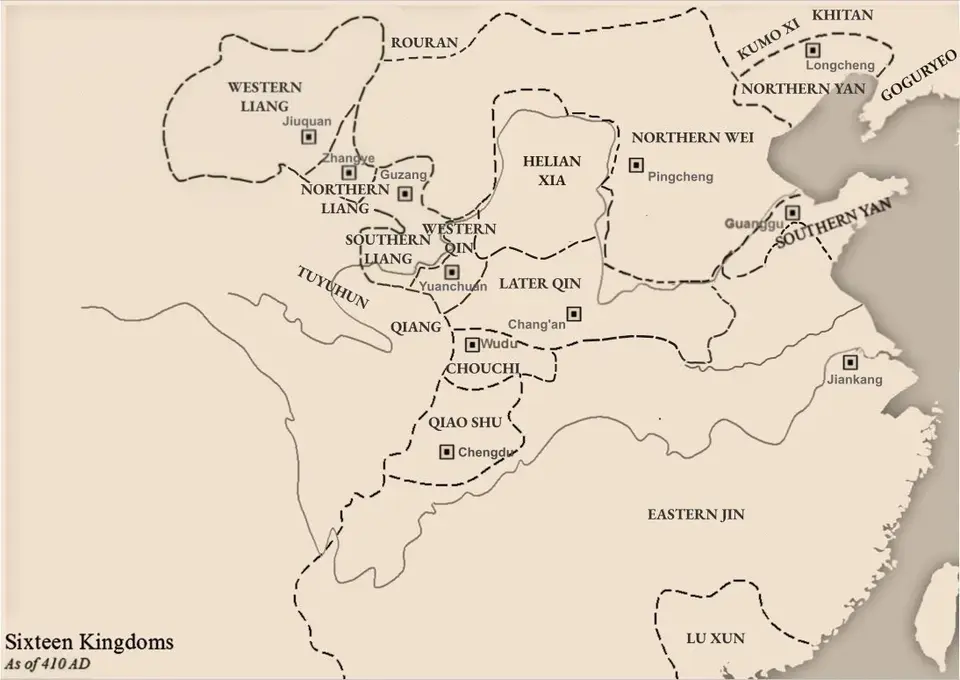
With the complete conquest of Yizhou, Qiao Zong formally inaugurated the Western Shu regime in Chengdu, proclaiming himself King of Chengdu. He elevated his kin and confederates, naming his cousin Qiao Hong as Inspector of Yizhou and his brother Qiao Mingzi as Inspector of Bazhou, establishing an independent warlord domain protected by the natural ramparts of Jianmen Pass and the Yangtze Gorges.
Vassalage to Later Qin and Resisting Jin Forces
Recognizing that the Eastern Jin court would never reconcile itself to the loss of the Upper Yangtze, and that Western Shu lacked the resources to withstand a concentrated imperial onslaught alone, Qiao Zong pursued an active diplomatic alliance with northern powers.
In the third year of Yixi (407 CE), Qiao Zong dispatched an embassy to Chang'an, tendering formal submission to Yao Xing, Heavenly King of Later Qin, requesting tributary status and military assistance. Delighted by the diplomatic coup, Yao Xing enfeoffed Qiao Zong as Commissioner with Special Powers, Palace Attendant, Grand Commander of Military Affairs in Yi and Liang Provinces, Prime Minister, and King of Shu, granting him the sovereign ceremonial honors of the Nine Bestowals.
That same year, Eastern Jin leader Liu Yu dispatched Liu Jingxuan, Administrator of Gaoping, with tens of thousands of infantry and cavalry to reclaim Shu. Liu Jingxuan advanced from Dianjiang toward Huanghu (modern Suining, Sichuan), where Shu general Qiao Daofu established deep trenches and formidable fortifications. The armies remained locked in a stalemate for over sixty days until Jin supplies ran out and pestilence decimated the invading ranks, compelling Liu Jingxuan to order a retreat, thereby securing Western Shu's survival.
In the fifth year of Yixi (409 CE), Qiao Zong allied with Murong Chao of Southern Yan and Daoist insurgent leader Lu Xun in the south, creating a coordinated multi-front coalition against Liu Yu. Qiao Zong dispatched Qiao Daofu to join forces with Later Qin general Gou Lin in Jingzhou, advancing to Jiangling and throwing the southern Jin territories into temporary panic.
The Campaign of Zhu Lingshi and Tragic Collapse
Following his conquest of Southern Yan and the defeat of Lu Xun, Liu Yu resolved to eradicate the Western Shu breakaway state. In the ninth year of Yixi (413 CE), Liu Yu appointed veteran commander Zhu Lingshi, Administrator of Xiyang, as supreme commander, assigning him twenty thousand elite troops for the conquest of Sichuan.
Prior to the campaign, Liu Yu devised a confidential stratagem of deception. Anticipating that the Shu defense would concentrate its main forces along the inner river route (the Fu River), Liu Yu secretly instructed Zhu Lingshi to march his primary army along the outer river route (the Min River), aiming directly at Pengmo.
Qiao Zong fell into the strategic trap, assuming that the main Jin offensive would follow the inner river. He deployed his most formidable commander, Qiao Daofu, with his primary army to guard the Fu River, while leaving only weak, elderly garrisons along the Min River at Pengmo. Zhu Lingshi launched an unexpected assault on Pengmo, taking the fortress and executing Shu commanders Hou Hui and Qiao Shen.
Zhu Lingshi then advanced rapidly upon Chengdu, prompting neighboring commanderies to surrender without resistance. Qiao Daofu was marooned hundreds of li away along the Fu River, unable to offer timely relief, leaving Chengdu utterly exposed.
Seeing that his regime had collapsed, Qiao Zong suffered a complete nervous breakdown and abandoned the capital, intending to flee to Qiao Daofu's camp. However, while hiding among the thickets of his ancestral cemetery outside Chengdu, he realized that capture would only result in public humiliation and torture. Overcome by despair, he untied his sash and hanged himself from a tree.
Local villagers decapitated his corpse and presented the head to Zhu Lingshi. The Western Shu regime collapsed after nine years of existence, and the Ba-Shu territories were reintegrated into Eastern Jin.
Major Accomplishments
Founding the Western Shu State in Sichuan
Taking advantage of the chaotic collapse of Eastern Jin authority and the local population's aversion to overseas military conscription, Qiao Zong established the Western Shu regime, which maintained regional independence for nine years.
The foundation of Western Shu severed Eastern Jin's strategic dominance over the Upper Yangtze and granted the Ba-Shu region independent political status during the Sixteen Kingdoms era. By implementing a regular bureaucratic administration, rewarding local clans, and stabilizing agricultural production, Qiao Zong maintained civic stability and commerce within Sichuan for nearly a decade.
Diplomatic Balance and Multi-Front Alliances
Qiao Zong understood the precarious nature of a regional border state and executed sophisticated multipolar diplomacy to ensure survival.
By accepting formal vassalage and the title King of Shu from Yao Xing of Later Qin, he prevented northern nomadic dynasties from encroaching south into Sichuan; concurrently, by establishing pacts with Lu Xun and Southern Yan, he constructed a broad geopolitical encirclement against Liu Yu. This delicate balancing enabled his modest state to survive amidst powerful imperial rivals.
Strategic Miscalculation at the Battle of Pengmo
Qiao Zong's catastrophic military deployment during the defensive campaign against Zhu Lingshi in 413 CE remains a classic textbook example of strategic misdirection and divided forces in Chinese military history.
Clinging dogmatically to rigid preconceptions, Qiao Zong committed his elite forces to the Fu River, leaving the vital Min River access through Pengmo defenseless. Zhu Lingshi exploited this vacuum to strike directly at the core of the state, causing Western Shu to implode before its main field armies could engage, resulting in Qiao Zong's tragic suicide.