Birth | Born at Changjianli, Yancheng, Chuzhou
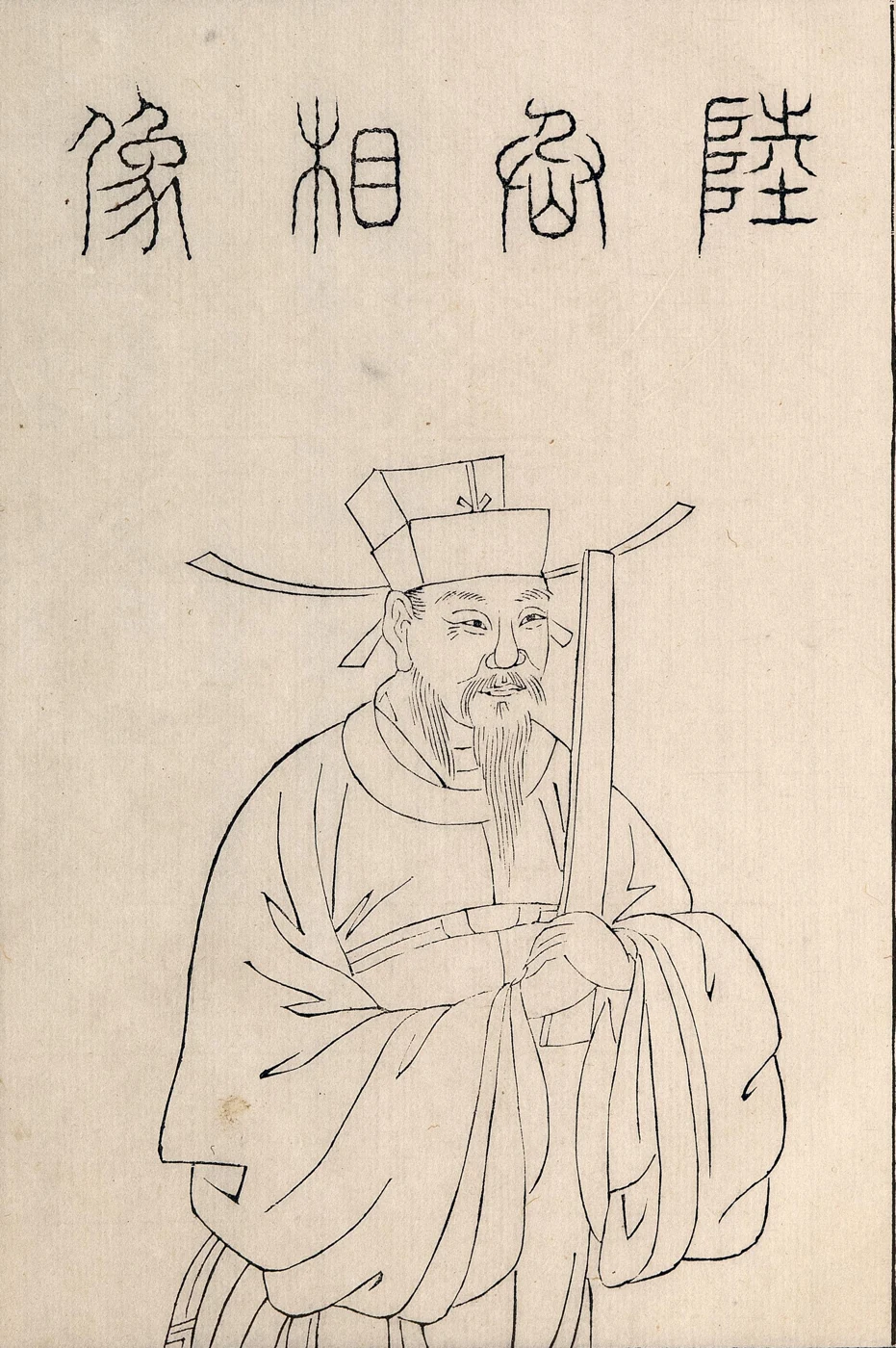
1238 CE–1279 CE
Chancellor
Lu Xiufu
陆秀夫
Lu Xiufu was a chancellor in the final years of the Southern Song. After Lin'an fell, he accompanied Emperor Bing south. When defeat at the Battle of Yashan made further resistance impossible, he carried the young emperor into the sea and died with him.
1238 CE–1279 CESouthern Song
PROFILE
Lu Xiufu was a chancellor in the final years of the Southern Song. After Lin'an fell, he accompanied Emperor Bing south. When defeat at the Battle of Yashan made further resistance impossible, he carried the young emperor into the sea and died with him.
- Other names
- Courtesy name Junshi; Junshi
- Courtesy name
- Junshi
- Period
- Southern Song
- Date of Birth
- November 15 1238
- Date of Death
- March 19 1279
- Dynasty/Regime
- Southern Song
- Identity
- Chancellor
- Ethnicity
- Not recorded in historical sources
- Native place
- Yancheng County, Chuzhou (present-day Yancheng, Jiangsu)
- Place of birth
- Changjianli, Yancheng, Chuzhou
- Place of death
- Not recorded in historical sources
- Highest office
- See Biography and Major Deeds
- Major achievements
- Chancellor in the final years of the Song; accompanied Emperor Bing south after the fall of Lin'an; after defeat at the Battle of Yashan, carried the young emperor into the sea and died with him
LIFE TIMELINE
Age 3 | Moved with his father to Zhenjiang
Youth | Studied under a local teacher surnamed Meng and earned his appreciation
Age 19 | Passed the jinshi examination in the same cohort as Wen Tianxiang
Staff service | Recruited into Li Tingzhi's Huainan staff and promoted through posts including administrative-secretary and staff adviser
Frontier crisis | While many staff members fled, Lu Xiufu remained; on Li Tingzhi's recommendation he entered court service and successively served as Assistant Director of the Court of the Imperial Granaries, Vice Minister of the Court of the Imperial Clan, and acting diarist
First month | Sent to the Yuan front as Vice Minister of Rites to negotiate peace; returned without success
Fall of Lin'an | Followed the two princes south to Wenzhou; with Chen Yizhong, Zhang Shijie, and others enthroned Prince Yi, Zhao Shi, as Emperor Duanzong; appointed Academician of Duanming Hall and an official of the Bureau of Military Affairs
Court dispute | Dismissed after disagreeing with Chen Yizhong, then restored after Zhang Shijie rebuked Chen
Fourth month | After Emperor Duanzong Zhao Shi died following illness at Naozhou, Lu Xiufu opposed dispersing the court and, with Zhang Shijie, enthroned Prince Wei Zhao Bing; became Left Chancellor and shared control of government with Zhang Shijie
Sixth day of the second lunar month | After defeat at the Battle of Yashan, first sent his wife and children into the sea and then carried the young emperor Zhao Bing into the sea, dying at the age of forty-four
BIOGRAPHY
Biography
Family Background and Early Years
Lu Xiufu was born in 1238, the second year of the Jiaxi era. His grandfather was Lu Dayou, and his mother, Lady Zhao, was a woman of the Song imperial clan. At the age of three he moved with his father to Zhenjiang. As he grew older, he studied under a local teacher surnamed Meng. The teacher had more than one hundred students but regarded Lu Xiufu with particular favor, saying that he was no ordinary child. In 1256, the fourth year of the Baoyou era, Lu Xiufu passed the jinshi examination in the same cohort as Wen Tianxiang, at the age of nineteen.
Service on the Huainan Staff
When Li Tingzhi was stationed in Huainan, he heard of Lu Xiufu's reputation and recruited him to his staff. At the time Li Tingzhi's Huainan headquarters was known for attracting so many capable men that it was nicknamed a “minor court.” Lu Xiufu was praised for graceful literary talent, which few writers of the day were said to equal. He was quiet by nature and did not seek recognition. When staff members visited the headquarters and hosts and guests socialized, Lu Xiufu alone often remained silent. At banquets he sat upright and reserved and did not seek favor. Yet the affairs entrusted to him were handled competently. Li Tingzhi therefore valued him increasingly and kept him in his staff through several changes of office. Lu Xiufu was promoted within the staff to administrative-secretary. In 1274, when Li Tingzhi became military commissioner of Huainan East, he promoted Lu Xiufu to staff adviser.
Fall of Lin'an and the Enthronement of the Two Princes
In 1275, the first year of the Deyou era, Yuan forces advanced and the frontier crisis intensified. Most members of the Huainan staff fled, but Lu Xiufu and a few others remained. Li Tingzhi recommended him to the court. Lu Xiufu was appointed Assistant Director of the Court of the Imperial Granaries and was later promoted to Vice Minister of the Court of the Imperial Clan while concurrently acting as a diarist. In the first month of 1276, as Vice Minister of Rites, he went to the Yuan front to negotiate peace but returned without achieving an agreement.
That year Lin'an fell and Emperor Gong of Song was captured. Lu Xiufu and Su Liuyi followed the two princes, Prince Yi Zhao Shi and Prince Guang Zhao Bing, south to Wenzhou. They summoned Chen Yizhong, Zhang Shijie, and others and together enthroned Zhao Shi at Fuzhou as Emperor Duanzong of Song. Lu Xiufu was promoted to Academician of Duanming Hall and appointed to the Bureau of Military Affairs.
Because Lu Xiufu had long served in military headquarters and understood military affairs, Chen Yizhong consulted him before making major decisions. Lu Xiufu gave advice fully and without reservation. Before long, however, the two disagreed over state affairs. Chen Yizhong induced remonstrance officials to impeach Lu Xiufu and have him dismissed. Zhang Shijie rebuked Chen, saying that at such a moment it was wrong to have men impeached at every disagreement. Alarmed, Chen Yizhong quickly recalled Lu Xiufu.
The Court in Exile and Government at Yashan
Emperor Duanzong's court moved along the coast, and the conduct of government became increasingly difficult. Consort Dowager Yang heard affairs from behind a curtain and, when speaking to ministers, referred to herself as a servant. At court audiences Lu Xiufu continued to hold his tablet formally and maintained the ceremonial bearing of a regular court. At times, while traveling, he wept and wiped his tears with his court robe until it was soaked, moving those around him to grief.
In 1278, the third year of the Jingyan era, Emperor Duanzong died after being frightened and falling ill following a storm at Jing'ao. Many officials wanted to disperse. Lu Xiufu argued that Emperor Duzong still had another surviving son and recalled examples of earlier restorations achieved with only a small force and a single city. Since the court still had its officials and tens of thousands of soldiers, he argued that if Heaven had not yet determined to destroy the Great Song, restoration might still be possible. He and the other officials therefore enthroned Prince Wei Zhao Bing.
Chen Yizhong had already gone to Champa and, because of conflict with Zhang Shijie, did not return despite repeated summonses. Lu Xiufu became Left Chancellor and governed jointly with Zhang Shijie. Zhang Shijie based the army at Yashan. Lu Xiufu coordinated military matters externally, organized labor internally, and drafted the court's edicts and official documents. Even while constantly displaced, he continued each day to copy passages from the Daxue Zhangju for imperial instruction.
Death at Yashan
In the second month of 1279, the second year of the Xiangxing era, the Yuan commander Zhang Hongfan led twenty thousand elite troops against Yashan, and the Southern Song force of two hundred thousand was defeated. On the night of the sixth day of the second lunar month, wind, rain, darkness, and fog made it impossible to see even at close range. Zhang Shijie sent a small boat to the emperor's vessel with the intention of escorting him out of the battle. Lu Xiufu feared that the emperor might be betrayed or captured and humiliated and refused to allow the attempt.
After Yashan fell, Lu Xiufu guarded the vessel carrying Prince Wei while Zhang Shijie and Su Liuyi each cut their cables and departed. Realizing that escape was impossible, Lu Xiufu first drove his wife and children into the sea with sword in hand, then took the young emperor Zhao Bing on his back and entered the sea, dying at the age of forty-four. Palace women, officials, and the empress dowager likewise threw themselves into the sea. The Southern Song came to an end.
Major Activities
Resistance to the Yuan and Death for the State
Lu Xiufu was one of the central figures who continued resisting the Yuan until the final moment of the Southern Song. After the fall of Lin'an he followed the two princes south and participated in establishing the courts of Emperor Duanzong and Zhao Bing. When Duanzong died and many officials wished to disperse, Lu Xiufu invoked the possibility of restoration even from a small remnant force and helped secure Zhao Bing's accession, allowing the remaining Southern Song regime to continue for another three years. After the defeat at Yashan, he refused to flee and carried the young emperor into the sea, making his death one of the defining episodes associated with the fall of the Southern Song.
Political Activity
During his years in the Huainan staff, Lu Xiufu was known for careful administration and became one of Li Tingzhi's trusted assistants. After entering central service, he held offices including Assistant Director of the Court of the Imperial Granaries, Vice Minister of the Court of the Imperial Clan, Vice Minister of Rites, Academician of Duanming Hall, an office in the Bureau of Military Affairs, and Left Chancellor. In the exiled court he effectively shouldered much of the central administration, coordinating military requirements, directing labor, and drafting edicts and official documents. Even in flight, he continued daily imperial instruction through the Daxue Zhangju.
Literary Writings
The History of Song described Lu Xiufu's literary talent as graceful and said that few writers of his time could equal him. While the court was at sea, he compiled a detailed account of the affairs of the two young emperors and entrusted it to Vice Minister of Rites Deng Guangjian, asking him to preserve it for posterity if he survived. Deng carried the manuscript back to Luling, but after his death early in the Dade era its fate became unknown, leaving many details of the maritime court unrecorded. Later writers collected Lu Xiufu's surviving works in the Lu Zhonglie Ji.
Posthumous Commemoration
After Lu Xiufu's death, he came to be grouped with Wen Tianxiang and Zhang Shijie as the “Three Heroes of the Late Song.” According to the source text, his body drifted ashore and was recovered and buried at Ercheng in Xinhui, present-day Yicheng Village, Duhu Town, Taishan. In the early Ming, around the Hongwu era, his tomb was repaired with stone horses, stone lions, and households assigned to guard it. In the middle Qing, descendants rebuilt a Lu Xiufu tomb at Mashan on the border between Lian'an in Sanhe Town, Taishan, and Dongshan Town, Kaiping. A cenotaph is also located beside Songshan Temple in Xiangshan Village, Dongzhuang Town, Xiuyu District, Putian.
The source further records numerous later memorial sites. During the Ming, a memorial arch for Lu Xiufu stood on West Street in Yancheng, and a stele marking the former home of the Song chancellor was erected on Ruxue Street with the inscription “Solitary Loyalty across the Seas.” A shrine dedicated to him, built in 1531, the tenth year of the Jiajing era, remains in Yancheng and is a protected provincial cultural site. Xinhui in Guangdong has a Lu Xiufu memorial hall, and a sculpture near the tomb of the last Song emperor at Xiaonanshan in Shenzhen depicts Lu carrying the young ruler into the sea. In Linpu, Fuzhou, villagers converted the palace where Emperor Duanzong had stayed into a temple honoring loyal Southern Song officials. Its main hall is called Taishan Hall, while the side hall, Dawang Hall, contains statues of Chen Yizhong, Lu Xiufu, Wen Tianxiang, and Zhang Shijie; every first lunar month a ritual procession known as “Leaving the Palace to Tour the Villages” is held. In Shuangxi District, New Taipei City, Taiwan, the Temple of the Three Loyalists, dedicated to the “Three Heroes of the Late Song,” was built in 1868, the seventh year of the Tongzhi era. Temples honoring the “Three Loyal Kings of the Great Song” are also recorded elsewhere in Taiwan and among Chinese communities in Singapore, Malaysia, Thailand, and other places.
The stages of his career can be set out as follows: in 1256 he passed the metropolitan examination in the same list as Wen Tianxiang and was taken into Li Tingzhi's Huainan establishment, rising to be in charge of confidential documents and then to consultative officer; in 1275, when the frontier crisis drove most of the staff to flee, he alone remained, and on Li Tingzhi's recommendation entered the court, serving as assistant in the Court of the Imperial Granaries and as junior chamberlain of the Imperial Clan with concurrent charge of the imperial diary; in the first month of 1276 he went as vice minister of rites to negotiate at the Yuan front and returned unsuccessful, and after the fall of Lin'an followed the two princes south to Wenzhou, where with Chen Yizhong and Zhang Shijie he installed Zhao Shi, Prince of Yi, as emperor, serving as academician of the Duanming Hall and signatory of the Bureau of Military Affairs; during the Jingyan years he was dismissed after disagreeing with Chen Yizhong and restored on Zhang Shijie's protest; in the fourth month of 1278, after Emperor Duanzong died at Naozhou, he overrode objections and with Zhang Shijie installed Zhao Bing, Prince of Wei, taking the office of left chief councillor and sharing power with Zhang Shijie; on the sixth day of the second month of 1279, after the defeat at the naval battle of Yashan, he drove his wife and children into the sea and then leapt in himself with the child emperor on his back, dying at the age of forty-four.
Personal Relations
- Lu Xiufu's grandfather was Lu Dayou. His mother, Lady Zhao, belonged to the Song imperial clan. His wife Lady Zhao was also described as an imperial clanswoman; he also had a later wife Lady Meng and concubines Lady Ni and Cai Liniang. The source states that he had nine sons, including Lu Yao, Lu Qilang, Lu Balang, Lu Jiulang, and Lu Zhao. When he was demoted he took his eldest son, his seventh, eighth, and ninth sons, and his youngest daughter to Chaozhou; when he later returned to office he was accompanied by the concubine Lady Ni and a young son.
- Teacher Meng: local teacher who instructed Lu Xiufu in youth
- Wen Tianxiang: jinshi of the same examination cohort and later grouped with Lu Xiufu among the “Three Heroes of the Late Song”
- Zhang Shijie: fellow commander in the resistance to the Yuan and joint leader of the final Southern Song court
- Deng Guangjian: Vice Minister of Rites entrusted with Lu Xiufu's record of the maritime court
- Su Liuyi: companion who followed the two princes south
- Emperor Duzong of Song
- Emperor Duanzong Zhao Shi: enthroned with Lu Xiufu's participation
- Zhao Bing: enthroned with Lu Xiufu's participation; Lu Xiufu later carried him into the sea at Yashan
- Consort Dowager Yang: exercised regency from behind a curtain
- Li Tingzhi: Huainan military commissioner who recruited and recommended Lu Xiufu
- Chen Yizhong: fellow senior official who clashed with Lu Xiufu and had him impeached and dismissed; Lu was later restored after Zhang Shijie's intervention
- Zhang Hongfan: Yuan commander and opponent at the Battle of Yashan
- Kublai Khan
Historical Assessment
Song and Contemporary Assessments
- The History of Song praised Lu Xiufu for graceful literary talent and described him as quiet, restrained, and uninterested in seeking fame.
- A contemporary-style saying cited in later literature paired Wen Tianxiang, who “held up Heaven,” with Lu Xiufu, who “supported the sun.”
- Lin Jingxi wrote a poem praising Lu Xiufu's loyalty and sacrifice during the collapse of the Song court at sea.
Song-Yuan Period
- Qu You cited Lu Xiufu's death for the state as an example that could disgrace treacherous ministers and glorify righteous men.
- Xie Jin wrote of Lu Xiufu throwing himself into the water after the defeat at Yashan.
- The Yuan-compiled History of Song included him in the Biographies of Loyal and Righteous Men and recorded that he carried the ruler into the sea and died at the age of forty-four.
Ming and Qing Periods
- Zhao Wenlian wrote that the deeds of Lu Xiufu, Zhang Shijie, and others shone in the historical record and inspired later generations to admire their conduct and aspirations.
- Ming-era Yancheng built memorial arches and a shrine to Lu Xiufu and erected a stele identifying his native place, commemorating his “solitary loyalty across the seas.”
- In the Qing, descendants of the Lu family in the Taishan and Kaiping region rebuilt his tomb and recorded his final offices and posthumous honors on the inscription.
Modern Assessments
- Cai Dongfan treated the perseverance and deaths of Wen Tianxiang, Zhang Shijie, and Lu Xiufu as morally exemplary in his historical writing.
- Xiong Yi contrasted Lu Xiufu, Wen Tianxiang, Zhang Shijie, and Xie Dieshan, who refused to serve the Yuan and died for their commitments, with literati who entered Yuan service.
- In modern popular remembrance, Lu Xiufu is commonly grouped with Wen Tianxiang and Zhang Shijie as one of the “Three Heroes of the Late Song” and regarded as a representative figure of Southern Song loyalty.
FIGURES ASSOCIATED WITH THIS DYNASTY
Bibliography
Bibliographic information is not yet available for this entry.