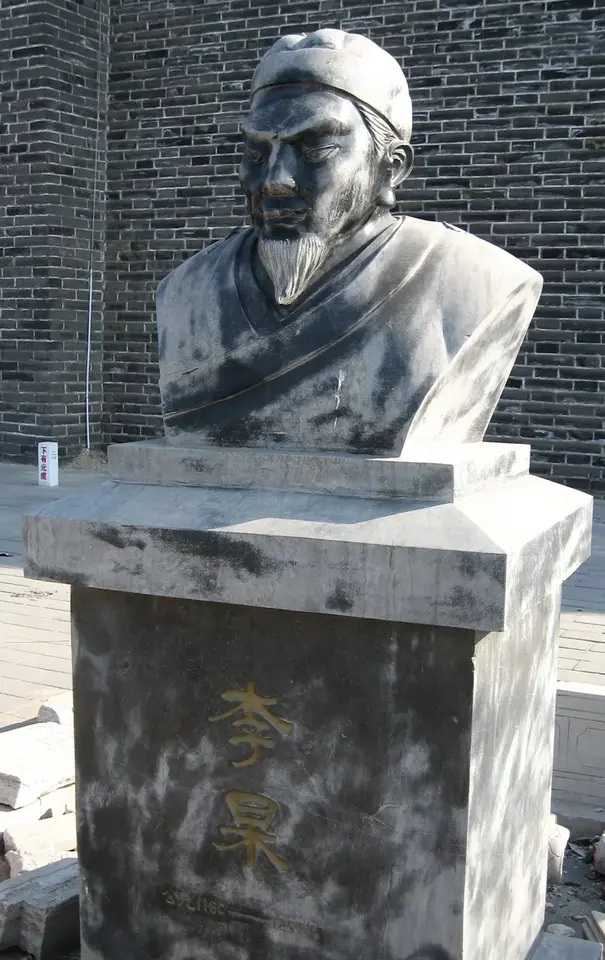
Life
Prestigious Lineage and Devotion to Medicine
Li Gao was born in the twentieth year of Dading during the reign of Emperor Shizong of the Jin dynasty (1180 CE) into an exceptionally prosperous family in Zhending Prefecture. Because Zhending had been known as the Kingdom of Dongyuan during the early Han dynasty, Li Gao styled himself the Dongyuan Elder in his advanced age, and he was universally revered by contemporaries and later generations as Li Dongyuan. Endowed with a contemplative disposition and high intellect, Li Gao received a classical education from his maternal uncle Wang Ruoxu, a celebrated Hanlin academician and foremost literary figure of the Jin court. Under Wang Ruoxu's tutelage, he studied the Analects, Mencius, Spring and Autumn Annals, and Classic of Changes, cultivating profound philosophical rigor and philological acumen.
In the fourth year of Cheng'an (1199 CE), when Li Gao was twenty years old, his mother, Lady Wang, fell gravely ill. His family engaged several renowned practitioners, but their conflicting diagnostic hypotheses and contradictory herbal prescriptions worsened her condition, leading to her untimely demise. Overcome with grief and guilt over his inability to comprehend medicine and save his mother, Li Gao resolved to abandon the civil service examinations and dedicate his existence to unraveling the fundamental mysteries of the healing arts to deliver humanity from suffering.
Mentorship under Zhang Yuansu and Herbal Formulation
During the Taihe reign of the Jin dynasty, the physician Zhang Yuansu of Yizhou enjoyed widespread renown across northern China. Zhang had pioneered an innovative medical doctrine based on visceral pattern differentiation and herbal affinities with specific meridian systems. Recognizing Zhang's unrivaled mastery, Li Gao carried one thousand pieces of gold to Yizhou to present as ceremonial apprenticeship offerings. During his years of rigorous study in Yizhou, Li Gao applied his classical learning to medical texts, studying day and night to absorb his mentor's therapeutic principles.
Zhang Yuansu imparted his entire clinical repertoire to Li Gao, who not only grasped the subtleties of visceral repletion and depletion but also synthesized the energetic classifications of medicinal substances. Returning to Zhending, Li Gao, possessing ample family fortunes, did not practice medicine as a commercial livelihood. Instead, he treated severe and intractable diseases among kin and scholars without remuneration, achieving extraordinary clinical outcomes that cemented his reputation across the Yan-Zhao region.
Wartime Wanderings and Relief during the Great Pestilence
The late Jin era was devastated by unending warfare as the Mongol forces pushed relentlessly southward. The Jin court abandoned the central capital of Zhongdu and fled to Bianjing (modern Kaifeng, Henan Province), and Li Gao likewise relocated south to escape the chaos. In the first year of Tianxing (1232 CE), the Mongol army besieged Bianjing for several months. Starvation and overcrowded conditions triggered an unprecedentedly virulent epidemic colloquially termed "big-head celestial contagion" (datou tianxing), characterized by catastrophic facial swelling, severe throat obstruction, and high fevers. Most local doctors misdiagnosed the epidemic as a common cold-damage disorder and administered aggressive purging and diaphoretic drugs, causing immense casualties.
Li Gao diagnosed the epidemic as an affliction of damp-heat pestilential toxicity attacking the head and upper body. He pointed out that violent purgatives would devastate the stomach qi and precipitate immediate collapse. He formulated the specialized herbal prescription "Puji Xiaodu Decoction" (incorporating Scutellaria, Coptis, Scrophularia, Isatis root, Cimicifuga, and Bupleurum). Because he could not personally attend to the vast numbers of afflicted citizens, he had the prescription carved onto large wooden tablets and erected at major thoroughfares and crossroads throughout Bianjing, instructing the public to brew and take the decoction. Within days, tens of thousands who took the medicine recovered, and the grateful populace heralded his recipe as a miraculous divine prescription.
Following the fall of Bianjing, Li Gao lived as a displaced refugee across Dongping and Liaocheng in modern Shandong Province. During these arduous wanderings, he witnessed how displaced refugees suffered from emotional trauma, irregular diet, extreme exhaustion, and climate exposure, accumulating extensive clinical observations regarding internal damage disorders.
Late Literary Endeavors and Mentorship
Following the establishment of Mongol administrative control over northern China, Li Gao returned to his native Zhending in his senior years. Now past sixty years of age and possessing unparalleled clinical experience, he recognized that previous medical traditions had concentrated disproportionately on external six-excess pathogens while neglecting the devastating systemic harm caused by dietary irregularity and physical exhaustion. Consequently, he secluded himself to compose an integrated theoretical system centered upon the preservation of spleen and stomach energetics.
During this period, he opened a private academy to transmit his teachings. The physician Luo Tianyi sought his instruction, serving him diligently and mastering the doctrine of the school. In the first year of Möngke Khan (1251 CE), Li Gao passed away at his home in Zhending at the age of seventy-two. On his deathbed, he entrusted all his unpublished drafts to Luo Tianyi, urging him to edit, verify, and engrave the treatises so that they might forever benefit medical practitioners and patients throughout the realm.
Major Contributions
Founding the Spleen-Stomach Doctrine and Earth-Supplementing School
Li Gao's most transformative legacy within Chinese medical history was his establishment of the internal spleen-stomach injury doctrine and the founding of the earth-supplementing school. Grounded in the ancient dictum of the Huangdi Neijing that "the spleen and stomach are the granary officials whence the five flavors originate" and "stomach qi is the root of human life," Li Gao formulated the fundamental principle that "the repletion of original qi depends entirely upon the spleen and stomach remaining undamaged; if stomach qi is depleted by dietary irregularity or excessive exertion, myriad ailments arise."
He argued that wartime deprivations, forced labor, and psychological distress primarily disrupt the spleen and stomach, which represent the fundamental foundation of post-natal vitality and the source of qi and blood transformation. When spleen-stomach qi is exhausted, clear yang cannot ascend and turbid yin fails to descend, allowing latent ministerial fire to flare upward destructively. This conceptual framework revolutionized Chinese therapeutics, shifting focus away from exclusive reliance on cold-damage exterior treatments toward internal constitutional harmonization.
Differentiating Internal Damage from External Afflictions and Master Formulations
In practical diagnosis and treatment, Li Gao meticulously distinguished internal injury fevers from externally contracted febrile disorders. While external afflictions require diaphoretic dispersion, internal injury fevers originate from qi depletion and ministerial fire agitation; treating internal damage with acrid cooling diaphoretics inevitably causes systemic collapse. Li Gao instituted the foundational therapeutic rule of "sweet and warm herbs expelling severe heat" (gan wen chu da re), revitalizing central qi to gently disperse secondary fire.
Guided by this therapeutic principle, Li Gao created numerous classical prescriptions that remain central to modern clinical medicine:
- Buzhong Yiqi Decoction (Center-Supplementing and Qi-Boosting Decoction): Combining Astragalus, Ginseng, Atractylodes, and Angelica with small doses of Cimicifuga and Bupleurum to elevate sunken clear yang, serving as the sovereign formula for visceral prolapse, chronic diarrhea, and fatigue-induced low-grade fevers;
- Shengyang Yiwei Decoction (Yang-Ascending and Stomach-Benefiting Decoction): Tailored for spleen qi deficiency complicated by lingering dampness, poor appetite, and limb heaviness;
- Qingshu Yiqi Decoction (Summerheat-Clearing and Qi-Boosting Decoction): Formulated for summerheat stroke accompanied by qi exhaustion and body fluid depletion;
- Danggui Buxue Decoction (Chinese Angelica Blood-Supplementing Decoction): Employing a five-to-one ratio of Astragalus to Angelica, embodying the profound physiologic axiom that blood generation fundamentally depends upon the flourishing of vital qi.
These formulations represent exquisite masterworks of traditional pharmacodynamics and clinical synergy.
Systematizing Jin-Yuan Medical Treatises
Li Gao's written treatises provided the enduring textual cornerstone for the earth-supplementing school. His principal work, the three-volume Treatise on the Spleen and Stomach (Piwei Lun), systematically details the paramount role of gastrointestinal vitality, dietary moderation, and energy conservation. His three-volume Clarifying Doubts on Internal and External Damage (Neiwai Shang Bianhuo Lun) presents thirteen exhaustive clinical points of differentiation between internal and external fevers, including pulse types, thirst patterns, head pain characteristics, and seasonal dynamics. His Secret Treasures of the Orchid Chamber (Lanshi Mizang) organizes hundreds of specific clinical recipes covering internal medicine, surgery, gynecology, and pediatrics. Later Ming dynasty medical luminaries such as Xue Ji, Zhang Jingyue, and Li Zhongzi drew extensively upon Li Gao's insights, establishing earth-nourishing therapy as an indispensable branch of classical medicine.