Suppressing Rebels at Dongping
Campaigned under Chaghan Tiemu'er, decapitating over ten thousand rebels and compelling Tian Feng and Wang Shicheng to surrender.
?–1375 CE
扩廓帖木儿
Köke Temür (扩廓帖木儿, ?–1375), widely known by his Han name Wang Baobao (王保保), was a native of Shenqiu in Yingzhou belonging to the Bayaut clan. He was a preeminent military commander and foundational pillar of the late Yuan Dynasty and the Northern Yuan court, rising to the supreme offices of Grand Preceptor (Taishi) and Right Grand Chancellor (Zhongshu You Chengsang), and ennobled as the Prince of Henan and Prince of Qi.…
Köke Temür (扩廓帖木儿, ?–1375), widely known by his Han name Wang Baobao (王保保), was a native of Shenqiu in Yingzhou belonging to the Bayaut clan. He was a preeminent military commander and foundational pillar of the late Yuan Dynasty and the Northern Yuan court, rising to the supreme offices of Grand Preceptor (Taishi) and Right Grand Chancellor (Zhongshu You Chengsang), and ennobled as the Prince of Henan and Prince of Qi. Born as the eldest son of Saiyinchidahu (Sayin Čidaqu), he was adopted in youth by his maternal uncle, the loyalist warlord Chaghan Tiemu'er, accompanying him in brutal campaigns across the Central Plains to crush the Red Turban Rebellions. In 1362, following Chaghan Tiemu'er's assassination outside Yidu in Shandong, the young Köke Temür was chosen by veteran commanders to succeed to his adoptive father's armies, earning the moniker the Little Commander-in-Chief. He besieged and stormed Yidu, executing the assassins Tian Feng and Wang Shicheng to avenge his father, and successfully recovered the entirety of Shandong. Following the pacification of the Central Plains, Köke Temür became entangled in vicious court factional struggles, engaging in protracted civil conflicts against Datong warlord Boluo-temür in Shanxi and Hebei, and fighting bitter turf wars against Guanzhong commanders Li Siqi and Zhang Liangbi. His insubordination precipitated an outright breach with Emperor Huizong. When Ming armies captured the imperial capital Dadu, Köke Temür's counter-offensive failed following a disastrous nocturnal cavalry rout outside Taiyuan, forcing him to withdraw into the northwest. After suffering crushing casualties at Shen'eryu in Dingxi, he crossed the Yellow River on timber rafts and fled across the Gobi Desert to Karakorum to serve Emperor Zhaozong (Ayushiridara). In 1372, during the Battle of Lingbei, he lured the invading 150,000-strong Ming northern expedition deep into the steppe and routed generalissimo Xu Da at the Tuul River, preserving Northern Yuan rule over the Mongolian plateau. Unyielding across a hundred battles, he resisted all overtures from Ming founder Zhu Yuanzhang, who famously revered him as the most remarkable man under heaven.
Campaigned under Chaghan Tiemu'er, decapitating over ten thousand rebels and compelling Tian Feng and Wang Shicheng to surrender.
Chaghan Tiemu'er was assassinated; Köke Temür took command, stormed Yidu, avenged his father, and was appointed Grand Commandant.
Stationed his main army at Jining; ambushed and routed Boluo-temür's invading forces at Shiling Pass, capturing commander Wuma'er.
Allied with Crown Prince Ayushiridara to encircle Dadu; following Boluo-temür's execution, ennobled as Prince of Henan and commander of imperial forces.
Clashed violently with Guanzhong commanders Li Siqi and Zhang Liangbi over command jurisdiction, engaging in over a hundred indecisive battles.
Refused imperial orders to divide his armies, executing court envoys; Emperor Huizong issued edicts stripping him of all offices while his subordinates revolted.
Ming armies captured Dadu; the court restored his titles; defeated Tang He at Handian before suffering a devastating night ambush by Xu Da at Taiyuan.
Regrouped in Gansu, besieging Lanzhou for months and ambushing Ming relief forces under Yu Guang at Gucheng.
Fought Xu Da at Dingxi; his army collapsed under a midnight assault, and he fled across the desert with only a handful of followers.
Following Emperor Zhaozong's enthronement, appointed Grand Preceptor and Right Grand Chancellor to reorganize Northern Yuan administration.
Confronted a multi-pronged Ming invasion; lured Xu Da's main force past the Tuul River and annihilated over ten thousand Ming troops.
Passed away from illness at his headquarters in Har-Nohai; his wife Lady Mao committed suicide to follow him in death.
Köke Temür was born in Shenqiu, Yingzhou, originally bearing the Han name Wang Baobao. His family had resided in the Central Plains for generations, absorbing profound classical Confucian cultural traditions. His biological father, Saiyinchidahu, was erudite in classical histories and bureaucratic governance while excelling in mounted archery and military strategy, serving as a Hanlin Academician and Grand Commandant during the chaotic late Yuan years. His mother, Lady Fo'er, was a noblewoman of the Naiman clan and the elder sister of loyalist leader Chaghan Tiemu'er. In 1352, as Red Turban uprisings flared across the Huai River basin, Saiyinchidahu joined Chaghan Tiemu'er in raising a regional loyalist militia in Shenqiu, fighting across Runan, Luoshan, and Xinyang to repel rebel armies.
Because the young Wang Baobao was frequently ill in childhood and his biological father campaigned constantly on distant battlefronts, he was placed in the care of his maternal uncle Chaghan Tiemu'er. Chaghan Tiemu'er doted upon the boy, treating him as his own son and formally adopting him as his primary heir. Acknowledging their multi-generational devotion, Emperor Huizong conferred the Mongol name Köke Temür upon him as a mark of special imperial favor. Growing up in the saddle, Köke Temür immersed himself in military manuals and mounted combat, earning high respect among officers for his stern discipline and tactical composure.
During the height of the Red Turban Rebellions, Chaghan Tiemu'er expanded his militia into an indispensable field army. From his adolescence, Köke Temür followed his adoptive father on the front lines, entrusted with planning sensitive operational assignments. In the autumn of 1361, Chaghan Tiemu'er dispatched Köke Temür at the head of crack cavalry to subdue rebel forces entrenched at Dongping in Shandong under veteran generals Tian Feng and Wang Shicheng.
Discerning the enemy's deployment weaknesses, Köke Temür executed double ambushes that crushed rebel lines, decapitating more than ten thousand fighters and pursuing the survivors directly to Dongping's gates. Intimidated by his relentless momentum, Tian Feng and Wang Shicheng yielded and surrendered the stronghold. This stunning triumph established Köke Temür's reputation across the northern armies, providing the tactical foundation for his eventual assumption of supreme field command.
In the summer of 1362, Chaghan Tiemu'er led his armies to invest the final Red Turban citadel of Yidu in Shandong. After months of siege, the recently surrendered commanders Tian Feng and Wang Shicheng harbored treachery. In June, taking advantage of Chaghan Tiemu'er's light cavalry tour inspecting frontline siege trenches, the conspirators sprang an ambush, brutally assassinating the supreme loyalist commander before scurrying back into Yidu to hold out.
The murder sent shockwaves through the loyalist encampment, plunging the troops into grief and fury. Emperor Huizong, heartbroken over the loss of his paramount general, posthumously ennobled Chaghan Tiemu'er as the Prince of Yingchuan with the posthumous title Zhongxiang. The veteran officers, bound by enduring gratitude to Chaghan, unanimously acclaimed the young Köke Temür as their new supreme leader, hailing the poised youth as the Little Commander-in-Chief. Anxious to retain the combat effectiveness of this elite force, Emperor Huizong issued immediate decrees appointing Köke Temür as Grand Master of Splendid Happiness, Manager of Governmental Affairs, and concurrent director of the Henan-Shandong Branch Bureau of Military Affairs, placing all his late father's armies under his unified command.
Clad in white mourning dress, Köke Temür swore a blood oath to avenge his adoptive father, galvanizing his weeping troops into an unbreakable fighting unit. He directed round-the-clock sapping operations toward the city foundations while massing hundreds of heavy trebuchets to batter Yidu's ramparts. After months of ferocious assaults, the fortress fell in November 1362, and both Tian Feng and Wang Shicheng were captured alive.
On the day of victory, Köke Temür personally gouged out the hearts and livers of the two assassins, placing them upon an altar before his father's memorial tablet in a solemn sacrificial rite. Following the recapture of Yidu, Köke Temür swept through eastern Shandong, clearing remaining rebel garrisons in Juzhou and restoring imperial control across the province. In recognition of his feats, the court elevated him to Silver-Blue Senior Grand Master for Glorious Happiness, Grand Commandant, and Director of the Bureau of Military Affairs, granting him full discretionary authority over the northern armies. Stationing his troops in Bianliang and Luoyang, he secured the Central Plains from the Zibo and Yishui rivers west to the mountain passes of Shaanxi, becoming the court's indispensable shield.
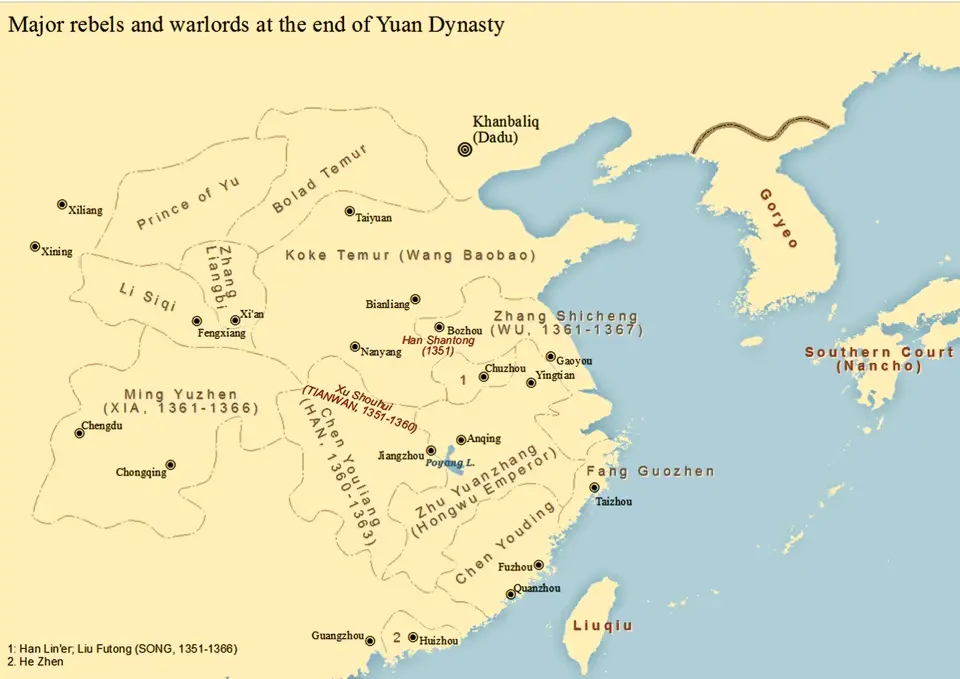
Despite his preeminent strength, Köke Temür was unable to march south against Jiangnan rebel regimes because he was sucked into the vortex of court factional politics. At the time, the two most powerful regional military forces backing the Yuan were Köke Temür's army in the Central Plains and Boluo-temür's host based in Datong. The two warlords engaged in intense territorial rivalry over Shanxi and Hebei, bringing their armies to the brink of open warfare. When Boluo-temür repeatedly encroached upon the Jining Route, Köke Temür marched his main divisions into Jining to confront him.
Both warlords engaged in heavy bribery at court, paying vast sums to the chief eunuch Park Bul-hwa and Chancellor Choes-jian, who manipulated imperial edicts based on the highest bidder. Emperor Huizong issued decrees reminding both generals that all soil and subjects belonged to the sovereign, ordering Shiling Pass to be the strict boundary between their respective zones. However, deep-seated grudges and corrupt courtiers nullified all peace decrees, and border skirmishes continued unabated. In October 1363, Boluo-temür sent generals Wuma'er and Yin Xingzu to mount a full invasion of Jining. Köke Temür ambushed the invaders at the narrow defiles of Shiling Pass, routing their army, capturing both commanders, and slaying thousands, hardening their rivalry into an irreconcilable feud.
Simultaneously, a bitter succession battle erupted between Emperor Huizong and Crown Prince Ayushiridara. The Emperor favored Boluo-temür, while the Crown Prince and Empress Gi forged a secret alliance with Köke Temür. In 1364, Boluo-temür marched on Dadu and purged the palace, forcing the Crown Prince to flee to Taiyuan to seek refuge under Köke Temür's protection.
Köke Temür sheltered the heir in Jining, establishing a Pacification Bureau (Fujun Yuan) to mobilize armies across the realm to encircle the capital. In July 1365, Emperor Huizong arranged Boluo-temür's assassination inside the palace and summoned the Crown Prince and Köke Temür back to court. Köke Temür escorted the Prince into Dadu with elite cavalry; a delighted Emperor appointed him Left Grand Chancellor and Prince of Henan, placing all imperial armies under his supreme command to eradicate southern insurgencies.
Upon entering the central government, Köke Temür was confronted by Crown Prince Ayushiridara's secret demands to use military force to coerce Emperor Huizong into abdication. Committed to classical principles of loyalty, Köke Temür adamantly refused to participate in unfilial usurpation, earning the deep resentment of the Crown Prince. Sensing the deadly intrigues of the capital, Köke Temür requested permission to return to Henan to organize southern defenses.
In 1366, operating as Prince of Henan and imperial commander-in-chief, Köke Temür ordered veteran Guanzhong commanders Li Siqi, Zhang Liangbi, and Kong Xing to submit to his strategic coordination for the southern expedition. The older generals regarded Köke Temür as an upstart and flatly rejected his authority, forming a coalition against him. From Köke Temür's perspective, the Guanzhong warlords held threatening positions flanking Tongguan, and marching his armies south would leave his rear exposed to their incursions.
Infuriated by their insubordination, Köke Temür dispatched his brother Tuoyin Temür into Shaanxi, igniting an internecine civil war that raged across Fengxiang and the Wei River basin for over a year. The conflict witnessed more than a hundred engagements, laying waste to local populations. When Emperor Huizong and the Crown Prince issued urgent edicts demanding a ceasefire and the dispatch of troops to Jiangnan, Köke Temür ignored the summons and executed imperial envoy Tianxianu.
By winter 1367, alarmed by his growing defiance, the court stripped Köke Temür of his chancellorship, his princely title, and his military commission, while secretly ordering his subordinate commanders Mo Gao and Guan Bao to attack him from behind. Forced to retreat to Zezhou and Luzhou, Köke Temür became bogged down in mutual slaughter with former subordinates, shattering the northern defense line on the eve of the Ming northern invasion.
As the Yuan dynasty devoured itself in civil strife, Zhu Yuanzhang founded the Ming Dynasty in Nanjing, commissioning generalissimo Xu Da and vice general Chang Yuchun to lead 250,000 troops north. Ming armies crossed the Yellow River, routed Tuoyin Temür at the Luo River, and accepted the surrender of Köke Temür's grandfather Liang Wang Aruwen. In utter panic, Emperor Huizong executed the turncoat Mo Gao to placate Köke Temür, restoring all his former offices as Grand Tutor, Chancellor, and Prince of Henan. Some advisors urged Köke Temür to remain in Yunzhong and watch the dynasty fall, but he rejected self-preservation, insisting that imperial salvation remained paramount. However, his mobilization came too late: in July 1368, Emperor Huizong fled Dadu toward Shangdu, and the Ming captured the imperial metropolis, ending Yuan rule over the Central Plains.
Following the fall of Dadu, renamed Beiping, Xu Da dispatched forward divisions under Tang He to probe Shanxi. Recognizing an isolated vanguard, Köke Temür launched a surprise counter-strike in October 1368 at Handian, enveloping and routing Tang He's army in the first major loyalist victory after the capital's fall. Encouraged by this success, Emperor Huizong elevated him to Prince of Qi, bestowing a golden seal and ordering him to retake Beiping.
Köke Temür assembled his main army, marched north through Yanmen Pass, and advanced along Bao'an toward Juyong Pass. Astutely recognizing that Beiping's fortifications were impregnable while Taiyuan lay exposed, Xu Da and Chang Yuchun executed a lightning strike directly against Taiyuan. Hearing that his rear base was imperiled, Köke Temür raced back to relieve Taiyuan, confronting Ming lines outside the walls. On a stormy night, Chang Yuchun coordinated with defecting Yuan commander Huobima, launching a devastating nocturnal cavalry raid straight into the center of the Yuan encampment. Köke Temür was reading military manuals by candlelight when the attack struck; caught completely unprepared, he mounted his warhorse wearing only a single boot and fled across the Fen River with eighteen retainers, escaping to Datong and retreating into the northwest.
Rebuilding his forces in Gansu, Köke Temür demonstrated incredible strategic resilience. In 1369, Emperor Huizong appointed him Right Grand Chancellor, but Köke Temür urged the Emperor to abandon Shangdu and Yingchang to establish a permanent redoubt at Karakorum. In late 1369, he laid siege to the Ming frontier hub of Lanzhou, surrounding general Zhang Wen. When Ming relief forces arrived under Yu Guang, Köke Temür sprang a devastating trap at Gucheng, annihilating the column and slaying Yu Guang.
Alarmed by the reverse at Lanzhou, Zhu Yuanzhang launched a massive counter-offensive in the spring of 1370. Rejecting his generals' preference to strike Ningxia, Zhu directed Xu Da to march through Tongguan to crush Köke Temür at Lanzhou while sending Li Wenzhong to attack Yingchang. In April, Xu Da confronted Köke Temür at Shen'eryu in Dingxi, entrenching across a deep ravine.
For days, Xu Da ordered nightly commotions with drums and horns to keep the Yuan defenders on constant alert. Once the defenders were completely exhausted, Xu Da maintained utter silence for an entire night, allowing the sleep-deprived Yuan soldiers to fall into deep slumber. In the dead of night, Ming shock troops breached the fortifications. The Yuan army disintegrated; over 84,000 officers and soldiers were captured alongside Prince Tan and commanders Yan Fengxian and Hanzhar. With his army wiped out, Köke Temür escaped through Sangyuan Gorge on makeshift drift-wood rafts across the torrential Yellow River, fleeing across the Ningxia desert to reach Karakorum.
The catastrophe at Dingxi did not break Köke Temür's resolve. Around that time, Emperor Huizong died in Yingchang, and Crown Prince Ayushiridara ascended the throne at Karakorum as Emperor Zhaozong of Northern Yuan. Fully aware that only Köke Temür could preserve the state, Zhaozong appointed him Grand Preceptor and Right Grand Chancellor, entrusting him with complete civil and military control. Reorganizing steppe garrisons and rallying Mongolian chieftains, Köke Temür restored the military capabilities of the Northern Yuan.
In 1372 (Fifth Year of the Hongwu Era), Zhu Yuanzhang launched a 150,000-man northern expedition to eradicate Northern Yuan for good. Supreme commander Xu Da marched through Yanmen Pass toward Karakorum, Li Wenzhong advanced along the eastern route, and Feng Sheng took the western route. Köke Temür adopted a calculated strategy of feigned retreats, drawing Xu Da's vanguard hundreds of miles past the Tuul and Orkhon rivers into waterless terrain.
In May 1372, Köke Temür joined forces with commander He Zongzhe to spring a coordinated double envelopment. Steppe cavalry swept around both flanks, routing the exhausted Ming vanguard and inflicting over ten thousand casualties, forcing Xu Da to fight his way back south. The Battle of Lingbei shattered Ming hopes of eliminating the Northern Yuan, preserving steppe independence and establishing a lasting geopolitical stalemate.
Recognizing that Köke Temür could not be broken by force, Zhu Yuanzhang sent seven personal letters urging him to submit, even sending former Yuan turncoats Li Laobao and Li Siqi to negotiate. Köke Temür poisoned Li Laobao; upon receiving Li Siqi, he treated him with courtesy, but upon departure at the border requested an arm as a parting keepsake, forcing Li Siqi to sever his own arm. Zhu Yuanzhang openly praised Köke Temür before his court, declaring him the only true man of unmatched caliber under heaven. In August 1375, Köke Temür passed away from overwork at his headquarters in Har-Nohai. His devoted wife, Lady Mao, hanged herself to join him in the afterlife. With his death, the Northern Yuan lost its indispensable pillar.
FIGURES ASSOCIATED WITH THIS DYNASTY