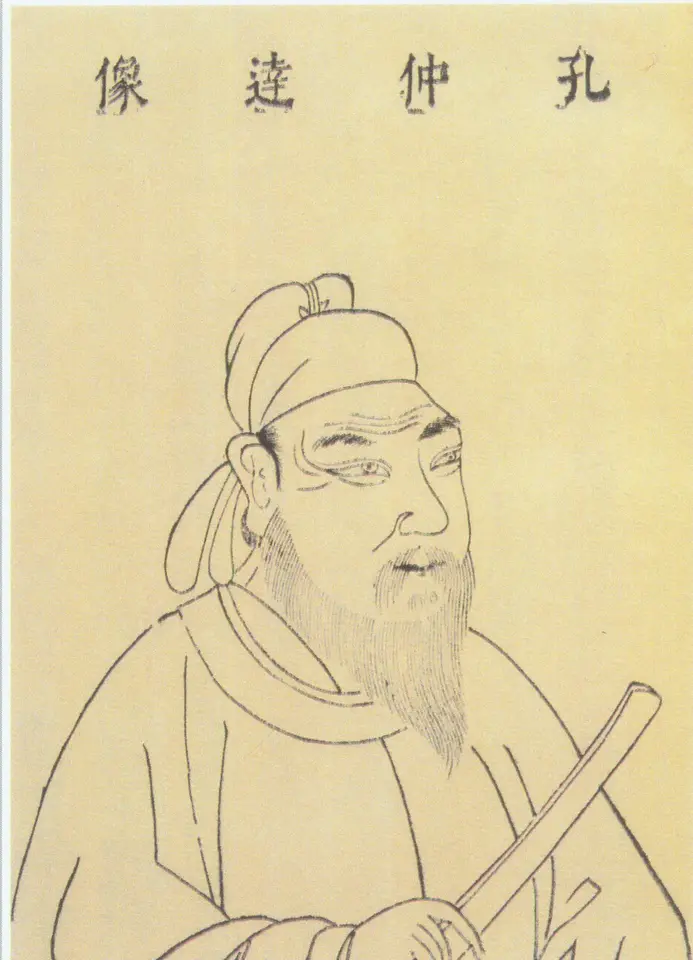
Biography
Classical Heritage and Rhetorical Triumph in Luoyang
Kong Yingda was born into the prominent hereditary lineage of Confucius in Hengshui, Jizhou, during the late Northern Qi. His great-great-grandfather Kong Linggui was an Erudite in Northern Wei, his grandfather Kong Shuo was a Vice Censor in Northern Wei, and his father Kong An served Northern Qi as a Judicial Assistant in Qingzhou. Reared in a family steeped in canonical rites, Kong Yingda's intellectual gifts matured with astonishing speed.
Following the Sui dynasty's unification of China, Emperor Wen revived classical academies. At eight years of age, Kong entered school, memorizing over a thousand characters daily and committing complex ritual exegeses to memory. As he grew, he achieved mastery of Fu Qian's commentary on the Zuo Commentary, Zheng Xuan's commentaries on the Documents, Rites, and Odes, and Wang Bi's commentary on the Changes, while displaying fluency in calendrical mathematics and prose. When he visited the renowned northern scholar Liu Zhuo, Liu was initially condescending due to Kong's youth; but when Kong raised rigorous textual dilemmas that Liu had never conceived, the veteran scholar was awestruck and treated him with profound veneration, urging him to remain as co-lecturer. Kong modestly declined and returned home to instruct local students.
In the early Daye era, Kong Yingda sat for the Sui imperial Mingjing examination, achieving the highest rank and receiving appointment as Erudite of Henan Commandery. Soon afterward, Emperor Yang summoned the realm's foremost scholars to Luoyang for an intellectual tournament, instructing palace academicians to engage in debates with regional masters. Grand Minister Yang Da evaluated the participants, declaring the thirty-year-old Kong Yingda the supreme victor across the empire. Shamed by their defeat at the hands of a young man, a clique of jealous senior scholars hired assassins to murder him. Fortunately, Chancellor Yang Xuangan sheltered Kong inside his private residence for several months, preserving his life and enabling his appointment as Instructor in the Imperial Academy.
The Eighteen Scholars and Admonishing the Throne
During the collapse of the Sui dynasty, Kong Yingda sought refuge at Wulao. In 621, Prince of Qin Li Shimin defeated warlords Wang Shichong and Dou Jiande, capturing Luoyang. Recognizing Kong Yingda's immense classical stature, Li Shimin appointed him Scholar in the Institute of Literary Studies (Wenxue Guan), enlisting him as one of the celebrated "Eighteen Scholars of the Qin Princely Mansion" who formulated administrative and cultural strategy for the rising Tang dynasty.
Following Emperor Taizong's accession in 626, Kong was appointed Erudite of the National University, ennobled as Baron of Qufu County, and transferred to Supervising Censor. During the early Zhenguan era, Emperor Taizong engaged in frequent philosophical dialogues with court scholars. Once, Taizong asked: "The Analects state: 'To ask of those who cannot when one can; to ask of those who possess little when one possesses much; to seem as though having none when possessing; to seem empty when full.' What does this mean?" Kong Yingda replied: "The sage instituted this teaching to cultivate modesty. Though possessing talent, one must never be arrogant, but seek counsel from the ordinary; though possessing abundant skill, one must still learn from those who possess little. This is true not merely for commoners, but preeminently for sovereigns. An emperor must harbor spiritual brilliance internally while displaying profound stillness externally. If a monarch flaunts his intellect, oppresses ministers with his eloquence, and rejects honest admonition, the communication between sovereign and subject is severed, leading invariably to dynastic collapse." Taizong was deeply moved by his words and praised his unbending candor.
In 632, Kong was appointed Director of Studies of the Directorate of Education and Right Mentor to the Crown Prince. When court scholars debated the imperial calendar and ritual hall architecture, all adopted Kong's proposals. He co-authored the official Book of Sui alongside Wei Zheng, receiving promotion to Regular Mounted Attendant. In 637, he directed the collation of the Five Rites of the Great Tang, resolving all disputed precedents and winning advancement to Viscount of Qufu County. Confronted by Crown Prince Li Chengqian's increasing dissipation, Kong repeatedly risked imperial wrath to deliver severe reprimands. When the prince's wet nurse cautioned him against embarrassing the heir apparent, Kong retorted: "Having received the sovereign's profound grace, I harbor no regret even in death!" and intensified his remonstrances.
The Wujing Zhengyi and Unifying Classical Tradition
Following the political unification of the empire under the Tang, classical intellectual discourse remained fractured. For over three centuries during the Northern and Southern Dynasties, northern scholars had favored literalist Han Dynasty glosses focused on phonology and institutional minutiae, whereas southern scholars had preferred Wei-Jin philosophical allegories influenced by Neo-Daoism. Because academies in different regions taught contradictory interpretations, students lacked a common standard, and civil service examiners operated without objective grading criteria.
In 638, Emperor Taizong elevated Kong Yingda to Chancellor of the Imperial University (Guozi Jijiu), placing him at the summit of the national educational system. Taizong commissioned Kong Yingda to lead a distinguished committee of scholars, including Yan Shigu, Sima Caizhang, and Yu Zhining, to standardize the Five Classics. Kong established a rigorous editorial methodology: for the Classic of Changes, he adopted the commentaries of Wang Bi and Han Kangbo; for the Book of Documents, the Kong Anguo commentary; for the Classic of Poetry, Zheng Xuan's annotations; for the Book of Rites, Zheng Xuan's commentary; and for the Spring and Autumn Annals, Du Yu's Collected Explanations on the Zuo Commentary. Building upon these canonical recensions, Kong supervised the drafting of expansive, systematic sub-commentaries (shu), reconciling conflicting glosses with exhaustive philological evidence.
The resulting 180-volume compilation, entitled Wujing Zhengyi (Correct Meanings of the Five Classics), was enthusiastically ratified by Emperor Taizong, who proclaimed: "You have synthesized ancient and modern learning, elucidating the profound intentions of the sages into an imperishable monument!" The emperor decreed that the Wujing Zhengyi be distributed through the Imperial University as the sole official curriculum for national schools and imperial examinations. In 640, Emperor Taizong conducted state sacrifices to Confucius at the Imperial University, commanding Chancellor Kong Yingda to lecture on the Classic of Filial Piety.
In 643, Kong retired due to advanced age. In 644, his portrait was enshrined in the Lingyan Pavilion with imperial encomiums praising his soaring eloquence and profound classical vision. On October 10, 648, Kong Yingda passed away peacefully in Chang'an at seventy-five years of age. Mourning his passing, Emperor Taizong decreed a day of court mourning, awarded him burial in the Zhao Mausoleum, and bestowed the posthumous title Xian. The Wujing Zhengyi remained the standard textbook for the civil service examinations for over three centuries through the Tang and Song dynasties, cementing Kong Yingda's stature as an eternal patriarch of Chinese classical scholarship.
Key Achievements
Supreme Orator of the Luoyang Debates and Enshrined in Lingyan Pavilion
In his youth, Kong Yingda defeated all senior scholars in the nationwide classical tournament in Luoyang. Later, as one of Li Shimin's "Eighteen Scholars of the Qin Princely Mansion," he shaped the cultural statecraft of the founding Tang dynasty and had his portrait enshrined in the Lingyan Pavilion.
Leading National Education and Fearless Remonstrance
Serving as Chancellor of the Imperial University and Right Mentor to the Crown Prince, Kong guided early Tang education, co-authored the Book of Sui, and boldly admonished Emperor Taizong and Crown Prince Li Chengqian on imperial humility and virtue.
Compiling the Wujing Zhengyi to Unify Classical Canons
Under imperial decree, Kong directed the compilation of the 180-volume Wujing Zhengyi (Correct Meanings of the Five Classics), synthesizing northern and southern classical commentaries and creating the definitive, standardized curriculum for state schools and civil examinations for centuries.