Birth in Yanmen
Born into a prominent bureaucratic clan in Loufan, Yanmen; secular surname Jia; mastered the classics and Daoist treatises during youth.
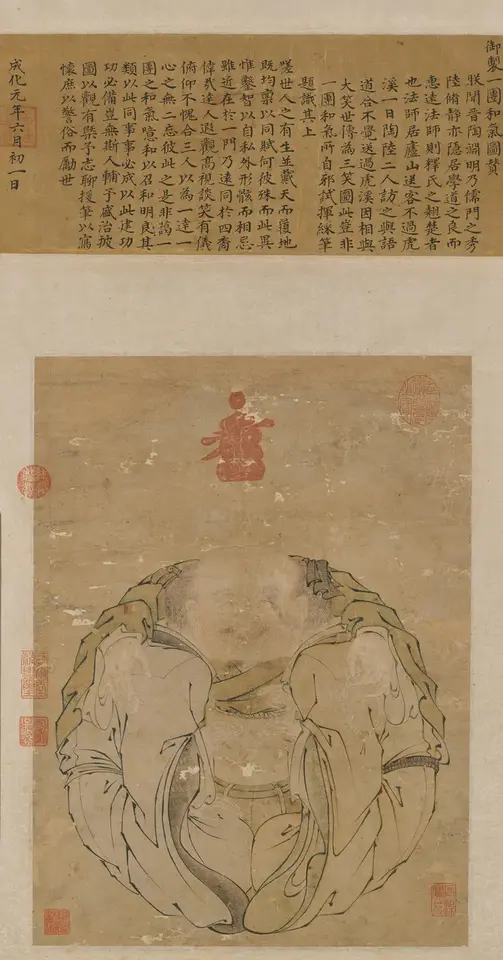
慧远
Huiyuan (慧远, 334–416), secular surname Jia, was a native of Loufan County in Yanmen Commandery (present-day Yuanping City, Shanxi Province). He was an illustrious Buddhist master, religious philosopher, and translation patron of the Eastern Jin dynasty, universally revered as the First Patriarch of the Pure Land school (Jingtu Zong) of Chinese Buddhism. Erudite from early youth, Huiyuan mastered the Confucian Six Classics…
Huiyuan (慧远, 334–416), secular surname Jia, was a native of Loufan County in Yanmen Commandery (present-day Yuanping City, Shanxi Province). He was an illustrious Buddhist master, religious philosopher, and translation patron of the Eastern Jin dynasty, universally revered as the First Patriarch of the Pure Land school (Jingtu Zong) of Chinese Buddhism. Erudite from early youth, Huiyuan mastered the Confucian Six Classics and developed exceptional expertise in Lao-Zhuang metaphysics. At the age of twenty-one, he traveled to the Taihang and Heng mountains to study under Shi Dao'an, the foremost disciple of Fotudeng. Upon hearing Dao'an lecture on the Prajnaparamita Sutra, Huiyuan experienced a profound spiritual awakening, shaving his head alongside his younger brother Huichi to become Dao'an's principal disciple, earning Dao'an's celebrated praise: "The propagation of the Buddhist path across the eastern lands depends entirely upon Huiyuan." In 381, traveling south toward Guangdong, Huiyuan was captivated by the seclusion and serenity of Mount Lu in Xunyang (modern Jiujiang, Jiangxi Province) and determined to settle permanently on the mountain. With financial patronage from Jiangzhou Governor Huan Yi, he founded Donglin Monastery, where he directed monastic cultivation for over three decades without setting foot outside the mountain valley. In 402, Huiyuan gathered 123 eminent literati and monks—including Liu Yimin, Zhou Xuzhi, Lei Cizong, and Zong Bing—before the statue of Amitabha Buddha at the Prajna Terrace of Donglin Monastery, taking collective vows to practice the mindfulness-of-the-Buddha samadhi (nianfo sanmei) and founding the White Lotus Society (Bailian She), establishing the historical foundation of the Chinese Pure Land tradition. Confronting the autocratic pressures of regent Huan Xuan, who attempted to purge the sangha and compel monks to prostrate before the emperor, Huiyuan composed his monumental treatise On Why Monks Do Not Bow Before Kings (Shamen Bu Jing Wangzhe Lun), establishing the philosophical and legal principles governing state-sangha relations in premodern China. He dispatched disciples across the Pamirs to collect original Sanskrit manuscripts, sponsored foreign masters to translate foundational treatises such as the Heart of Abhidharma and the Dharmatrata Dhyana Sutra, and conducted extensive doctrinal correspondences with Kumarajiva in Chang'an, laying an enduring foundation for the sinification of Buddhism.
Born into a prominent bureaucratic clan in Loufan, Yanmen; secular surname Jia; mastered the classics and Daoist treatises during youth.
Journeyed to Mount Heng in the north, experienced awakening listening to Dao'an lecture on the Prajnaparamita, and received monastic ordination.
Emboldened by mastery of Lao-Zhuang, he utilized Zhuangzi concepts to explicate Buddhist ultimate reality (tathata); Dao'an granted him special dispensation to cite secular literature.
Accompanied Dao'an to Xiangyang to escape northern warfare; debated and dismantled the erroneous "Mental Non-Being" doctrine advocated by Daoheng.
Arrived at Mount Lu in Jiangxi; supported by Governor Huan Yi, he founded Donglin Monastery and pledged never to cross Tiger Creek.
Invited northern Indian master Sanghadheva to Mount Lu to translate the Heart of Abhidharma, inaugurating southern Abhidharma scholarship.
Assembled 123 literati and monks before Amitabha Buddha at Donglin Monastery to take mutual vows for rebirth in the Western Pure Land.
Submitted petitions to Huan Xuan opposing compulsory prostration, composing On Why Monks Do Not Bow Before Kings.
Conducted extensive written dialogues with Kumarajiva in Chang'an regarding the Mahayana Dharmakaya, compiled into the Grand Chapter on the Meaning of the Mahayana.
Passed away peacefully in meditation at Donglin Monastery at the age of eighty-three; posthumously titled Master Bianjue by the Tang court.
Huiyuan was born in 334 into the esteemed Jia clan of Loufan County, Yanmen Commandery. An exceptionally studious youth, he accompanied his maternal uncle to Xuchang and Luoyang at the age of thirteen, reading omnivorously across the Confucian Six Classics and achieving mastery in Laozi and Zhuangzi. Contemporary senior scholars consistently marveled at his intellectual breadth and philosophical maturity.
In 354, at the age of twenty-one, Huiyuan intended to cross the Yangtze River to study under the Confucian recluse Fan Xuanzi in Yuzhang. However, civil strife within the Later Zhao regime and protracted military campaigns launched by the Eastern Jin blocked southern transport corridors. Hearing that the venerable master Shi Dao'an was lecturing on Buddhist doctrine at Mount Heng in the Taihang Range, Huiyuan traveled there with his younger brother Huichi. Listening to Dao'an expound the Prajnaparamita Sutra, Huiyuan experienced a profound awakening, declaring that "Confucianism and Daoism are merely chaff and husks compared to the transcendent Dharma." He promptly renounced secular life, shaved his head, and took monastic vows under Dao'an.
Living in austere poverty within Dao'an's monastic community, Huiyuan studied day and night, resolving to shoulder the transmission of the Buddhist Dharma. Dao'an recognized his exceptional capacity, observing: "The propagation of the Buddhist path across the eastern lands depends entirely upon Huiyuan." At the age of twenty-four, Huiyuan began lecturing publicly on the Prajnaparamita. When listeners struggled to comprehend the ontological concept of "ultimate reality", Huiyuan deftly drew analogies from the philosophical vocabulary of Zhuangzi, instantly clarifying the doctrine. Impressed by his pedagogical skill, Dao'an granted Huiyuan exclusive dispensation to study secular texts and cite non-Buddhist literature when lecturing.
In 365, as the Murong clan of Former Yan expanded southward, northern China was engulfed in military turmoil. Huiyuan accompanied Dao'an and more than four hundred monastic followers on a southward trek to Xiangyang in Hubei. At that time, a prominent monk named Daoheng was actively propagating the "Mental Non-Being" (Xinwu) theory, which argued for purifying the mind of emotional attachments while acknowledging the concrete reality of external phenomena.
Recognizing that this interpretation compromised the fundamental Prajna principle of universal emptiness, master Zhu Fatai organized a formal scholastic debate, assigning Huiyuan to represent orthodox doctrine. In the debate, Huiyuan deployed rigorous logic and textual citations, dismantling Daoheng's arguments in rapid succession. Visibly shaken, Daoheng struck the table with his whisk in silence. Huiyuan playfully quoted the Book of Changes: "Advancing with swiftness, why rattle the loom?" The audience erupted in laughter, and the "Mental Non-Being" doctrine collapsed, establishing Huiyuan's theological supremacy throughout Jingzhou.
In 378, the armies of Former Qin under Fu Jian laid siege to Xiangyang. To preserve the monastic lineage, Dao'an dispersed his disciples to different regions of China on the eve of the city's fall. Huiyuan led dozens of followers southward, initially residing at Shangming Monastery in Jingzhou. In 381, intending to seek hermetic reclusion on Mount Luofu in Guangdong, Huiyuan traveled through Xunyang (modern Jiujiang) and visited Mount Lu. Enchanted by the towering emerald peaks, rushing waterfalls, and secluded valleys, he decided to establish his permanent monastery there.
Initially lodging in the modest Longquan Hermitage, Huiyuan soon found the facilities insufficient to accommodate the hundreds of scholars and monks flocking to his sanctuary. Moved by his virtue, Huan Yi, Governor of Jiangzhou, financed the clearing of land on the western slopes of Mount Lu to construct Donglin Monastery. Entering Donglin, Huiyuan pledged never to cross Tiger Creek (Huxi) or descend into secular cities. Over the next thirty-six years, he remained secluded in the mountain sanctuary, dedicating himself to meditation, lectures, and scriptural collation, transforming Donglin Monastery into the intellectual capital of southern Chinese Buddhism.
On the twenty-eighth day of the seventh month in 402, Huiyuan gathered 123 prominent literati and monks before the statue of Amitabha Buddha at the Prajna Terrace of Donglin Monastery. Among them were retired officials and master thinkers including Liu Yimin of Pengcheng, Zhou Xuzhi of Yanmen, Lei Cizong of Yuzhang, Bi Yingzhi of Xincai, and Zong Bing of Nanyang. Together, they conducted a solemn fast and bound themselves by collective oaths to practice the mindfulness-of-the-Buddha samadhi, seeking common rebirth in the Western Paradise.
Huiyuan commissioned Liu Yimin to compose the Vow Text, which was engraved on stone, while poet Xie Lingyun excavated east and west ponds filled with white lotus blossoms in homage to their assembly, earning the community the enduring title of the White Lotus Society (Bailian She). The White Lotus Society marked the earliest documented religious association in Chinese history uniting monastic clerics and secular literati. By transforming abstract Prajna metaphysics into an accessible contemplative and devotional practice, Huiyuan established the doctrinal and liturgical paradigm of Chinese Pure Land Buddhism.
Although secluded within Mount Lu, Huiyuan exerted immense moral authority over contemporary statesmen and military rulers. When Yin Zhongkan, Governor of Jingzhou, passed through Xunyang on military maneuvers, he visited Huiyuan at Donglin Monastery, spending hours discussing the metaphysics of the Book of Changes beside mountain streams, departing with immense reverence for Huiyuan's intellectual depth.
Later, when warlord Huan Xuan launched a naval campaign down the Yangtze River to overthrow Yin Zhongkan, he anchored his fleet at Xunyang. Ambitious and domineering, Huan Xuan commanded Huiyuan to travel to his camp to welcome him. Upholding clerical dignity, Huiyuan pleaded chronic infirmity and remained seated within Donglin. Huan Xuan was forced to travel up the mountain to pay personal homage. Attempting to trap the master, Huan Xuan asked: "The Classic of Filial Piety states that our body, hair, and skin are received from our parents and must not be damaged; why then do monks shave their heads?" Huiyuan serenely responded: "Establishing oneself and practicing the Way, spreading one's name to subsequent generations to glorify one's parents—this is the supreme height of filial piety!" Huan Xuan bowed in silent admiration.
Later, when rebel leader Lu Xun led troops past Mount Lu, Huiyuan granted him an audience based on their shared youth in northern schoolhouses, conversing amicably on past memories. When suspicious officials accused Huiyuan of treasonous communication, the imperial regent Liu Yu dismissed the charge, declaring: "Master Huiyuan is an exemplar to heaven and humanity, boundless in compassion and detached like empty space; how could he harbor partisan worldly interests?"
During his ascendancy, Huan Xuan sought to subordinate the Buddhist sangha to imperial state authority, enacting decrees to defrock unfit monastics and requiring all remaining monks to prostrate before the sovereign. While high court ministers yielded to his commands, Huiyuan drafted firm petitions from Mount Lu, engaging in extensive epistolary debates.
In 404, Huiyuan composed his five-part treatise, On Why Monks Do Not Bow Before Kings (Shamen Bu Jing Wangzhe Lun). Dividing the work into five essays ("In the Household", "Leaving the Household", "Seeking the Ultimate and Not Following Transmutation", "Embodying the Ultimate and Not Harmonizing with Two Realms", and "The Physical Body Ends but the Spirit Does Not Perish"), Huiyuan argued that while secular lay practitioners must abide by filial and civic duties, ordained monastics abandon worldly rank to liberate all sentient beings. He demonstrated that their moral cultivation subtly protected the realm, making secular obeisance fundamentally inappropriate. Persuaded by Huiyuan's reasoning, Huan Xuan rescinded the prostration decree and exempted the Mount Lu monastic community from purges, securing the constitutional autonomy of the Chinese sangha.
In 401, the Kuchean master Kumarajiva arrived in Chang'an under the patronage of Later Qin. Rejoicing at the arrival of an authentic Mahayana master, Huiyuan dispatched couriers with congratulatory epistles. Kumarajiva reciprocated with deep respect, hailing Huiyuan as a "bodhisattva protector of the Dharma in the east".
Over the next several years, Huiyuan submitted eighteen complex theological inquiries to Kumarajiva concerning the nature of the Dharmakaya, the enlightenment of Arhats, the reality of the ultimate Dharma nature, and the longevity of Bodhisattvas. Their exchanges were compiled into the three-volume Grand Chapter on the Meaning of the Mahayana (Dasheng Dayi Zhang). When Huiyuan's treatise On the Dharma Nature reached Chang'an, Kumarajiva commended it warmly, noting: "Without having seen the complete Mahayana corpus, your insights harmonize invisibly with the truth—truly marvelous!"
In the eighth month of 416, at the age of eighty-three, Huiyuan fell ill at Donglin Monastery. As his condition worsened, disciples offered fermented bean soup as medicine, but Huiyuan declined because vinaya texts did not specify its permissibility. They then presented rice water, which he refused because the hour had passed noon. Finally, attendants offered honeyed water; Huiyuan instructed them to consult the vinaya rules to verify whether honey was permitted outside regular meal hours. Before the scroll could be fully unrolled, Huiyuan passed away peacefully in meditative posture. His disciples buried him in a stone crypt on the western ridge of Mount Lu. He was posthumously titled Master Bianjue by Emperor Xuanzong of Tang.
Huiyuan was the founding father of the Pure Land tradition in China. Amidst the relentless warfare and existential trauma of the Six Dynasties, abstract Prajna philosophy and rigorous monastic vinaya codes remained inaccessible to ordinary believers. Recognizing the human longing for salvation, Huiyuan grounded his teachings in the Larger Sukhavativyuha Sutra and Amitabha Sutra, promoting devotional rebirth in the Western Paradise of Ultimate Bliss.
At Donglin Monastery, Huiyuan formulated the practice of the "mindfulness-of-the-Buddha samadhi" (nianfo sanmei), articulating in his preface: "What is called samadhi? It means focused concentration and tranquil reflection. When concentration is focused, the will is unified and undivided." By synthesizing complex Indian visualization techniques with inward contemplation and oral recitation of Amitabha's name, he democratized Buddhist practice, making salvation accessible to all social strata and creating the most enduring tradition in East Asian Buddhism.
Huiyuan's treatise On Why Monks Do Not Bow Before Kings represents a foundational milestone in Chinese political thought and the history of church-state relations. It resolved a structural conflict that had persisted since the introduction of Buddhism into China: the collision between monastic renunciation and Confucian imperial absolutism.
Huiyuan demonstrated that the outward non-conformity of the sangha did not constitute rebellion against imperial sovereignty, but served as a complementary moral pillar for dynastic stability. By distinguishing between secular lay ethics and transcendent monastic discipline, his treatise established an enduring equilibrium between religious communities and imperial authorities that shielded the Buddhist order throughout medieval China.
Huiyuan acted as a visionary organizer of Buddhist translation during the Eastern Jin. Recognizing that scriptures in southern China were incomplete and vinaya codes defective, he dispatched his disciples Fa Jing and Fa Ling across the Pamirs to procure Sanskrit manuscripts, while extending hospitality to foreign masters traveling southward.
In 391, he hosted Sanghadheva to translate the Heart of Abhidharma and Tridharmaka-shastra, opening the golden age of Abhidharma philosophy in Jiangnan. In 401, he sheltered Buddhabhadra, commissioning him to translate the Dharmatrata Dhyana Sutra, which introduced the five classic visualization methods (impurity, compassion, dependent origination, breath counting, and element analysis). He convinced Dharmaruci to complete the translation of the Ten Recitations Vinaya, while abridging Kumarajiva's hundred-volume Treatise on the Great Perfection of Wisdom into the accessible twenty-volume Dazhi Lun Chao.
Huiyuan was a pioneering architect of the "harmonization of the three teachings" (Sanjiao Heyi) in Chinese intellectual history. Utilizing Dao'an's concept-matching approach, he incorporated Confucian ethical categories and Daoist metaphysical concepts into Buddhist discourse.
In his essay The Physical Body Ends but the Spirit Does Not Perish, Huiyuan adopted the famous allegory of fire and firewood from Zhuangzi to explain how the conscious soul transmutes across successive rebirths driven by karmic retribution, even as the mortal body dissolves. This conceptual translation bridged Indian karmic rebirth doctrines with ancestral Chinese views on spiritual immortality, anchoring Buddhism deeply into Chinese philosophical culture and exerting an enduring influence on Song and Ming Neo-Confucianism.
FIGURES ASSOCIATED WITH THIS DYNASTY