Birth in Hailing
Born into a scholarly family in Hailing, Taizhou; composed poetry at age seven and mastered the Five Classics by thirteen.
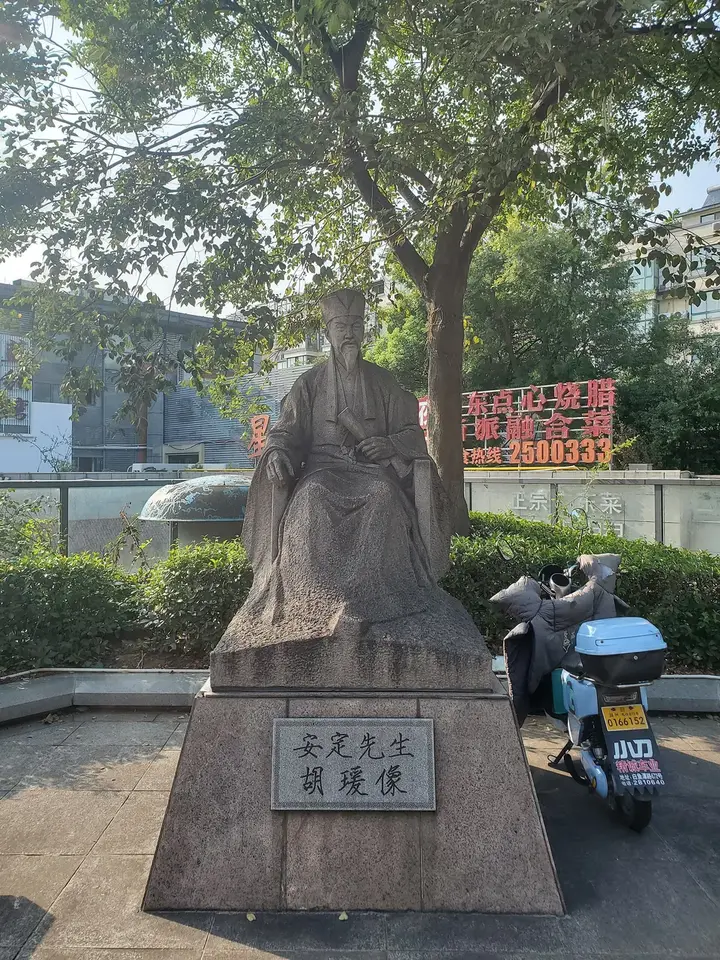
胡瑗
Hu Yuan (胡瑗, 993–1059), courtesy name Yizhi and styled Master Anding (An’ding Teacher), was a preeminent Chinese philosopher, educator, and foundational pioneer of the Northern Song Confucian revival. Tracing his ancestral lineage to Anding Fort in Shaanxi, he was honored by contemporaries as Master Anding (An’ding Teacher). Along with Sun Fu and Shi Jie, he was venerated as one of the Three Masters of the Early Song…
Hu Yuan (胡瑗, 993–1059), courtesy name Yizhi and styled Master Anding (An’ding Teacher), was a preeminent Chinese philosopher, educator, and foundational pioneer of the Northern Song Confucian revival. Tracing his ancestral lineage to Anding Fort in Shaanxi, he was honored by contemporaries as Master Anding (An’ding Teacher). Along with Sun Fu and Shi Jie, he was venerated as one of the Three Masters of the Early Song (Songchu San Xiansheng). In his youth, Hu retreated to Mount Tai for a decade of intense classical study, cultivating an austere way of life and committing himself to ancient sage learning. Hu dedicated his career to classical education, directing Suzhou Prefectural School and Huzhou Prefectural School for over two decades before assuming leadership of the Imperial Academy (Taixue) in the capital Kaifeng. Challenging the decadent literary triviality and rhyming verse memorization prevalent in civil service examinations, Hu established the central educational doctrine of Understanding the Substance and Applying It to Affairs (also rendered as Understanding Substance and Applying It in Practice). He created the celebrated Su-Hu Teaching Method, establishing Division of Studios Teaching (Teaching in Separate Studios) with two distinct tracks: the Classics Studio (Jingyi Zhai) for moral philosophy and the Affairs Studio (Zhishi Zhai) for civil administration, defense, hydraulic engineering, and mathematics. In 1241, he was posthumously granted enshrinement in the Imperial Confucian Temple.
Born into a scholarly family in Hailing, Taizhou; composed poetry at age seven and mastered the Five Classics by thirteen.
Withdrew to the Qizhen Daoist Cloister on Mount Tai for ten years of rigorous classical research alongside Sun Fu and Shi Jie.
Invited by Prefect Fan Zhongyan to direct Suzhou Prefectural School, where he instituted modular curriculum tracks.
Transferred to direct Huzhou Prefectural School, formulating the renowned Su-Hu Teaching Method.
Summoned by Emperor Renzong to the Chuigong Hall to advise on state education; appointed Subprefectural Registrar of Danyang.
Fan Zhongyan enacted the Qingli Reforms, decreeing that all provincial and subprefectural schools adopt Hu Yuan's educational curriculum.
Appointed Director of Instruction (Zhijiang) at the Imperial Academy (Guozijian), lecturing to thousands of scholars in the capital.
Retired with the honorific title of Court Gentleman of Taichang; died in Hangzhou at age sixty-seven, and was later honored with enshrinement in the Imperial Confucian Temple.
Hu Yuan was born in the fourth year of the Chunhua era (993) in Hailing, Taizhou. His ancestors originally inhabited the frontier stronghold of Anding Fort in Shaanxi before settling in the lower Yangtze delta, leading scholars to revere him as Master Anding (An’ding Teacher). From childhood, Hu possessed exceptional intellectual acuity, composing sophisticated literary verses at seven and mastering the moral imperatives of the Five Classics by thirteen.
During the reigns of Emperor Zhenzong and Emperor Renzong, civil examination aspirants focused heavily on poetic ornamentation and superficial parallel prose, neglecting practical statecraft. Disdaining these trivial pursuits, Hu resolved to explore the profound principles of human nature and administrative order embedded in the original Confucian canons.
During the early Tiansheng era, Hu left his family and secluded himself in the Qizhen Cloister on Mount Tai in Shandong. Fellow scholars Sun Fu and Shi Jie joined him in hermit study, forming a close intellectual fraternity committed to cultural rejuvenation, later known as the Three Masters of the Early Song.
During his decade on Mount Tai, Hu lived under ascetic discipline. He studied without rest, wearing coarse garments and sleeping on rough straw mats. This prolonged period of meditation on the Book of Changes, the Classic of History, and the Spring and Autumn Annals provided the intellectual foundation for his subsequent institutional reforms.
In the first year of the Jingyou era (1034), Fan Zhongyan was appointed Prefect of Suzhou. Committed to reviving administrative integrity through talent cultivation, Fan sought out Hu Yuan, appointing him head instructor of Suzhou Prefectural School.
At Suzhou, Hu raised the banner of Understanding the Substance and Applying It to Affairs (Understanding Substance and Applying It in Practice). He replaced rote recitation with systematic lectures on ethical conduct and practical governance, enforcing strict disciplinary standards. Rising before dawn to lead morning assemblies in full academic dress, Hu inspired deep devotion among his students.
Soon afterward, at the invitation of Prefect Teng Zijing, Hu transferred to lead Huzhou Prefectural School. In Huzhou, where he remained for over twenty years, Hu brought his pedagogical reforms to full fruition, institutionalizing the renowned Su-Hu Teaching Method.
Scholars from across the empire flocked to Huzhou, expanding the student body into hundreds of dedicated pupils. Hu implemented Division of Studios Teaching (Teaching in Separate Studios) with Classics Studio and Affairs Studio, creating academic branches to adapt instruction to individual student talents and making Huzhou the premier academic center in Song China.
In 1042, Emperor Renzong heard of Hu's outstanding success in moral and practical education, summoning him to the Chuigong Hall for an imperial audience on statecraft and school administration.
Addressing the emperor with serene confidence, Hu argued that the peace of the realm depended upon talent, the cultivation of talent rested upon education, and the foundation of education lay in schools. Impressed by his lucid analysis, Emperor Renzong awarded him civil status as Subprefectural Registrar of Danyang, later promoting him to Judge of the Court of Judicature and Revision.
In 1043, Fan Zhongyan inaugurated the Qingli Reforms, submitting memorials detailing how Hu's curriculum at Huzhou fostered authentic talent. Emperor Renzong formally decreed that all local schools across Song China adopt Hu's modular curriculum and Division of Studios Teaching.
In 1056, Hu was summoned to Kaifeng as Director of Instruction (Zhijiang) at the Imperial Academy (Guozijian), concurrently serving as Lecturer at the Tianzhang Pavilion. Lecturing on the Book of Changes and the Great Plan (Hongfan), Hu taught thousands of imperial academy scholars, transforming the capital's scholastic culture from hollow rhetorical competition into serious moral inquiry.
In his early sixties, plagued by chronic fatigue from decades of teaching, Hu Yuan submitted his resignation. Emperor Renzong conferred the honorific rank of Court Gentleman of Taichang (Taichang Boshi) upon his retirement, granting him imperial robes and silver insignia.
On July 18, 1059 (the fourth year of the Jiayou era), Hu passed away peacefully at his residence in Hangzhou at the age of sixty-seven. Hundreds of scholars and high officials gathered in deep mourning. Statesman Wang Anshi composed an elegy mourning Hu as the "paramount leader among all heroic talents of the realm."
During the reign of Emperor Shenzong, the emperor inquired about Hu's teachings from his disciple Liu Yi, who summarized his master's lifelong philosophy: "The Master's way of the sages was rooted entirely in Understanding the Substance and Applying It to Affairs (Understanding Substance and Applying It in Practice)."
In 1241, Emperor Lizong of Song formally recognized Hu Yuan as a primary progenitor of Neo-Confucian thought, conferring upon him the posthumous title of Baron of Baoding and enshrining his spirit tablet in the Imperial Confucian Temple.
Hu Yuan's primary contribution to Chinese philosophical history was the formulation of the doctrine of Understanding the Substance and Applying It to Affairs (Understanding Substance and Applying It in Practice, Mingti Dayong).
Hu asserted that the Way of the Sages encompassed three interconnected components: Essence (ti), Function (yong), and Form (wen). "Essence" represented the immutable moral principles of human relationships and cosmic order; "Function" referred to practical statecraft, public administration, and agrarian welfare; and "Form" constituted the written words that transmitted these verities.
Hu insisted that genuine scholarship required mastering moral principles while actively applying them to state administration, rejecting the division between abstract moralizing and pragmatic administration. His doctrine directly catalyzed the Neo-Confucian synthesis developed by the Cheng brothers and Zhu Xi.
Hu Yuan revolutionized Chinese pedagogy through the Su-Hu Teaching Method, establishing the earliest systematic model of Division of Studios Teaching (Teaching in Separate Studios).
Within the academy, Hu established two complementary branches: the Classics Studio (Jingyi Zhai), designed for students inclined toward philosophical inquiry, and the Affairs Studio (Zhishi Zhai), structured into specialized professional tracks including civil administration, military strategy, water management, and astronomy.
Students mastered one primary discipline while acquiring literacy in secondary fields. This institutional innovation reconciled moral philosophy with technical competence, serving as the direct institutional prototype for the Three-Hall System (Sanshe Fa) of the Northern Song Imperial Academy.
In classical commentary, Hu Yuan authored influential texts including Oral Meaning of the Zhou Changes (also known as Oral Explanations of the Zhou Changes, Zhouyi Kouyi) and Oral Meaning of the Great Plan (also known as Oral Explanations of the Great Plan, Hongfan Kouyi).
In Zhouyi Kouyi, Hu broke decisively with Han dynasty traditions that interpreted the hexagrams through numerology, astrology, and omens. Instead, he interpreted the hexagrams and line statements through ethical human relations and statecraft, demonstrating that the cosmic changes of the Yijing reflected human moral duties.
Hu's hermeneutic method established the "Rationalist School of Yijing Interpretation" (Yili Yixue), which was later fully inherited and canonized in Cheng Yi's Yichuan Yizhuan.
In his eulogy for Hu Yuan, Wang Anshi observed: "The Master's virtue made him the teacher of the realm; the Master's learning made him the standard of the realm. Now buried beneath the yellow earth through countless generations, who can succeed him? This is the deep sorrow of the world!"
Ouyang Xiu evaluated his institutional impact: "For over seventy years since the rise of Song, scholars across the realm have dedicated themselves to classical virtue and statecraft—this is entirely the fruit of Master Hu's instruction."
In Classified Conversations of Master Zhu (Zhuzi Yulei), Zhu Xi affirmed: "Master Anding (An’ding Teacher) maintained exquisite regulatory order in teaching at Huzhou. Establishing Division of Studios Teaching (Teaching in Separate Studios) with Classics Studio and Affairs Studio to guide scholars in essence and application, he created the crowning institutional achievement of Song schools."
The official History of Song (Song Shi) recorded: "Hu Yuan was gentle and generous, nurturing junior scholars with complete sincerity. Teaching according to ritual propriety, his academic discipline was solemn and dignified; scholars revered him as though standing in the presence of Confucius and Mencius."
FIGURES ASSOCIATED WITH THIS DYNASTY