Birth
Born on November 30 at Abaskun southeast of the Caspian Sea as the eldest son of Arghun.
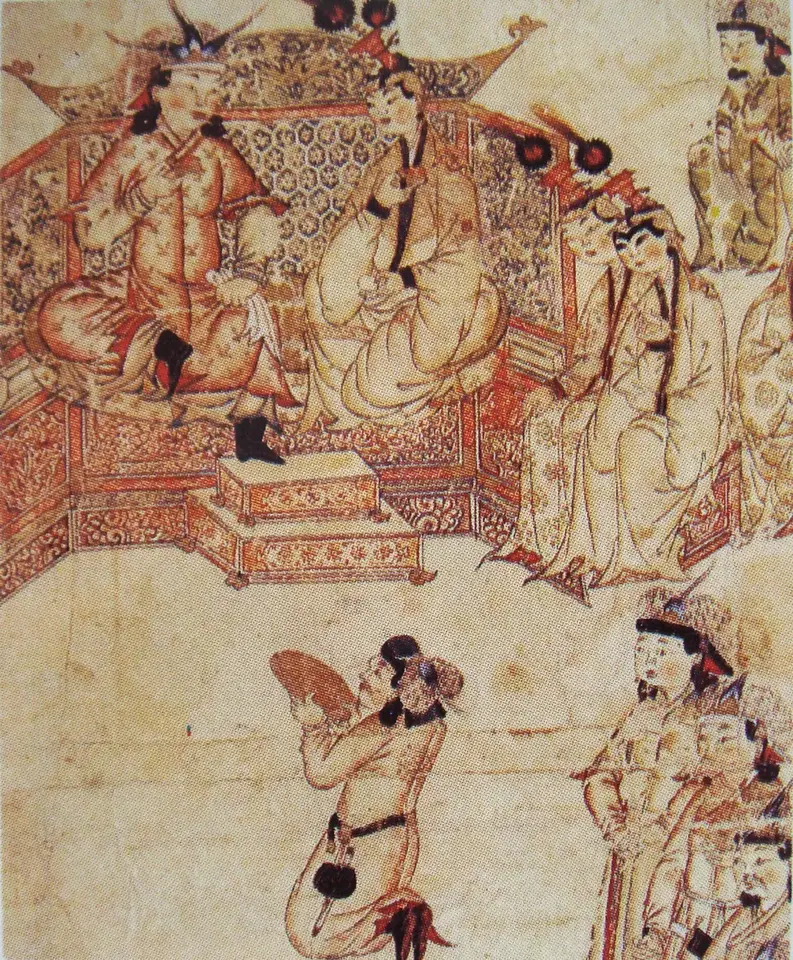
1271 CE–1304 CE
孛儿只斤·合赞
Borjigin Ghazan (孛儿只斤·合赞, November 30, 1271 – May 17, 1304), a sixth-generation direct descendant of Genghis Khan, eldest son of the fourth Ilkhan Arghun, and grandson of Abaqa Khan, was the seventh ruler of the Ilkhanate (伊利汗国). Born at Abaskun along the southeastern shore of the Caspian Sea, he displayed extraordinary precocity from childhood and was raised by Bulughan Khatun, consort of Abaqa Khan. Endowed with remarkable…
Borjigin Ghazan (孛儿只斤·合赞, November 30, 1271 – May 17, 1304), a sixth-generation direct descendant of Genghis Khan, eldest son of the fourth Ilkhan Arghun, and grandson of Abaqa Khan, was the seventh ruler of the Ilkhanate (伊利汗国). Born at Abaskun along the southeastern shore of the Caspian Sea, he displayed extraordinary precocity from childhood and was raised by Bulughan Khatun, consort of Abaqa Khan. Endowed with remarkable linguistic gifts, he mastered Mongolian, Arabic, Persian, and other languages, while studying astronomy, medicine, crafts, and Mongolian ancestral lore. In his youth, his father appointed him governor of the frontier provinces of Khorasan and Mazandaran, where he protected the borders and practiced Buddhism. In 1295, when the fifth Ilkhan Gaykhatu was murdered and Baydu seized the throne, Ghazan marched west to claim the crown with the support of the military commander Nawruz. To secure the political backing of Persian Muslim elites and the general population, Ghazan publicly converted to Sunni Islam in the Lar valley on June 19, 1295, adopting the Muslim name Mahmud and the title of Sultan; he defeated and executed Baydu in October and ascended the throne on November 3, 1295, making Islam the state religion and prompting over 100,000 Mongol soldiers and nobles to convert. Throughout his reign, Ghazan maintained loyal diplomatic ties with the Yuan Dynasty as nominal suzerain, dispatching tribute to Temür Khan (Emperor Chengzong of Yuan), who recognized his accession and Islamic conversion while granting him silk revenues from ancestral appanages in North China. During his nine-year reign, Ghazan appointed the eminent scholar Rashid al-Din as vizier and enacted the transformative "Ghazan Reforms." He abolished corrupt tax-farming in favor of fixed and unified land taxes, curbed arbitrary postal courier requisitions, instituted the military land grant (iqta) system, unified weights and measures, issued standardized gold and silver coinage bearing Quranic verses and his royal name, restored extensive canal networks to revitalize agriculture, and established Islamic courts across the realm. A generous patron of scholarship and science, he built mosques, madrasas, and a grand observatory, and commissioned Rashid al-Din to compile the monumental world history Jami al-Tawarikh (Compendium of Chronicles). He died of illness on May 17, 1304, at the age of thirty-four, having stabilized the Ilkhanate at the zenith of its power.
Born on November 30 at Abaskun southeast of the Caspian Sea as the eldest son of Arghun.
Hunted with his grandfather Abaqa Khan at age eight and received education in languages, riding, and crafts under Bulughan Khatun.
Assigned by his newly enthroned father Arghun to govern Khorasan, Mazandaran, and Qumis.
Rose against Baydu in spring; converted to Islam as Mahmud in the Lar valley on June 19, executed Baydu in October, and ascended the throne as the seventh Ilkhan on November 3.
Dispatched envoys to Dadu; Emperor Chengzong formally confirmed his royal title and recognized his Islamic policy.
Appointed Rashid al-Din as vizier, initiating comprehensive fiscal, legal, and agrarian reforms across the Ilkhanate.
Invaded Syria against the Mamluk Sultanate, capturing Damascus after winning the Battle of Wadi al-Khazandar.
Ordered Rashid al-Din to compile the definitive imperial history Jami al-Tawarikh, dictating Mongolian oral genealogies himself.
Died of illness on May 17 at age thirty-four; succeeded by his younger brother Öljaitü.
Borjigin Ghazan was born on November 30, 1271 (the 8th year of the Zhiyuan reign of Kublai Khan) at Abaskun along the southeastern shore of the Caspian Sea, the eldest son of Arghun Khan. From infancy he exhibited remarkable precocity. His grandfather Abaqa Khan, hearing of his sharp intellect, summoned the child to the royal court at Tabriz, placing him under the care of his favored consort Bulughan Khatun.
Raised in Abaqa Khan's royal household, Ghazan received an intensive education in courtly and martial arts. An enthusiastic student and superb horseman, he took part in imperial hunts alongside his grandfather at the age of eight. Beyond fluency in the Mongolian and Uyghur scripts, he learned Arabic, Persian, and Hindi, and acquired knowledge of Tibetan and Chinese. He possessed an extraordinary memory for Mongolian clan genealogies, customs, and court history, while demonstrating keen curiosity in astronomy, pharmacology, chemistry, crafts, and mineralogy, frequently surprising court artisans with novel technical designs.
When his father Arghun ascended the throne in 1284, he entrusted thirteen-year-old Ghazan with the governance of his former appanage in Khorasan, Mazandaran, Rayy, and Qumis. During his years in Khorasan, Ghazan patronized Buddhist monasteries and engaged in theological discussions with monks. At the same time, he actively defended the northeastern frontier against cross-border incursions by the Chaghatai and Ögedeid princes Duwa and Sarban, forging a seasoned military reputation among his troops.
In March 1295, dynastic strife erupted when the fifth Ilkhan Gaykhatu was assassinated and his cousin Baydu seized the throne. Stationed in Khorasan, Ghazan resolved to avenge Gaykhatu and marched west. In the ensuing struggle, he allied with the influential military commander Nawruz. Recognizing that sustainable rule over Persia required bridging the gulf between the ruling Mongol nomadic minority and the predominantly Muslim population, Ghazan made a momentous decision.
On June 19, 1295, in the Lar valley, Ghazan underwent a formal conversion to Sunni Islam, adopting the Muslim name Mahmud and the title of Sultan. He then mandated that his royal retinue, military commanders, and over 100,000 Mongol troops accept the Islamic faith. This historic conversion rallied Persian Muslim elites, bureaucrats, and commoners to his banner. In October 1295 Ghazan defeated Baydu's forces and executed him; on November 3, 1295, he was enthroned at Tabriz as the seventh Ilkhan.
Following his accession, Ghazan preserved diplomatic allegiance to the Yuan Dynasty as the nominal central authority of the Mongol world empire. He sent periodic embassies bearing precious gems and tribute to Emperor Chengzong (Temür Khan) in Dadu. In return, Emperor Chengzong confirmed Ghazan's royal title and his adoption of Islam, granting him an official seal of office and assigning him the silk revenues from Hulagu's ancestral estates in Zhangde Route (modern Anyang, Henan).
Inheriting a state plagued by factional strife, empty treasuries, extortionate nomadic lords, and a ruined peasantry, Ghazan launched far-reaching reforms in 1298, appointing the scholar-physician Rashid al-Din as vizier.
In taxation and finance, Ghazan abolished the predatory practice of tax-farming (qabchur), which had devastated agricultural communities through arbitrary assessments. He conducted a kingdom-wide land and population survey, establishing fixed, uniform tax rates and scheduled collection dates to eliminate extortion. To relieve commoners living along major thoroughfares, he curtailed the abusive requisition privileges of imperial couriers (yam), closing redundant post stations and funding travel expenses from the central treasury. In agriculture, he provided state loans and tax exemptions to reclaim abandoned farmland, repaired underground irrigation channels (qanats) and river dikes across Mesopotamia and Iran, and institutionalized the iqta military land-grant system, allocating state-owned plots to soldiers to guarantee their sustenance while prohibiting officers from dispossessing peasant cultivators.
In commerce and currency, Ghazan standardized coinage throughout the Ilkhanate, issuing uniform gold dinars and silver dirhams bearing Quranic verses alongside his royal name, and made the weights and measures of Tabriz the sole legal standard for the empire. In law, he codified Islamic jurisprudence (sharia) to supersede customary Mongol tribal law, establishing an appellate court in Tabriz and stationing certified judges (qadis) across all provinces to adjudicate civil and criminal matters impartially. These coordinated reforms restored fiscal stability, revived rural productivity, and inaugurated the golden age of the Ilkhanate.
Ghazan combined administrative vigor with lavish cultural patronage. Outside Tabriz he built the magnificent "Ghazaniyya" suburban complex, centering around his prospective mausoleum and encompassing Friday mosques, madrasas, hospitals, academies, and a monumental domed observatory where Persian, Arab, and East Asian scholars collaborated.
Recognizing the danger of his people losing their cultural roots, Ghazan commissioned Rashid al-Din around 1302 to compile an exhaustive history of the Mongols and the civilized world. Ghazan personally dictated oral genealogies, ancestral tales, and confidential court archives to the compilation team. Completed under his successor, this masterpiece became the celebrated Jami al-Tawarikh (Compendium of Chronicles).
Abroad, Ghazan sought to wrest control of Syria and the eastern Mediterranean trade routes from the Mamluk Sultanate of Egypt, launching major expeditions in 1299, 1300, and 1303. In December 1299 he crushed the Mamluk army at the Battle of Wadi al-Khazandar and briefly occupied Damascus. However, extended supply lines and fierce Mamluk counterattacks prevented permanent annexation. On May 17, 1304, while preparing further administrative measures, Ghazan died of eye ailments and complications at the age of thirty-four. He was succeeded by his younger brother Öljaitü, who maintained his institutional legacy.
FIGURES ASSOCIATED WITH THIS DYNASTY