Birth in the Steppe
Born on the northern Mongolian steppe as the eldest son of Ögedei and grandson of Genghis Khan.
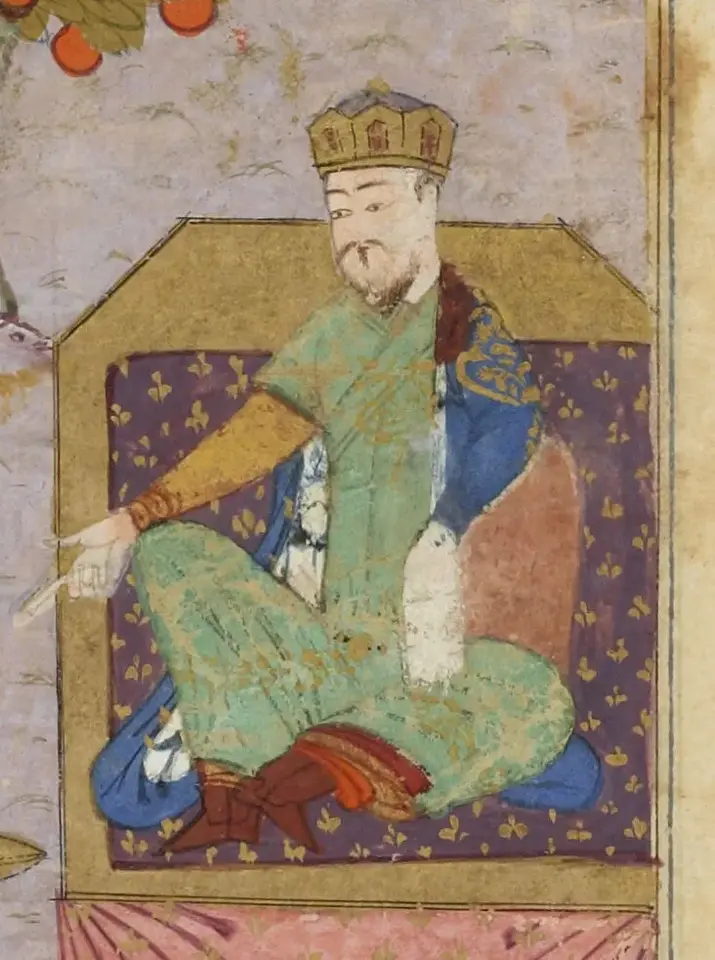
贵由
Güyük (贵由, 1206 – April 20, 1248), also known as Emperor Dingzong of Yuan, was the third Great Khan of the Mongol Empire (reigned 1246–1248). He was the eldest son of Ögedei Khan (Emperor Taizong of Yuan) and Empress Töregene (Empress Zhaoci), as well as a grandson of Genghis Khan. During his youth, Güyük campaigned in Liaodong, capturing Puxian Wannu, the ruler of the Eastern Xia kingdom. In 1235, he participated in the…
Güyük (贵由, 1206 – April 20, 1248), also known as Emperor Dingzong of Yuan, was the third Great Khan of the Mongol Empire (reigned 1246–1248). He was the eldest son of Ögedei Khan (Emperor Taizong of Yuan) and Empress Töregene (Empress Zhaoci), as well as a grandson of Genghis Khan. During his youth, Güyük campaigned in Liaodong, capturing Puxian Wannu, the ruler of the Eastern Xia kingdom. In 1235, he participated in the monumental Princes' Western Expedition, subduing the Kipchaks, Asud, and Rus principalities, taking the formidable citadel of Maghas and projecting Mongol power into the Caucasus and Eastern Europe. Following Ögedei Khan's unexpected demise in 1241, Empress Töregene exercised regency for five years, actively maneuvering to secure her eldest son's succession. In August 1246, Güyük was elected Great Khan at the grand Kurultai convened at Dalan Daba near Karakorum. After assuming personal rule, Güyük executed the corrupt merchant Abd al-Rahman, reinstated seasoned statesmen Zhenhai and Mahmud Yalavach to restore governance and fiscal administration, and facilitated the historic submission of Tibetan leader Sakya Pandita, formally integrating Tibet into the imperial administrative framework. Long estranged from Batu Khan, Güyük launched a western military expedition in 1247 under the pretext of recuperation, but died suddenly at Hengxiangyi'er in March 1248 at the age of forty-three. He was posthumously honored as Emperor Dingzong by Kublai Khan in 1266.
Born on the northern Mongolian steppe as the eldest son of Ögedei and grandson of Genghis Khan.
Followed Prince Anqidai into Liaodong, capturing Jurchen warlord Puxian Wannu and subduing Eastern Xia.
Joined Batu and Möngke in the grand Western Expedition of imperial eldest sons against the Kipchaks and Rus.
Led an elite force across the Caucasus Mountains to storm and capture the mountain fortress of Maghas.
Recalled eastward by Ögedei following personal friction with supreme commander Batu and the khan's illness.
Ögedei Khan died during a hunting expedition; Empress Töregene assumed regency to engineer Güyük's elevation.
Elected Great Khan at the Kurultai of Dalan Daba with broad support from imperial princes and dignitaries.
Supported the Liangzhou Alliance, receiving the allegiance of Sakya Pandita and integrating Tibet into the empire.
Died abruptly at Hengxiangyi'er while leading an army westward to confront Batu, buried at Yemi'li.
Borjigin Güyük was born in 1206, the seminal year when his grandfather Temüjin unified the nomadic tribes to establish the Great Mongol State as Genghis Khan. Güyük was the eldest son of Ögedei, the third son of Genghis Khan, and his mother was Töregene Khatun (Empress Zhaoci), Ögedei's sixth consort from the Naiman tribe. The name Güyük in the Mongolian tongue signified one who runs or swift. Reared on horseback in the steppe nomadic tradition, Güyük developed a reserved and resolute demeanor, though he was afflicted from youth with chronic joint stiffness in his hands and feet. Upon attaining adulthood, he followed customary imperial practice by entering active military service.
In 1233 (the fifth year of Ögedei's reign), Güyük was commissioned by his father to accompany imperial prince Anqidai on an expedition to Liaodong against the Jurchen secessionist regime of Eastern Xia. The Mongol cavalry executed a swift river crossing and launched an unexpected offensive. Güyük fought bravely on the frontline, coordinating closely with senior commanders to breach Eastern Xia fortresses and capture its ruler, Puxian Wannu, effectively terminating Jurchen resistance across the Liao River basin. This initial military triumph earned Güyük substantial acclaim among the Borjigin royal lineage, establishing his reputation within the imperial high command.
In 1235, Ögedei Khan convened an imperial Kurultai at Karakorum, determining that because the Kipchaks, Asud, and Rus principalities remained unsubdued, a continental military campaign should be launched, known as the Princes' Western Expedition. The supreme command was entrusted to Batu, the second son of Jochi, while every imperial branch dispatched its eldest sons to participate. Güyük and his cousin Möngke led their respective contingents westward. Deep within the Pontic-Caspian steppe and Eastern Europe, Güyük and Möngke directed a mountain corps across the rugged Caucasus, subjugating the Asud and storming their formidable mountain capital of Maghas in 1239, spreading his military renown into Central Europe.
However, during the prolonged campaign, acute personal friction developed between Güyük and supreme commander Batu over strategic jurisdiction and banqueting precedence. Batu asserted his authority as the elder commander of the entire expedition, whereas Güyük, conscious of his status as the reigning khan's eldest son, refused to yield precedence. The conflict escalated into heated altercations that created deep animosity. Upon receiving reports of this discord, Ögedei sent a severe rebuke to Güyük for insubordination, relieving him of frontline command. In the winter of 1240, as Ögedei fell ill, Güyük obeyed imperial orders to depart from the western campaign and journey back to the Mongolian heartland.
In November 1241, Ögedei Khan died suddenly during a hunting excursion fueled by heavy drinking. While alive, Ögedei had favored his third son Kochu as heir, and following Kochu's death in southern campaigns against Song, he designated Kochu's son Shiremun as prospective successor; however, his sudden demise prevented the promulgation of a formal testament. Senior minister Yelü Chucai argued vigorously for honoring Ögedei's known intention by elevating young Shiremun. Nevertheless, Empress Töregene was determined to enthrone her eldest son Güyük, assuming regency under the pretext that Shiremun was too young and Güyük had not yet returned, holding supreme authority for five years.
During her regency, Empress Töregene distributed vast treasury reserves as private gifts to imperial princes and high officials, forging political alliances to smooth Güyük's path to the throne while eroding imperial institutional discipline. Exploiting the interregnum, Genghis Khan's youngest brother, Temüge Otchigin, assembled his private cavalry and marched toward Karakorum to seize the supreme khanate. Fortunately, Güyük arrived at his ancestral appanage of Yemi'li and rode with armed guards to Karakorum, deterring Temüge Otchigin through military intimidation and successfully neutralizing the coup attempt.
In August 1246, Empress Töregene convened a grand Kurultai at Dalan Daba near Karakorum to formalize the royal succession. Deeply distrusting Güyük, western campaign leader Batu feigned illness and boycotted the assembly, sending his younger brother Berke as his representative. Having secured extensive support through imperial largesse, the assembled princes and ministers unanimously proclaimed Güyük the new Great Khan. After an initial ritual display of reluctance, Güyük accepted the throne on the condition that the imperial succession remain perpetually within his own lineage. The gathered nobility swore solemn oaths of compliance, and Güyük formally ascended the throne.
Güyük's enthronement was celebrated on an unprecedented scale, attended by Chinese civil officials, the crown prince of Goryeo, envoys from Islamic states, and Friar John of Plano Carpini, who arrived as an ambassador from Pope Innocent IV. Several months after the festivities, Empress Töregene died, enabling the forty-year-old Güyük to exercise personal rule. He immediately arrested and executed the Central Asian merchant Abd al-Rahman, who had exploited the empress dowager's favor to engage in widespread corruption, restoring bureaucratic discipline and legal authority to the central court.
To stabilize administrative governance, Güyük reappointed the venerable imperial advisor Zhenhai to direct central state affairs, revived the authority of the supreme judges, and assigned seasoned administrator Mahmud Yalavach to manage census registration and fiscal revenues in northern China. Furthermore, Güyük ordered General Chahan to advance against Song positions along the Huai River and dispatched Eljigidey to lead western expeditions in the Middle East. However, Güyük's delicate physical constitution, compounded by chronic joint ailments and an indulgence in alcohol, hindered his ability to heal the deep structural divisions fracturing the Borjigin ruling house.
During Güyük's reign, the Mongol Empire achieved a historic geopolitical milestone through the formal incorporation of the Tibetan plateau into the imperial realm. Prince Köden, stationed as regional commander in Liangzhou, summoned the prominent Tibetan religious leader Sakya Pandita Kunga Gyaltsen to Liangzhou between 1246 and 1247 to conduct the momentous Liangzhou Talks. Both sides reached a comprehensive consensus governing political allegiance, military security, and fiscal tribute, inaugurating the incorporation of Tibet into the unified Chinese state.
Following these negotiations, Sakya Pandita issued his celebrated Epistle to the Tibetans, describing the immense power of the Mongol Empire and the benevolent authority of Great Khan Güyük, urging Tibetan religious and secular elites to submit peacefully. Tibetan leaders responded affirmatively, presenting letters of submission, offering hostages, and agreeing to administrative appointments, census registration, and taxation. The Tibetan plateau was thus formally incorporated into the administrative domain of the Great Mongol State, constituting the most enduring administrative legacy of Güyük's reign.
Despite these territorial and administrative successes, the factional hostility between Güyük and Batu of the Golden Horde rapidly pushed the empire toward civil war. Güyük harbored intense resentment over Batu's refusal to attend his coronation, while Batu, firmly entrenched in the Kipchak steppe, acted with increasing autonomy. In the autumn of 1247, Güyük announced an imperial progress to his appanage of Yemi'li for climatic recuperation, while covertly mobilizing veteran steppe cavalry to launch a surprise attack against Batu's headquarters on the Volga River.
Sorghaghtani Beki, the politically astute widow of Tolui, discerned Güyük's hostile intentions and dispatched confidential messengers to alert Batu. Forewarned, Batu mobilized his cavalry divisions and established a fortified defensive perimeter along his frontier. In March 1248, as Güyük's army reached Hengxiangyi'er (near the upper Ulungur River in present-day Emin County, Xinjiang), the khan's physical ailments were aggravated by arduous travel, leading to his sudden death in his military pavilion at forty-three years of age. His reign lasted only one year and eight months, and he was laid to rest at Yemi'li.
In his youth, Güyük distinguished himself through notable military achievements. In 1233, he participated in the expedition to Liaodong, defeating Eastern Xia forces and capturing its ruler Puxian Wannu, thereby securing the northeastern borderlands. In 1235, he took part in the Princes' Western Expedition alongside Batu and Möngke, campaigning across the Kipchak steppe, leading an assault through the Caucasus, and capturing the mountain stronghold of Maghas, demonstrating impressive cavalry command and siege expertise.
Navigating the succession crisis following Ögedei Khan's unexpected demise, Güyük relied upon Empress Töregene's regency and his own military stature to thwart the coup attempt led by his granduncle Temüge Otchigin. In 1246, at the Kurultai of Dalan Daba, he secured unanimous election from the assembled princes, completing his transition from frontline commander to the supreme ruler of the Mongol Empire.
Upon assuming personal rule, Güyük purged the corrupt merchant Abd al-Rahman, who had dominated court affairs under his mother's regency, revitalizing central judicial integrity. He reappointed respected elder statesman Zhenhai and fiscal expert Mahmud Yalavach to reorganize census records and tax systems in northern China, restoring regular administrative functioning across imperial territories.
During Güyük's reign, the imperial court supported Prince Köden in conducting the Liangzhou Talks with Tibetan leader Sakya Pandita, successfully bringing the Tibetan plateau into peaceful submission. Through the issuance of the Epistle to the Tibetans and the establishment of administrative and fiscal mechanisms, Tibet was formally incorporated into the imperial domain, establishing the historical foundation for the Xuanzheng Yuan administration under the Yuan dynasty.
| Relationship Type | Name | Identity and Historical Connection |
|---|---|---|
| Primary Consort and Successor | Oghul Qaimish | Empress Qinshu; assumed regency for three years following Güyük's death before being executed in succession struggles. |
| Cousin and Chief Rival | Borjigin Batu | Eldest surviving son of Jochi, founder of the Golden Horde; engaged in prolonged rivalry with Güyük. |
| Cousin | Borjigin Möngke | Eldest son of Tolui, Emperor Xianzong of Yuan; campaigned with Güyük in the West and succeeded to the khanate in 1251. |
| Senior Advisor | Zhenhai | Right Chancellor and senior statesman; reappointed by Güyük to direct central imperial administration. |
| Fiscal Administrator | Mahmud Yalavach | Senior minister of Central Asian descent; appointed by Güyük to oversee tax administration and household registration in Han territories. |
Song Lian recorded in the History of Yuan: "Emperor Dingzong's accession followed the regency of the empress dowager, during which administrative directives lacked unity; upon ascending the throne, he introduced order, but his reign was brief and his achievements remained incomplete." This evaluation reflects Güyük's success in curbing internal corruption and reappointing capable statesmen, while noting that his early death prevented long-term institutional consolidation. Persian historian Ata-Malik Juvayni observed in the History of the World Conqueror that Güyük was strict in enforcing law and generous in distributing rewards, while also recounting the tragedy of internal strife within the golden lineage. Güyük's reign stands as a crucial pivot in Mongol history, marking the shift from outward expansion toward internal succession contests among Genghisid branches.
FIGURES ASSOCIATED WITH THIS DYNASTY