Noble Descent
Born in Jiexiu, Fenzhou; demonstrated remarkable childhood intellect through the legendary floating ball in the tree cavity.
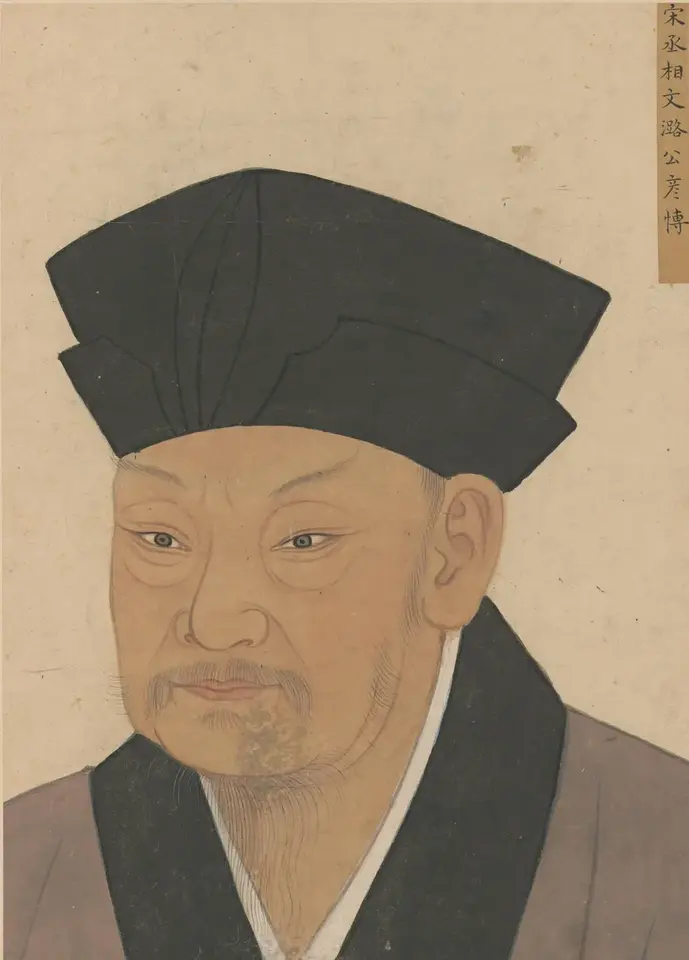
文彦博
Wen Yanbo (文彦博, 1006–1097), courtesy name Kuanfu, art name Yisou and popularly revered as the Duke of Lu, was a native of Jiexiu in Fenzhou (modern Jiexiu, Shanxi). He was a paramount grand chancellor, military strategist, and master calligrapher of the Northern Song dynasty, serving four successive emperors across a five-decade career. His family originally bore the surname Jing, changing it twice to avoid the taboo…
Wen Yanbo (文彦博, 1006–1097), courtesy name Kuanfu, art name Yisou and popularly revered as the Duke of Lu, was a native of Jiexiu in Fenzhou (modern Jiexiu, Shanxi). He was a paramount grand chancellor, military strategist, and master calligrapher of the Northern Song dynasty, serving four successive emperors across a five-decade career. His family originally bore the surname Jing, changing it twice to avoid the taboo names of Later Jin founding emperor Shi Jingtang and Song imperial ancestor Zhao Jing. In 1027, Wen Yanbo passed the imperial examinations as a Jinshi, serving with distinction as Magistrate of Yicheng, Vice Prefect of Jiangzhou, and Palace Censor. During the Qingli era, he restored mountain supply routes as Fiscal Commissioner in Hedong to repel Western Xia incursions and pacified popular unrest as Prefect of Yizhou (Chengdu). In 1047, when military officer Wang Ze launched a dangerous religious insurrection in Beizhou, imperial forces were repeatedly repulsed. Wen Yanbo volunteered to direct operations, employing covert subterranean tunneling to infiltrate and capture the fortress within a month. Promoted to Joint Manager of Affairs with the Secretariat-Chancellery (Grand Chancellor) at forty-three, he tackled the crippling fiscal burdens of the state by courageously demobilizing over eighty thousand superfluous soldiers. During his second chancellorship in 1055, he preserved dynastic equilibrium when Emperor Renzong fell gravely ill, ensuring the peaceful elevation of Emperor Yingzong. Under Emperor Shenzong, Wen Yanbo directed the Bureau of Military Affairs, vehemently opposing Wang Anshi's New Policies and famously declaring in imperial audience that the dynasty ruled in partnership with scholar-officials, not with the commoners alone. Retiring to Luoyang as Grand Preceptor, he founded the celebrated Luoyang Elders Society alongside Fu Bi and Sima Guang, creating an enduring cultural ideal of scholarly fellowship. When Emperor Zhezong ascended the throne under the regency of Grand Empress Dowager Gao in 1086, Wen Yanbo was recalled at eighty-one as Commissioner of Military and State Affairs to lead the Yuanyou Restoration. He passed away at the age of ninety-two, was posthumously honored with the prestigious name Zhonglie, and was later enshrined in the Temple of Past Dynastic Emperors under the Qing dynasty.
Born in Jiexiu, Fenzhou; demonstrated remarkable childhood intellect through the legendary floating ball in the tree cavity.
Passed the imperial examination as a Jinshi; served as Magistrate of Yicheng and Vice Prefect of Jiangzhou with judicial acumen.
Promoted to Palace Censor, gaining widespread renown for fearless memorials impeaching corrupt court dignitaries.
Appointed Fiscal Commissioner of Hedong, repairing hundreds of miles of mountain roads to supply troops against Western Xia.
Appointed Prefect of Yizhou (Chengdu), executing corrupt mutineers, repairing Dujiangyan weirs, and stabilizing southwestern administration.
Directed imperial armies to crush Wang Ze's rebellion in Beizhou through tunnel assault; elevated to Grand Chancellor at forty-three.
Spearheaded the demobilization of over eighty thousand superfluous imperial soldiers, saving vast state treasury reserves.
Resigned from the chancellorship following factional slanders and remonstrances, departing to govern Xuzhou and Daming.
Reappointed Grand Chancellor alongside Fu Bi; decisively guarded palace security and stabilized the state during Emperor Renzong's critical illness.
Appointed Commissioner of Military Affairs; openly opposed Wang Anshi's Green Sprouts and Market Trade laws in front of Emperor Shenzong.
Resigned from the Bureau of Military Affairs due to policy irreconcilability, departing to govern Heyang and Daming.
Retired to Luoyang as Grand Preceptor; organized thirteen eminent senior scholars into the celebrated Luoyang Elders Society.
Recalled by Grand Empress Dowager Gao at eighty-one as Commissioner of Military and State Affairs to direct the Yuanyou Restoration.
Re-submitted retirement memorials and returned to Luoyang, enjoying universal public reverence.
Demoted to Junior Guardian of the Heir Apparent under the revived New Policies faction; died peacefully at ninety-two, posthumously named Zhonglie.
Wen Yanbo, courtesy name Kuanfu, native of Jiexiu in Fenzhou, was born in the third year of Emperor Zhenzong's Jingde reign (1006). His ancestral lineage originated from the ancient Jing clan of the Han and Wei dynasties. During the Later Jin period of the Five Dynasties, the family altered their surname to Wen to avoid the naming taboo of founding monarch Shi Jingtang. Following the foundation of the Song dynasty, to avoid the taboo of imperial ancestor Zhao Jing, the family permanently retained the surname Wen and settled in Fenzhou, becoming one of the most prominent noble clans of northern China. His grandfather Wen Yu served as Editorial Assistant, while his father Wen Ji reached Department Director in the Ministry of Punishments, posthumously elevated to Duke of Qi.
Wen Yanbo exhibited extraordinary intellect and dignified composure from earliest childhood. A widely celebrated historical anecdote records that while playing in a garden courtyard with local children, a leather ball accidentally fell into a deep tree hollow. The hollow was so narrow and profound that the children could not reach it, dissolving into anxious tears. The young Wen Yanbo calmly carried jars of water and poured them into the tree cavity. As the water level steadily rose, the leather ball floated safely to the surface. This ingenious demonstration of hydraulic buoyancy was documented in ancient pedagogical texts, celebrated as a classic paradigm of childhood resourcefulness.
Under strict family tutelage, Wen Yanbo immersed himself in canonical texts and dynastic histories, developing profound mastery over the Classic of Changes, the Zuo Zhuan, and historical administrative jurisprudence. Blessed with a tall, imposing physical stature and authoritative presence, he conducted himself with natural decorum and emotional restraint, foreshadowing his future greatness as a premier pillar of the state.
In 1027, at the young age of twenty-two, Wen Yanbo passed the provincial and metropolitan examinations with high honors, obtaining the prestigious Jinshi degree. His initial appointment was Magistrate of Yicheng in Jiangzhou. Yicheng was situated in a rugged mountainous district where local society was fractious and tax burdens were severely skewed toward the poor. Upon assuming office, Wen Yanbo personally inspected cadastral records, uncovered unregistered arable lands concealed by influential magnates, and equalized corvee duties, allowing impoverished farming families to regain economic stability.
He was subsequently promoted to Vice Prefect of Jiangzhou. A protracted theft case had lingered in the yamen archives for years; the previous magistrate had subjected several suspects to severe torture until they yielded false confessions, yet the stolen gold could never be recovered. Reviewing the case files, Wen Yanbo discovered glaring contradictions between the confessions and the physical construction of the robbed mansion during that night's weather. He ordered the suspects freed from their chains and launched covert investigations across the border, successfully arresting the actual thieves and recovering the hidden gold within days. The innocent were exonerated, and grateful townspeople acclaimed him as an enlightened magistrate.
During the early Jingyou era, when the imperial government evaluated provincial governance records across all circuits, Wen Yanbo was summoned to the capital and promoted to Assistant in the Court of Judicial Review, earning praise from censorate leaders for his incorruptible legal administration.
In 1037, Wen Yanbo was elevated to Palace Censor. Within the Censorate, he established a formidable reputation for uncompromising integrity. When Western Xia ruler Li Yuanhao began encroaching upon the northwestern frontier while leading grand chancellors succumbed to passive appeasement, Wen Yanbo submitted comprehensive memorials detailing the decay of military readiness, openly rebuking senior ministers for negligence.
In 1040, Western Xia forces launched a massive invasion against Yanzhou, plunging the northwestern frontier into acute crisis. Recognizing Wen Yanbo's strategic competence, Emperor Renzong appointed him Fiscal Commissioner of the Hedong Circuit, placing him in sole charge of military logistics along the strategic Shaanxi-Shanxi perimeter. The rugged mountain corridors linking Jiangzhou and Weisheng to border outposts in Yanan and Linzhou had collapsed from years of neglect, leaving grain transports stranded and frontline garrisons facing starvation.
Wen Yanbo rode across the precipitous mountain ranges in person to survey alternative bypasses. He mobilized local labor forces and military construction battalions, completely repairing and widening hundreds of miles of mountain road networks within months. He established relay grain depots and purchased autumn wheat across southern Shanxi, transporting hundreds of thousands of bushels of grain directly to frontier strongholds. Observing that Song defenses were impregnable and logistical lines unbroken, Western Xia cavalry withdrew without invading Hedong, preserving the territorial integrity of Shanxi.
During the Qingli era, Wen Yanbo was made Academician of the Bureau of Military Affairs and Prefect of Yizhou (Chengdu). As the political and cultural capital of the southwest, Chengdu suffered from burdensome tax surcharges inherited from the Five Dynasties, while local garrisons had grown insolent and corrupt. Arriving in Chengdu, Wen Yanbo executed the ringleaders of a pending garrison mutiny to reassert military discipline, abolished illegal administrative levies, and personally supervised annual repairs of the Dujiangyan waterworks and Jinjiang riverbanks. The Chengdu plain enjoyed bumper harvests, and grateful local residents erected an ancestral shrine in his honor outside the Qingyang Temple.
In the winter of 1047, a catastrophic military insurrection erupted in Beizhou (modern Qinghe, Hebei), led by garrison officer Wang Ze. Wang Ze had infiltrated the Xuanxi troops, using clandestine religious societies to mobilize soldiers, murdering Prefect Zhang Deyi, occupying the fortified city, and proclaiming himself Prince of Dongping. Beizhou boasted colossal walls and deep moats, and imperial forces commanded by senior generals were repeatedly routed with heavy casualties during months of futile assaults.
As anxiety engulfed the court in Kaifeng, Wen Yanbo, then serving as Assistant Commissioner of Military Affairs, stepped forward to volunteer: "Beizhou is merely a few days' march from the imperial capital. If the spring floods arrive, the entire northern plain will collapse. I request permission to lead the expeditionary force, pledging my life to eradicate the rebels!" Emperor Renzong granted him the title of Pacification Commissioner of Hebei with supreme command and the Sword of State.
Arriving outside Beizhou in January 1048, Wen Yanbo surveyed the terrain, noting that the northern perimeter was dry and firm, while the southern marshlands had swallowed previous assaults. He ordered heavy trebuchets and scaling ladders erected on the east and west, bombarding the ramparts day and night to fix rebel attention. Concurrently, he secretly organized specialized engineering teams to excavate subterranean tunnels from the north straight under the city foundations.
When the tunnels were completed, Wen Yanbo dispatched hundreds of elite shock troops armed with short blades to infiltrate the fortress in the dead of night. The shock troops surfaced inside, set fire to rebel headquarters, slew gatekeepers, and opened the northern gates to the imperial army. Surprised from within and overwhelmed from without, the insurgent army disintegrated, and Wang Ze was captured alive to be executed in Kaifeng. Having annihilated the insurrection within a month, Wen Yanbo was elevated to Joint Manager of Affairs with the Secretariat-Chancellery, entering the grand chancellorship at the young age of forty-three.
In the summer of 1048, Wen Yanbo formally assumed the duties of Grand Chancellor. Following the suspension of the Qingli Reforms, the empire suffered from the chronic diseases of redundant officials, redundant soldiers, and redundant expenditures. Extended mobilization along northern borders had expanded imperial armies to nearly 1.4 million men, consuming the vast majority of dynastic tax revenues.
Wen Yanbo made military demobilization his highest administrative priority. While timid councilors feared soldier mutinies, Wen Yanbo devised an equitable demobilization framework: aging and physically incapable soldiers were provided generous retirement bonuses and land grants to return to farming; competent veterans were consolidated into professional combat corps; and vacant rosters were eliminated.
Under his decisive execution, the court demobilized over eighty thousand redundant soldiers within a single year without provoking the slightest civil disturbance, saving millions of strings of state treasury allocations annually. Scholar-officials universally acclaimed his statesmanship. In 1051, when censors accused him of having presented a golden crown to the late Concubine Zhang in earlier years, Wen Yanbo stepped down with unruffled dignity, departing to administer Xuzhou and Daming.
In 1055, Emperor Renzong recalled Wen Yanbo to the capital as Grand Academician of the Zhaowen Institute and Grand Chancellor, governing harmoniously alongside Fu Bi. The pair governed with supreme mutual trust, and contemporaries praised them as the model ministerial partnership.
In the spring of 1056, Emperor Renzong collapsed from sudden vertigo during a court audience, lapsing into unconsciousness. With palace eunuchs meddling and rumors of imperial succession crises spreading panic through Kaifeng, Wen Yanbo took command with imperturbable dignity. He and Fu Bi remained inside the palace day and night, locking inner palace gates, establishing round-the-clock guards patrols, and calming court anxiety.
Wen Yanbo personally supervised imperial medication at the sovereign's bedside while issuing calming decrees. When Emperor Renzong regained consciousness and found public order untarnished, he took Wen Yanbo's hand and expressed profound gratitude for preserving the dynasty. Furthermore, Wen Yanbo urged the heirless emperor to formally designate Zhao Shu (Emperor Yingzong) as crown prince, permanently eliminating succession turbulence. During Emperor Yingzong's reign, Wen Yanbo was promoted and assigned to govern Henan (Luoyang).
In 1069, Emperor Shenzong appointed Wen Yanbo Commissioner of Military Affairs. Confronting Wang Anshi's sweeping New Policies, Wen Yanbo steadfastly defended traditional Confucian governance against aggressive state commercialization.
During court audiences, when Emperor Shenzong asserted that ancestral institutions had to change with the times, Wen Yanbo famously replied: "The dynasty rules the empire in partnership with scholar-officials, not with the commoners alone!" This statement became the defining constitutional declaration of the Song scholar-official class, warning the monarch against undermining social cohesion for fiscal extraction.
Wen Yanbo openly exposed the predatory nature of the Market Trade and Green Sprouts laws, demonstrating that state monopolies impoverished urban traders and peasants. Recognizing that his differences with the throne were irreconcilable, Wen Yanbo submitted multiple retirement memorials, being reassigned to govern Heyang and Daming. In 1083, having reached seventy-seven years of age, he retired to Luoyang as Grand Preceptor.
Living in retirement in Luoyang, Wen Yanbo cultivated gardens and patronized scholarly gatherings alongside prominent statesmen such as Fu Bi, Sima Guang, and Cheng Hao.
In the winter of 1083, emulating the ancient Nine Elders gathering of Tang poet Bai Juyi, Wen Yanbo founded the celebrated Luoyang Elders Society. Inviting thirteen venerable scholars—including Fu Bi (aged eighty), Sima Guang (sixty-five), and Neo-Confucian master Cheng Hao—the group met regularly for poetry, philosophy, and wine.
The society enforced a radical egalitarian code: seating was determined solely by age rather than aristocratic or bureaucratic rank; food was plain; theatrical music was banned in favor of philosophical conversation; and wine was limited to five rounds to foster longevity. When these white-haired elder statesmen rode together through Luoyang streets, thousands of citizens lined the avenues in celebratory reverence. Wen Yanbo commissioned the Painting of the Luoyang Elders Society, establishing an enduring cultural ideal of refined scholarly retirement.
In 1085, Emperor Shenzong died, and the ten-year-old Emperor Zhezong ascended the throne under the regency of Grand Empress Dowager Gao. Committed to reversing the New Policies, Grand Empress Dowager Gao appointed Sima Guang chancellor and summoned the eighty-one-year-old Wen Yanbo back to the capital.
In 1086, Wen Yanbo was bestowed the supreme office of Commissioner of Military and State Affairs, with the special privilege of attending court only once every six days and sitting without prostrating. Collaborating with Sima Guang and Lu Gongzhu, he repealed oppressive New Policies regulations, rehabilitated purged officials, and solidified frontier peace with Western Xia and the Liao dynasty. Liao envoys who witnessed the vigorous octogenarian statesman marveled openly, hailing him as a transcendent figure of the age.
In 1090, having reached eighty-five years of age, Wen Yanbo retired permanently to Luoyang with rich imperial gifts. However, when Emperor Zhezong assumed direct rule after Grand Empress Dowager Gao's death in 1093, radical New Policies ministers led by Zhang Dun launched vindictive political purges against the Yuanyou faction. In 1097, the court demoted the ninety-two-year-old Wen Yanbo to Junior Guardian of the Heir Apparent.
Bearing his demotion with untroubled equanimity, Wen Yanbo passed away peacefully in Luoyang in May 1097 at ninety-two. A master of vigorous Yan Zhenqing-style calligraphy, his surviving San Zha Juan remains a national treasure, and his collected writings were preserved in the forty-volume Wen Lu Gong Ji. Emperor Huizong subsequently exonerated his name, restored his rank as Grand Preceptor, and granted the glorious posthumous title Zhonglie. In 1722, the Qing dynasty enshrined him in the Temple of Past Dynastic Emperors.
The Beizhou insurrection of 1047 posed an acute threat to the capital, as rebel forces held an impregnable walled stronghold and repelled imperial forces for months.
Stepping forward in the crisis, Wen Yanbo bypassed futile frontal ladder assaults, devising an ingenious subterranean strategy. While staging diversionary bombardments on the eastern and western battlements, he excavated covert tunnels beneath the northern walls, infiltrating shock troops who seized the gates from within.
His decisive operational maneuver extinguished the dangerous revolt within a single month, restoring peace to the northern plains and establishing his reputation as an exceptional military and civil statesman.
During the middle of the Renzong reign, long-standing border wars inflated imperial armed forces to 1.4 million men, exhausting state revenues.
Upon assuming the chancellorship in 1048, Wen Yanbo boldly enacted comprehensive army reductions. To prevent mutinies, he established generous retirement bonuses, provided agricultural land, and merged hollow units into effective combat formations.
He peacefully demobilized over eighty thousand redundant soldiers in one year, saving vast sums of treasury funds annually while maintaining flawless military discipline, providing an enduring model of military reform.
When Emperor Renzong suffered sudden unconsciousness in 1056, court rumors and palace intrigues threatened the dynasty with succession chaos.
Wen Yanbo guarded the palace day and night, sealing outer gates and suppressing unauthorized communications with majestic authority. His steady vigilance prevented palace coups, while his foresight in securing Zhao Shu's elevation as Emperor Yingzong ensured the unbroken continuity of the imperial lineage.
During the heated debates of the Xining era, Wen Yanbo stood as the foremost intellectual defender of traditional Confucian governance.
Challenging state economic monopolies under the Market Trade and Green Sprouts laws, he articulated the fundamental constitutional principle that the dynasty governed in partnership with the scholar-official class. His principled opposition safeguarded social cohesion against state extortion, earning universal admiration from dynastic historians.
Retiring to Luoyang, Wen Yanbo led the golden age of Northern Song elite culture by establishing the Luoyang Elders Society.
Uniting figures such as Fu Bi, Sima Guang, and Cheng Hao, the society discarded bureaucratic hierarchy in favor of age and moral virtue, celebrating plain living, philosophical dialogue, and poetic composition. The gathering provided a healing retreat from intense factional strife, immortalized in art as the supreme manifestation of Confucian scholarly fellowship.
FIGURES ASSOCIATED WITH THIS DYNASTY