Serving in the Imperial Medical Office
Appointed Erudite of the Imperial Medical Office, supervising medical education and official examinations.
巢元方
Chao Yuanfang (巢元方), whose dates of birth and death remain unrecorded, was a preeminent physician of the Sui dynasty who served as Erudite of the Imperial Medical Office and Director of the Imperial Medical Office during the Daye era (605–618 CE). Following the reunification of China, the Sui dynasty established the Imperial Medical Office (Taiyi Shu), the earliest documented state-administered medical academy, and…
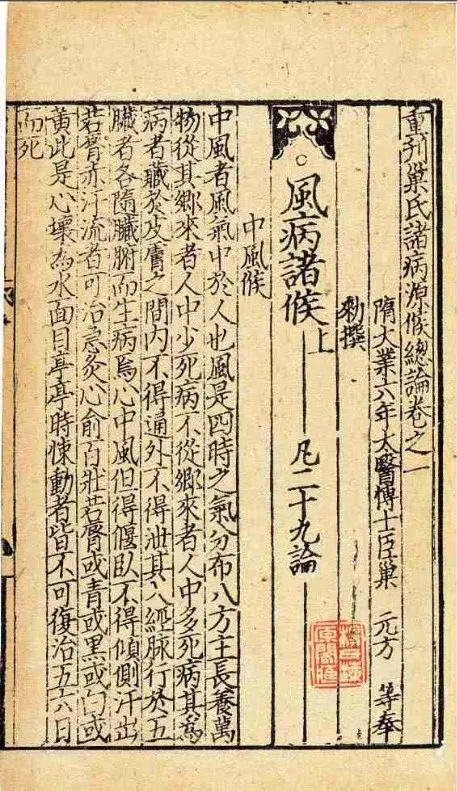
Chao Yuanfang (巢元方), whose dates of birth and death remain unrecorded, was a preeminent physician of the Sui dynasty who served as Erudite of the Imperial Medical Office and Director of the Imperial Medical Office during the Daye era (605–618 CE). Following the reunification of China, the Sui dynasty established the Imperial Medical Office (Taiyi Shu), the earliest documented state-administered medical academy, and systematically collated medical literature across the realm. In 610 CE, Emperor Yang of Sui issued an imperial decree ordering Chao Yuanfang to direct the compilation of a comprehensive treatise on disease mechanisms. Leading medical academicians and distinguished practitioners, Chao Yuanfang synthesized centuries of clinical observations and earlier literature to produce the monumental fifty-volume Treatise on the Origin and Symptoms of Diseases (Zhubing Yuanhou Lun, also known as Chao's Source of Diseases). Comprising 67 categories and 1,739 clinical discourses, it stands as the earliest specialized medical text in world history devoted systematically to disease etiology, pathology, and clinical symptomatology. The work made historic breakthroughs in epidemiology, parasitic infections (such as schistosomiasis and scrub typhus), allergic dermatitis, surgical debridement, intestinal anastomosis, and physical therapeutic exercises (daoyin). Chao Yuanfang's systematic contributions established Chinese pathology as an autonomous discipline, earning him veneration as the founding father of Chinese disease etiology.
Appointed Erudite of the Imperial Medical Office, supervising medical education and official examinations.
Promoted to Director of the Imperial Medical Office; successfully cured Grand Canal Director Ma Shumou of acute wind inversion disorder.
Commissioned by Emperor Yang of Sui to head the imperial compilation of the Treatise on the Origin and Symptoms of Diseases.
Completed the fifty-volume Treatise on the Origin and Symptoms of Diseases, promulgated nationwide as the standard textbook for state medical training.
Eminent physician and Director of the Imperial Medical Office of the Sui dynasty, founding pioneer of traditional Chinese etiology and symptomatology, who led the compilation of China's first specialized treatise on disease etiology, the Zhubing Yuanhou Lun.
Chao Yuanfang flourished from the late Northern and Southern dynasties into the Sui dynasty. Following centuries of political division, the reunified Sui state established the Imperial Medical Office, instituting specialized faculties in internal medicine, acupuncture, massage manipulation, and incantation therapy alongside rigorous academic examinations for practicing physicians.
Mastering fundamental classical treatises including the Yellow Emperor's Inner Classic (Huangdi Neijing), the Classic of Difficult Issues (Nanjing), and the Treatise on Cold Damage and Miscellaneous Diseases (Shanghan Zabing Lun), Chao Yuanfang achieved renown across clinical branches. In the early Daye era, he entered imperial service as Erudite of the Imperial Medical Office, instructing medical students in diagnostic principles. Recognized for his profound clinical acumen and administrative skill, he rose to become Director of the Imperial Medical Office, the supreme state officer overseeing public health and imperial medical policy.
Although dynastic standard histories omitted an independent biographical chapter for medical practitioners, contemporaneous and Song dynasty historical sketches recorded Chao Yuanfang's exceptional clinical mastery. According to the Song chronicle Kaihe Ji (Records of Canal Excavation), in August of 609 CE during the excavation of the Tongji Canal and Jiangnan Canal, Director-General Ma Shumou collapsed from severe exhaustion and acute wind inversion disorder, suffering from violent abdominal convulsions and rigid paralysis that baffled court physicians.
Emperor Yang dispatched Chao Yuanfang to diagnose and treat the imperial supervisor. Performing a meticulous examination of the patient's arterial pulses and pathological roots, Chao identified the illness as severe wind-cold-damp invasion of the bodily meridians caused by chronic overexertion. Administering targeted acupuncture, therapeutic manipulation, and meridian-warming decoctions, he restored Ma Shumou to complete health. This dramatic recovery solidified Chao Yuanfang's undisputed clinical authority within the central imperial administration.
While the Sui court had assembled the vast 2,600-volume prescription compendium Prescriptions Categorized from Across the Four Seas (Sihai Leiju Fang), contemporary medical practice still lacked a rigorous theoretical foundation explaining why illnesses originated and evolved. In 610 CE, Emperor Yang promulgated a decree commanding Chao Yuanfang to organize the compilation of an authoritative pathological treatise.
Assembling dozens of clinical masters across faculties, Chao reviewed centuries of clinical archives. He established a distinctive methodology: focusing exclusively on the underlying origins and clinical syndromes of diseases while intentionally omitting specific pharmacological formulas, thereby forcing physicians to comprehend pathological causality rather than rotely matching prescriptions. Spanning fifty volumes, 67 categories, and 1,739 analytical discourses, the resulting Treatise on the Origin and Symptoms of Diseases became the world's first state-sponsored pathological encyclopedia.
Upon its completion, the Treatise on the Origin and Symptoms of Diseases was officially promulgated throughout the empire and incorporated as the foundational textbook for the imperial medical examination system. The subsequent Tang dynasty retained this institutional standard, mandating that all aspiring court physicians be tested on Chao's treatise. The work resolved historical ambiguities surrounding disease classification and established systematic pathological diagnostics across East Asia.
Prior to Chao Yuanfang, Chinese medical writings mixed etiology, diagnostics, prescription formulas, and acupuncture indiscriminately. Chao's Treatise on the Origin and Symptoms of Diseases systematically organized human afflictions across internal medicine, surgery, gynecology, pediatrics, ophthalmology, dermatology, and infectious epidemics. By analyzing the pathological etiology (yuan) followed by symptomatic progressions (hou), Chao constructed the first rigorous clinical taxonomy in Chinese medical history.
Chao Yuanfang provided astonishingly accurate epidemiological descriptions of parasitic and vector-borne infections. Describing schistosomiasis (historically termed water poison, shegong, or stream poison), he accurately pinpointed endemic regions in southern river basins and marshlands, noting that larvae dwelled in water during summer and infected humans wading or bathing during spring and autumn. He even invented an early diagnostic technique, immersing patients in warm water infused with crushed garlic to observe characteristic erythematous skin markings.
Regarding scrub typhus (sand lice infection), Chao observed that microscopic parasites residing in damp foliage penetrated human skin, proposing thermal fumigation to cause the mites to detach and even describing an early immunizing salve made from dried crushed lice and musk. He demonstrated that scabies resulted from microscopic mites burrowing under the epidermal layers, noting that curing the condition required extracting and destroying the mites. Furthermore, he identified that tapeworm infections (cunbaichong) derived from ingesting raw or undercooked beef, raw fish, and contaminated milk, pioneering foodborne parasitic epidemiology centuries ahead of European science.
In immunological pathology, Chao Yuanfang's analysis of lacquer dermatitis (qichuang) offered a revolutionary understanding of contact hypersensitivity. He observed that while many workers handled raw lacquer daily without adverse reactions, certain individuals developed immediate facial itching, cutaneous erythema, and spreading pustules upon slight contact. Chao explicitly attributed this phenomenon to individual constitutional disparities and congenital susceptibility, providing one of the earliest documented recognitions of contact allergic reactivity in world medicine.
Chao Yuanfang dismantled deep-seated societal misconceptions regarding fertility by asserting that childlessness did not rest solely with women. He documented that male infertility stemmed from deficient, cold, or absent seminal ejaculation, introducing objective pathological criteria to reproductive health. In female reproductive medicine, he analyzed organic causes including pelvic wind-cold, menstrual irregularities, abdominal tumors, and uterine prolapse. For pediatrics, he detailed the pathogenesis of neonatal tetanus (umbilical ulceration) and infantile epilepsy, establishing scientific foundations for specialized pediatric care.
In cardiovascular medicine, Chao introduced acute diagnostic distinctions regarding true heart pain (zhen xintong). He observed that damage penetrating the primary channel of the heart caused lethal cardiac arrest within hours ("morning onset leading to evening death"), whereas afflictions confined to collateral arterial branches provoked recurrent, non-fatal thoracic spasms. By correlating clinical prognosis with the anatomical scale of vascular damage, he demonstrated profound insight into cardiovascular pathology.
In surgical trauma, Chao recorded astonishingly advanced surgical procedures in his discourse on intestinal rupture from sharp weapon trauma. He documented a standardized protocol: thoroughly cleaning the prolapsed bowel with warm water, ligating damaged arterial vessels of necrotic omentum before resection, aligning severed intestinal ends, and suturing the bowel wall with natural raw silk threads. He enforced strict postoperative dietary management, permitting only thin rice water before gradually resuming solid food after one hundred days. This comprehensive methodology established principles of debridement, hemostasis, anastomosis, and nutritional convalescence in the early 7th century.
Emphasizing preventive healthcare and holistic bodily regulation, Chao appended therapeutic exercise regimens (daoyin) to every discourse. He compiled physical stretching exercises, guided respiration, and therapeutic massage techniques to invigorate meridian circulation and prevent chronic stagnation. Additionally, he highlighted the vital connection between emotional distress and visceral dysfunction, while identifying routine post-meal rinsing and teeth cleaning as essential practices to prevent gingival decay and maintain dental longevity.
FIGURES ASSOCIATED WITH THIS DYNASTY