Birth into the Langye Wang Aristocracy
Born in Kuaiji as the seventh son of Wang Xizhi; began calligraphic training at age seven, astonishing his father.
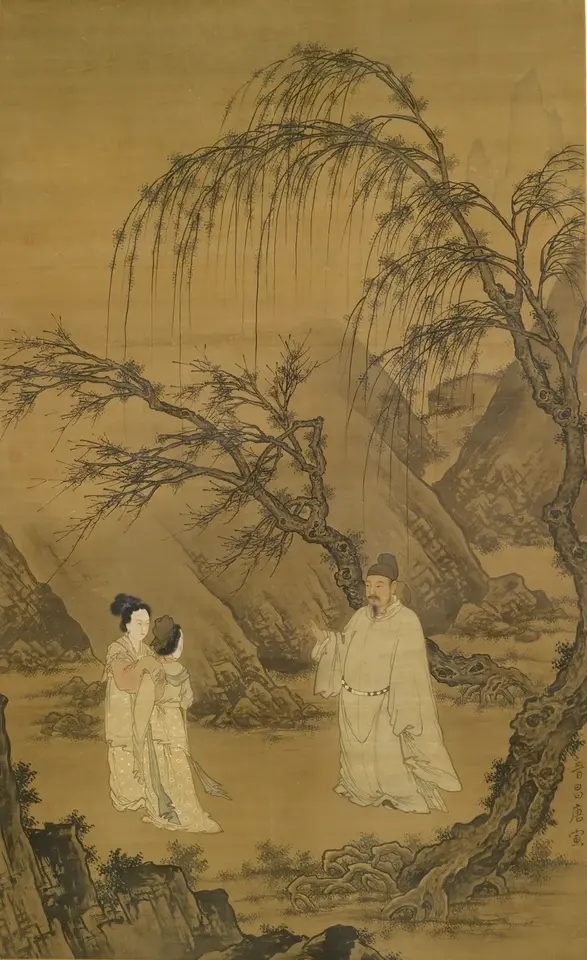
王献之
Wang Xianzhi (王献之; 344–386), courtesy name Zijing, was a native of Linyi, Langye (modern Shandong Province). He was an illustrious calligrapher, master poet, and essayist of the Eastern Jin Dynasty, standing alongside his father, the Sage of Calligraphy Wang Xizhi, as one of the legendary "Two Wangs." In subsequent centuries, he was celebrated with the honorific titles "Little Wang" and "Wang Daling" (reflecting his senior…
Wang Xianzhi (王献之; 344–386), courtesy name Zijing, was a native of Linyi, Langye (modern Shandong Province). He was an illustrious calligrapher, master poet, and essayist of the Eastern Jin Dynasty, standing alongside his father, the Sage of Calligraphy Wang Xizhi, as one of the legendary "Two Wangs." In subsequent centuries, he was celebrated with the honorific titles "Little Wang" and "Wang Daling" (reflecting his senior ministerial office). Inheriting the domestic artistic tradition of the noble Langye Wang clan, Wang Xianzhi exhibited precocious calligraphic genius under his father's tutelage. Rather than merely imitating parental models, he boldly synthesized the seal-clerical archaic forms of Zhong Yao and Zhang Zhi with dynamic cursive vigor, innovating the "broken script" (poti) and the cursive "one-brush writing" (yibishu). Throughout the Eastern Jin and the Southern Dynasties (Song, Qi, and early Liang), his fluid, expansive style held empire-wide sway, with contemporary masters often ranking him above his father. His surviving masterpieces, including the Duck Head Pill Letter (Yatouwan Tie), Mid-Autumn Letter (Zhongqiu Tie), and the exquisite standard regular script of the Ode to the Goddess of the Luo River in Thirteen Lines (Luoshenfu Shisan Hang), remain eternal paragons of Chinese calligraphic art. In his political career, Wang served as Gentleman of the Secretariat, Senior Clerk to the Minister over the Masses, Grand Administrator of Wuxing, and ultimately Director of the Secretariat (Zhongshu Ling). Renowned for unyielding composure and romantic detachment, he embodied the quintessential aesthetic ethos of the Wei-Jin literati spirit. His deep romantic devotion to his first wife and cousin Chi Daomao ended in tragic sorrow when imperial edicts coerced him to divorce her to wed Princess Xin'an. He passed away in Jiankang in 386 at the age of forty-three, having laid the stylistic foundations that inspired wild cursive calligraphy across the Tang and Song dynasties.
Born in Kuaiji as the seventh son of Wang Xizhi; began calligraphic training at age seven, astonishing his father.
At age ten, participated in the celebrated Orchid Pavilion gathering at Kuaiji, absorbing literati elegance.
Entered bureaucratic service as Commandery Registrar, marrying his beloved cousin Chi Daomao; later appointed Gentleman of the Secretariat.
Coerced by imperial decree to divorce Chi Daomao to wed Princess Xin'an; intentionally scorched his own feet to resist the union to no avail.
Appointed Grand Administrator of Wuxing, governing with benevolence; perfected his revolutionary "one-brush writing" in his leisure.
Recalled to the capital to serve as Director of the Secretariat, supervising imperial decrees; popularly honored as Wang Daling.
Fell mortally ill; when a Daoist asked for his deathbed regrets, lamented only his divorce from Chi Daomao, passing away in the ninth lunar month.
Wang Xianzhi was born in 344 in Shanyin, Kuaiji Commandery (modern Shaoxing, Zhejiang Province). The Langye Wang clan was the premier aristocratic family of the Eastern Jin, sharing imperial authority with the Sima dynasty. His father Wang Xizhi served as General of the Right and Internal Administrator of Kuaiji, revered across generations as the "Sage of Calligraphy." His mother Chi Xuan originated from the elite Gaoping Chi clan and was renowned for her own calligraphic elegance. Among Xizhi's sons, Xianzhi was the seventh and intellectually the most gifted.
From the age of seven, Xianzhi pursued rigorous calligraphic training under his father's watchful eye. Legend recounts that the youth exhausted eighteen massive ceramic basins of water to grind ink. On one occasion, Xizhi crept up behind the boy while he was practicing, attempting to snatch the brush from his hand; finding Xianzhi's grip immovable, the master sighed with delight: "This child will certainly achieve immense fame!" On another occasion, Xianzhi proudly presented a newly composed character to his father; Xizhi added a single dot to the character for "great" to form the character for "supreme." When Xianzhi showed the work to his mother, she remarked: "After years of practice, only this single dot resembles your father's brushwork!" Humbled, Xianzhi renounced complacency, dedicating himself to ceaseless mastery.
In 353 (Yonghe 9), at age ten, Xianzhi accompanied his father and elder brothers to the historic Orchid Pavilion gathering at Mount Kuaiji. Although the boy failed to compose a verse during the winding-creek drinking game and was penalized three goblets of wine, the transcendent literati spirit of the assembly permanently shaped his creative worldview.
Reaching adulthood, Wang Xianzhi possessed striking physical beauty, refined composure, and unyielding independence, epitomizing the Wei-Jin aesthetic ethos. He entered imperial service during the Taihe era, serving as Commandery Registrar, Gentleman of the Secretariat, and Senior Clerk to the Minister over the Masses.
During this period, Grand Marshal Huan Wen dominated the imperial court with dictatorial authority. Huan Wen summoned Xianzhi to court, presenting a fine silk fan and requesting a calligraphic inscription; Xianzhi composed a spontaneous masterpiece with effortless speed, earning the general's admiration. Later, when Huan Wen constructed a palatial palace in Jiankang, he sought a grand plaque inscribed by Xianzhi, instructing Chancellor Xie An to convey the imperial commission.
Xianzhi flatly refused, reminding Xie An: "In ancient times, when the Lingyun Tower of Cao Wei was completed, Emperor Ming ordered Wei Dan to scale a hanging cradle to inscribe the beam; Wei Dan's hair turned white with terror. Cao Cao subsequently decreed that no scholar should ever be subjected to such humiliation. Does Your Excellency wish to emulate Cao Wei's tyranny?" Astounded and embarrassed by Xianzhi's moral rebuke, Xie An abandoned the request. Xianzhi's courageous defense of scholarly dignity resonated across the empire.
In his youth, Wang Xianzhi married his maternal cousin Chi Daomao, daughter of his uncle Chi Tan. Endowed with grace, literary refinement, and deep devotion, Chi Daomao shared an idyllic marriage with Xianzhi. The couple exchanged poems and shared artistic pursuits, celebrated throughout Jiangnan as an ideal match.
However, this blissful marriage was destroyed by imperial interference. Following the death of Emperor Jianwen, his daughter Princess Xin'an (Sima Daofu), formerly married to Huan Wen's disgraced son Huan Ji, became an imperial widow. Long infatuated with Xianzhi's dazzling talent and physical grace, the princess petitioned Emperor Xiaowu and the Grand Empress Dowager to command Xianzhi to wed her. The throne issued an autocratic decree ordering Xianzhi to divorce Chi Daomao immediately.
Devastated by this tyrannical demand, Xianzhi sought desperately to sabotage the union. He gathered moxa herbs and scorched his own feet until the flesh festered, leaving him permanently lame, hoping to claim physical disability. However, the imperial house remained ruthless, dispatching imperial guards to expel Chi Daomao from the estate.
Forced back to her paternal household, Chi Daomao resolved never to remarry, dying shortly thereafter of heartbroken grief. Coerced into an unwanted imperial marriage, Xianzhi spent his remaining years consumed by crushing guilt and sorrow. His surviving calligraphic fragments frequently contain anguish-ridden laments, mourning his betrayal of Chi Daomao as the defining tragedy of his mortal life.
Seeking refuge from court sycophancy and domestic grief, Wang Xianzhi petitioned for provincial assignment. In 379 (Taiyuan 4), at age thirty-six, he was appointed General of Inspiring Might and Grand Administrator of Wuxing (modern Huzhou, Zhejiang Province).
In Wuxing, Xianzhi proved an enlightened and benevolent magistrate. He streamlined administrative regulations, abolished excessive labor burdens, rectified judicial miscarriages, and protected peasant households. During his leisure along Lake Tai, he channeled his profound inner melancholy into calligraphic experimentation.
During his Wuxing administration, Xianzhi's calligraphy attained its transcendent zenith. Rejecting the rigid detachment of archaic draft cursive and the restrained composure of his father's running script, he eliminated the boundaries between running and cursive styles. Moving his brush across long silk rolls with breathtaking velocity, he allowed the concluding stroke of one character to generate the opening stroke of the next, uniting multiple characters into an unbroken, swirling river of ink. This revolutionary creation, known as "one-brush writing" (yibishu), ignited intense enthusiasm among connoisseurs, who competed to acquire letters dispatched from his administrative yamen.
In 384 (Taiyuan 9), following the Eastern Jin victory at the Battle of Fei River, Emperor Xiaowu and Chancellor Xie An recalled Xianzhi to the capital, elevating him to Director of the Secretariat (Zhongshu Ling). Supervising the drafting of imperial edicts and confidential military affairs, he was universally honored by contemporaries as "Wang Daling."
Throughout his tenure in the Secretariat, Xianzhi's daily conduct exemplified transcendent literati detachment. On one occasion, while sleeping alone in his study, several burglars broke into the chamber, ransacking chests. Xianzhi watched quietly from his bed. As the thieves were wrapping up his last possession—a cherished green woolen blanket—Xianzhi spoke with serene courtesy from behind the bedcurtain: "Good thieves, that green blanket is an ancient heirloom of my clan; pray leave it behind!" Terrified by his unruffled majesty, the burglars dropped their plunder and fled into the night.
On another occasion, while sitting with his brother Wang Huizhi, a fire suddenly erupted in the outer chambers, sending flames roaring through the roof. Huizhi panicked, fleeing barefoot into the courtyard; Xianzhi remained calmly seated, adjusted his robes, and walked slowly outward supported by his attendants. Xie An praised him, remarking: "Daling's composure and dignity demonstrate the true capacity of a grand chancellor!"
However, chronic foot ailments, grueling administrative burdens, and the unhealed psychological trauma of his separation from Chi Daomao rapidly destroyed Xianzhi's constitution. In autumn 386 (Taiyuan 11), the forty-three-year-old statesman fell critically ill.
Believing in the Heavenly Master Dao tradition, his family summoned a Daoist priest to perform the ritual ascent of petitionary talismans. According to the liturgy, the dying petitioner was required to confess his lifetime sins and deepest regrets. The priest asked: "Does the Master recall any lifetime transgressions to confess?" Weeping uncontrollably, the dying Xianzhi whispered his final words: "I recall no other deeds, save only my divorce from the Chi family!"
In the ninth lunar month of 386, Wang Xianzhi passed away in Jiankang at the age of forty-three. When his brother Wang Huizhi received the news, he rushed to the funeral chamber without shoes. Sitting upon Xianzhi's bed, Huizhi took up Xianzhi's beloved zither to play, but the strings snapped under his sorrowful touch. Hurling the instrument to the floor, Huizhi cried aloud: "Zijing, Zijing, person and zither are both lost!" Within a month, Huizhi died of grief, immortalizing the phrase "person and zither are both lost" (renqin juwang) as an eternal metaphor for fraternal devotion.
Wang Xianzhi's paramount contribution to the history of Chinese art was his creation of the "broken script" (poti) and cursive "one-brush writing" (yibishu). This innovation completed the historic transition from ancient constrained calligraphy to the liberated momentum of modern cursive forms.
Dissatisfied with the restrained detachment of his father's compositions, which preserved archaic traces of Han-Wei clerical script, Xianzhi combined the weight of clerical script, the fluency of running script, and the velocity of cursive script. He introduced dynamic vertical connections, allowing characters to link continuously across multiple lines like a dragon soaring through clouds. In Shuduan, Tang critic Zhang Huaiguan lauded: "Zijing created one-brush writing; its structural tension is astonishing, flowing like a roaring river that cannot be dammed." Xianzhi's stylistic revolution directly laid the path for the wild cursive (kuangcao) art of Tang masters Zhang Xu and Huai Su.
In calligraphic history, Wang Xianzhi and his father Wang Xizhi are celebrated as the "Two Wangs," representing the dual summits of classical Chinese calligraphy.
Throughout the century following Xianzhi's demise—spanning the Liu Song, Southern Qi, and early Southern Liang dynasties—Xianzhi's artistic prestige completely eclipsed that of his father among Jiangnan aristocrats. Emperors Song Mingdi and Qi Gaodi exclusively collected Xianzhi's handscrolls, and contemporary scholars revered his style as transcendent and divine, criticizing Xizhi's compositions as overly rigid. Scholar Yu He recorded in his Memorial on Calligraphy: "Across the seas, all scholars vied to emulate Zijing; Wang Youjun's fame was nearly eclipsed." Only when Emperor Wu of Liang systematically promoted Xizhi to align with Confucian orthodoxy did the reputations of the Two Wangs balance into equal majesty.
Xianzhi's mastery extended beyond cursive script into the highest realm of small regular script (xiaokai). His supreme masterpiece, the Ode to the Goddess of the Luo River in Thirteen Lines (Luoshenfu Shisan Hang, preserved in jade engravings), stands as an unexcelled landmark of Chinese regular script.
In this work, Xianzhi eliminated the residual clerical flavor of Three Kingdoms script, introducing delicate vertical tilts and expansive internal balance. His brushwork combines resilient bone structure with ethereal fluidity, resembling silk spun by celestial silkworms. Ming and Qing masters, including Dong Qichang, revered this work as the ultimate model for regular script, praising its characters as immortal beings floating gracefully through the void.
Wang Xianzhi's extant letters and calligraphic rubbings have been cherished as priceless national treasures across dynasties. His Duck Head Pill Letter (Yatouwan Tie), preserved in the Shanghai Museum, is an extraordinarily rare genuine Eastern Jin ink-on-silk masterpiece displaying miraculous ink gradations from saturated moisture to dry friction.
His cursive masterpiece Mid-Autumn Letter (Zhongqiu Tie), housed in the Palace Museum in Beijing, was enshrined alongside Wang Xizhi's Timely Clear Snow Letter and Wang Xun's Letter to Boyuan by the Qianlong Emperor in the Hall of the Three Rarities (Sanxitang). Other celebrated rubbings, including Dihuangtang Tie, Ershijiuri Tie, and Dongshan Tie, display incomparable vitality, establishing eternal benchmarks for stroke technique and compositional aesthetics.
Beyond his artistic accomplishments, Wang Xianzhi stood as a moral exemplar of literati independence amid a corrupt aristocratic society.
Confronting military dictator Huan Wen, he refused to inscribe the new palace to defend scholar-official dignity. Confronting imperial coerced remarriage, he scorched his own feet to fight for marital loyalty. Confronting nighttime thieves, he displayed serene detachment to disarm greed. Confronting raging house fires, he adjusted his robes with majestic dignity. By harmonizing calligraphic freedom with moral fortitude, Wang Xianzhi elevated Wei-Jin literati elegance from superficial aestheticism into an eternal standard of spiritual nobility.
FIGURES ASSOCIATED WITH THIS DYNASTY