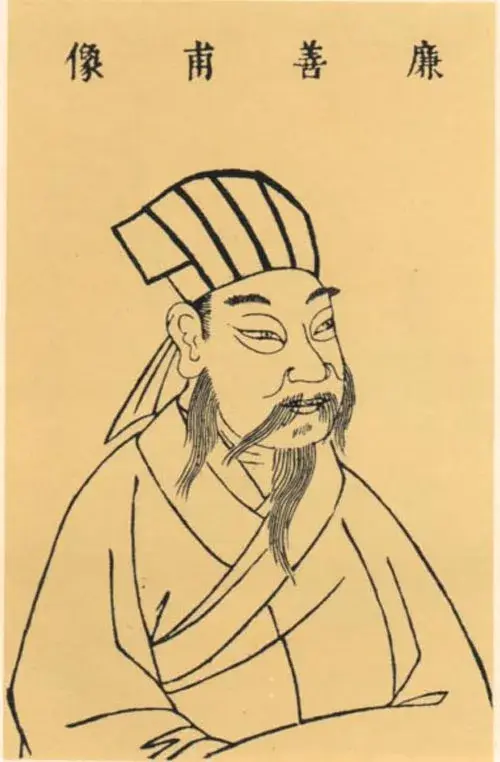
Life and Career
Noble Uyghur Heritage and Mencius Lian
Lian Xixian was born on June 26, 1231 (the 25th day of the fifth lunar month in the third year of Ogedei Khan) in Yanjing (modern Beijing). His family traced its ancestry to the ancient royal Uyghur lineage of Qocho in the Western Regions (modern Turpan, Xinjiang), where his great-grandfather Yarba Bukha and grandfather Qitai Bukha had rendered eminent service to the Uyghur idiq-qut monarchs. His father, Bilge Bukha, submitted to Genghis Khan during the westward expansion of the Mongol Empire and rose through the imperial bureaucracy to become Surveillance Commissioner of Yannan. Taking the Chinese character Lian from his office of surveillance commissioner (lianfanshi), Bilge Bukha adopted Lian as his family name, pioneering the family's deep cultural assimilation. Lian Xixian's mother, Lady Shimo, was descended from the noble consort clan of Western Liao.
From childhood, Lian Xixian displayed an imposing physical stature, dignified deportment, and remarkable intellectual acumen. Although born into a high-ranking Central Asian aristocratic family, his father harbored a profound reverence for Chinese classical civilization. Bilge Bukha invited the celebrated Jin Dynasty literatus and Hanlin scholar Wang E to establish a family academy, where Lian Xixian and other aristocratic youths studied classical canons, historical annals, and Confucian statecraft. Lian Xixian possessed an exceptional memory and absorbed Confucian ethical principles of humaneness and righteousness.
In 1249, at the age of nineteen, Lian Xixian accompanied his father north to the Mongol imperial steppe. Prince Kublai was then actively assembling intellectuals and strategists in his princely tent. Impressed by Lian Xixian's martial poise and elegant discourse, Kublai enlisted him in his royal guard (kheshig). In his spare moments between sentry duties, Lian Xixian read constantly.
One day, while absorbed in the Mencius in a corner of the encampment, he was abruptly summoned to Kublai's presence. Lacking time to set the scroll aside, he slipped it into the breast of his robe. Observing the protruding silk, Kublai asked what he was carrying. Lian Xixian respectfully produced the book and answered that it was the Mencius. When Kublai inquired about its contents, Lian Xixian delivered an eloquent discourse on the inherent goodness of human nature, the moral boundary between righteousness and profit, and the profound contrast between benevolent kingship and tyrannical despotism. Delighted by his political maturity, Kublai praised his erudition and affectionately bestowed upon him the moniker "Mencius Lian." From then on, this sobriquet became celebrated across northern China. Lian Xixian was equally accomplished in archery, once striking the bulls-eye three consecutive times with a heavy composite bow before Kublai, earning universal acclaim as an officer of both civil and military excellence.
Governance in Guanzhong and Patronage of Xu Heng
In 1252, Lian Xixian accompanied Kublai on the expedition against the Kingdom of Dali, participating in operational deliberations and gaining valuable military experience.
In 1254, following the return of imperial armies from the southwest, Mongke Khan allocated the strategic region of Jingzhao (modern Xi'an, Shaanxi) as Kublai's personal appanage. Guanzhong commanded the passes connecting the Central Plains, Sichuan, and the Tibetan frontier, with various Mongol princes holding adjacent fiefs and diverse ethnic populations living interspersed, making it an exceptionally volatile region. Kublai entrusted the administration of this critical territory to the twenty-four-year-old Lian Xixian, appointing him Pacification Commissioner of Jingzhao.
Upon assuming office, Lian Xixian conducted inquiries into popular grievances and enacted reforms. Central Asian merchant consortia had dominated local credit networks, charging predatory usury that compounded principal several times over, forcing impoverished peasant families into bondage. Lian Xixian promulgated an official edict: "Regardless of how many years a loan has endured, debtors shall repay only the original principal plus one standard unit of legal interest; all excess demands are extinguished!" The populace rejoiced at this debt relief. Furthermore, although imperial statutes allowed enslaved Chinese scholars to be ransomed, powerful local military magnates held educated bondservants illegally. Lian Xixian enforced the law, personally inspecting private estates and emancipating over one hundred scholars.
Recognizing that enduring governance depended upon cultivating moral leadership, Lian Xixian recommended master philosopher Xu Heng of Henan to Kublai, urging that Xu Heng be appointed Education Supervisor of Jingzhao. With Lian Xixian's support, Xu Heng established academies, instructing Guanzhong students in classical texts such as the Reflections on Things at Hand and the Four Books. This revived Neo-Confucian studies across northwestern China after decades of war and produced a cadre of civil administrators for the nascent empire.
In 1257, Mongke Khan became suspicious of Kublai's growing popularity and dispatched Alamdar to conduct a hostile financial audit in Guanzhong, dissolving the Jingzhao Pacification Commission. Lian Xixian managed the crisis with composure, stepping down and returning to Kublai's princely camp.
The Succession Crisis and Enlisting the Eastern Princes
In 1259, Mongke Khan led the grand invasion of Sichuan, while Kublai commanded imperial forces attacking Ezhou on the Yangtze River. Lian Xixian served as a senior advisor in Kublai's headquarters. As imperial forces crossed the river to invest Ezhou, Lian Xixian led over one hundred scholars to kneel before Kublai's command tent, petitioning: "The purpose of this crossing is to pacify the realm, not to treat cultivated scholars as plunder. I pray that Your Highness decree that any educated Song subjects captured by our forces be ransomed with state funds and safely repatriated." Kublai granted the request, securing the release of over five hundred southern literati and establishing imperial goodwill.
In July 1259, Mongke Khan died suddenly from injuries at Diaoyu Fortress in Sichuan. Ariq Boke, who had been left in charge of Karakorum, prepared to seize the throne, sending Judge Tolich to forcibly conscript Chinese subjects in Yanjing. Upon receiving the news at Ezhou, Kublai hesitated. Lian Xixian sought a midnight audience and warned: "He who strikes first controls others; he who strikes late is controlled. Heaven's mandate cannot be declined, and the will of the people cannot be spurned. If this moment is lost, no cleverness can recover it!" He submitted his Memorial on Grand Strategy, arguing: "Your Highness is the eldest legitimate grandson of Genghis Khan and the uterine younger brother of the late emperor. You pacified Dali and conquered the south with distinction; you revere the worthy and cherish the common people, winning universal allegiance. The imperial succession belongs rightfully to no one but Your Highness!" Kublai resolved to return north.
To secure the throne, Kublai needed the backing of the powerful eastern princes, headed by Prince Taghachar. Lian Xixian volunteered to undertake this diplomatic mission, riding alone with imperial gifts to Taghachar's camp. Addressing the prince with eloquence, Lian Xixian praised Kublai's virtues and concluded: "The consensus among all ministers is already settled. Your Highness holds the most elevated status among all princes; if you ride posthaste to Kaiping to take the lead in proclaiming the emperor, none can surpass your glory!" Convinced by his arguments, Taghachar pledged his allegiance.
In the spring of 1260, the princely assembly convened at Kaiping. As Ariq Boke lingered in Karakorum, several princes hesitated. Lian Xixian counseled Kublai: "Ariq Boke has held the imperial camp for years. If wicked plotters proclaim him khan and issue an imperial summons, Your Highness will be placed at a fatal disadvantage. If Your Highness ascends the imperial throne first and promulgates an edict, Ariq Boke's refusal to attend will define him as a rebel. Time is urgent; settle the grand design immediately!" Kublai followed this advice and proclaimed himself emperor at Kaiping. Lian Xixian also proposed concluding a truce with the Southern Song, withdrawing frontline troops from the Yangtze, and escorting the Korean crown prince back to his homeland to ensure security on the eastern frontier.
The Liupan Insurgency and Securing the Northwest
Shortly after Kublai's accession, civil war erupted. Intelligence from Shaanxi revealed that Ariq Boke's agents, Liu Taiping and Khoruqai, had infiltrated Jingzhao, seized regional treasuries, and conspired with General Qunduqai, who commanded forty thousand cavalry at Mount Liupan. They plotted a coordinated uprising alongside commanders in Chengdu and Qingju, threatening to sever the empire's northwestern flank.
In April 1260, Kublai dispatched Lian Xixian and Shang Ting as Pacification Commissioner and Vice Commissioner of Shaanxi and Sichuan. Arriving in Jingzhao two days after Liu Taiping, Lian Xixian confronted a divided administration. He assembled civil and military officials, proclaimed Kublai's accession edict, and restored public order. When Qunduqai executed imperial envoys at Mount Liupan and prepared to march on Jingzhao, Lian Xixian acted decisively. He ordered Han commander Liu Heima to arrest Liu Taiping and Khoruqai and threw them into prison. He then dispatched Liu Heima to execute rebel sympathizers in Chengdu, instructed Wang Weizheng to neutralize dissidents at Qingju, and entrusted military tallies and silver seals to Wang Liangchen to lead the regional army against the rebels, opening the public granaries to reward the troops.
When an imperial general amnesty arrived from Kaiping, Lian Xixian recognized that releasing Liu Taiping would reignite rebellion in his rear. He ordered the immediate execution of Liu Taiping and Khoruqai outside the military gates before reading the amnesty decree, subsequently submitting a formal self-impeachment memorial for executing prisoners prior to imperial proclamation. Kublai praised his situational flexibility, issuing an edict validating his actions.
Qunduqai retreated westward from Mount Liupan to Ganzhou, joining forces with Ariq Boke's northern army under Alamdar before mounting a counteroffensive. In August, Kublai elevated the pacification bureau to the Shaanxi-Sichuan Branch Secretariat, naming Lian Xixian Right Vice Administrator. In a decisive desert engagement near Ganzhou fought amidst raging sandstorms, imperial forces led by Prince Qadan and Wang Liangchen routed the combined rebel army, slaying both Alamdar and Qunduqai. With the northwest secure, Lian Xixian enacted humane policies: prohibiting soldiers from plundering displaced Sichuan civilians, banning human trafficking, remitting salt taxes, corresponding with Southern Song commander Yu Jie to ease border tensions, and treating surrendered general Liu Zheng and his captives with generosity.
Central Administration and Resisting Corruption
In the spring of 1261, with the western frontier pacified, Kublai recalled Lian Xixian to the capital and appointed him Manager of Governmental Affairs (Grand Councilor) in the Central Secretariat.
In the central government, Lian Xixian worked to implement civil governance based on Chinese administrative practices. He established regular bureaucratic evaluation procedures to weed out incompetent wartime appointees and advocated abolishing hereditary local offices to strengthen imperial centralization.
In 1268, seeking to curb bureaucratic corruption, Lian Xixian successfully petitioned for the establishment of the Censorate (Yushitai) and regional surveillance inspectorates. Ahmad Fanakati, the powerful Central Asian finance minister, challenged him at court: "Civil affairs belong to the regional routes and finances are managed by transport commissions. Now that your honor has created censorates and surveillance commissions to investigate them, how can officials perform their duties?" Lian Xixian retorted: "The institution of the censorate is an ancient imperial law. Its purpose is to impeach treacherous ministers at court, investigate official misconduct in the provinces, and discern the hardships of the common people. Nothing benefits the state more! If we abandon surveillance, allowing officials high and low to act tyrannically and enrich themselves through corruption, how can the dynastic enterprise endure?" Ahmad was silenced, but harbored deep resentment.
In 1270, after clashing with the emperor during a policy dispute, Lian Xixian was dismissed from the grand council. Soon afterward, he fell seriously ill. Regretting his harshness, Kublai sent three imperial physicians to treat him. The physicians reported that high-grade sugar was required to compound his medicine. As Lian Xixian's household was poor, his family searched the markets in vain. Hearing of this, Ahmad sent two catties of fine imperial sugar to curry favor. Lian Xixian refused the gift, declaring: "Even if this medicine could save my life, I would never preserve my existence through the charity of a wicked flatterer!" Kublai learned of this and dispatched palace attendants to deliver sugar from the imperial stores. In 1274, Kublai reappointed Lian Xixian as Manager of Governmental Affairs of the Beijing Branch Secretariat, where he reorganized military defense across Liaodong.
Pacifying Jingnan and Final Days
In 1275, after imperial armies captured Jiangling from the Southern Song, Kublai urgently summoned Lian Xixian to court and appointed him Pacification Commissioner of Jingnan, granting him discretionary authority to appoint officials ranked third class and below. Although weakened by illness, Lian Xixian traveled south. When Right Vice Administrator Ariha Ya led provincial officials ten li outside Jiangling to receive him, the local populace was deeply impressed.
Upon entering Jiangling, Lian Xixian prohibited looting, encouraged commerce, and enlisted over twenty capable former Southern Song administrators. When these officials presented him with precious curiosities out of gratitude, he refused, warning them: "You are former officials of the Southern Song; now employed by our court, you must repay the imperial grace through diligent service. If I accepted these treasures, it would be unrighteous; if they belong to the state, taking them is theft; if they were extracted from the people, it is a crime! Conduct yourselves with prudence!"
Confronting wartime devastation, Lian Xixian implemented benevolent measures: decreed that slaying captive civilians was equivalent to murder; established medical shelters for abandoned captives, granting them freedom upon recovery; prohibited the sale of wives and children; drained the congested moats of Jiangling to reclaim tens of thousands of mu of fertile farmland for destitute refugees; opened the Shashi granaries to distribute two hundred thousand bushels of grain to relieve famine in Gong'an County; and restored Confucian schools. His governance won over local populations and prompted tribal chieftains of Bozhou and Sizhou, as well as Song commander Zhao Dingying at Chongqing, to surrender voluntarily. Jiangling commoners praised him, remarking: "The emperor sent Chancellor Lian to govern Jingnan; not only the people, but even the plants and insects have received his benevolent grace!"
In 1277, as chronic illness worsened, Lian Xixian was recalled to the capital. Tens of thousands of Jiangling residents wept along the roads, building a living shrine in his honour. Lian Xixian departed with nothing but his zither and books. In 1279, Kublai Khan again placed him in charge of Central Secretariat affairs, but his health was failing. Crown Prince Zhenjin visited his sickbed to seek counsel on statecraft. Lian Xixian wept and advised: "In governing the realm, the sovereign's primary duty is selecting worthy men. Employing gentlemen brings order; relying on petty men brings chaos. My illness is beyond cure, but my deepest dread is that treacherous ministers dominate the court, leading the state to ruin. I pray that Your Highness urge the emperor to purge these flatterers!"
Lian Xixian passed away on the night of December 12, 1280 (the 19th day of the eleventh lunar month in the 17th year of the Zhiyuan era) at the age of fifty. On his deathbed, he exhorted his sons: "My illness cannot be healed; you children must study diligently to uphold your father's ideals!" In 1304, Emperor Chengzong posthumously honoured him as Grand Preceptor, Duke of Wei, and canonized him as Wenzheng. Emperor Renzong later elevated his posthumous title to Prince of Hengyang.