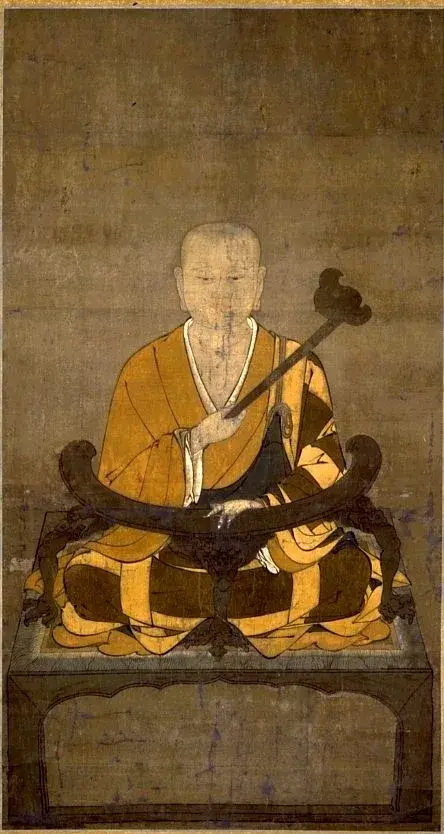
Biographical Narrative
Noble Lineage of Yingchuan and Renunciation in Jingxiang
Zhiyi was born on the sixteenth day of the second month in 538 (the fourth year of the Datong era of Emperor Wu of Liang). His family belonged to the prominent Chen gentry clan originating from Yingchuan (modern Yuzhou, Henan), a cradle of eminent scholar-officials in northern China. During the southward migrations of the Western Jin collapse, his ancestors crossed the Yangtze to settle in Huarong County, Jingzhou (modern Jianli, Hubei). His father, Chen Qizu, was an accomplished civil and military official endowed with spotless moral virtue, serving the Southern Liang Dynasty in high administrative posts and being enfeoffed as the Founding Marquis of Yiyang County; his mother, Lady Xu, was likewise born of a cultured and noble lineage.
From early childhood, Zhiyi displayed majestic dignity, a solemn countenance, and double pupils in his eyes, radiating an innate affinity for the Buddhist Dharma. At the age of seven, whenever he passed Buddhist sanctuaries, he would halt his steps to prostrate before the images. Once, when resident monks recited the "Universal Gateway Chapter of Avalokiteśvara Bodhisattva" a single time, young Zhiyi committed the entire chapter to memory instantly without missing a single syllable.
However, worldly tranquility was soon shattered. In 548 (the second year of Taiqing), the renegade general Hou Jing ignited a catastrophic rebellion that engulfed southern China. Fratricidal slaughter decimated the Liang imperial clan, and soon afterward Western Wei armies stormed Jiangling, executing Emperor Yuan of Liang and transforming the fertile plains of Jingchu into a slaughterhouse. In this horrific maelstrom of famine and warfare, Zhiyi's parents died of illness and grief in quick succession, reducing his prominent family to ruins. Suffering the agonizing bereavement of his parents and homelessness, the seventeen-year-old Zhiyi perceived with acute clarity the ephemeral vanity of worldly fortune and the endless sorrow of the cycle of rebirth.
In 554 (the third year of Chengsheng of Liang), the seventeen-year-old Zhiyi knelt before the golden Buddha image in Changsha Monastery in Jingzhou, weeping bitterly as he made a sacred vow: "I, your disciple, willingly cast aside all secular attachments and worldly vanities to dedicate this body to the Tathāgata's sacred teachings, seeking unexcelled bodhi to deliver all suffering beings across the Dharma realm!"
In 556, having reached eighteen years of age, Zhiyi traveled to Xiangzhou (modern Changsha, Hunan) and placed himself under Master Faxu at Guoyuan Monastery, receiving tonsure and the ten novice precepts. Shortly thereafter, he attached himself to Vinaya Master Huikuang to master the vinaya codes and disciplinary rituals. In 557, at the age of twenty, Zhiyi took full monastic ordination (Upasampadā). He subsequently retreated into Mount Daxian, closing his doors to study the Lotus Sūtra, Innumerable Meanings Sūtra, and Sūtra of Meditation on the Bodhisattva Universal Worthy, penetrating their profound subtleties within a mere twenty days.
Grand Awakening at Mount Dasu and Fame in Jinling
In 560 (the first year of Tianjia of Chen), the twenty-three-year-old Zhiyi learned that the renowned northern meditation master Huisi had traveled south to escape war, taking up residence at Mount Dasu in Guangzhou along the Dabie Mountains (modern Guangshan County, Henan). Master Huisi uniquely synthesized northern dhyāna meditation techniques with southern scriptural exegesis, advocating the dual cultivation of meditative concentration (samādhi) and transcendent wisdom (prajñā). Longing for authentic guidance, Zhiyi traveled over a thousand miles across mountains and rivers to pay homage to Huisi on Mount Dasu.
Upon beholding Zhiyi for the very first time, Master Huisi greeted him as though an intimate spiritual companion had returned from afar, stroking his head with deep joy: "Splendid! In an ancient aeon on Vulture Peak, you and I listened together as Shakyamuni preached the Lotus Sūtra. That deep karmic affinity from past lives has drawn us together once more today!" Huisi immediately inducted Zhiyi into the Universal Worthy sanctuary, instructing him in the Four Pleasant Practices (catuḥ-sukha-samudācāra) of the Lotus Sūtra.
Zhiyi embraced these teachings like quenching rain after drought, constructing a thatched hut in the wilderness and practicing the repentance rituals and seated dhyāna day and night, his mind becoming pure as flawless crystal. One evening in 561, as Zhiyi was chanting the "Chapter on the Ancient Deeds of the Medicine King Bodhisattva" in the Lotus Sūtra, he reached the sacred passage: "All the Buddhas praised him together, saying: 'Splendid, splendid! Good son, this is true diligence; this is called the true offering of the Dharma to the Tathāgata!'" In that transcendent moment, Zhiyi felt his physical body and mental consciousness dissolve into luminous emptiness; he attained grand awakening, directly realizing the Lotus Samādhi and beholding the true mark of all dharmas in cosmic clarity.
When Zhiyi presented his realization to Huisi, the master tested his insight rigorously and exclaimed with unreserved confirmation: "None but you could have realized this, and none but I could recognize it! What you have attained is the initial revolving dhāraṇī (prathama-āvartā-dhāraṇī) of the Lotus Samādhi. Even if thousands of worldly textual scholars were to challenge you with forensic logic, they could never exhaust your divine eloquence!" Thenceforth, Huisi instructed Zhiyi to ascend the seat on his behalf to preach Mahayana scriptures before the assembly.
In 567 (the first year of Guangda of Chen), Master Huisi resolved to travel south into Mount Heng to enter permanent seclusion. On the eve of his departure, Huisi solemnly charged Zhiyi: "My karmic affinity here is ending, and I must journey to the Southern Peak; your teaching mission lies in Jinling and Jiangnan. Propagating the flame of the Dharma can find no greater field than this. Go to the Chen capital to preach meditation, and do not become the one who breaks the lineage!" Obeying his master's charge, Zhiyi led Faxi and twenty-seven disciples down the Yangtze to Jinling, the glittering capital of the Chen Dynasty.
Initially lecturing at Lingyao Monastery, Zhiyi was soon invited to serve as abbot of Waguan Monastery. Opening his lectures on the title of the Lotus Sūtra, Zhiyi pioneered the method of interpreting scripture titles through the "Fivefold Profound Meaning," demolishing the superficial pedantry of southern exegetes and establishing the foundational framework of Tiantai hermeneutics. Residing at Waguan Monastery for eight years, Zhiyi preached the Mahāprajñāpāramitā-upadeśa, Sequential Steps to the Perfection of Dhyāna, and Six Subtle Dharma Gates. Imperial ministers, aristocrats, and eminent monks—including Prefect of the Masters of Writing Mao Xi and Left Vice Director Xu Ling—became his devoted followers, transforming the intellectual landscape of southern Buddhism.
Seclusion on Mount Tiantai and Cultivating the Perfect and Sudden
Despite the immense prestige and luxurious imperial patronage he commanded in Jinling, Zhiyi remained profoundly troubled by the spiritual superficiality of urban society. He recognized that most aristocrats attended his lectures merely to engage in witty philosophical debates rather than to undertake genuine spiritual cultivation. Zhiyi frequently lamented: "When I first came to Waguan Monastery, forty people listened and twenty attained spiritual fruit; the next year a hundred listened and twenty attained fruit; subsequently hundreds and thousands crowded my hall, yet those who truly tasted the Dharma and achieved genuine realization were barely two or three!"
Determined to break free from the snares of worldly fame and create an enduring monastic community dedicated to rigorous meditation, thirty-eight-year-old Zhiyi bid farewell to the ministers of Jinling in the autumn of 575 (the seventh year of Taijian of Chen), leading Faxi, Guanding, and dozens of disciples into the rugged wilderness of Mount Tiantai in eastern Zhejiang.
Mount Tiantai, renowned for its towering peaks and cascading gorges, had long been celebrated as the dwelling place of immortals and recluses. On the northern slopes of the range, Zhiyi constructed modest thatched cells, founding the Xiuchan Cloister (the embryonic precursor to Guoqing Monastery). Leading his disciples through physical labor, Zhiyi cleared mountain rocks, planted pine trees, and tilled the rocky soil, inaugurating a balanced communal lifestyle combining intensive seated meditation with self-sufficient agricultural work.
Ascending alone to the highest pinnacle of Huading Peak, Zhiyi sat in full lotus posture upon a bare granite boulder. Enduring fierce tempests, torrential rains, and terrifying hallucinations sent by demonic forces, he plunged into deep samādhi, thoroughly realizing the ultimate truths of "Three Thousand Realms in a Single Thought-Moment" (Yinian Sanqian) and the "Threefold Truth in Perfect Harmony" (Yuanrong Sandi). Over ten years of mountain seclusion, Zhiyi synthesized meditative praxis (guan) with philosophical doctrine (jiao), erecting the unprecedented theoretical paradigm of the "Dual Perfection of Doctrinal Understanding and Meditative Praxis" (Jiao Guan Shuang Mei).
The fame of Mount Tiantai echoed throughout the empire. Emperor Xuan of Chen issued an imperial decree assigning all local tax revenues of Tiantai County to support Zhiyi's monastic community, strictly forbidding secular authorities from disturbing their sanctuary. Emperor Chen Houzhu, upon ascending the throne, regarded Zhiyi as a supreme national treasure, issuing nineteen personal letters imploring him to return to the capital to protect the state. Moved by compassion for the realm, Zhiyi returned to Jiankang in 585, taking up residence at Guangzhai Monastery to preach the Benevolent Kings Prajñā Sūtra and Words and Phrases of the Lotus Sutra before the court, receiving the veneration of the sovereign and all high officials as National Preceptor.
Navigating Dynastic Change and Administering Precepts to Prince Yang Guang
In 589 (the ninth year of Kaihuang), Emperor Wen of Sui commanded his second son, Prince of Jin Yang Guang, to lead imperial armies across the Yangtze, capturing Jinling and extinguishing the Chen Dynasty. Southern Chinese society was plunged into intense trauma and political volatility. To safeguard Buddhist texts and monastic culture from warfare, Zhiyi braved military perils to lead his community to Mount Lu, where he lectured on Mahayana doctrines to console displaced refugees and literati.
In 590, Yang Guang was appointed Governor-General of Yangzhou, tasked with pacifying the southern territories. Yang Guang recognized that winning the genuine allegiance of southern elites and commoners required the spiritual cooperation of Master Zhiyi, who commanded absolute religious authority throughout Jiangnan. Yang Guang dispatched confidential envoys bearing personal letters to Mount Lu three times, earnestly imploring Zhiyi to travel to Yangzhou to preach the Dharma.
Recognizing that national unification was an irreversible historical necessity, and that winning imperial patronage would soothe regional animosities while safeguarding the Dharma, the fifty-four-year-old Zhiyi accepted the invitation, arriving at the Governor-General's headquarters in Yangzhou in the eleventh month of 591.
In the magnificent Jincheng Hall, Yang Guang convened a grand, non-discriminatory assembly (Pañcavārṣika-pariṣad) attended by all civil and military dignitaries. The twenty-three-year-old prince knelt reverently before Zhiyi's teaching platform, formally taking the Mahayana Bodhisattva Precepts as a humble disciple. Profoundly moved by Zhiyi's transcendent wisdom, Yang Guang conferred upon him the historic honorific title "Master Zhizhe" (Master of Wisdom); Zhiyi in turn praised the prince's imperial capacity, addressing him as the "Bodhisattva of Universal Dharani." This historic ordination in Jincheng Hall became a legendary paradigm of church-state cooperation in Chinese history, defusing deep-seated political hostility between northern conquerors and southern subjects.
Grand Synthesis at Yuquan and Final Demise at Shicheng
Following the ordination ceremony, Zhiyi gently declined Yang Guang's entreaties to remain permanently in Yangzhou amidst court luxury, setting out on a westward journey toward his ancestral home in Jingzhou to repay his familial debt of gratitude.
In 593 (the thirteenth year of Kaihuang), the fifty-six-year-old Zhiyi arrived at Mount Yuquan in Dangyang, Jingzhou. Beholding its verdant bamboo groves and crystal springs, he established thatched cloisters, founding the historic Yuquan Monastery. During his residence at Yuquan Monastery, Zhiyi's philosophical creativity attained its absolute culmination.
In the spring of 593 and summer of 594, Zhiyi ascended the Dharma throne in the main hall of Yuquan Monastery, delivering his master discourses on the Profound Meaning of the Lotus Sutra (Fahua Xuanyi) and the Great Calming and Contemplation (Mohe Zhiguan). His chief disciple Zhang'an Guanding attended him daily, transcribing every word with extraordinary fidelity.
These two masterworks, coupled with his earlier lectures on the Words and Phrases of the Lotus Sutra (Fahua Wenju) delivered in Jinling, constituted the celebrated "Three Great Tiantai Treatises." Spanning millions of words, they elevated Mahayana cosmology, mind-nature philosophy, and meditative praxis to the supreme peak of classical Eastern philosophy, marking the complete maturation of the Tiantai theoretical system.
In 595, Yang Guang invited Zhiyi to Yangzhou once more to lecture on the Vimalakīrti Sūtra, after which Zhiyi returned to his beloved Xiuchan Cloister on Mount Tiantai.
In the autumn of 597, Yang Guang dispatched another envoy to the mountains, pleading with Zhiyi to visit Yangzhou. Aware that his karmic span in this mortal world was drawing to a close, Zhiyi set out on his northern journey despite severe illness to fulfill his final spiritual covenant with the prince. Upon reaching Shicheng Monastery in Xinchang (modern Dafo Monastery in Xinchang, Zhejiang), his physical strength failed him completely.
Resting on his sickbed at Shicheng Monastery, Zhiyi gathered his disciples and drafted a final letter to Prince Yang Guang, entrusting the welfare of the Tiantai community to the prince's care and requesting imperial funding to construct a grand monastery on Mount Tiantai according to his architectural designs.
On November 24, 597 (the twenty-fourth day of the eleventh month of the seventeenth year of Kaihuang), during the hour of the sheep (wei), Zhiyi washed his hands, rinsed his mouth, adjusted his monastic robes, and sat upright facing the west. Commanding his disciples to chant the titles of the Lotus Sūtra and Amitāyur-dhyāna Sūtra, he entered final Nirvana with a serene smile at the age of sixty, having spent forty years in the Sangha.
Following Zhiyi's demise, Prince Yang Guang was overwhelmed with grief. In strict accordance with Zhiyi's designs, the prince allocated vast funds from the imperial treasury to construct a magnificent monastery on Mount Tiantai. Upon its completion in 605, Yang Guang personally conferred the temple plaque reading "Guoqing Monastery" (reflecting the auspicious prophecy that "when the temple is completed, the country will be purified"), establishing it as the eternal ancestral seat of the Tiantai School. His chief disciple Zhang'an Guanding dedicated decades of his life to editing and publishing Zhiyi's complete works, allowing the Tiantai Dharma to nourish East Asian civilization for millennia.
Major Achievements
Founding the First Indigenous Buddhist School in China
Zhiyi's most monumental historical achievement was ending Chinese Buddhism's prolonged dependence on Indian monks and imported translations, formally founding China's first mature, indigenous Buddhist sect endowed with an independent philosophical paradigm, comprehensive contemplative system, and dedicated monastic centers—the Tiantai School.
Prior to Zhiyi, Buddhist intellectual movements in the Northern and Southern Dynasties (such as the Nirvāṇa, Chengshi, Dilun, and Sheliun masters) were merely exegetical circles dependent on specific Indian translations, lacking unified sectarian frameworks and integrated contemplative methods.
Anchoring his thought in the Lotus Sūtra, Zhiyi synthesized the meditative concentration of northern Buddhism with the philosophical exegesis of southern scholarship, establishing a comprehensive institutional framework spanning doctrine, monastic discipline, contemplative praxis, and lineage transmission, revered as the pioneer of indigenous Chinese Buddhist sectarianism.
Authoring the Three Great Treatises and the Five Periods and Eight Teachings
Zhiyi's oral teachings, recorded and edited by his chief disciple Zhang'an Guanding, were gathered into the "Three Great Tiantai Treatises": the twenty-volume Fahua Xuanyi, twenty-volume Fahua Wenju, and twenty-volume Mohe Zhiguan, forming the most majestic philosophical encyclopedia in Eastern history.
To synthesize the vast, seemingly contradictory library of Buddhist scriptures translated into Chinese over centuries, Zhiyi formulated the celebrated "Five Periods and Eight Teachings" (Wu Shi Ba Jiao) hermeneutical framework.
The Five Periods categorized the Buddha's preaching according to his audience's developmental maturity (Avataṃsaka, Mṛgadāva, Vaipulya, Prajñā, and Lotus-Nirvāṇa periods); the Eight Teachings encompassed the Four Methods of Conversion (Sudden, Gradual, Secret, Indeterminate) and Four Doctrines of Conversion (Tripitaka, Shared, Distinct, Perfect). This framework structured the entire Buddhist canon into an orderly, coherent ladder of spiritual ascent, providing Chinese Buddhism with an authoritative hermeneutical paradigm.
Synthesizing Doctrinal Understanding and Meditative Praxis with Threefold Truth Philosophy
In metaphysical philosophy, Zhiyi formulated the celebrated doctrines of the "Threefold Contemplation in a Single Mind" (Yixin Sanguan), the "Threefold Truth in Perfect Harmony" (Yuanrong Sandi), and "Three Thousand Realms in a Single Thought-Moment" (Yinian Sanqian).
Emphasizing that "doctrine inspires contemplation, and contemplation verifies doctrine," he eradicated the centuries-old divide between southern textual scholars and northern meditation hermits, achieving the ideal of "Dual Perfection of Doctrinal Understanding and Meditative Praxis."
He demonstrated that all phenomena in the universe embody the threefold truth simultaneously: Emptiness (kong, lack of inherent self-nature), Provision (jia, provisional existence arising through conditions), and the Middle (zhong, the transcendent ultimate reality). A single thought-moment in the mind of any ordinary being fully encompasses the three thousand realms of existence across the ten Dharma realms, demolishing the ontological gulf between Buddhas and sentient beings and establishing the inherent dignity of universal Buddha-nature.
Establishing the Contemplative Systems of Mohe Zhiguan and the Six Subtle Dharma Gates
Zhiyi was not merely a brilliant speculative philosopher, but a meditation master of the highest realization who codified three contemplative frameworks tailored to different spiritual capacities: Gradual Calming and Contemplation, Indeterminate Calming and Contemplation, and Perfect and Sudden Calming and Contemplation.
His magnum opus Mohe Zhiguan, delivered at Yuquan Monastery, methodically detailed the twenty-five preparatory practices, ten modes of contemplation, and ten contemplative realms, transforming subtle mystical experiences into rigorous, verifiable meditative practices.
His introductory manuals, including Sequential Steps to the Perfection of Dhyāna, Six Subtle Dharma Gates, and Tongmeng Zhiguan (Lesser Calming and Contemplation), were concise yet profound, becoming the most universally studied meditation manuals in East Asia and providing foundational nourishment for the later development of Chan and Pure Land traditions.
Constructing Guoqing and Yuquan Monasteries as Southern Monastic Seats
In monastic institution-building, Zhiyi personally founded thirty-six monasteries during his lifetime, most famously Guoqing Monastery on Mount Tiantai and Yuquan Monastery in Dangyang, Hubei.
Guoqing Monastery on Mount Tiantai established an enduring monastic tradition combining strict disciplinary codes with mountain farming and meditation; funded entirely by imperial decree under Emperor Yang of Sui, it became an internationally celebrated monastic center. Yuquan Monastery was ranked alongside Lingyan, Qixia, and Jinshan as one of the "Four Wonders of the Realm."
These twin patriarchal monasteries nurtured generations of Buddhist masters and became the premier pilgrimage destinations for Japanese and Korean pilgrim monks seeking the authentic Dharma, embedding the Tiantai lineage deeply into the fabric of East Asian civilization.