Enfeoffment as Prince of Beiping
Invested as Prince of Beiping and granted a camel-knobbed gilded silver seal to defend the northern frontier.
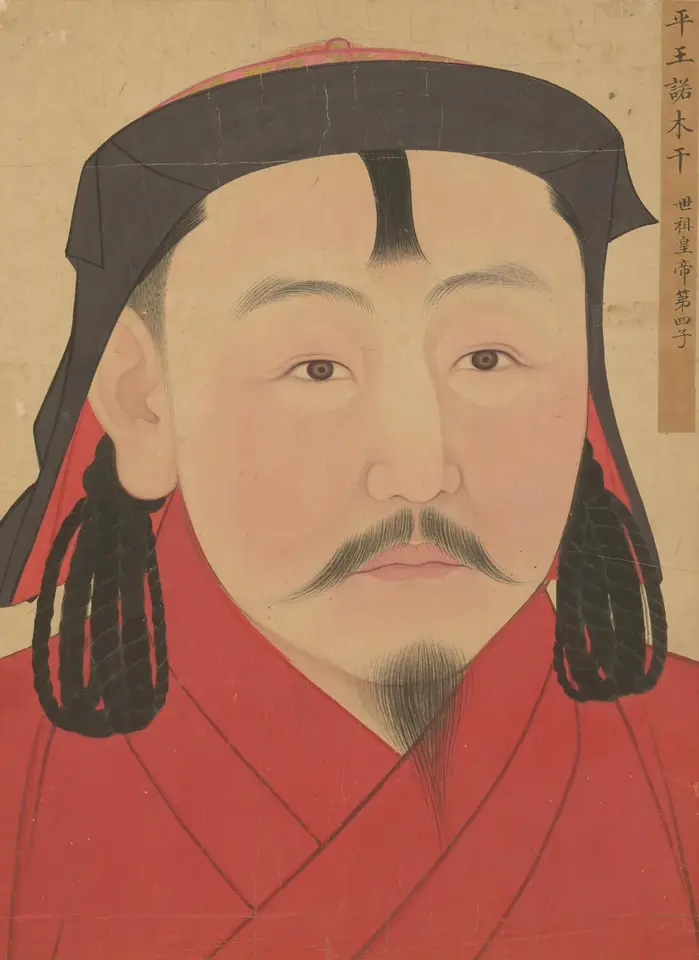
那木罕
Nomughan (那木罕, ?–1292), also rendered in historical texts as Nomughan, Nanmuhe, or Nömöghan, was an imperial prince of the Mongol Borjigin clan, the fourth son of Kublai Khan (Emperor Shizu of Yuan) and Empress Chabi, and a full brother of Crown Prince Zhenjin. Under the tutelage of the eminent Confucian scholar Gao Dao, Nomughan cultivated scholarly restraint and military discipline from his youth. In 1266 (Zhiyuan 3), the…
Nomughan (那木罕, ?–1292), also rendered in historical texts as Nomughan, Nanmuhe, or Nömöghan, was an imperial prince of the Mongol Borjigin clan, the fourth son of Kublai Khan (Emperor Shizu of Yuan) and Empress Chabi, and a full brother of Crown Prince Zhenjin. Under the tutelage of the eminent Confucian scholar Gao Dao, Nomughan cultivated scholarly restraint and military discipline from his youth. In 1266 (Zhiyuan 3), the Yuan court invested him as Prince of Beiping, conferring upon him a gilded silver seal with a camel knob. In 1271 (Zhiyuan 8), Kublai Khan appointed Nomughan supreme commander of an expeditionary force of seven imperial princes to garrison the northwestern frontier at the strategic oasis city of Almalik, checking the aggressive eastward expansion of Kaidu, ruler of the Chagatai and Ogedei realms. During his command in the northwest, Nomughan capitalized on internecine warfare between the Chagatai and Ogedei lines to crush the remnants of the rebel prince Negübei in 1273, temporarily pacifying the regions north and south of the Tianshan Mountains. However, during the winter of 1276–1277, the subordinate princes Shirigi and Tokhtemür staged a nocturnal mutiny, seizing Nomughan and Right Chancellor Antong. Nomughan was handed over to Möngke Temür, ruler of the Golden Horde (Kipchak Khanate), where he endured eight years of honorable confinement without yielding to rebel entreaties. Following the internal collapse of the rebel alliance, Nomughan was released and returned to Dadu in 1284, where Kublai Khan elevated him to Prince of Bei'an and granted him a massive appanage of 65,000 households in Linjiang Lu. Reassigned to the northern frontier, he established his headquarters along the Tamir River to fortify the Mongolian steppe against Kaidu. In 1287, when the eastern prince Nayan rebelled, Nomughan successfully held the northern mountain passes, preventing Kaidu's western armies from linking up with Nayan and enabling Kublai Khan's main force to achieve decisive victory in Manchuria. Nomughan died at his frontier post in August 1292, and was posthumously honored as Prince Zhaoding in 1320.
Invested as Prince of Beiping and granted a camel-knobbed gilded silver seal to defend the northern frontier.
Commissioned to lead seven imperial princes to the northwestern border, establishing a fortified headquarters at Almalik against Kaidu.
Exploited rivalries among Central Asian princes to annihilate the rebellious forces of Negübei, pacifying the Ili River basin.
Kublai Khan dispatched Right Chancellor Antong to Almalik to assist Nomughan in managing civil and military administration.
Abducted during a nocturnal mutiny orchestrated by Princes Shirigi and Tokhtemür; transferred to the Golden Horde for prolonged detention.
Following the suppression of the rebellion, Nomughan was repatriated to Dadu and elevated to Prince of Bei'an by Kublai Khan.
Reassigned to garrison the northern frontier, establishing military headquarters on the Tamir River to contain Kaidu.
Defended northern mountain corridors during Nayan's rebellion, blocking Kaidu's armies from joining forces with the eastern rebels.
On the fourth day of the seventh month, Nomughan died at his post on the Tamir River; posthumously granted the title Prince Zhaoding in 1320.
Nomughan was born into the golden lineage of Genghis Khan as the fourth son of Kublai Khan and his primary consort, Empress Chabi. Along with Crown Prince Zhenjin, Prince of Anxi Manggala, and other imperial siblings, he occupied the highest hereditary status within the Yuan court. Following Kublai Khan's adoption of Chinese bureaucratic governance and the founding of the Yuan Dynasty, the imperial family emphasized comprehensive training in both military leadership and classical scholarship. During his youth, Nomughan was instructed by the renowned Confucian scholar Gao Dao, studying historical classics and statecraft, which cultivated his calm, deliberate demeanor and steadfast character.
In 1266 (Zhiyuan 3), as military campaigns against the Southern Song intensified, Kublai Khan systematically distributed trusted imperial princes to command strategic border outposts. Nomughan was invested with the noble rank of Prince of Beiping and awarded a gilded silver seal with a camel knob, symbolizing his role as an imperial bulwark. Meanwhile, across the northwestern steppe, Kaidu, grandson of Ogedei Khan, refused to acknowledge Kublai Khan's authority as Khagan, aligning with dissaffected princes of the Chagatai and Kipchak khanates to raid frontier garrisons and threaten the Silk Road trade corridors.
To confront Kaidu's growing challenge, Kublai Khan dispatched Nomughan in 1271 (Zhiyuan 8) at the head of an expeditionary force comprising seven imperial princes, including Shirigi, son of Möngke Khan. Leading tens of thousands of elite Mongol and auxiliary troops, Nomughan marched thousands of li into the western regions, making his base at Almalik (northwest of modern Huocheng, Xinjiang). Situated on the northern slopes of the Tianshan Mountains, Almalik controlled critical transit routes between Central Asia and the Mongolian heartland. There, Nomughan erected fortified encampments, organized reconnaissance squadrons, and constructed an effective defense line against nomadic incursions.
Upon establishing his base at Almalik, Nomughan demonstrated acute strategic perception in exploiting rivalries among the Central Asian khanates. At that time, internal succession struggles plagued the Chagatai Khanate, and its ruler, Negübei, turned against Kaidu, erupting into open warfare across the Tianshan region. In 1273 (Zhiyuan 10), Negübei was killed during clashes with Kaidu's troops, throwing the Chagatai forces into disarray.
Seizing this tactical opening, Nomughan dispatched elite cavalry squadrons to launch swift flanking assaults against the scattered Chagatai forces. In the mountain valleys of the Tianshan, Yuan forces encircled and eliminated the remaining rebel formations, capturing regional chieftains and pacifying tens of thousands of nomadic pastoralists. This swift victory restored Yuan military prestige throughout the western borderlands, deterred adjacent nomadic tribes from joining anti-imperial coalitions, and ensured several years of relative stability across the Ili River basin.
Nevertheless, managing an extensive frontier army across vast distances posed immense logistical difficulties, while subtle jealousies among the allied princes strained operational unity. To strengthen executive command, Kublai Khan dispatched Right Chancellor Antong to Almalik in 1275 (Zhiyuan 12). A great-grandson of Muqali, the legendary founding general of the Mongol Empire, Antong possessed profound administrative and strategic expertise. Working in close collaboration with Nomughan, Antong reorganized logistics, secured food supplies, and reinforced the fortifications at Almalik, consolidating the Yuan military presence in the west.
Just as Nomughan and Antong were consolidating northwestern defenses, an internal conspiracy erupted within their own ranks. Princes Shirigi, Tokhtemür, and Yoqughur had long harbored deep resentment against Kublai Khan's adoption of Chinese governance and his accession to the imperial throne. In late 1276 (Zhiyuan 13), following news of the surrender of the Southern Song capital at Linjiang, the disaffected princes concluded that central Yuan armies were bogged down in the south, leaving northern defenses vulnerable.
In early 1277 (the spring of Zhiyuan 14), Tokhtemür and Shirigi launched a surprise nocturnal attack on Nomughan's central headquarters. Caught entirely off guard, Nomughan and his younger brother Kokochü were seized in their tents. The mutineers then assaulted Antong's encampment; despite fierce resistance, the chancellor was overwhelmed and taken prisoner. Raising the banner of revolt, Shirigi proclaimed himself Khagan. To gain foreign recognition and military support, Shirigi sent Nomughan and Kokochü to Möngke Temür, ruler of the Golden Horde, while handing Chancellor Antong over to Kaidu.
During his eight years of captivity in the Golden Horde, Nomughan faced harsh physical conditions and political isolation in the cold Russian steppes. Although Möngke Temür refrained from executing the son of Kublai Khan, Nomughan was placed under close surveillance. Throughout his prolonged confinement, Nomughan steadfastly refused all demands by rebel envoys to renounce Kublai Khan's legitimacy, maintaining his integrity and composure as an imperial prince, which won him the enduring respect of his captors.
Following Shirigi's betrayal, Kublai Khan dispatched veteran commanders Bayan and Liu Guojie to crush the rebellion. Yuan expeditionary armies inflicted severe defeats on the rebels along the Orkhon River. Deprived of popular support, Shirigi, Tokhtemür, and Yoqughur turned against each other in internal power struggles. The rebel commander Sarban eventually seized Shirigi and surrendered to the Yuan court, leading to the complete collapse of the mutinous faction.
Following the death of Möngke Temür, internal politics within the Golden Horde shifted. Seeking to repair diplomatic relations with the Great Khan and wary of Kaidu's expanding ambition, the new ruler Töde Möngke decided to release the detained Yuan princes. In 1284 (Zhiyuan 21), after eight years in captivity, Nomughan began his journey home, arriving in Dadu the following year. Kublai Khan received his loyal son with deep emotional gratitude, elevating him to Prince of Bei'an and bestowing upon him 65,000 households in Linjiang Lu as an appanage, a grant that ranked among the most lavish given to any imperial prince.
Declining a life of leisure in the capital, Nomughan returned to active frontier duty. In 1285 (Zhiyuan 22), Kublai Khan appointed the Prince of Bei'an to command the entire northern defensive perimeter, establishing his headquarters along the Tamir River, northwest of Karakorum. The Tamir River valley served as the primary gateway protecting the heartland from incursions across the Altai Mountains. Nomughan reorganized frontier garrisons, expanded military agricultural colonies, and repaired postal relay stations, creating an integrated defensive barrier across the northern steppe.
In 1287 (Zhiyuan 24), the Yuan Dynasty confronted its most dangerous internal crisis when Prince Nayan, a descendant of Genghis Khan's youngest brother Temüge Otchigin, launched a massive rebellion among the eastern princely lineages in Manchuria. Nayan secretly coordinated with Kaidu in the west, intending to launch a simultaneous two-front offensive against Dadu. Kublai Khan personally led the main army northward to confront Nayan, entrusting Nomughan with the vital task of preventing Kaidu from advancing eastward.
Exercising resolute tactical patience, Nomughan established an impenetrable blocking position across the Khangai Mountains and the Tamir River. He personally inspected forward outposts, deployed mobile cavalry patrols to interdict mountain passes, and captured enemy couriers, severing all communication between Kaidu and Nayan. By maintaining strict defensive cohesion, Nomughan repelled repeated probes by Kaidu's vanguard, pinning down the massive western nomadic coalition west of the Altai Mountains. His strategic holding action prevented the two rebel forces from joining together, enabling Kublai Khan's central army to encircle and crush Nayan in the east.
Following the suppression of Nayan's uprising, Nomughan remained at his northern post despite failing health. The physical tolls of frontier warfare and eight years of foreign captivity had severely depleted his strength. On August 17, 1292 (the fourth day of the seventh month of Zhiyuan 29), Nomughan passed away in his military encampment on the Tamir River. In 1320 (Yanyou 7), Emperor Renzong posthumously granted him the honorable title of Prince Zhaoding in recognition of his unwavering loyalty and distinguished defense of the northern frontiers.
Between 1271 and 1275, Nomughan's tenure as supreme military commander at Almalik constituted a foundational chapter in Yuan administration of the western regions. Overcoming extreme climatic conditions, he established an integrated defensive infrastructure encompassing garrison citadels, supply depots, and postal relay stations along the northern slopes of the Tianshan Mountains. By adeptly exploiting dynastic fissures within the Chagatai Khanate to crush Negübei's forces, Nomughan restored security to vital trans-Eurasian trade routes and asserted Yuan central authority throughout the Ili River basin, effectively checking Kaidu's early westward territorial ambitions.
The Shirigi Mutiny of 1277 was among the most dangerous dynastic rebellions in early Yuan history. When surprised and captured in his encampment, Nomughan demonstrated unyielding moral resolve. Resisting severe coercion and political inducements from Shirigi to join the anti-imperial coalition, Nomughan adamantly defended Kublai Khan's legitimacy as Great Khan. Throughout eight arduous years of confinement in the Golden Horde, he maintained his dignified composure as an imperial prince, winning the respect of the Kipchak rulers and providing an enduring moral example of loyalty for the entire Mongol nobility.
Nomughan's successful defense of the Tamir River frontier during the 1287 Nayan rebellion proved decisive to the survival of the Yuan Dynasty. Confronted with a coordinated two-front conspiracy linking eastern princes with western nomadic forces, Nomughan executed a disciplined containment strategy. Operating with inferior numbers, he sealed the Khangai passes, severed hostile intelligence links, and pinned down Kaidu's western armies. By denying Kaidu passage into the eastern steppe, Nomughan eliminated the threat of a combined rebel offensive, allowing Kublai Khan to achieve total victory in Manchuria and preserving the territorial integrity of the empire.
FIGURES ASSOCIATED WITH THIS DYNASTY