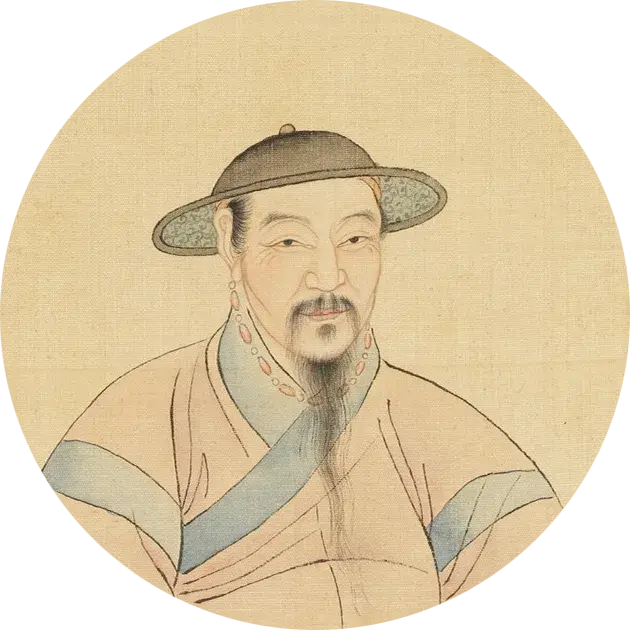
Biography
Princely Retinue and Recruiting Northern Literati
Dong Wenyong was born into the celebrated Gaocheng Dong lineage, one of the prominent Han hereditary military houses of northern China. His father, Dong Jun, was a founding commander under Genghis Khan who perished heroically in battle. Orphaned at the age of ten, Dong Wenyong was educated under the rigorous tutelage of his eldest brother, Dong Wenbing. Combining classical Chinese mastery with knowledge of Mongol customs, he attained early fame across Hebei.
In 1243, because Gaocheng constituted the private appanage estate of Empress Dowager Sorghaghtani Beki (mother of Möngke and Kublai), the court ordered promising youths of the region to report to the imperial camp at Karakorum. Dong Wenyong accompanied his elder brother to audience. Prince Kublai, who was then establishing his princely court at Jinlianchuan to govern the southern territories, immediately recognized Dong Wenyong's administrative clarity and literary refinement. Kublai appointed him to supervise official correspondence and deliver lectures on canonical statecraft. In 1253, Dong accompanied Kublai on the southwestern campaign against Dali, supervising military provisions and ordnance with flawless precision. In 1257, Kublai commissioned Dong to tutor the imperial princes Nomoghan and Qogachi in the Confucian classics, while instructing him to travel across northern China to recruit esteemed Jin dynasty scholars, successfully enlisting masters Dou Mo, Yao Shu, Li Junmin, and Li Ye into Kublai's advisory council.
Military Campaigns and Stabilizing the Western Xia Frontier
In 1259, Dong Wenyong accompanied Kublai's grand invasion of Southern Song, participating in the siege of Ezhou. Facing formidable defensive fleets commanded by Chancellor Jia Sidao and General Lü Wende along the Yangtze, Kublai stood on the northern riverbank to direct operations. When Dong Wenbing volunteered to spearhead the amphibious assault, Dong Wenyong and his younger brother Dong Wenzhong requested permission to accompany him. Kublai personally presented them with heavy armor and selected warships; the Dong brothers advanced through heavy arrow fire, routing the Song flotillas. Following the death of Möngke Khan at Diaoyu Fortress, Kublai hesitated along the river. Discerning the urgent dynastic crisis, Dong Wenyong submitted three memorials within a single day, persuasively arguing that continuing the siege risked losing the throne. Kublai heeded the counsel and marched north to secure the imperial succession in Beijing. Following the founding of the Zhongtong era, Dong served as Director in the Ministry of War and assisted General Qoqotei in encircling and decapitating the rebel warlord Li Tan in Yidu. When Grand General Aju sought to recruit him into frontline command, Dong invoked new imperial decrees prohibiting hereditary princely houses from monopolizing hereditary military posts, declining the offer to uphold institutional centralism.
In 1264, the court appointed Dong Wenyong Director of the Regional Secretariat for Western Xia (Zhongxing Route). Following the civil war of Kunduqai, the regional economy was shattered, with populations hiding as outlaws in the mountains. Arriving in the west, Dong posted conciliatory proclamations throughout major highways, calming the terrified populace. He directed the dredging of the ancient Tanglai, Hanyan, and Qinjia irrigation canals, clearing agricultural colonies that settled between forty and fifty thousand households in Liangzhou, Ganzhou, Suzhou, Guazhou, and Shazhou. Concurrently, Prince Jibiq Temür, who commanded the western borders, allowed his aristocratic retinue to make predatory demands upon provincial granaries. Dong Wenyong sat resolutely in his headquarters, refusing unlawful requisitions according to imperial law. When the enraged prince dispatched interrogators, Dong replied fearlessly: "I am an official appointed by the Son of Heaven. If my life is forfeit, so be it! What grieves me is that so noble and generous a prince should be discredited by subordinates who plunder the people and humiliate the law." Presenting an indictment of dozens of crimes committed by princely retainers, Dong so moved the prince that Jibiq Temür personally apologized, commanding his retinue never again to infringe upon civil law.
Agricultural Governance and Defending Common Livelihood
In 1271, upon the creation of the Bureau of Agriculture, Dong Wenyong was appointed Agricultural Commissioner for the Eastern and Western Circuits of Shandong. Traveling through regions ravaged by decades of war, he inspected remote hamlets to encourage tillage and animal husbandry. Observing effective land-clearing methods in Dengzhou, he composed poems to commend the local prefect and disseminated the techniques empire-wide. Over his five-year tenure, agricultural production in Shandong reached the highest levels in the nation. In 1276, he was appointed Governor of Weihui Route, wearing the Golden Tiger Tally. Situated along the strategic route between the north and newly conquered Jiangnan, Weihui was overwhelmed by logistics teams transporting state records and treasures to the capital, consuming the labor of thousands of farmers daily. Fearing catastrophic disruption to agricultural production, Dong personally wrote a legal guarantor bond to the imperial transportation commissioner, utilizing local garrison soldiers and clerks to perform logistics duties so that peasant families could plant their crops. When water transport officials proposed diverting the treacherous Qin River into the imperial canal, Dong surveyed the topography and demonstrated that the highest pagoda in Weihui was level with the river's high-water mark, preventing an engineering blunder that would have inundated several northern cities.
In 1283, Dong was summoned to the court as Minister of War, subsequently serving as Minister of Rites and Academician of the Jixian Academy. At that time, Vice Chancellor Lu Shirong gained imperial favor by proposing aggressive revenue exactions, claiming he could double treasury income without oppressing the people. While the court remained silent, Dong Wenyong challenged Lu directly: "Does this wealth come from your private estate, or from the common people? If from the people, hear this: sheep owners shear fleece twice a year, and the sheep survive; but if a shepherd plucks the fleece daily to present to his master, the sheep will perish from exposure, and no fleece will remain! Human resources are finite; to strip them bare is to invite ruin!" The eloquent analogy silenced Lu Shirong and won praise from Chancellor Antong. In 1286, when the court planned a second invasion of Japan, Dong submitted a strongly worded memorial warning against exhausting valuable domestic resources to pursue an isolated and distant island, persuading Kublai to abandon the campaign.
Censorate Rigor and Compiling the Veritable Records
In 1288, Dong Wenyong was appointed Vice Censor-in-Chief. He declared that high censorial leaders must prioritize the recruitment of upright men over trivial paperwork, selecting eminent Confucian literati such as Hu Zhiyu, Wang Yun, Lei Ying, and Wei Chu to head regional surveillance commissions. When the all-powerful and corrupt Chancellor Sangha dominated the court, Dong stood completely aloof. When Sangha pressured him to praise the revenue ministry before the emperor, Dong refused to speak. When Sangha's arbitrary taxation provoked widespread peasant revolts, Dong confronted the chancellor with official bandit registers, declaring: "The common people desire only peace; it is violent exactions that drive them to outlawry! The Censorate exists to correct executive overreach; you must support it rather than suppress it." Sangha slandered Dong before Kublai Khan, accusing him of insubordination, but Kublai firmly dismissed the charges, remarking: "Dong Wenyong is performing his proper censorial duty. He is a man of absolute rectitude whom I have known for decades!" Dong was subsequently appointed Chamberlain for the National Treasury, where he blocked aristocratic encroachment onto peasant farmlands.
Following the accession of Emperor Chengzong in 1294, Dong Wenyong was appointed Chief Academician of the Hanlin Academy, Grand Master of Dignified Virtue, and Drafter of Imperial Pronouncements, entrusted with the compilation of the Veritable Records of Shizu (Shizu Shilu). With his encyclopedic knowledge of early Mongol genealogies, dynastic battles, and imperial institutions, Dong provided instant and accurate resolutions to every historical puzzle raised by imperial compilers. In 1297, at seventy-four years of age, he retired to Gaocheng with imperial honors and ten thousand strings of paper currency. He passed away in the sixth lunar month of that year at age seventy-five. Emperor Chengzong bestowed posthumous honors as Junior Protector, ennobling him as Duke of Shou with the posthumous title Zhongmu. Throughout his life, Dong Wenyong balanced compassionate civil administration with fearless censorial courage, standing as a noble exemplar of Han scholar-officials in the founding era of the Yuan dynasty.
Key Achievements
Inner Council Service and Guiding Early Mongol Policy
Serving Prince Kublai from 1243 onward, Dong Wenyong managed military correspondence during the Dali campaign and recruited foundational scholars like Dou Mo, Yao Shu, and Li Ye into the Jinlianchuan retinue, facilitating the administrative adoption of Han classical institutions by the Mongol state.
Frontier Reconstruction in Western Xia and Imperial Agricultural Leadership
As Director in Western Xia, he rebuilt ancient irrigation networks, resettling tens of thousands of displaced households, and peacefully disciplined overbearing imperial princes. Later, as Agricultural Commissioner for Shandong, he achieved the foremost agricultural performance in the empire and safeguarded peasant labor while governing Weihui.
Resisting Fiscal Extortion and Advising Against Invading Japan
Dong famously defeated the predatory fiscal schemes of Lu Shirong with his celebrated "shearing sheep" allegory, stood alone against the despotic Chancellor Sangha to protect censorial independence, and successfully counseled Kublai Khan against launching a second expedition against Japan.
Directing the Compilation of the Veritable Records of Shizu
In his twilight years, Dong served as Chief Academician of the Hanlin Academy, utilizing his exceptional memory of Mongol history and Chinese archives to lead the authoritative compilation of the Veritable Records of Shizu.