Painting Xiangguo Monastery
At over sixty years of age, recruited as master muralist to restore rain-damaged frescoes at the imperial Xiangguo Monastery in Kaifeng.
崔白
Cui Bai (崔白), courtesy name Zixi, was a native of Haozhou (present-day Fengyang County, Anhui Province). He was an eminent court painter, artistic pioneer, and revolutionary leader in Chinese bird-and-flower painting during the mid-Northern Song Dynasty. Originating as a professional artisan painter whose early training remains unrecorded in historical annals, Cui lived a nomadic life across Jiangnan for decades, selling…
Cui Bai (崔白), courtesy name Zixi, was a native of Haozhou (present-day Fengyang County, Anhui Province). He was an eminent court painter, artistic pioneer, and revolutionary leader in Chinese bird-and-flower painting during the mid-Northern Song Dynasty. Originating as a professional artisan painter whose early training remains unrecorded in historical annals, Cui lived a nomadic life across Jiangnan for decades, selling paintings while immersing himself in direct natural observation. He developed mastery in painting bamboo, feathered birds, insects, and beasts, as well as Buddhist and Daoist wall murals. In 1065, when the imperial Xiangguo Monastery in the capital of Kaifeng was damaged by torrential rains, Cui was enlisted to execute massive restorations of the temple's frescoes, winning renown across the capital for his vigorous brushwork and transcendent compositions. In 1068, following the completion of the Xiangguo Monastery project, Emperor Shenzong broke with bureaucratic convention by directly recruiting the sixty-something artisan into the imperial Hanlin Painting Academy. Soon after, when Emperor Shenzong commissioned academy artists including Ai Xuan and Ding Kuang to paint decorative crane-and-bamboo screens for the Chuigong Hall, Cui's compositions triumphed above all competitors with their fresh and serene vigor. Shenzong appointed him Art Student in the Painting Academy, subsequently promoting him to Painter-in-Attendance. Recognizing his free-spirited temperament, Shenzong granted him an extraordinary royal privilege, decreeing that no official could assign Cui to paint without direct imperial authorization. In the history of Chinese art, Cui Bai's greatest achievement was dismantling the century-long monopoly of the ornate and rigid court style founded by Huang Quan and Huang Jucai during the Five Dynasties and early Song. Cui introduced expressive ink landscape techniques into bird-and-flower painting, harmonizing meticulous fine-brush detailing with freehand brushwork. He painted directly from nature without preliminary charcoal sketches or drawing rulers, creating serene, sparse compositions capturing autumn and winter wildscapes, ducks among reeds, withered lotus, magpies, and winter sparrows. His work revitalized the court academy and directly influenced Emperor Huizong's aesthetic synthesis; his surviving masterpieces Magpies and Hare and Winter Sparrows are revered as supreme treasures of Asian art history.
At over sixty years of age, recruited as master muralist to restore rain-damaged frescoes at the imperial Xiangguo Monastery in Kaifeng.
Following the completion of the monastery murals, Emperor Shenzong directly recruited him into the Hanlin Painting Academy.
Commissioned to paint screens of cranes and bamboo for the Chuigong Hall, surpassing all rivals and receiving imperial exemption from routine duties.
Elevated to Painter-in-Attendance in the Hanlin Painting Academy, leading the aesthetic transformation of court art.
Painted the monumental silk hanging scroll Magpies and Hare, achieving a pinnacle of naturalistic vitality in Chinese art.
Cui Bai was born in Haozhou in the Huai River valley during the early Northern Song Dynasty. Minimal documentation survives regarding his family background or artistic lineage, and modern historians agree that he originated from a humble artisan background. Throughout his youth and middle age, Cui lived as an itinerant professional painter in the bustling towns and rural markets of Jiangnan. To earn a livelihood amidst intense market competition, he was required to fulfill diverse commercial commissions, acquiring comprehensive mastery across diverse genres including Buddhist and Daoist deities, landscapes, bamboo, birds, insects, and quadrupeds.
Crucially, his decades of itinerant life allowed him to observe nature directly rather than copying ancestral pattern books in palace archives. Traversed between the Huai River and the marshes of the Yangtze, he spent years studying wild waterfowl, wind-bent withered lotus, and winter sparrows across shifting seasons and climates. This empirical grounding freed him from the formulaic patterns of workshop traditions, endowing him with acute observational skills and exceptional life-sketching ability.
In the second year of the Zhiping era (1065) under Emperor Yingzong, torrential downpours in Kaifeng damaged ancient wall paintings throughout the sprawling Xiangguo Monastery. The imperial court issued an edict summoning accomplished painters across the empire to restore the murals, and the sixty-year-old Cui was enlisted. In executing the temple murals, Cui deployed vigorous, archaic brushwork; his deities radiated sublime majesty while his accompanying landscapes and pine rocks showed profound compositional power, drawing vast crowds of scholars and officials and establishing his fame throughout the capital.
The Xiangguo Monastery mural project was successfully completed around the first year of the Xining reign (1068). The newly enthroned Emperor Shenzong, an ardent connoisseur of painting, personally inspected the murals. Deeply moved by Cui's unconstrained and archaic brushwork, the emperor bypassed strict bureaucratic conventions to summon the elderly artisan directly into the Hanlin Painting Academy.
In the early Xining era, Emperor Shenzong decided to replace the imperial screens flanking the Zichen and Chuigong Halls, ordering Cui Bai and veteran academy painters including Ai Xuan, Ding Kuang, and Ge Shouchang to execute screen panels depicting cranes and bamboo. While other painters adhered strictly to the symmetrical, opaque color formulas of the Huang Quan school, Cui introduced a novel approach, depicting graceful bamboo and cranes with lifelike posture and naturalistic feathers. Shenzong judged Cui's work superior to all others, granting him the title of Art Student and later promoting him to Painter-in-Attendance.
Despite these honors, Cui was inherently unconstrained and resistant to bureaucratic protocols, finding standard court assignments burdensome and requesting permission to retire. Recognizing his rare genius, Emperor Shenzong issued a protective imperial decree: from that time forward, no court official or ministry could require Cui to paint without an explicit imperial command. This rare exemption granted Cui complete creative independence within the palace academy.
Cui Bai's arrival in the Hanlin Painting Academy acted as a refreshing northern gale across a painting scene that had remained stagnant for nearly a century. Ever since Huang Quan and his son Huang Jucai established their meticulous, richly colored style as the court standard during the Five Dynasties and early Song, three generations of academy painters had treated Huang's decorative, double-outline method as the sole acceptable formula, actively rejecting divergent approaches.
Entering the court in his sixties, Cui dared to defy this convention. He integrated the untamed, ink-based style of Southern Tang master Xu Xi with the dynamic brush-and-ink texturing methods of northern landscape giants such as Guan Tong, Li Cheng, and Fan Kuan, creating the fresh Cui style. His bird-and-flower paintings paired structural precision with expansive wilderness aesthetics, captivating scholar-officials in Kaifeng.
Prominent literary statesmen including Ouyang Xiu, Su Shi, and Huang Tingjian lavished praise upon his work, declaring that his brushwork achieved spontaneous perfection where the ancients did not consciously calculate. Younger academy painters and scholar-artists outside the court eagerly emulated his methods, dismantling the rigid monopoly of the Huang tradition and ushering in an era that prized naturalism, psychological vitality, and poetic expression. His younger brother Cui Que and grandson Cui Shunzhi inherited his family methods, ensuring that Cui Bai became the pivotal figure transforming late Northern Song painting.
Cui Bai's foremost contribution to Chinese art history was single-handedly breaking the century-long monopoly of the Huang Quan style within the imperial painting academy. Established during the Five Dynasties, the Huang style emphasized meticulous double-outlined contours and heavy mineral colors, but over a hundred years of repetition it had degenerated into rigid, lifeless decorative patterns.
Cui discarded the narrow focus on indoor exotic birds and palace gardens, turning his brush toward expansive, wild marshlands and windswept plains. Reinvigorating the untamed aesthetic tradition of Xu Xi, he introduced textural brushstrokes from ink landscape painting into bird-and-flower subjects, pioneering a style characterized by sparse composition, refined ink washes, and atmospheric clarity. His works paired rigorous structural depiction of animals with panoramic wilderness settings, elevating Chinese flower-and-bird painting from artisanal decoration into a sublime vehicle for philosophical expression.
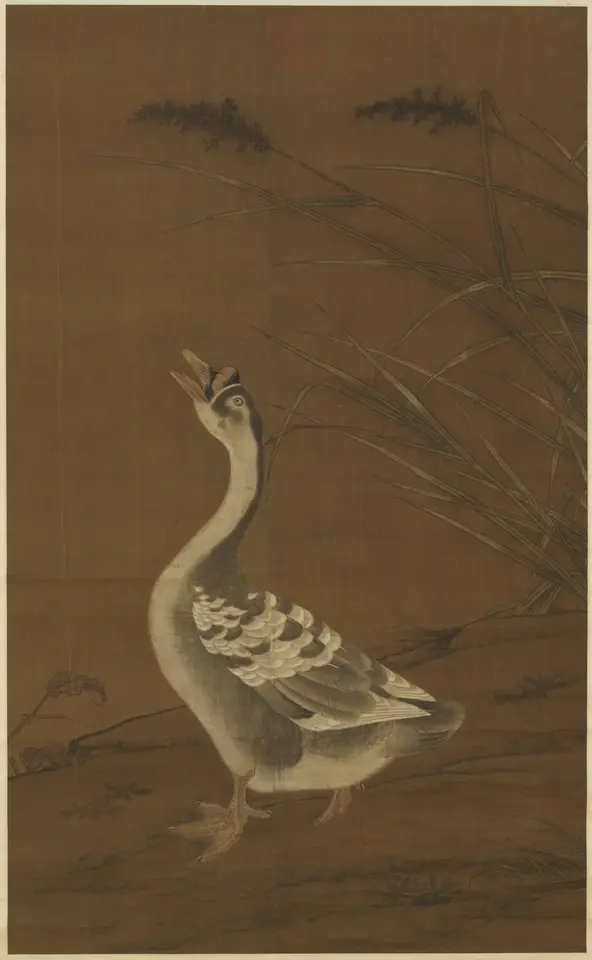
In physical technique, Cui Bai possessed legendary traditional draftsmanship that astonished his contemporaries. According to authoritative historical treatises including the Xuanhe Painting Manual and An Overview of Painting, Cui worked directly on silk without ever using charcoal to sketch preparatory outlines.
Furthermore, when rendering long linear architectural elements or tree limbs, he painted freehand without rulers or boundary pens, executing long lines with continuous curvature that conformed perfectly to geometrical proportions. This spontaneous freedom was built upon decades of acute observational study and disciplined practice. He painted with astonishing speed and concentration; his depictions of geese, cicadas, and sparrows were celebrated as three unrivaled specialties, exemplifying the highest ideal of artistic spontaneity achieved through consummate skill.
Currently preserved in the National Palace Museum in Taipei, Magpies and Hare (Shuangxi Tu, hanging scroll, ink and color on silk, 193.7 cm by 103.4 cm, signed Cui Bai in the Jiayou Xinchou year) represents his greatest surviving masterwork. The painting captures a dynamic confrontation in an autumn wilderness: two magpies fly against a gusting wind, perching on a gnarled, broken branch and screeching downward, while a brown hare halts abruptly in the withered grass, looking back warily at the birds above.
Technically, Cui achieved an unprecedented synthesis of fine-brush detailing and expressive brushwork. The trunk and twisted branches are rendered with rugged ink contours and coarse texturing, reflecting monumental landscape brushwork, while the bending grasses are defined with fine double-outlined strokes. To portray the hare's soft fur, Cui utilized dense clusters of fine brush-tip dabs built up in transparent layers of ink and color, capturing the subtle trembling of fur in the chill autumn wind. The entire composition vibrates with the tension of seasonal change, replacing conventional auspicious symbolism with a drama of nature.
Preserved in the Palace Museum in Beijing, Winter Sparrows (Hanque Tu, handscroll, ink and light color on silk, 25.5 cm by 101.4 cm) is another national treasure from Cui's hand. The scroll portrays nine sparrows resting and settling upon a withered, frost-bitten ancient branch at twilight in midwinter.
The composition displays sophisticated rhythmic pacing: at the right, two sparrows arrive late with fluttering wings, introducing movement; in the center, four sparrows huddle together in sleep, forming the static visual anchor; while at the left, three sparrows preen, stretch, and chirp. The nine sparrows display diverse postures and orientations, while the gnarled tree trunk is rendered with bold ink washes and rough texturing strokes that leave no discernible brush outlines. Although the mineral pigments have mellowed over a millennium, the serene, untamed beauty of the birds endures as a pinnacle of Chinese ink painting.
FIGURES ASSOCIATED WITH THIS DYNASTY