Biography
Fisherman Origins and Joining the Red Turbans (1320–1352)
Chen Youliang was born in 1320 in Huangpeng Town, Mianyang Prefecture, Huguang (present-day Xiantao, Hubei Province), into a family that had sustained itself as river fishermen for generations. His ancestral lineage originally carried the surname Xie, but adopted the surname Chen after an impoverished ancestor married into a maternal Chen household. In his youth, despite the grinding poverty of life along the Yangtze riverbanks, Chen Youliang proved exceptionally sharp-witted, robust in constitution, and gifted with great physical strength. In addition to mastering navigation and watercraft operations, he independently studied Confucian classics and history, acquired skilled bookkeeping and literacy, and served for a period as a clerk in the Mianyang county yamen.
In the late Yuan period, official corruption reached unprecedented depths, while catastrophic river floods and droughts devastated the central Yangtze plains. In August 1351, White Lotus religious leaders Xu Shouhui, Zou Pusheng, and Ni Wenjun launched the Tianwan Red Turban uprising in Qishui (modern Xishui, Hubei), attracting thousands of impoverished peasants and river laborers. Recognizing that local administrative service offered no future amid dynastic collapse, Chen Youliang resigned his municipal post and joined the Red Turban insurgency.
Assigned to the secretariat of Chancellor Ni Wenjun, Chen Youliang quickly distinguished himself through his tactical acumen and boldness under fire. In multiple engagements against imperial Yuan counter-offensives, he devised riverine ambushes and coordinated amphibious assaults, earning the profound confidence of Ni Wenjun. Demonstrating remarkable military capability, he rose rapidly from a junior scribe to become an army marshal commanding tens of thousands of waterborne combatants.
Execution of Ni Wenjun and Consolidating Power (1357)
As the Tianwan state expanded across the middle Yangtze, conquering Hanyang and Wuchang by 1356, real authority became concentrated in the hands of Chancellor Ni Wenjun. Arrogant and power-hungry, Ni Wenjun clashed with the nominal emperor Xu Shouhui. In the autumn of 1357, Ni Wenjun launched an unsuccessful palace coup in Hanyang to depose Xu Shouhui. When the plot collapsed, Ni Wenjun fled with personal retainers to Huangzhou, seeking refuge with his former protégé Chen Youliang.
Recognizing an extraordinary geopolitical opening, Chen Youliang feigned warm hospitality, hosting an elaborate banquet to welcome his former superior. In the midst of the festivities, Chen Youliang abruptly drew his sword and executed Ni Wenjun, sending the chancellor's severed head to Emperor Xu Shouhui to demonstrate his feigned loyalty. Elated by the elimination of the traitorous chancellor, Xu Shouhui promptly elevated Chen Youliang to Grand Councilor and placed the entire military apparatus of Ni Wenjun under his supreme command.
Through this calculated maneuver, the thirty-seven-year-old Chen Youliang assumed de facto control over the entire Tianwan military establishment. Integrating Ni's veteran troops with his own riverine brigades, he assumed the title of Pacification Commissioner and quickly centralized decision-making in his own hands. Enforcing iron discipline and executing commanders who hesitated on the battlefield, he forged an exceptionally fierce amphibious fighting force that dominated the middle Yangtze waterways.
Expansion Across Jiangxi and the Central Yangtze (1358–1359)
Having consolidated his command, Chen Youliang embarked on a campaign of aggressive territorial expansion toward the fertile plains of Jiangxi. In 1358, he led tens of thousands of amphibious troops downriver against the fortified bastion of Anqing, driving the Yuan defenders into headlong retreat and establishing an unobstructed gateway into northern Jiangxi.
Chen Youliang then pushed southward, storming Longxing Route (Nanchang) and Ruizhou (Gao'an) in rapid succession. Advancing in multiple columns along the Gan River and its tributaries, his armies overran Shaowu, Ji'an, Fuzhou, Jianchang, and Ganzhou, absorbing the majority of the former Yuan Jiangxi province. In early 1359, he dispatched forces northward to capture the strategic Han River fortress of Xiangyang, while his general Wang Fengguo conquered Xinzhou. His sphere of control stretched from the Three Gorges eastward to the borders of Zhejiang and from Xiangyang southward to the mountains of Jiangxi, making him the most formidable warlord in southern China.
During these campaigns, Chen Youliang relied heavily on veteran naval commanders like Zhao Pusheng, nicknamed "Double Swords Zhao," who fortified Chizhou to block downstream threats. However, this expansion brought Chen Youliang into direct contact with Zhu Yuanzhang, whose generals Xu Da and Chang Yuchun engaged the Tianwan forces in frequent skirmishes along the Anhui waterways.
Assassination of Zhao Pusheng and Coronation at Caishi (1359–1360)
As his authority grew, the nominal sovereignty of Emperor Xu Shouhui became an intolerable obstacle to Chen Youliang's imperial aspirations. In December 1359, Chen Youliang coerced Xu Shouhui into moving the capital from Hanyang downriver to Jiangzhou (Jiujiang), where he placed the emperor under armed house arrest, assumed the title of King of Han, and created his own dynastic administration.
Seeking to eliminate internal military rivals before seizing the throne, Chen Youliang targeted Zhao Pusheng, whose independent prestige and residual loyalty to Xu Shouhui caused him deep suspicion. In the spring of 1360, Chen Youliang invited Zhao Pusheng to a banquet at his naval base in Anqing and had him executed by ambush. While this eliminated a major rival, it severely damaged morale within his officer corps, prompting key commanders such as Zhang Desheng to defect to Zhu Yuanzhang.
In June 1360, Chen Youliang brought his fleet to Caishiji near Taiping. In the cabin of his flagship, he ordered his henchmen to bludgeon Xu Shouhui to death with an iron flail. Amidst a violent thunderstorm, Chen Youliang hastily erected an imperial altar outside the local Wutong Shrine at Caishi, proclaiming himself Emperor of Da Han, adopting the reign title Dayi, and naming Zou Pusheng as Grand Preceptor and Zhang Bixian as Chancellor.
The Disaster at Longwan and Strategic Reversal (1360)
Immediately following his coronation, Chen Youliang determined to deliver a decisive blow against Zhu Yuanzhang in Nanjing. In June 1360, he mobilized an immense armada of multi-tiered tower ships clad in raw cattle hide, carrying hundreds of thousands of infantry and marines down the Yangtze River toward Yingtian in a breathtaking display of naval might.
Alarmed by this overwhelming force, several of Zhu Yuanzhang's advisers urged defensive entrenchment or retreat into the mountains. However, master strategist Liu Ji advocated exploiting Chen Youliang's arrogance through a deceptive riverine ambush. Zhu Yuanzhang enlisted defected commander Kang Maocai to forge a letter to Chen Youliang, promising to lower the drawbridge and betray the Jiangdong Bridge when the Han fleet arrived.
Deceived by the ruse, Chen Youliang sailed directly toward the Jiangdong Bridge, only to discover that the wooden span had been replaced with an impassable stone bridge too narrow for his colossal warships to maneuver. As the tide receded, the massive Han vessels ran aground in the mudflats of Longwan. Hidden beneath the embankments, Xu Da, Chang Yuchun, and Yang Jing launched a coordinated barrage of fire arrows and artillery, igniting the dry hulls and wooden superstructures. The Han armada was shattered; tens of thousands were slain or captured, and hundreds of prime vessels fell into enemy hands. Chen Youliang narrowly escaped aboard a light skiff back to Jiangzhou, suffering a ruinous defeat from which his offensive momentum never recovered.
Prior to advancing toward Nanjing, Chen Youliang had stormed the city of Taiping, where loyalist commander Hua Yun died heroically after refusing to submit. Flushed with this initial triumph and possessing abundant captured armaments, Chen Youliang had prematurely assigned administrative estates in Nanjing among his officers. This overconfidence and tactical impatience blinded him to the grave peril of committing heavy warships into confined waterways without securing broad reconnaissance, directly precipitating the catastrophe at Longwan.
Loss of Jiangzhou and Relocation to Wuchang (1361–1362)
The defeat at Longwan permanently tilted the strategic balance in favor of Zhu Yuanzhang. In the autumn of 1361, Zhu Yuanzhang launched a major counter-offensive led by Xu Da and Chang Yuchun, sweeping west along the Yangtze toward Anqing and Jiangzhou. The Han garrisons, their morale shattered by the previous year's catastrophe, collapsed in rapid succession.
Caught unprepared by the speed of the Ming advance, Chen Youliang fled Jiangzhou under cover of darkness with his family, retreating upriver to Wuchang in Hubei. The capture of Jiangzhou enabled Zhu Yuanzhang to absorb the entire northern Jiangxi plain; regional Han commanders such as Hu Tingrui in Nanchang and Ou Puxiang in Ji'an surrendered their territories without major resistance.
At Wuchang, Chen Youliang worked feverishly to rebuild his military power. He mobilized tens of thousands of skilled shipwrights, harvesting timber from the mountains of Huguang to construct an armada of even larger multi-decked warships. Rising several stories above the water, painted in brilliant cinnabar, and outfitted with iron catapults and armored parapets, these vessels were designed to withstand enemy boarding tactics and dominate the Yangtze. Within two years, Chen Youliang reconstituted an army of six hundred thousand troops, preparing for a final showdown.
The Epic Siege of Hongdu (1363)
In April 1363, learning that Zhu Yuanzhang had crossed the Yangtze to relieve the besieged garrison of Han Lin'er at Anfeng, Chen Youliang seized the opportunity to strike at the exposed southern flank of the Ming territories. Leading his new armada of hundreds of massive tower ships and six hundred thousand troops down the river, he laid siege to the strategic capital of Jiangxi, Hongdu (modern Nanchang).
Hongdu was defended by Zhu Yuanzhang's nephew Zhu Wenzheng alongside veteran generals Deng Yu and Zhao Desheng. Chen Youliang utilized his colossal ships to deploy assault ramps directly onto the parapets, deploying siege rams and scaling towers against the river gates. The defense was desperate and ferocious; Deng Yu deployed heavy firearms to repulse human-wave assaults, while Zhu Wenzheng personally led reserve units to plug collapsed sections of the stone walls with sharpened timber palisades under heavy fire.
The siege dragged on for eighty-five grueling days. Although General Zhao Desheng was killed by an arrow on the ramparts, the defenders held the city against all odds. Chen Youliang's massive army suffered enormous casualties and exhausted its offensive supplies without breaching the inner defenses. By tying down his primary field force before an isolated fortress, Chen Youliang forfeited the opportunity to march directly upon the undefended capital of Nanjing, allowing Zhu Yuanzhang ample time to assemble an elite relief fleet.
Battle of Lake Poyang and Death at Jingjiang (1363)
In July 1363, Zhu Yuanzhang arrived at the mouth of Lake Poyang with a fleet of two hundred thousand seasoned troops. Compelled to abandon the siege of Hongdu, Chen Youliang withdrew his armada into the open waters of the lake to confront the Ming fleet near Kanglangshan.
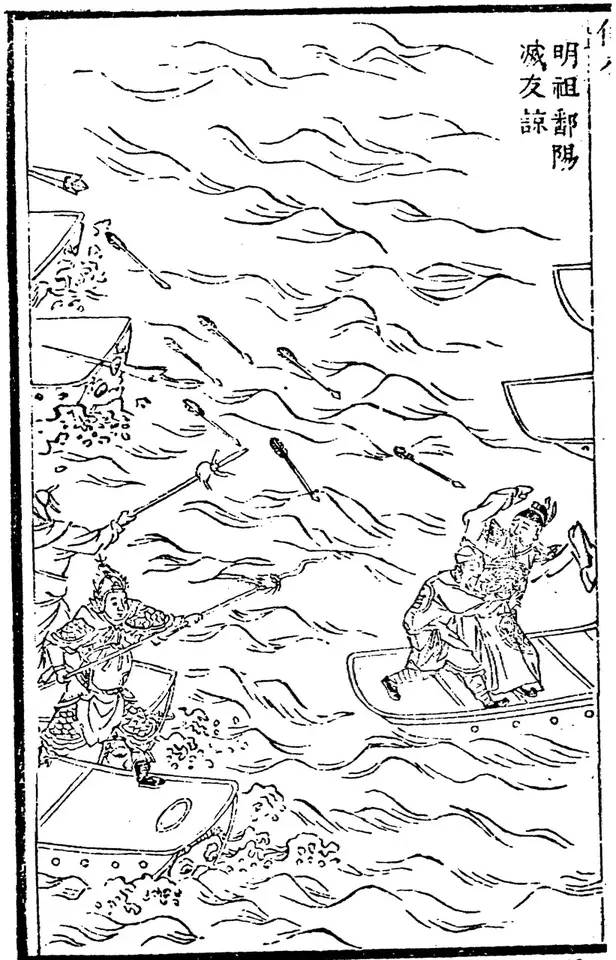
Initially, the sheer scale of the Han warships gave Chen Youliang a formidable advantage. Chained together to form floating fortresses, the Han vessels poured boulders, incendiary pots, and arrows downward upon the smaller Ming craft, nearly capturing Zhu Yuanzhang's flagship. However, this dense formation proved fatal. On the afternoon of July 21, a strong northeast gale swept across the lake. Exploiting the wind, Zhu Yuanzhang dispatched seven fireships loaded with gunpowder, pitch, and dry reeds into the center of the tethered Han armada.
The ensuing conflagration consumed the Han fleet, turning the lake waters scarlet with blood and burning wreckage. Key Han commanders, including Chen Youliang's brothers Chen Youren and Chen Yougui, perished in the flames. During the height of the engagement, Han general Zhang Dingbian executed a daring charge with three swift skiffs straight toward Zhu Yuanzhang's vessel, engaging in desperate hand-to-hand combat until Chang Yuchun wounded his vanguard with an arrow and forced him to withdraw.
The grueling campaign persisted for thirty-six days until the surviving Han forces were starved and trapped within the lake. On October 3, 1363, Chen Youliang attempted a desperate breakout through the narrow Jingjiang outlet into the Yangtze. As he leaned out from the bridge of his flagship to direct the lead vessels, a stray arrow struck him directly through the forehead, killing him instantly at the age of forty-four. His veteran general Zhang Dingbian recovered his body under cover of darkness and escorted his young son Chen Li back to Wuchang, where the remnants of the Da Han dynasty surrendered to the Ming armies in early 1364.
Key Achievements
Development of Naval Architecture and River Armadas
Originating from a family of Yangtze rivermen, Chen Youliang possessed unmatched expertise in aquatic combat and vessel design. Throughout his reign across Huguang and Jiangxi, he directed enormous state resources toward naval construction, creating the largest and most sophisticated river fleet in medieval Chinese history. In state shipyards established at Hanyang and Wuchang, he pioneered the construction of massive three-tiered tower warships designed specifically for inland waterways.
These colossal vessels measured dozens of meters in length and towered several stories above the waterline. Each ship featured three distinct deck levels: lower banks for dozens of oarsmen, middle holds for infantry and stores, and elevated top decks equipped with battlements, iron trebuchets, and arrow slits. Outfitted with iron plating and raw cattle hide to resist incendiary attacks, each vessel could transport up to a thousand armored warriors and warhorses. This monumental naval engineering achieved absolute dominance over the central Yangtze and the Lake Poyang basin, establishing a technical high-water mark for Chinese riverine warfare.
Reforming Institutions and Mobilizing Regional Talent
Following the founding of the Da Han regime, Chen Youliang instituted an administrative apparatus blending traditional central bureaucratic structures with the martial hierarchy of the Southern Red Turbans. He established the Secretariat and the Bureau of Military Affairs in Wuchang, appointing Zou Pusheng as Grand Preceptor, Zhang Bixian as Chancellor, and Zhang Dingbian as Grand Defender, creating a centralized wartime chain of command.
Breaking with hereditary elite privileges, Chen Youliang promoted officers strictly according to battlefield performance and tactical daring, elevating common soldiers, boatmen, and fishermen to high command. Furthermore, he enlisted and promoted non-Han tribal commanders, integrating skilled Miao and Yao cavalry regiments into his military structure. Across local administration, he replaced the Yuan darughachi oversight system with civilian magistrates, providing an institutional framework capable of sustaining long-term warfare across three provinces.
Wartime Agricultural Colonies and River Conservancy
Confronted with widespread economic devastation and food scarcity caused by protracted warfare, Chen Youliang instituted rigorous agricultural colony programs across Hubei, Hunan, and Jiangxi. He mandated that garrison forces allocate thirty percent of their manpower to city defense and seventy percent to agricultural reclamation, establishing expansive military farming settlements along the alluvial floodplains of the Yangtze and Han rivers while providing state oxen and iron implements.
In addition to military farming, Chen Youliang prioritized water conservancy in the flood-prone Jianghan Plain. He organized civilian and military labor to construct and reinforce extensive dike networks and drainage gates around Mianyang and Hanyang, converting marshlands into productive agricultural fields. However, the immense fiscal demands of supporting his massive armies compelled the regime to enforce severe requisitioning, confiscating wealth from affluent merchants and subjecting young men to near-universal conscription. While these harsh measures fueled popular discontent in the closing years of the regime, the agricultural colonies and flood-control works provided the vital logistical foundation that sustained Da Han armies through over a decade of continuous combat.