Birth in Guanzhong
Born in Fengyi County, Tongzhou under the original surname Kang; adopted into the palace by Palace Attendant Zhang Tai.
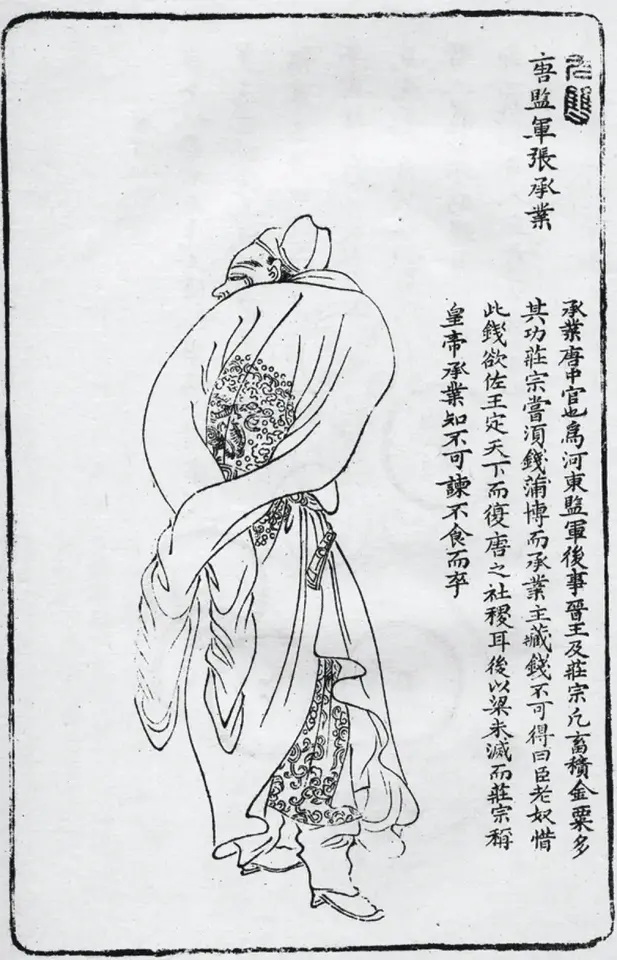
张承业
Zhang Chengye (张承业) (846 – November 2, 922), originally surnamed Kang, was a native of Fengyi in Tongzhou (in modern Dali, Shaanxi Province). He was a celebrated palace eunuch, statesman, and chief logistical commander during the late Tang dynasty and the Five Dynasties period. Castrated and entering the imperial palace in his youth, he was adopted by Palace Attendant Zhang Tai, thereby acquiring the surname Zhang. During the…
Zhang Chengye (张承业) (846 – November 2, 922), originally surnamed Kang, was a native of Fengyi in Tongzhou (in modern Dali, Shaanxi Province). He was a celebrated palace eunuch, statesman, and chief logistical commander during the late Tang dynasty and the Five Dynasties period. Castrated and entering the imperial palace in his youth, he was adopted by Palace Attendant Zhang Tai, thereby acquiring the surname Zhang. During the Guangqi era, he served within the imperial palace and was subsequently promoted to Palace Attendant. During the Qianning era, he was appointed Army Monitoring Commissioner of Hedong, participating alongside Prince of Jin Li Keyong in the suppression of Wang Xingyu and establishing a relationship of mutual trust. In 903, Chancellor Cui Yin conspired with Zhu Wen to exterminate court eunuchs across all military circuits. Unwilling to harm Zhang, Li Keyong concealed him in Houlv Temple and substituted an executed criminal's head to appease the court, securing Zhang's unyielding loyalty. In 908, on his deathbed, Li Keyong entrusted his young heir Li Cunxu to Zhang's care. Zhang promptly collaborated with senior commanders to execute the mutinous uncle Li Kening, stabilizing the Shatuo realm. During the ensuing decade of ferocious wars against Later Liang, Li Cunxu campaigned continuously along the Yellow River, entrusting domestic civil and military administration in Taiyuan entirely to Zhang. Zhang governed Hedong with integrity, encouraging agriculture, accumulating grain, forging weapons, and raising warhorses, while boldly defying Li Cunxu's attempts to squander treasury funds on court entertainers. Zhang remained steadfastly loyal to the Tang dynasty throughout his life, repeatedly rejecting ministerial and princely titles conferred by Li Cunxu and insisting on identifying merely as the Tang Army Monitoring Commissioner of Hedong. In 921, when generals urged Li Cunxu to declare himself emperor, an ailing Zhang traveled from Taiyuan to Weizhou to deliver a weeping admonition, arguing that destroying the Liang usurpers must precede any dynastic claims. When his counsel was declined, he returned to Taiyuan in despair, went on a hunger strike, and passed away on November 2, 922, at the age of seventy-seven. Upon founding Later Tang, Li Cunxu posthumously honored him as Senior General of the Left Martial Guard with the posthumous name Zhenxian.
Born in Fengyi County, Tongzhou under the original surname Kang; adopted into the palace by Palace Attendant Zhang Tai.
Oversaw garrison military administration in Heyang; awarded purple robes for meritorious service and promoted to Palace Attendant.
Appointed Army Monitoring Commissioner under Li Keyong in the campaign against Wang Xingyu, earning Li's lifelong trust.
Zhu Wen and Cui Yin ordered nationwide massacres of eunuchs; Li Keyong saved him by substituting a condemned convict's head.
Zhu Wen usurped the Tang throne; Li Keyong preserved the Tang reign era and reappointed Zhang as Army Monitoring Commissioner.
Li Keyong passed away; Zhang assisted Li Cunxu in capturing and executing the mutinous Li Kening, securing the succession.
Remonstrated with Li Cunxu against reckless head-on charges, persuading Jin troops to withdraw to Haoyi and securing victory.
Li Cunxu advanced across Hebei; Zhang assumed total administrative and logistical command over Taiyuan for a decade.
Learned of Li Cunxu's imperial ambitions; traveled while gravely ill to Weizhou to plead against premature enthronement.
Overcome by grief and fasting, he passed away in Taiyuan on November 2 at age seventy-seven; posthumously named Zhenxian.
Zhang Chengye was born in 846 during the reign of Emperor Wuzong of Tang. Born into impoverished circumstances, he was castrated in his youth and entered the imperial palace in Chang'an, where he was adopted by Palace Attendant Zhang Tai and took the surname Zhang. During the Guangqi era of Emperor Xizong, Zhang was placed in charge of military affairs at Heyang. His prudence, meticulous conduct, and administrative diligence earned him high praise within the palace, culminating in the award of purple robes and promotion to Palace Attendant. In 895, warlords Wang Xingyu and Li Maozhen threatened the imperial capital, and Emperor Zhaozong summoned Li Keyong of Hedong to mount a loyalist relief expedition. Having served as imperial envoy to the northern military camps, Zhang was appointed Army Monitoring Commissioner of Hedong, assisting Li Keyong in crushing Wang Xingyu. Following the campaign, he was reassigned as Director of the Wine Brewery.
In 896, Li Maozhen again rebelled, prompting Emperor Zhaozong to contemplate taking refuge in Taiyuan. Recognizing Zhang's close relationship with Li Keyong, the court dispatched Zhang as Army Monitoring Commissioner to Jinyang to arrange imperial reception quarters. Although Zhaozong ultimately fled to Huazhou instead, Zhang remained stationed in Taiyuan, was appointed General of the Left Gate Guard, and earned Li Keyong's deep respect. In 903, Chancellor Cui Yin allied with Zhu Wen of Xuanwu to seize control of the capital, slaughtering palace eunuchs and issuing secret decrees commanding regional governors to execute all assigned eunuch monitors. Li Keyong admired Zhang's public-spirited devotion and refused to harm him. He covertly hid Zhang within Houlv Temple on the southern outskirts of Taiyuan and decapitated a condemned prisoner to report compliance to the throne. Zhang lived in hiding in the temple for several years, swearing eternal gratitude to the house of Li.
In 907, Zhu Wen murdered the Tang emperor and founded Later Liang. Li Keyong adamantly refused to submit, retaining the Tang Tianyou reign title in Taiyuan and rallying support to overthrow the Liang usurpers and restore the Tang dynasty. Li Keyong recalled Zhang from the monastery and reinstated him as the Tang Army Monitoring Commissioner of Hedong, placing him in charge of vital military and state deliberations. In the first month of 908, Li Keyong fell critically ill in Jinyang. On his deathbed, he summoned Zhang Chengye, his younger brother Li Kening, and senior generals Li Cunzhang and Wu Gong to his bedside, weeping as he grasped their hands and entrusted his twenty-four-year-old heir Li Cunxu to their care.
Grief-stricken, Li Cunxu wept uncontrollably and was unable to conduct public business. Zhang sternly admonished the young prince, declaring that true filial piety lay in preserving ancestral achievements rather than shedding tears. He personally guided Li Cunxu into the main hall to receive the allegiance of civil and military officers, formally confirming his accession as Prince of Jin. In the second month, Li Kening conspired with regional warlords to stage a palace coup, intending to depose Li Cunxu and deliver both mother and son to Kaifeng in chains. Senior officer Shi Jingrong warned Li Cunxu's mother, Lady Cao, who urgently summoned Zhang and tearfully pleaded for safety.
Shocked by the conspiracy, Zhang fell to his knees and declared his absolute fidelity to the late prince's will. Li Cunxu also entered, expressing reluctance to kill his own uncle and offering to abdicate to preserve peace. Zhang adamantly rejected conciliation, asserting that treason could not be tolerated. He coordinated with loyal commanders Li Cunzhang, Wu Gong, Li Cunjing, and Zhu Shouyin to place armed guards around the palace. Days later, during a royal banquet, hidden guards ambushed and executed Li Kening, instantly extinguishing the internal insurrection and securing Li Cunxu's undisputed authority.
With internal stability restored, Zhang aided Li Cunxu in planning the campaign that broke the siege of Luzhou at Jiacheng, decisively altering the balance of power against Later Liang. Overflowing with gratitude, Li Cunxu honored Zhang as "Seventh Brother," visited his home to pay respects to his adoptive mother, and established intimate household ties. Exercising regional prerogatives, Li Cunxu repeatedly sought to grant Zhang exalted titles such as Grand Guardian, Specially Advanced Official, and Duke of Yan, but Zhang resolutely declined each honor, insisting on styling himself solely as a Tang commissioner. Before the Battle of Baixiang in 910, Li Cunxu impetuously prepared to charge enemy lines; veteran commander Zhou Dewei recommended retreating thirty li to Haoyi to draw the enemy into an unfavorable posture, but the young prince refused. Zhang entered Li's personal tent, forcefully arguing that seasoned commanders understood the realities of war; Li Cunxu relented, repositioned his army, and secured a crushing victory.
In 913, Zhang assisted front-line operations to subjugate Liu Shouguang in Youzhou. Following the capture of Weibo and Hebei in 915, Li Cunxu spent nearly a decade leading elite cavalry formations along the Yellow River against Later Liang. He delegated complete administrative, judicial, fiscal, and logistical authority over the Taiyuan home base to Zhang. Residing in Jinyang, Zhang welcomed war refugees, promoted farming, tightened fiscal audits, and maintained flawless domestic order. Armories in Taiyuan forged armor day and night, state pastures bred prime warhorses, and provisions for hundreds of thousands of front-line soldiers arrived without fail. Whenever royal clansmen or aristocratic relatives committed crimes in the rear, Zhang punished them without hesitation, and Li Cunxu never dared intervene.
In 921, having reconquered the Hebei commanderies, Li Cunxu stood poised to crush Later Liang, prompting his civil and military commanders to urge him to take the imperial title. The seventy-six-year-old Zhang Chengye had been bedridden in Jinyang for months. Shattered by the news, he disregarded his failing health and ordered attendants to carry him in a litter across hundreds of li to the front-line encampment at Weizhou. Prostrating himself before Li Cunxu's desk, Zhang wept bitterly, reminding the prince that their three decades of bloodshed had been dedicated to avenging the Tang ancestral altars. To seize the throne prematurely before the Liang usurpers were destroyed would alienate the realm. He urged Li to destroy the enemy first and seek out surviving Tang imperial descendants; only if the imperial lineage was truly extinct should he accept the mandate.
Eager to mount the throne, Li Cunxu gently rebuffed the old eunuch's counsel. Realizing that the dynastic momentum could not be turned, Zhang looked toward the heavens and wept aloud: "Warlords across the realm spilled their blood to restore the house of Tang, yet now Your Highness seizes it for yourself; you have deceived this old slave!" Refusing all gifts and honors, he returned to Jinyang in utter despair. Back home, he refused nourishment and medical care, sinking into terminal illness. On November 2, 922, Zhang passed away in his Taiyuan quarters at age seventy-seven. Lady Cao rushed to his residence dressed in mourning weeds to weep. When Li Cunxu assumed the throne of Later Tang in 923, he posthumously conferred upon Zhang the rank of Senior General of the Left Martial Guard and the posthumous name Zhenxian.
Zhang Chengye's most enduring administrative achievement was turning the mountainous enclave of Hedong into an impregnable economic and military foundation for Later Tang. While Li Cunxu campaigned abroad for nearly ten years, the entire burden of provincial administration rested squarely on Zhang's shoulders.
Understanding the primacy of agriculture, Zhang established military agricultural colonies across Hedong, invited displaced peasant households from the war-torn Central Plains, eliminated extortionate levies, and guarded agrarian stability. Furthermore, he strictly overhauled salt, iron, and liquor taxation, eliminating corruption among fiscal clerks and filling state granaries to capacity. Relying on Zhang's unyielding rear support, the compact territory of Jin outlasted and ultimately conquered the far larger Later Liang empire.
Zhang was celebrated for his absolute incorruptibility and sharp distinction between public funds and personal property. In his later years, Li Cunxu developed a passion for musical theatre and gambling with palace jesters. On one occasion, Li hosted a banquet for Zhang inside the state treasury vault, directing his son Li Jiji to perform a celebratory dance. Zhang presented his personal jade belt and prized horse to the young prince as a gift. Li Cunxu pointed at the towering stacks of copper currency and silk bales in the treasury, laughing that a horse was trivial and ordering Zhang to bestow the entire mound of state money upon his son.
Zhang flatly refused, maintaining that his official stipend was private property to give freely, whereas the treasury held the public wealth of the realm, reserved solely for sustaining soldiers on campaign. Feigning drunken fury, Li Cunxu drew his sword to threaten Zhang. Unflinching, Zhang seized the prince's robe and wept, crying out that he would die without shame having defended state funds in fidelity to the late prince. When general Yan Bao attempted to pull Zhang away, Zhang struck Yan Bao with his fists, denouncing him as a former Liang turncoat who indulged in flattery rather than honest counsel. Upon learning of the confrontation, Lady Cao whipped her son and personally visited Zhang's residence to apologize.
Although positioned as a domestic commissioner, Zhang demonstrated remarkable strategic vision and military composure. During the siege of Jiacheng, Zhang was sent to Fengxiang to request reinforcements. Arriving at the Yellow River in midwinter, he found the crossing blocked by treacherous ice floes. Zhang conducted solemn prayers along the riverbank to the river deity and dreamt of a spirit assuring him of safe passage. By morning, ferry officials reported that the entire river had frozen solid overnight; Zhang led his contingent across the ice, and no sooner had they landed than the ice broke apart.
Within the Jinyang military staff, scholar-official Lu Zhi was notoriously haughty, frequently drinking to excess and publicly reviling Li Cunxu's brothers as dogs and pigs. Enraged, Li Cunxu contemplated executing him. To save the scholar's life, Zhang adopted reverse psychology, telling Li: "Lu Zhi is insufferably arrogant; Your Highness should execute him immediately." Li Cunxu protested: "I am building a hegemonic enterprise and recruiting talented men; how could you advise this?" Zhang solemnly replied: "If Your Highness can truly tolerate such an eccentric genius, what realm could resist you?" Li Cunxu laughed and permanently spared Lu Zhi, illustrating Zhang's subtle diplomatic tact.
Despite reaching the zenith of political power, Zhang subjected his extended family to uncompromising moral and legal discipline, forbidding relatives from exploiting his standing. His nephew Zhang Guan had previously joined the bandit commander Liu Zhijun and lived outside the law. Prior to taking the throne, Li Cunxu appointed Zhang Guan as Prefect of Linzhou out of gratitude to Zhang Chengye.
Zhang Chengye summoned his nephew, castigating him as an ordinary commoner who had repeatedly broken state laws, warning him that continued defiance would lead straight to execution. Chastened by the rebuke, Zhang Guan reformed his conduct and served several regional posts with notable integrity. On another occasion, another nephew killed a cattle merchant during an altercation; Zhang ordered his immediate execution according to statutory law. When Li Cunxu dispatched an emissary on horseback to grant a pardon, the sentence had already been carried out, demonstrating Zhang's unwavering adherence to law over kin.
FIGURES ASSOCIATED WITH THIS DYNASTY