Following His Father
Accompanied his father Dashibadulu from Xiangyang to Henan, confronting the main rebel forces led by Liu Futong.
1320 CE–1368 CE
孛罗帖木儿
Bolod-temür (孛罗帖木儿, ?–1365) was a prominent Mongol general and paramount chancellor in the late Yuan Dynasty, belonging to the Sanji'ut clan. He rose to the highest ranks of Grand Commandant (Taiwei) and Right Grand Chancellor (Zhongshu You Chengsang), being the son of Dashibadulu, the Left Grand Chancellor of the Sichuan Branch Secretariat. Following the outbreak of the Red Turban Rebellions, Bolod-temür campaigned…
Bolod-temür (孛罗帖木儿, ?–1365) was a prominent Mongol general and paramount chancellor in the late Yuan Dynasty, belonging to the Sanji'ut clan. He rose to the highest ranks of Grand Commandant (Taiwei) and Right Grand Chancellor (Zhongshu You Chengsang), being the son of Dashibadulu, the Left Grand Chancellor of the Sichuan Branch Secretariat. Following the outbreak of the Red Turban Rebellions, Bolod-temür campaigned alongside his father across Xiangyang, Fancheng, and the Central Plains, distinguishing himself through valor and strategic acumen. After his father died of grief following setbacks against the rebels, Bolod-temür assumed command of the remaining troops and was appointed Manager of Governmental Affairs for Henan. He successively captured Puzhou and Caozhou, checking rebel advances toward the metropolitan region. Later transferred to garrison Datong and lead the Chief Military and Agricultural Commission (Dadudu Bingnong Si), he repeatedly crushed Guan Xiansheng's Red Turban forces and reclaimed northern Shanxi and Shangdu. Subsequently, he engaged in prolonged, bitter warfare with rival warlord Chaghan Tiemu'er and his adoptive son Kuokuo Tiemu'er over territorial dominance in Shanxi and Hebei, dragging the court into civil conflict. In 1364, after being stripped of his titles for harboring the Censor-in-chief Laodisha, Bolod-temür staged an armed march on the capital Dadu under the guise of purging the court, executed powerful palace eunuch Park Bul-hwa and Chancellor Choes-jian, and appointed himself Right Grand Chancellor, monopolizing central civil and military power. In 1365, Crown Prince Ayushiridara formed an alliance with Kuokuo Tiemu'er and frontier armies to lay siege to Dadu. Emperor Huizong (Toghun Temür), alarmed by Bolod-temür's overbearing despotism, orchestrated a palace conspiracy, leading to Bolod-temür's assassination at the Yanchun Pavilion.
Accompanied his father Dashibadulu from Xiangyang to Henan, confronting the main rebel forces led by Liu Futong.
Dashibadulu died in camp from grief and frustration; Bolod-temür led the troops back to Jingxing Pass to reorganize his father's retinue.
Appointed Manager of Governmental Affairs for Henan; defeated the rebels at Weihui, captured Puzhou, and stormed Caozhou, slaying rebel commander Chancellor Wu.
Ordered to garrison Datong to protect the imperial capital and oversee military agricultural colonies (tuntian); defeated Guan Xiansheng's rebel army and recovered Yunnei and Fengzhou.
Promoted to Manager of Governmental Affairs in the Central Secretariat; suppressed several rebel groups before clashing fiercely with Chaghan Tiemu'er over the Jining Route.
Promoted to Grand Commandant (Taiwei) and senior Manager of Governmental Affairs; accepted the submission of Shaanxi warlord Zhang Liangbi; seized Zhending Route from Kuokuo Tiemu'er.
Defeated and accepted the surrender of Guan Xiansheng's remnants returning from Goryeo; dispatched troops against Jining but suffered defeat at Shiling Pass.
Stripped of titles for harboring Laodisha; led an armed assault on Dadu, executing Park Bul-hwa and Choes-jian; marched into the capital and assumed the office of Right Grand Chancellor.
Faced an encircling coalition led by the Crown Prince; assassinated by imperial guards inside the Yanchun Pavilion under Emperor Huizong's secret decree.
Bolod-temür was born into the Sanji'ut clan of the Mongols, the son of Dashibadulu, one of the foremost loyalist military commanders during the late Yuan Dynasty. As peasant uprisings spread like wildfire across the Central Plains and Huai River valleys during the Zhizheng era, Bolod-temür followed his father on grueling campaigns around Xiangyang and Fancheng, gaining reputation as a capable field officer. In 1355, the Yuan court ordered Dashibadulu to Henan to confront the formidable Red Turban forces led by Liu Futong. Serving under his father, Bolod-temür demonstrated tactical daring and strategic caution, quickly earning the dread of his rebel adversaries.
By late 1357, Dashibadulu became bogged down in Henan due to rebel counter-espionage, severe supply shortages, and factional slander from courtiers. Following military setbacks against Liu Futong, Dashibadulu fell ill and succumbed to indignation in his command camp. With the army shaken by this loss, Bolod-temür stepped forward decisively, gathered his father's scattered forces, and retreated strategically to Jingxing Pass to preserve the army's core strength. In the first month of 1358, the Yuan court, desperate to stabilize northern defenses, officially appointed Bolod-temür as Manager of Governmental Affairs for the Henan Branch Secretariat, formally confirming his hereditary command over his father's seasoned troops.
In the spring of 1358, Liu Futong's Red Turban forces launched a massive multi-pronged northern expedition, placing both the metropolitan provinces and Shaanxi in imminent danger. While Chaghan Tiemu'er and Li Siqi defended Guanzhong, Bolod-temür shouldered the defense of the Central Plains and Hebei. Upon taking command, Bolod-temür launched aggressive counter-offensives. In March, he routed Liu Futong's vanguard at Weihui and subsequently recaptured Puzhou, effectively frustrating rebel attempts to sweep northward from Henan into Hebei and threaten Dadu. In April, he moved his garrison to Zhending, forcing rebel general Mao Gui to withdraw back to Shandong.
In May 1358, rebel forces captured Bianliang (Kaifeng) and pushed westward into Shanxi. The court dispatched Chaghan Tiemu'er to Shanxi while directing Bolod-temür southward to clear eastern communication lines. Bolod-temür led his cavalry south, crushing rebel leader Sha Liu at Pengcheng and reopening courier routes linking the court with the Huai River basin. In September, he was ordered to lead multiple divisions in besieging Caozhou, a vital communications nexus linking Henan and Shandong. The rebels mounted a determined defense led by rebel Chancellor Wu and Bureau of Military Affairs Official Qiu. In October, Bolod-temür coordinated a multi-directional assault: Vice Administrator Kuang Fu led Miao infantry through the west gate, while Bolod-temür spearheaded the main charge through the north gate. The city fell, both rebel leaders were captured and executed, and the strategic connection between Bianliang and Shandong rebels was severed.
Toward the end of 1358, the central branch of the Red Turban northern expedition seized Datong and sacked Shangdu, severely menacing the imperial capital from the north. In February 1359, the Yuan court urgently transferred Bolod-temür to Daizhou, where he absorbed retreating loyalist units from Shandong under Meng Benzhou and advanced into Datong to establish a defensive shield. In March, the court established the Chief Military and Agricultural Commission (Dadudu Bingnong Si) with ten regional branches, placing Bolod-temür in direct charge of military farming and civilian cultivation throughout the northern frontier.
Arriving in Datong, Bolod-temür took the initiative, launching strikes against Yunnei and Fengzhou. He smashed the main rebel force led by Guan Xiansheng, compelling the remnants to retreat east toward Liaodong and reclaiming jurisdiction over Datong Route. In May, he led his army against rebel forces in Weizhou, defeated rebel commander Yang Cheng, and pursued them to Feihu County, accepting the surrender of all surviving combatants. In February 1360, Bolod-temür was promoted to Manager of Governmental Affairs in the Central Secretariat. When Guan Xiansheng briefly recaptured Shangdu and Daning in March, Bolod-temür dispatched frontier expeditions that reclaimed both strongholds, driving rebel forces into the frontier marches between Liaodong and Goryeo. In July, he defeated rebel forces under Wang Shicheng, forcing Tian Feng to withdraw to Dongping, and was granted the seal of Generalissimo (Zongbingguan) with discretionary field authority.
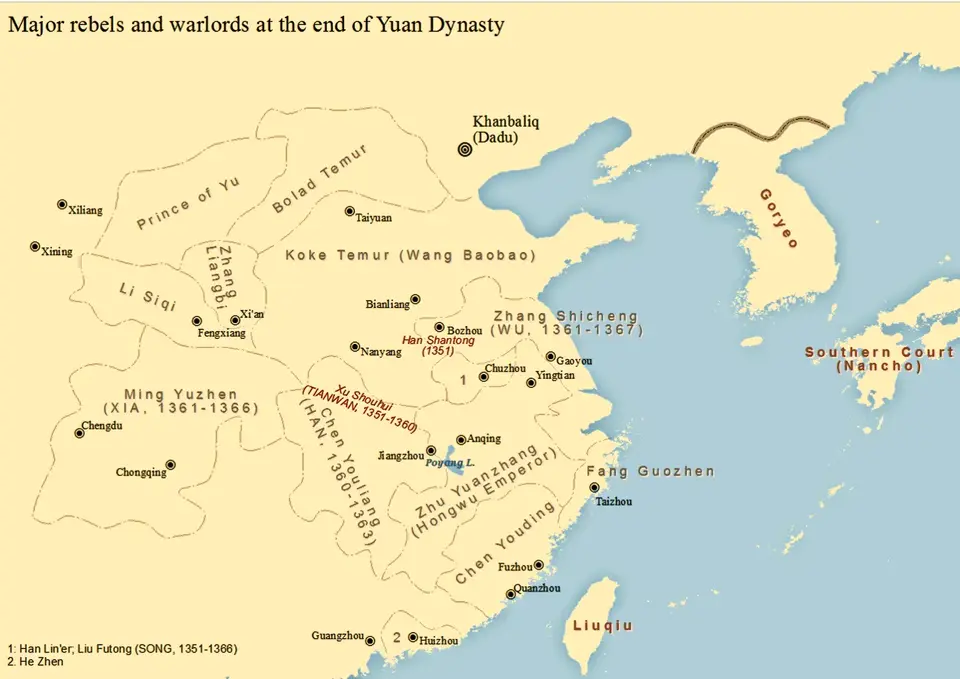
As peasant rebellions were pushed back, the territorial domains of Bolod-temür and fellow loyalist warlord Chaghan Tiemu'er began to overlap, escalating tensions into outright open warfare across Shanxi and Hebei. Both warlords competed for the patronage of court grandees, bribing Chancellor Choes-jian and senior eunuch Park Bul-hwa to obtain imperial decrees endorsing their territorial claims. In an attempt to prevent mutual destruction, the court issued edicts establishing Shiling Pass as a demarcation line, assigning territory north of the pass to Bolod-temür and territory south to Chaghan Tiemu'er. However, both sides repeatedly crossed the boundary in armed skirmishes.
In the autumn of 1360, Bolod-temür besieged Jining Route (Taiyuan) for three days before relocating his camp to Jiaocheng. In October, the court designated Jining as Bolod-temür's defensive station, but when his officers Bao Bao, Yin Xingzu, and Gao Tuoyin raced to take possession, Chaghan Tiemu'er's garrison locked the gates and repulsed them. Regarding Jining as the fiscal lifeline of his military, Chaghan mobilized large armies across the Yellow River, and violent fighting erupted across Fenzhou and Dongsheng. In 1361, imperial commissioners brokered a formal truce, and Bolod-temür ostensibly returned to Datong, though he secretly dispatched his general Tuoliebo to occupy Yan'an and probe Shaanxi. In 1362, the court elevated Bolod-temür to Grand Commandant (Taiwei) and first-ranking Manager of Governmental Affairs. Shaanxi warlord Zhang Liangbi pledged allegiance to Bolod-temür. Following Chaghan Tiemu'er's assassination in Yidu later that year, his adoptive son Kuokuo Tiemu'er took command and continued the blood feud, during which Bolod-temür wrested control of Zhending Route from Kuokuo's forces.
In the spring of 1363, remnants of Guan Xiansheng's rebel force retreating from Goryeo attacked Shangdu, but Bolod-temür defeated and fully incorporated them into his ranks. That autumn, he launched another assault on Jining but suffered a setback at Shiling Pass, where Kuokuo Tiemu'er captured his commanders Wuma'er and Yin Xingzu. Meanwhile, an irreconcilable power struggle erupted between Emperor Huizong and Crown Prince Ayushiridara, splitting the court into imperial and crown prince factions. Censor-in-chief Laodisha and Bureau of Military Affairs Commissioner Tujian Tiemu'er, targeted by the Crown Prince, fled to Datong and sought refuge with Bolod-temür, who sheltered them and refused imperial summons to hand them over.
In March 1364, the Crown Prince coerced Emperor Huizong into stripping Bolod-temür of his official ranks and military titles, ordering Kuokuo Tiemu'er and eastern palace guards to march against him. Bolod-temür dispatched Tujian Tiemu'er, who ambushed and routed the Crown Prince's forces at Huanghoudian. Tujian Tiemu'er advanced directly to the gates of Dadu, forcing the Emperor to execute the Crown Prince's leading conspirators, eunuch Park Bul-hwa and Chancellor Choes-jian. Bolod-temür's titles were restored and he was elevated to Grand Guardian (Taibao). When the Crown Prince ordered renewed assaults upon his return, Bolod-temür personally led his army through Juyong Pass in July and stormed Dadu. The Crown Prince fled to Jining to seek refuge with Kuokuo Tiemu'er. Bolod-temür entered the capital and prostrated himself before Huizong in tears, professing loyalty; Huizong appointed him Left Grand Chancellor and promoted him to Right Grand Chancellor in August, granting him supreme control over both civil administration and all imperial armies.
Having taken control of the Central Secretariat, Bolod-temür ruled autocratically, purged political opponents, and plotted to formally depose Crown Prince Ayushiridara in favor of Xueshan, the young son of Empress Bayan Khutugh. Operating from Taiyuan, the exiled Crown Prince established a Pacification Bureau (Fujun Yuan), issued a call to arms across the empire, and mobilized troops from Lingbei, Gansu, Liaoyang, Shaanxi, and Kuokuo Tiemu'er's main forces to encircle the capital. In early 1365, allied armies recaptured Datong, and Bolod-temür's trusted general Yesu defected to the Crown Prince, leaving Dadu isolated.
Trapped within the capital, Bolod-temür became increasingly suspicious, volatile, and overbearing, terrifying and alienating Emperor Huizong. In July 1365, the Emperor secretly enlisted Confucian scholar Xu Shiben, imperial attendant Wei Guan, and palace guards Yao Yanbuhua and Boliang to orchestrate an assassination. On July 29, 1365, as Bolod-temür entered the palace to report on affairs of state, Yao Yanbuhua and fellow conspirators sprang from behind palace pillars near the Yanchun Pavilion and decapitated him on the spot. Huizong ordered his head placed in a wooden box and dispatched by courier to the Crown Prince's camp at Jining. With Bolod-temür's demise, his faction collapsed immediately, paving the way for the Crown Prince's return.
FIGURES ASSOCIATED WITH THIS DYNASTY