Born at Lukhung in Ngamring | Born at Lukhung in Ngamring, Tsang, as the son of Zangtsa Sönam Gyaltsen and Machig Kunga Kyi
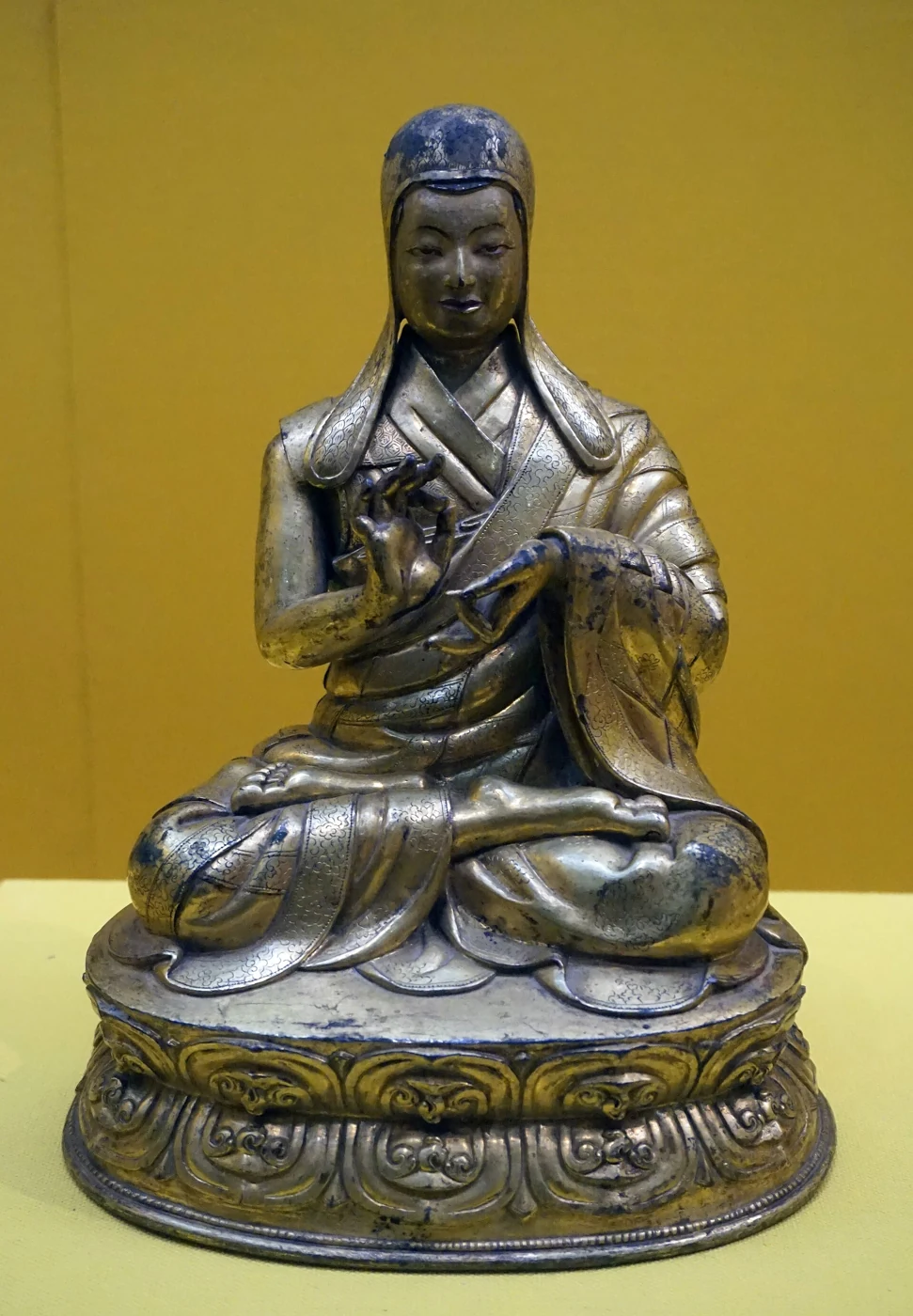
1235 CE–1280 CE
Yuan Buddhist leader and statesman
Lodro Gyaltsen Palzangpo
罗追坚参·贝桑波
Lodro Gyaltsen Palzangpo (Tibetan: འཕགས་པ་; Wylie: 'phags pa; 6 March 1235–15 December 1280), whose personal name was Lodro Gyaltsen and who was also known as Drogön Chögyal Phagpa, was the fifth leader of the Sakya school of Tibetan Buddhism and the first Imperial Preceptor of the Yuan Dynasty. Phagpa came from the Khön lineage of Sakya and studied Buddhism from childhood under his uncle, Sakya Pandita Kunga Gyaltsen. In…
1235 CE–1280 CEYuan Dynasty
PROFILE
Lodro Gyaltsen Palzangpo (Tibetan: འཕགས་པ་; Wylie: 'phags pa; 6 March 1235–15 December 1280), whose personal name was Lodro Gyaltsen and who was also known as Drogön Chögyal Phagpa, was the fifth leader of the Sakya school of Tibetan Buddhism and the first Imperial Preceptor of the Yuan Dynasty. Phagpa came from the Khön lineage of Sakya and studied Buddhism from childhood under his uncle, Sakya Pandita Kunga Gyaltsen. In 1244, the third year after Töregene's regency began, he accompanied Sakya Pandita to Liangzhou to meet the Mongol prince Köden and took monastic vows on the journey. In 1253, during the third year of Möngke's reign, he met Kublai Khan at Mount Liupan and conferred a tantric initiation on him, after which Kublai regarded him as a religious master. After Kublai's accession, Phagpa was honored as State Preceptor and placed over Buddhist affairs throughout the realm. In 1264, the first year of the Zhiyuan era, he was placed in charge of the Bureau of General Regulation and concurrently supervised military and administrative affairs in Tibet. In 1269, the sixth year of Zhiyuan, he completed a new Mongolian script based on Tibetan letters, later known as the Phags-pa script; the Yuan court promulgated it throughout the empire the following year. In 1270, the seventh year of Zhiyuan, he was elevated to Imperial Preceptor and Great Precious Dharma King. On the 22nd day of the 11th lunar month of the 17th year of Zhiyuan (15 December 1280), Phagpa died at Sakya Monastery at the age of forty-six. His life was devoted to the spread of Tibetan Buddhism, the establishment of relations between Tibet and the Yuan central government, and the creation of the Phags-pa script, all of which had lasting political, religious, and cultural influence in the Yuan period.
- Alternative names
- Lodro Gyaltsen; Drogön Chögyal Phagpa; Lodro Gyaltsen
- Period
- Yuan
- Date of Birth
- 1235
- Date of Death
- 1280
- Dynasty / polity
- Yuan Dynasty
- Identity
- Yuan Buddhist leader and statesman
- Ethnicity / group
- Tibetan
- Native place
- Sakya, Ü-Tsang (present-day Sakya County, Tibet)
- Place of birth
- Not recorded in historical sources
- Place of death
- Not recorded in historical sources
- Highest office
- See Biography and Major Deeds
- Major achievements
- Nephew of Sakya Pandita; appointed Imperial Preceptor by Kublai Khan; created the Phags-pa script, which was honored as an imperial script
LIFE TIMELINE
Age 10 | Age ten; accompanied his uncle Sakya Pandita to Liangzhou and took novice vows on the journey
Reached Liangzhou with Sakya Pandita | Reached Liangzhou with Sakya Pandita
Took part in the Liangzhou meeting between Sakya Pandita and Köden | Took part in the Liangzhou meeting between Sakya Pandita and Köden, after which Tibet submitted to Mongol authority
Sakya Pandita died | Sakya Pandita died; Phagpa succeeded him as leader of the Sakya school
Met Kublai Khan at Mount Liupan | Met Kublai Khan at Mount Liupan, conferred the Hevajra initiation, and was accepted as his religious master
Met Kublai Khan again at a place transcribed in Chinese as Teci and received an edict prot | Met Kublai Khan again at a place transcribed in Chinese as Teci and received an edict protecting monasteries
Received full ordination at Hezhou | Received full ordination at Hezhou
Pilgrimage to Mount Wutai | Pilgrimage to Mount Wutai; composed works including Praise of the Names of Manjushri
Participated in the great Buddhist-Daoist debate at Kaiping and helped the Buddhist side p | Participated in the great Buddhist-Daoist debate at Kaiping and helped the Buddhist side prevail
Kublai took the throne | Kublai took the throne; appointed Phagpa State Preceptor, granted him a jade seal, and placed him over Buddhist affairs throughout the realm
Placed in charge of the Bureau of General Regulation and given concurrent responsibility f | Placed in charge of the Bureau of General Regulation and given concurrent responsibility for Tibetan military and administrative affairs; returned to Tibet with his younger brother Chakna Dorje by imperial order
Reached Sakya | Reached Sakya, repaired Sakya Monastery, and studied Buddhist doctrine under a number of masters
Returned to Dadu and presented the new Mongolian script he had created | Returned to Dadu and presented the new Mongolian script he had created; Kublai promulgated it throughout the realm
Again initiated Kublai | Again initiated Kublai; elevated to Imperial Preceptor of the Great Yuan and granted the title Great Precious Dharma King
Left Dadu to spend the summer retreat at Lintao | Left Dadu to spend the summer retreat at Lintao, where he built a monastery and taught the Dharma
Returned to Tibet under escort by Crown Prince Zhenjin | Returned to Tibet under escort by Crown Prince Zhenjin; composed the Shes bya rab gsal on the journey
Reached Sakya | Reached Sakya, assumed the position of Sakya Dharma King, and appointed the pönchen Shakya Zangpo to govern the thirteen myriarchies of Tibet
Held the Chumig Chökor gathering at Chumig Ringmo | Held the Chumig Chökor gathering at Chumig Ringmo, attended by seventy thousand monks
Died at Sakya Monastery at the age of forty-six | Died at Sakya Monastery at the age of forty-six
BIOGRAPHY
Biography
Family Background and Early Years
Phagpa was born on the sixth day of the third month in the second year of the Southern Song Duanping era, the Wood Sheep year of the fourth Tibetan rabjung cycle (1235), at Lukhung in Ngamring, Tsang. His personal name was Lodro Gyaltsen. Because he was born in a Wood Sheep year, his childhood name was recorded in Chinese transcription as Leiji, meaning “little sheep child.” His father was Zangtsa Sönam Gyaltsen and his mother Machig Kunga Kyi. He was his mother's eldest son and was born when his father was fifty-two.
Phagpa came from the prominent Khön aristocratic lineage, written in some Chinese sources with another character form. The Khön clan rose to prominence in the early eighth century. In 1073, the sixth year of the Northern Song Xining era, Khön Könchok Gyalpo founded Sakya Monastery beneath Mount Ponpor and established the Sakya school. After more than two centuries of development, the Sakya school became firmly established in Tibet and grew into an influential religious tradition.
Phagpa was described as extraordinarily gifted. Tradition held that he could read and write the Five Sciences without instruction: the five major sciences included grammar or phonology, logic, medicine, arts and crafts, and Buddhist studies, while the five minor sciences included rhetoric, lexicography or poetics, prosody, drama, and astrology. At age three he was said to be able to recite mantras and perform meditative practices from memory. Those around him regarded this as extraordinary and called him “Phagpa,” understood in the source as meaning a holy sage or wise banner.
Journey to Liangzhou and Succession as Sakya Leader
During Phagpa's childhood, the Mongol Empire rose and expanded in all directions. In 1239, the third year of the Southern Song Jiaxi era, Mongol forces advanced toward Tibet. The following year, Köden, a son of the Great Khan Ögedei, sent troops into Tibetan areas and began managing Tibetan affairs. In 1244, Köden invited Phagpa's uncle, Sakya Pandita Kunga Gyaltsen, head of the Sakya school, to Liangzhou (present-day Wuwei, Gansu) to discuss future arrangements for Tibet. Although already sixty-three and in poor health, Sakya Pandita set out with his two nephews, who were regarded as designated heirs to the religious and secular leadership of the Khön family: ten-year-old Phagpa and six-year-old Chakna Dorje.
Sakya Pandita's party reached Liangzhou in 1246, the first year of Güyük's reign. In the first lunar month of 1247 they met Köden and held the Liangzhou talks, an event that reshaped Mongol-Tibetan relations. After the meeting, Tibet formally submitted to Mongol rule. Sakya Pandita remained in Liangzhou as Köden's religious teacher, and Phagpa stayed with him and continued his Buddhist studies. Chakna Dorje adopted Mongol dress, learned the Mongol language, and married a daughter of a Mongol prince.
At the end of 1251, the first year of Möngke's reign, Sakya Pandita died at Huanhua Monastery in Liangzhou. Phagpa, then only seventeen, became the monastery's second abbot and succeeded as head of the Sakya school. Because of his mastery of the Five Sciences, he was also known as a pandita, meaning a learned scholar.
Establishing a Relationship with Kublai Khan
In the summer of 1253, the third year of Möngke's reign, the army of Kublai, younger brother of Möngke Khan, reached the Mount Liupan and Lintao region during its southern campaign. Probably between the fourth and eighth lunar months, Phagpa was invited to Mount Liupan to meet Kublai. Kublai first asked about Tibetan history and Sakya Pandita, then said he intended to send officials to Tibet to levy military obligations and collect valuables. Phagpa replied that Tibet was only a remote and poor land with little territory and asked him not to impose such burdens. When Kublai initially ignored these pleas, Phagpa said that under such conditions Tibetan monks had no reason to remain there and asked permission to return home.
At this impasse, Kublai's principal wife Chabi told him that Phagpa surpassed many elderly monks in learning and spiritual accomplishment and should be kept at court. Kublai met him again and asked, “What achievements did your ancestors have?” Phagpa replied that earlier members of his lineage had been revered as spiritual teachers by rulers in China, Western Xia, Tibet, and elsewhere and therefore possessed great prestige. Kublai, unfamiliar with Tibetan history, questioned whether Tibet had ever possessed kings and suggested the claim conflicted with Buddhist texts. Phagpa recounted how Tibetan kings had fought Chinese states, won victories, then entered marriage alliances and received a princess and sacred image. He explained that the Buddhist scriptures did not record the story, but written historical records did. He was referring to the marriage of Songtsen Gampo and Princess Wencheng. Kublai consulted Chinese histories and found the episode recorded in Tang historical works. Phagpa then cited other historical precedents that could also be verified, increasing Kublai's respect. Kublai asked him to confer the Hevajra initiation.
Phagpa, however, imposed a condition: “After receiving initiation, the master sits above; one bows physically to the master, obeys the master's words, and does not violate the master's wishes.” Kublai found this difficult to accept. Chabi mediated, proposing that when few people were present the religious master could sit above, but at assemblies of princes, imperial sons-in-law, officials, and subjects, the khan would occupy the higher seat. Kublai thereby accepted Phagpa as his religious master, laying a foundation for the Yuan system of Imperial Preceptors and the privileged position later accorded Tibetan Buddhism. Kublai, Chabi, and their children, twenty-five people in all, are described as having received tantric initiation from Phagpa according to the etiquette of lay patrons meeting a master. Kublai presented valuables as offerings for the initiation.
Kublai continued south toward Dali. After presiding over the consecration of Sakya Pandita's reliquary in Liangzhou, Phagpa set out toward Ü-Tsang, intending to receive full monastic ordination from a master whose name is preserved only in phonetic transcription in the Chinese source. At Dokham he learned from merchants that the master had died and therefore turned back. In 1254, the fourth year of Möngke's reign, Phagpa again met Kublai, returning north from Yunnan, at a place transcribed in Chinese as Teci. Kublai was delighted and in early May issued an edict protecting monasteries from violation. It also instructed monks not to compete for official rank or use imperial decrees to oppress others, but instead to “revere Heaven and pray for me.”
In the fifth lunar month of 1255, Phagpa went to Hezhou and received full ordination from Nethangpa Drakpa Sengge, Chapa Chökyi Sengge, Yarlungpa Lama Jangchub Gyaltsen, and others. He later returned to Shangdu, in present-day Zhenglan Banner of Xilingol, Inner Mongolia, and continued religious activities.
Buddhist-Daoist Debate and the Position of State Preceptor
In 1257, the seventh year of Möngke's reign, Phagpa made a pilgrimage to the Buddhist sacred site of Mount Wutai and wrote poems such as Praise of the Names of Manjushri and Praise of Manjushri's Firm Wheel of Dharma, as well as a work recorded as Extensive Notes on Hearing the Dharma. At the time, disputes between Buddhists and Daoists frequently arose. To resolve them, Kublai, acting under authority from Möngke Khan, presided over a major debate at Kaiping in 1258, the eighth year of Möngke's reign. Seventeen representatives from each side participated, debating in particular the authenticity of the Scripture of Laozi Converting the Barbarians. Phagpa took part and ranked second after the master Namo. His debating ability contributed to the Buddhist victory. When Daoists used the Records of the Grand Historian to challenge Buddhist claims of orthodoxy and the Buddhist side momentarily lacked an answer, Phagpa turned the Daoists' own evidence against them and demonstrated contradictions in their position. The Daoist side eventually acknowledged defeat. After the debate, Fan Zhiying and sixteen other Daoists were tonsured as Buddhist monks, and a small number of Daoist temples were converted into Buddhist monasteries. Möngke was said to be “greatly pleased” and appreciated Phagpa's ability. In the same year, Phagpa wrote the Bright Mirror of the Lamdré Teaching, setting out Sakya positions.
Phagpa continued to follow Kublai through the succession struggle with Kublai's younger brother Ariq Böke after Möngke's death. In the 12th lunar month of 1260, the first year of Zhongtong, after achieving an initial advantage over Ariq Böke, Kublai returned to Yanjing (present-day Beijing), assumed the Mongol khanship, appointed the twenty-two-year-old Phagpa State Preceptor, granted him a jade seal, and placed him over Buddhist affairs throughout the realm. Phagpa thereby became the leading Buddhist authority in the empire.
Administration of the Bureau of General Regulation and Creation of the New Mongolian Script
After becoming Great Khan, Kublai recognized that difficult travel across the Tibetan Plateau hindered administration, military supply, and commercial travel. He decided to establish postal stations connecting the central government with Tibet. With Phagpa's support, Kublai principally constructed a relay route from Qinghai toward the Sakya region. Phagpa issued religious orders to the Tibetan Buddhist establishment requiring full cooperation. Twenty-seven major relay stations were eventually created between Qinghai and Sakya, improving communications.
In 1264, the first year of Zhiyuan, Kublai moved his capital to Dadu, that is, Yanjing (present-day Beijing), and established the Bureau of General Regulation, a special institution responsible for Buddhism throughout the realm and for “concurrently governing Tibetan affairs.” Phagpa, as State Preceptor, was placed in charge of the bureau. In the same year, Kublai issued an edict stating that he had received initiation from Phagpa, had appointed him State Preceptor, and had placed him in charge of the Buddhist administration of the empire. The edict ordered respect for monks and protection of monastic property.
At this time Phagpa's younger brother Chakna Dorje was granted the title Prince of Bailan. In the summer of 1264, the brothers were ordered to return to the Sakya region and complete the establishment of a Tibetan administrative system. On New Year's Day of 1265, the second year of Zhiyuan, Phagpa reached Lhasa and offered distant New Year congratulations to Kublai from the Jokhang. In spring he arrived at Sakya, repaired Sakya Monastery, installed a new stone Buddha image in the Tashi Gomang stupa, created canopies and Dharma wheels for statues of the first seven Sakya lamas, and produced more than two hundred volumes of the Kangyur written in gold. He also studied under more than twenty masters, including a Kashmiri pandita whose name is preserved only in phonetic transcription in the Chinese source, the translator Sherab Rinchen, and the Narthang abbot Chim Namkha Drak, studying Buddhist logic, sutra doctrine, tantric practice, ritual, and the traditional Tibetan Five Sciences.
Phagpa remained in Tibet for three years. In addition to establishing local administrative structures, one of his most important achievements during this period was the creation of a new Mongolian script. Based on thirty Tibetan letters, he designed a new script of forty-one letters, with its phonetic system adapted for Mongolian. It later became known as the Phags-pa script. In 1269, the sixth year of Zhiyuan, Phagpa returned to Dadu and was welcomed by Crown Prince Zhenjin, princes, and senior officials. He presented the new script commissioned by Kublai, who was greatly pleased and immediately promulgated it throughout the realm.
Elevation to Imperial Preceptor and Later Years
In 1270, the seventh year of Zhiyuan, Phagpa conferred a second tantric initiation on Kublai. In the same year, Kublai elevated him to Imperial Preceptor of the Great Yuan and granted him another jade seal. The source records a full title presenting him as the universal Buddhist teacher, incarnate Buddha, creator of the script, protector of state government, and pandita learned in the Five Sciences; he was also known as Imperial Preceptor and Great Precious Dharma King. He received one thousand large ingots of silver and 59,000 bolts of silk. As Imperial Preceptor, Phagpa lectured on Buddhist doctrine to the emperor, empress, and crown prince, prayed for their longevity and good fortune, and conducted large-scale rituals for the stability of the state. In the 12th lunar month of 1269, the sixth year of Zhiyuan, he led monks in seven days and nights of Buddhist rites at the Imperial Ancestral Temple. The following year a white parasol bearing Sanskrit letters in gold was placed above the imperial throne to “subdue evil spirits and protect the state and its sacred precincts.”
When Kublai received the great Sakya tantric initiation from Phagpa, he is described as having offered, as religious patronage, the thirteen myriarchies of Tibet and three cholkha, including Dokham and Amdo and thus almost the entire Tibetan region, giving Phagpa authority over these religious-administrative areas.
In 1271, the eighth year of Zhiyuan, Phagpa left Dadu for a summer retreat at Lintao, where he built a monastery and taught the Dharma. In the third lunar month of 1274, the 11th year of Zhiyuan, he traveled toward Lhasa under the escort of Crown Prince Zhenjin, while his younger half-brother Rinchen Gyaltsen succeeded to the post of Imperial Preceptor. During the journey, Phagpa repeatedly wrote to Kublai to inquire after his health, congratulated him on Yuan victories over Southern Song cities, urged virtuous conduct and restraint in killing, and explained Buddhist doctrine to Zhenjin. These teachings later formed the Shes bya rab gsal.
At the end of 1276, the 13th year of Zhiyuan, Phagpa reached Sakya. Geshe scholars responsible for religious teaching in Ü-Tsang and regional chiefs responsible for local affairs came to meet him. Phagpa assumed the position of Sakya Dharma King and appointed the pönchen Shakya Zangpo to command the thirteen myriarchies of Tibet, marking the beginning of Sakya's combined religious and political rule in the region. In cultural exchange, he brought Tibetan arts into the interior and introduced printing and theatrical arts from the interior to Tibet.
In the first lunar month of 1277, the 14th year of Zhiyuan, Phagpa held a great religious assembly at Chumig Ringmo in Tsang, near Narthang Monastery, attended by seventy thousand monks. Crown Prince Zhenjin acted as patron in Kublai's name. The assembly helped resolve disagreements, strengthened the Tibetan administrative system, and expanded Sakya religious influence.
While Phagpa was at Sakya, he made new appointments among officials in Ü-Tsang. These measures provoked dissatisfaction. After Zhenjin's escort troops withdrew, tensions sharpened. The Han-Tibetan Historical Collection records that because the pönchen Kunga Zangpo committed acts of betrayal, the matter was reported to the court. The emperor, concerned about the importance of relations with the Sakya school, decided to protect it and sent the minister Sangge at the head of a Mongol army to investigate. Sangge led seventy thousand Mongol troops and thirty thousand troops from Dokham and Amdo, for a total of one hundred thousand. He quickly defeated the opposition and executed Kunga Zangpo, then paid respects to Phagpa before returning with the army.
In the Iron Dragon year of the fifth Tibetan rabjung cycle, on the 22nd day of the 11th lunar month of the 17th year of Zhiyuan (15 December 1280), Phagpa died at the Lhakhang Labrang of Sakya Monastery at the age of forty-six; another account claims that an attendant poisoned him. After his death at Sakya, Kublai conferred another elaborate posthumous honorific praising him as a supreme teacher, protector of government, enlightened sage, Great Precious Dharma King, and Imperial Preceptor of the Great Yuan.
After Phaqpa's death Kublai granted him the further title of "Great Treasure Dharma King, Son of Buddha of the Western Heaven, Imperial Preceptor of the Great Yuan, Opening the Teaching and Spreading Culture, Aiding Government, of Great Sageliness and Perfect Virtue, of Universal Enlightenment and True Wisdom, Protector of the State, Fulfilling All Wishes, One Man Above All Under Heaven," and the office of imperial preceptor passed to his brother Rinchen Gyaltshan. Most imperial preceptors of the Yuan thereafter came from the Khon clan of Sakya, and the sect's religious and political standing in Tibet lasted to the end of the dynasty. The Clear Knowledge he composed for the edification of the heir apparent Zhenjin, together with the History of the Sakya Lineage and other works by later Sakya historians, preserve his life and his religious decrees, Yuan official documents and Tibetan sources corroborating each other and forming the basic material for the study of Tibetan Buddhism and the administration of Tibet under the Yuan. He founded monasteries and taught at Dadu and Lintao and held assemblies at Mount Wutai and Chumig, his religious activity bound up with the state ritual of the Yuan, and his influence on the religious landscape of the dynasty was profound.
The Phaqpa script served in the Yuan for seals, stelae and official documents and fell out of use after the dynasty's fall, but surviving inscriptions and papers are direct material for the study of Yuan language, writing and institutions.
This relation between Sakya and the Yuan lasted to the end of the dynasty, the office of imperial preceptor becoming a fixed institution joining politics and religion under the Yuan.
His religious decrees and the Yuan patents survive in both Tibetan and Chinese sources.
Major Activities
Liangzhou Meeting and Tibetan Submission
Phagpa accompanied his uncle Sakya Pandita to Liangzhou and participated in the Liangzhou talks, which helped bring Tibet under Mongol authority and laid a foundation for its later incorporation into the Yuan political order. After the meeting, Sakya Pandita remained at Liangzhou, while Phagpa studied under him and succeeded as leader of the Sakya school after his death.
Buddhist-Daoist Debate
In 1258, the eighth year of Möngke's reign, Phagpa took part in the major Buddhist-Daoist debate at Kaiping presided over by Kublai. His debating ability contributed to the Buddhist victory. He used Daoist evidence to expose contradictions in the Daoist case, and the Daoist representatives eventually acknowledged defeat. Fan Zhiying and sixteen other Daoists were tonsured as Buddhist monks.
Creation of the New Mongolian Script (Phags-pa Script)
At Kublai's order, Phagpa created a new Mongolian script of forty-one letters based on the Tibetan alphabet. He presented it to Kublai in 1269, the sixth year of Zhiyuan, and it was promulgated throughout the empire. Later known as the Phags-pa script, it served as an official Yuan script and was used to write Mongolian and other languages.
Administration of the Bureau of General Regulation and Governance of Tibet
In 1264, the first year of Zhiyuan, Phagpa, as State Preceptor, was placed concurrently in charge of the Bureau of General Regulation, overseeing Buddhist affairs throughout the empire as well as Tibetan military and administrative affairs. After returning to Sakya, he established a local administrative system, appointed a pönchen to govern the thirteen myriarchies, and created administrative offices recorded in the Chinese source as “cilang.” These measures established Sakya's combined religious and political rule in Tibet and provided an administrative foundation for Yuan governance in the region.
Chumig Religious Assembly
In 1277, the 14th year of Zhiyuan, Phagpa held a great assembly at Chumig Ringmo in Tsang, gathering seventy thousand monks. Crown Prince Zhenjin acted as patron in Kublai's name. The gathering reduced disagreements, strengthened the Tibetan administrative system, and expanded the Sakya school's religious influence.
Cultural Exchange
Phagpa brought Tibetan artistic traditions into the interior and introduced printing technology and theatrical arts from the interior into Tibet, promoting cultural exchange among Mongols, Tibetans, and Han Chinese.
Writings and Translation
Phagpa participated in the translation of Sanskrit Buddhist texts and wrote works including the Shes bya rab gsal, Bright Mirror of the Lamdré Teaching, Catalogue of the Tantra Continuations, Collection of Instructions for Rulers: Clear Admonitions, Treasury of the Bodhi Path, Catalogue of the Collected Works of the Five Sakya Founders: Illusory Key, and Praise of the Names of Manjushri.
Phaqpa's principal achievements may be grouped under several heads. First, he made religious ties the bond that joined Tibet to the Mongols and the Yuan. From his journey to Liangzhou with his uncle Sakya Pandita in 1244 onward he dealt with the Mongol leadership at Liangzhou, Liupanshan and Tela; in 1253 he conferred tantric initiation on Kublai and twenty-five of his household, and the next year received an edict protecting monasteries. In 1260 he was made national preceptor with charge of all Buddhist affairs, and from then on a stable religious-political relation between the Tibetan sangha and the Yuan throne was established, on which the office of imperial preceptor was founded.
Second, he devised the new Mongol script. Ordered to model a script on the Tibetan alphabet, he produced one of forty-one letters, its sounds spelled according to Mongol usage, and presented it in 1269 for promulgation throughout the realm; later ages called it the Phaqpa script. It formed part of the official writing system of the Yuan and is an important instance of Tibetan scribal tradition reaching the interior.
Third, he helped build the administrative and post-station system in Tibet. In 1264 the Yuan set up the General Administration for Buddhist Affairs and gave it to him as national preceptor, and he and his brother Qanadog were sent back to Sakya to establish a local administration. For the post stations he issued an order requiring the full cooperation of the Tibetan Buddhist world, and twenty-seven great stations were built from Qinghai to Sakya. In 1276 he took the office of Sakya hierarch, appointing the ponchen Shakya Sangpo over the thirteen myriarchies, the beginning of Sakya rule combining religion and government in Tibet.
Fourth, his religious and cultural work. In 1257 he visited Mount Wutai and composed praises of Manjushri and the Wide Record of Hearing the Law; in 1258 he took part, at Kublai's order, in the great Buddhist-Daoist debate at Kaiping, seventeen disputants on each side, over the authenticity of the Scripture of Laozi's Conversion of the Barbarians, where he used the Daoists' own authorities to expose their contradictions, the Buddhist side prevailed, and seventeen Daoists including Fan Zhiying were shaved as monks; that year he wrote the Clear Mirror of the Path and Fruit. In the twelfth month of 1269 he led monks in a seven-day service in the ancestral temple, and the next year set a white umbrella inscribed in golden Sanskrit over the throne to ward off evil. In the first month of 1277 he held the great assembly at Chumig Ringmo in Tsang, gathering seventy thousand monks with the heir apparent Zhenjin as patron in Kublai's name, settling differences and strengthening the position of the Sakya. He brought Tibetan art to the interior and the printing arts and drama of the interior to Tibet, an exchange of cultures worth recording.
Personal Relations
- Zangtsa Sönam Gyaltsen (father)
- Machig Kunga Kyi (mother)
- Sakya Pandita Kunga Gyaltsen (uncle, fourth leader of the Sakya school)
- Chakna Dorje (younger brother, enfeoffed as Prince of Bailan)
- Rinchen Gyaltsen (half-brother, succeeded as Imperial Preceptor)
- Dharmapala Raksita (nephew, succeeded as Imperial Preceptor)
- Sakya Pandita Kunga Gyaltsen (Buddhist transmission)
- A master whose name is preserved only in phonetic transcription in the Chinese source (intended teacher for full ordination, but the ordination did not take place)
- Nethangpa Drakpa Sengge, Chapa Chökyi Sengge, and Yarlungpa Lama Jangchub Gyaltsen (teachers at his full ordination)
- A Kashmiri pandita whose name is preserved only in phonetic transcription in the Chinese source, translator Sherab Rinchen, and Narthang abbot Chim Namkha Drak (Buddhist studies)
- Kublai Khan (Emperor Shizu of Yuan; patron and disciple; appointed Phagpa State Preceptor and Imperial Preceptor)
- Köden (Mongol prince; participant in the Liangzhou talks)
- Möngke Khan (Great Khan; appreciated Phagpa's debating ability)
- Zhenjin (crown prince; escorted Phagpa back to Tibet and acted as patron of the Chumig assembly)
- Chabi (Kublai's principal wife, who helped establish the relationship between Kublai and Phagpa)
- Sangge (Yuan minister who led troops to suppress opposition)
- Daoist leaders (opponents in the Buddhist-Daoist debate)
- Pönchen Kunga Zangpo (Sakya pönchen accused of betrayal and executed by Sangge)
Historical Assessment
Yuan / Contemporary
- Kublai granted Phagpa an elaborate title presenting him as the supreme religious figure beneath Heaven and praising him as teacher, protector of government, great sage, Great Precious Dharma King, Son of the Buddha in the West, and Imperial Preceptor of the Great Yuan.
- The History of Yuan states that over a century the court showed the Imperial Preceptors extreme respect and trust; emperors, empresses, consorts, and imperial women bowed to them after receiving initiation, and at formal court assemblies an Imperial Preceptor might occupy a separate honored seat. This illustrates the extraordinary status of the office associated with Phagpa.
- In 1320, the seventh year of the Yanyou era under Emperor Renzong of Yuan, the court ordered halls dedicated to Phagpa the Imperial Preceptor to be built in circuits throughout the empire. In 1324, the first year of Taiding, the court produced eleven images of Phagpa for distribution to the provinces so that statues could be made and worship offered. A lengthy posthumous title again praised his religious and political achievements, showing continued Yuan recognition of his role.
Ming and Qing Periods
- Ming scholars generally emphasized Phagpa's dual political and religious role, regarding his assistance in Yuan administration of Tibet and his creation of a new script as contributions to political unification.
- Qing official compilations such as the Continuation of the Comprehensive Treatises recorded his creation of the new Mongolian script and his administration of the Bureau of General Regulation, treating him as a key figure in Yuan governance of Tibet.
- Later eminent monks of the Tibetan Buddhist schools revered Phagpa as one of the Five Founders of Sakya. Tibetan-language sources evaluated him highly for spreading Buddhism and supporting government.
Modern Scholarship
- Chen Dezhi, in “A Study of the Date of Phagpa's First Meeting with Kublai,” argued through chronological research that the meeting took place in 1253, the third year of Möngke's reign, and affirmed Phagpa's key role in Yuan-Tibetan relations.
- In modern Tibetan studies, Phagpa is regarded as an important historical figure in Tibet's incorporation into the Chinese political sphere; the Phags-pa script he created is also an important source for the study of Yuan-period languages and writing.
- Works including Wang Liangliang's edited volume The First Emperor to Unify All Under Heaven—Kublai describe Phagpa as one of Kublai's central assistants in governing Tibet and implementing religious policy.
- International Tibetan studies also attach major importance to Phagpa, treating him as a landmark figure in the development of the Sakya school. Works such as the Shes bya rab gsal are regarded as having significant scholarly value.
FIGURES ASSOCIATED WITH THIS DYNASTY
Bibliography
- , relevant accounts of the northwestern princes and Emperor Chengzong;, History of Yuan, et al.
- Chen Dezhi, Research on Chinese History, Research on Chinese History, 2004no. 01