Birth in Urban Suzhou
Born in Suzhou into an impoverished commoner household that subsequently amassed wealth through herbal medicine and landscape horticulture.
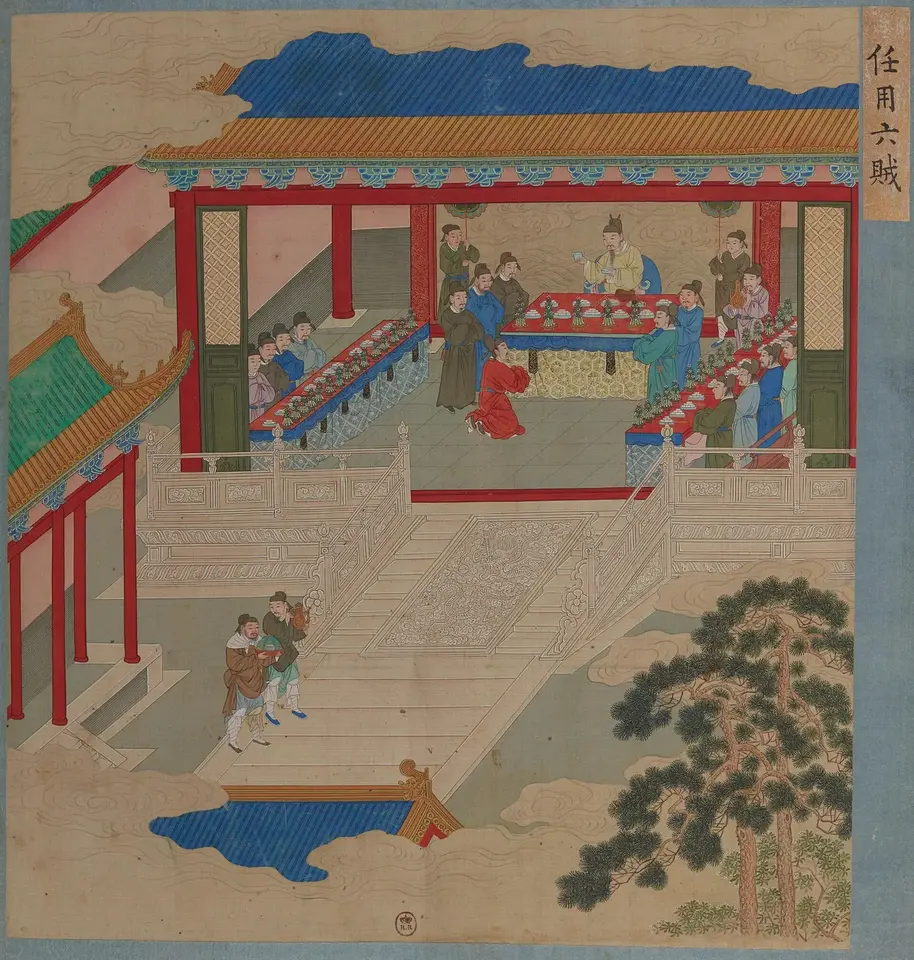
朱勔
Zhu Mian (朱勔, 1075–1126), also written as Zhu Mian (朱勉), was a native of Suzhou (苏州, present-day Suzhou, Jiangsu Province) and one of the infamous Six Bandits of the late Northern Song Dynasty, serving as the principal instigator and director of the devastating Flower-and-Stone Convoys. Born into an impoverished commoner family, his father Zhu Chong acquired considerable wealth through peddling folk medicines and gardening.…
Zhu Mian (朱勔, 1075–1126), also written as Zhu Mian (朱勉), was a native of Suzhou (苏州, present-day Suzhou, Jiangsu Province) and one of the infamous Six Bandits of the late Northern Song Dynasty, serving as the principal instigator and director of the devastating Flower-and-Stone Convoys. Born into an impoverished commoner family, his father Zhu Chong acquired considerable wealth through peddling folk medicines and gardening. The father and son entered officialdom by expending immense funds to curry favor with the disgraced grand chancellor Cai Jing, who procured fraudulent military commissions for them upon his return to court. Catering to Emperor Huizong's Daoist predilections and insatiable appetite for exotic flora and bizarre rocks to construct the imperial Yanfu Palace and Genyue gardens, Zhu Mian established the Suzhou Yingfeng Bureau (commonly referred to as the Yingfeng Bureau) in 1105. For more than twenty years, he terrorized the southeastern provinces under the banner of imperial procurement. He dispatched ruffians to invade private homes, marking prized plants and Lake Tai stones with imperial yellow seals and confiscating them without compensation while demolishing walls, residences, and ancestral graves. In 1123, he conscripted thousands of boat trackers to haul a colossal four-zhang Lake Tai stone along the Grand Canal to Kaifeng; Emperor Huizong bestowed upon the rock the title Stone of Divine Transport and Manifest Merit and ennobled it as Marquis of Firm Foundation, promoting Zhu Mian to military commissioner. In Jiangnan, Zhu Mian annexed over 300,000 mu of fertile farmland, built the Tongle Garden whose grandeur rivaled imperial palaces, and commanded several thousand private guards. Regional governors and prefects across the southeast bowed subserviently to his directives, leading contemporaries to dub his faction a small court in the southeast. His predatory exactions triggered massive social fury, culminating in the Fang La Rebellion of 1120, which mobilized under the explicit battle cry of slaying Zhu Mian. Following the accession of Emperor Qinzong in 1126 amid the Jin invasion, universal outrage compelled the throne to strip Zhu Mian of his ranks, confiscate his ill-gotten fortune, and exile him to Xunzhou in Guangdong, where he was summarily executed by imperial decree.
Born in Suzhou into an impoverished commoner household that subsequently amassed wealth through herbal medicine and landscape horticulture.
Financed the construction of a grand temple pavilion for Cai Jing in Suzhou, gaining fraudulent registration in the imperial palace guards.
Created the Suzhou Yingfeng Bureau, also known as the Yingfeng Bureau, initiating the predatory Flower-and-Stone Convoys that devastated the Jiangnan populace.
Elevated to Defense Commissioner of Hezhou for delivering rare boxwood trees and ornamental rocks through the Yingfeng Bureau, bankrupting thousands of middle-class households.
Falsely invoked imperial decrees to evict hundreds of residents around Sunlao Bridge in Suzhou, constructing the Divine Empyrean Hall where local magistrates paid homage.
Widespread agrarian despair prompted Fang La to launch a major rebellion in Muzhou, explicitly proclaiming the execution of Zhu Mian as his primary goal.
Promptly reinstated after Tong Guan crushed the rebellion, wearing imperial yellow silk around his arm to intimidate high ministers.
Forced thousands of laborers to transport a four-zhang stone named Stone of Divine Transport and Manifest Merit and ennobled as Marquis of Firm Foundation, earning promotion to military commissioner.
Fled south with Emperor Huizong to Zhenjiang during the Jin siege of Kaifeng, planning to shelter the retired sovereign in his private Suzhou manor.
Stripped of all offices and had 300,000 mu of estates confiscated by Emperor Qinzong; banished to Xunzhou and executed by imperial messenger.
Zhu Mian was born in 1075 during the reign of Emperor Shenzong of Song in Suzhou. His father, Zhu Chong, was originally a man of humble status who worked as a hired laborer. Characterized by a cunning, recalcitrant, and aggressive temperament, Zhu Chong was once convicted of a crime and subjected to flogging on his back by local authorities. Facing ruin, Zhu Chong fled to neighboring prefectures to solicit loans, where he acquired clandestine medical manuals. Returning to Suzhou, he established an apothecary; his remedies proved effective, attracting numerous patrons and quickly accumulating substantial wealth. With their newfound affluence, the father and son landscaped opulent gardens, planted exotic flora, and mastered artificial rockery crafting, earning regional notoriety under the nickname Gardeners.
In the early Chongning era, Grand Chancellor Cai Jing was temporarily dismissed from court and exiled to Qiantang. Passing through Suzhou, Cai sought to fulfill a vow by constructing a massive multi-storied Buddhist pavilion requiring enormous funding, but could find no contractor willing to undertake the costly endeavor. A local abbot recommended Zhu Chong. Eagerly seizing this opportunity to ingratiate himself with the political titan, Zhu Chong pledged to shoulder the entire cost independently. Within days, Zhu Chong amassed thousands of towering timbers in the temple courtyard. Cai Jing was astonished by this capability. When Cai was recalled to the imperial court in 1102 to resume the grand chancellorship, he brought Zhu Chong and Zhu Mian along to the capital, arranging with court eunuch Tong Guan to fraudulently enroll the pair into the imperial guard registries, thereby securing official commissions.
Upon ascending the throne, Emperor Huizong developed an obsession with Daoist rituals and the collection of bizarre rocks and exotic flora to landscape the sprawling Yanfu Palace and Genyue imperial pleasure grounds in Kaifeng. Cai Jing secretly prompted Zhu Mian to inform his father to covertly gather rare southeastern botanical specimens for the court. Initially, Zhu Mian transported three peculiar ancient boxwood trees into the inner palace, which delighted Emperor Huizong. Thereafter, tribute shipments multiplied from several shipments a year to an unending torrent.
In the eleventh month of 1105, the imperial court formally established the Suzhou Yingfeng Bureau, placing Zhu Mian in supreme control of this bureau, often called the Yingfeng Bureau. Armed with imperial warrants, Zhu Mian treated state treasuries as his personal purse, drawing hundreds of thousands of strings of cash at will. However, the items sent to the capital were obtained through ruthless extortion from the common people without a single coin in compensation. Leading bands of armed thugs, Zhu Mian raided private gardens throughout Jiangnan; whenever an ornamental tree or unique boulder caught his eye, he affixed an imperial yellow seal to it, designating it as state tribute.
Once sealed, homeowners were compelled to guard the specimen under threat of execution for lese-majesty should it suffer damage. When the time came for extraction, Zhu Mian ordered the demolition of roofs, walls, and ancestral residences to extract the objects. Possessing any unusual plant or rock became an omen of financial doom across the southeast. Over two decades of relentless exactions, thousands of respectable households were bankrupted, with families forced to sell their children into bondage to satisfy extortionate demands.
To cater to Emperor Huizong's mania for cavernous limestone rocks, Zhu Mian conscripted tens of thousands of quarrymen and boatmen to dredge Taihu Lake and scale precipitous peaks. In 1123, Zhu discovered a colossal Lake Tai stone measuring four zhang in height. To transport this massive monolith to the capital, Zhu constructed an enormous flat-bottomed barge and conscripted thousands of trackers. Wherever the vessel navigated, bridges, city gates, water locks, and riverside residences were systematically demolished to permit passage.
Upon its arrival in Kaifeng, Emperor Huizong rejoiced and personally inscribed its title as the Stone of Divine Transport and Manifest Merit, ennobling it with the peerage title Marquis of Firm Foundation. For this exploit, Zhu Mian was elevated to military commissioner. Exploiting imperial favor, Zhu impounded grain barges traversing the Grand Canal and commandeered private merchant vessels to transport his rockeries, disrupting national food logistics. His flotilla crew and thugs abused their authority, extorting provincial officials and terrorizing the populace along the waterways.
In Suzhou, Zhu Mian falsely claimed an imperial decree to purchase properties around Sunlao Bridge at depressed prices, forcing hundreds of resident families to vacate their homes within five days. On this confiscated land, he constructed the lavish Divine Empyrean Hall to enshrine Daoist deities, compelling local magistrates and prefects to bow before his gates before granting audiences. His private residence, Tongle Garden, was famed as the most magnificent estate in southern China, rivaling the imperial gardens. Zhu acquired 300,000 mu of fertile farmland, collected over 100,000 piculs of rent annually, and maintained several thousand private armed guards. Provincial administrators across the southeast owed their promotions to his patronage, earning his household the moniker a small court in the southeast. Together with Cai Jing, Tong Guan, Wang Fu, Liang Shicheng, and Li Yan, Zhu was reviled throughout China as one of the Six Bandits.
The relentless extortion perpetrated by Zhu Mian's clique pushed the populace of Jiangnan beyond endurance. In the tenth month of 1120, Fang La instigated a major agrarian insurrection in Muzhou, utilizing local millenarian religious networks. Exploiting universal hatred toward the Flower-and-Stone Convoys, Fang La explicitly proclaimed the execution of Zhu Mian as his primary rallying cry.
The rebel army swept through eighteen prefectures and more than sixty county seats across Liangzhe, Jiangnan East, and Huainan West, shaking the foundations of the Northern Song state. Local insurgents under Shi Sheng in Suzhou rose in coordination. Terrified by the scale of the uprising, Emperor Huizong dispatched Tong Guan with elite border cavalry to suppress the rebellion, reluctantly decreeing the dismissal of Zhu Mian and the suspension of floral tributes to mollify public fury.
However, after Tong Guan crushed the Fang La uprising in the spring of 1121, Zhu Mian was swiftly restored to his posts and imperial favor. He attended the emperor in inner chambers without observing the modesty required around palace consorts. During an imperial banquet, Emperor Huizong took Zhu Mian by the arm in a gesture of intimate favor. Delirious with vanity, Zhu Mian wrapped the favored arm in imperial yellow silk, refusing to lift it when bowing to fellow ministers.
In the winter of 1125, the Jurchen Jin dynasty launched a massive invasion, marching toward Kaifeng. In panic, Emperor Huizong abdicated the throne to Crown Prince Zhao Huan (Emperor Qinzong) and fled south to Zhenjiang, accompanied by Cai Jing, Tong Guan, and Zhu Mian, intending to seek refuge in Zhu's fortified estate in Suzhou. In early 1126, after Jin forces temporarily withdrew from Kaifeng following ransom extortions, popular indignation exploded across the capital.
Imperial scholars led by Chen Dong and court censors submitted urgent memorials demanding the execution of the Six Bandits to appease heaven and earth. Seeking to stabilize the dynasty, Emperor Qinzong stripped Zhu Mian of all official titles, reducing him to commoner status, and invalidated the commissions granted to his relatives. Imperial investigators confiscated his private fortune, discovering 300,000 mu of landed estates and vast hoards of gold and silver. Under continued pressure from the censorate, Emperor Qinzong ordered Zhu exiled to Hengzhou, then Shaozhou, and finally Xunzhou in modern Guangdong.
In the ninth month of 1126, Emperor Qinzong dispatched an imperial commissioner to Xunzhou, where Zhu Mian was summarily beheaded, while his descendants were banished to military garrisons in Jinghu North. When news of his execution reached Suzhou, crowds of aggrieved citizens stormed his luxurious estate, demolishing the Tongle Garden and leaving the once-haughty sycophant to face historical infamy.
Zhu Mian orchestrated the Flower-and-Stone Convoys through the Suzhou Yingfeng Bureau to gratify Emperor Huizong's architectural extravagance in constructing Yanfu Palace and Genyue. Misappropriating millions in imperial treasury reserves through the Yingfeng Bureau, he transformed southeastern China into a private hunting ground for exotic flora and rocks. By enforcing predatory confiscations through armed intimidation and demolishing homes, his operations impoverished countless middle-class households and brought severe socioeconomic devastation to the Jiangnan region.
In 1123, Zhu Mian oversaw the transport of an immense four-zhang Lake Tai stone, later designated the Stone of Divine Transport and Manifest Merit and ennobled as Marquis of Firm Foundation, to Kaifeng, compelling thousands of conscripted laborers to dismantle waterway infrastructure, bridges, and city walls. Furthermore, he commandeered imperial grain convoys and commercial shipping on the Grand Canal, paralyzing the empire's vital grain transportation network and enabling his subordinates to extort local officials along the shipping corridors.
Leveraging more than two decades of royal favor, Zhu Mian amassed over 300,000 mu of agricultural land and built the luxurious Tongle Garden, which exceeded the protocol permitted for imperial princes. He maintained an armed retinue of several thousand private guards and held sway over the appointment of regional magistrates throughout the southeast, functioning as a small court in the southeast that crippled provincial administration in the late Northern Song.
The extreme socioeconomic polarization and misery generated by Zhu Mian's exactions directly ignited the Fang La Rebellion of 1120. Mobilizing under the slogan of executing Zhu Mian, the insurrection consumed significant imperial resources and combat troops from the northern borders to suppress. This distraction depleted the imperial treasury and fatally weakened Song frontier defenses on the eve of the catastrophic Jin invasion.
FIGURES ASSOCIATED WITH THIS DYNASTY