Orphaned in Sichuan
Born into a military family; moved with her father Liu Tong to Huayang in Chengdu and was raised by her maternal relatives, the Pang family, after her parents died
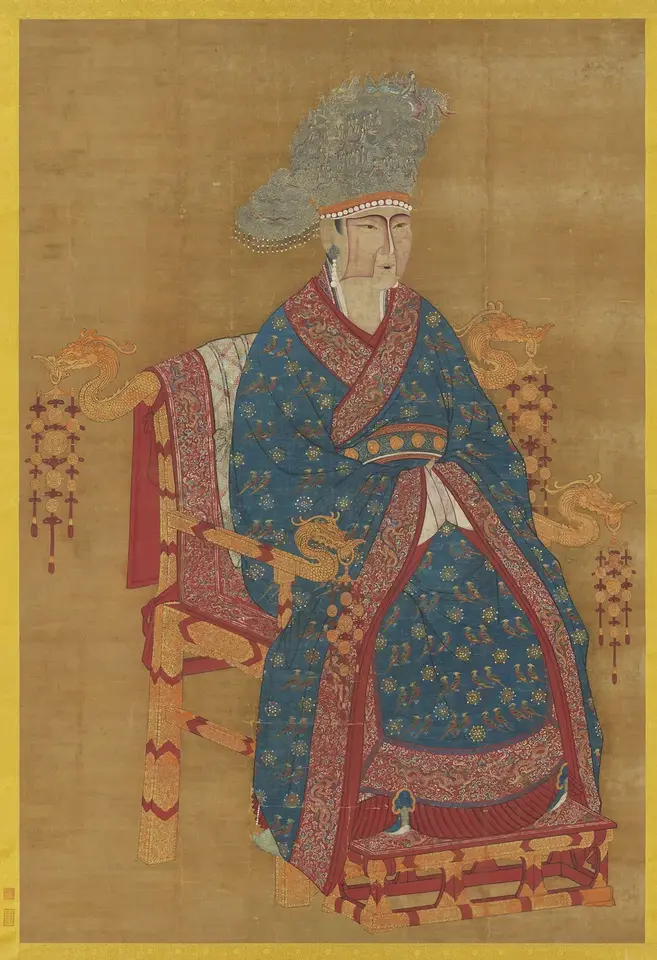
刘娥
Liu E (刘娥, 969–1033), known historically as Empress Zhangxian Mingsu, had her ancestral home in Taiyuan (modern Taiyuan, Shanxi Province) and moved with her father in childhood to Huayang, Yizhou (modern Chengdu, Sichuan Province); she was the empress of Emperor Zhenzong (Zhao Heng) and the first female regent of the Northern Song dynasty. The second daughter of Jiazhou Prefect Liu Tong, she was orphaned in infancy and raised…
Liu E (刘娥, 969–1033), known historically as Empress Zhangxian Mingsu, had her ancestral home in Taiyuan (modern Taiyuan, Shanxi Province) and moved with her father in childhood to Huayang, Yizhou (modern Chengdu, Sichuan Province); she was the empress of Emperor Zhenzong (Zhao Heng) and the first female regent of the Northern Song dynasty. The second daughter of Jiazhou Prefect Liu Tong, she was orphaned in infancy and raised in poverty in Sichuan, where she married the silversmith Gong Mei and traveled with him to the capital Kaifeng; in 983 (Taiping Xingguo 8), she was introduced into the residence of Prince Han Zhao Heng by the princely guard commander Zhang Qi. After Zhao Heng ascended the throne as Emperor Zhenzong in 997 (Zhidao 3), he brought her into the palace, where she formed a lifelong sisterly bond with Consort Yang, adopted the imperial son Zhao Zhen (Emperor Renzong) born to her attendant Lady Li (Consort Li), and overcame ministerial opposition to be invested as Empress in the twelfth month of 1012 (Dazhong Xiangfu 5). During Emperor Zhenzong's protracted illness in his final years, Liu E participated in reviewing memorials and thwarted the 1020 (Tianxi 4) plot by Kou Zhun and Zhou Huaizheng to establish the Crown Prince as regent. Following Emperor Zhenzong's death in the second month of 1022 (Qianxing 1), she became Empress Dowager and regent behind the lowered screen, swiftly banishing the overreaching chancellor Ding Wei and the eunuch Lei Yungong. Across her eleven-year regency, she terminated the wasteful "Heavenly Texts" movement, established the Yizhou Jiaozi Bureau in Chengdu to issue the world's first government-backed paper currency, founded the Bureau of Remonstrance, expanded prefectural schools, curbed bureaucratic factionalism and maternal relatives, and wore the imperial ceremonial robe and crown to sacrifice at the Imperial Ancestral Temple without usurping the Zhao throne. She died of illness in the third month of 1033 (Mingdao 2) at the age of sixty-five and was interred at Yongding Mausoleum with the four-character posthumous title Empress Zhangxian Mingsu.
Born into a military family; moved with her father Liu Tong to Huayang in Chengdu and was raised by her maternal relatives, the Pang family, after her parents died
Traveled to Kaifeng with the silversmith Gong Mei, entered the residence of Prince Han Zhao Heng through Zhang Qi, and lived hidden in Zhang Qi's house for fifteen years after Emperor Taizong ordered her expulsion
Brought into the imperial palace upon Emperor Zhenzong's accession, living harmoniously alongside the favored Consort Yang
Formally invested as a fourth-rank Beauty in the first month; recognized her former husband Gong Mei as her elder brother under the name Liu Mei
Adopted the infant prince Zhao Shouyi (Zhao Zhen, future Emperor Renzong), born to her palace attendant Lady Li, raising him together with Consort Yang
Promoted to Virtuous Consort in the fifth month and invested as Empress in the twelfth month despite objections from Kou Zhun, Wang Dan, and Zhao Anren
Assisted the ailing Emperor Zhenzong with memorials, foiled the Crown Prince regency plot of Kou Zhun and Zhou Huaizheng, and dismissed Kou Zhun from the chancellorship
Honored as Empress Dowager upon Emperor Zhenzong's death in the second month; exposed and banished Chief Minister Ding Wei in the sixth month, instituting joint audiences behind the lowered screen at Chengming Hall
Established the Yizhou Jiaozi Bureau and Paper-Making Directorate in Chengdu to issue the world's first official paper currency, while founding the Fiscal Planning Commission and prefectural schools
Used the treasonous offense of Cao Rui to strip the overbearing Privy Council Commissioner Cao Liyong of power, driving him to suicide on his way into exile
Sacrificed at the Imperial Ancestral Temple wearing a ten-emblem imperial robe in the second month; rehabilitated former rivals and died in the third month, buried at Yongding Mausoleum in the tenth month
Liu E traced her ancestral origins to Taiyuan in Bingzhou and hailed from a military family active during the Five Dynasties and early Northern Song. Her grandfather Liu Yanqing served as Right Courageous Guard General-in-Chief under Later Jin and Later Han, while her father Liu Tong served Emperor Taizu of Song as Commander-in-Chief of the Hujie Guard and Prefect of Jiazhou (modern Leshan, Sichuan), moving his household to Huayang in Yizhou (modern Chengdu, Sichuan). According to the History of Song, her mother Lady Pang dreamed that a bright moon fell into her bosom shortly before conceiving Liu E, her second daughter. While Liu E was still in swaddling clothes, however, her father died on campaign and her mother passed away soon afterward, leaving the orphaned girl to be raised by her mother's natal Pang clan. As her maternal relatives fell into poverty, Liu E learned to sing while playing the hand-drum (botiao) and was married in her early teens to a local Sichuan silversmith named Gong Mei, who took her down the Yangtze River to the imperial capital Kaifeng to seek a livelihood. According to historical anecdotes, while passing through Zhenzhou by boat, a Buddhist monk marveled at her bearing and singing voice, predicted her future eminence, and provided funds for their journey to the capital.
In Kaifeng, struggling to make ends meet, Gong Mei planned to sell Liu E into remarriage. In 983 (Taiping Xingguo 8), when Emperor Taizong's third son, Prince Han Zhao Yuanxiu (later renamed Zhao Heng, the future Emperor Zhenzong), sought attendants from Sichuan, his princely guard commander Zhang Qi introduced the fifteen-year-old Liu E into the prince's residence, where Zhao Heng immediately fell deeply in love with her. Noticing that the third prince looked pale and gaunt, Emperor Taizong questioned his wet nurse, Lady Liu of Qinguo, who disliked Liu E and disclosed the whole affair. Enraged that his son was consorting with a woman of obscure background from Sichuan, Emperor Taizong ordered Zhao Heng to expel Liu E from the princely residence and arranged his marriage to the daughter of the founding general Pan Mei. Unwilling to part with Liu E yet unable to defy his father, Zhao Heng secretly lodged her in the residence of Commander Zhang Qi, who moved out of his own home to avoid suspicion while assigning his household to wait upon her with the utmost care. Liu E remained hidden in Zhang Qi's house for fifteen years until Emperor Taizong died in the third month of 997 (Zhidao 3) and Zhao Heng ascended the throne as Emperor Zhenzong, summoning her into the palace.
When Liu E first entered the imperial palace, Emperor Zhenzong's second principal wife, Empress Guo, already presided over the inner court alongside numerous consorts, leaving Liu E without an official title for several years. Prudent and self-effacing, Liu E never competed for favor and cultivated a lifelong sisterly bond with the equally favored Consort Yang (later Consort Shu), with whom she shared all fortunes without discord. In the first month of 1004 (Jingde 1), Emperor Zhenzong formally conferred upon Liu E the fourth-rank title of Beauty. Because she had no surviving parents or siblings, Liu E petitioned the emperor to recognize her former husband Gong Mei as her elder brother; Gong Mei thereupon changed his surname and given name to Liu Mei and entered the palace guard service. Following the death of Empress Guo in 1007 (Jingde 4), Liu E was promoted to Master of Ceremonies in the first month of 1009 (Dazhong Xiangfu 2). When Emperor Zhenzong expressed his intention to elevate Liu E to Empress, Chief Minister Wang Dan, Privy Council Commissioner Kou Zhun, Participant in Determining Governmental Affairs Zhao Anren, and Hanlin Academicians Li Di and Xiang Minzhong all objected strongly on the grounds of her humble background, with Zhao Anren proposing instead Consort Shen, granddaughter of former chancellor Shen Lun.
In the fourth month of 1010 (Dazhong Xiangfu 3), Lady Li (posthumously Empress Zhangyi, Consort Li), originally a palace maid attending Liu E, gave birth after receiving the emperor's favor to the sole surviving imperial son, Zhao Shouyi (later renamed Zhao Zhen, the future Emperor Renzong). While the infant was still in swaddling clothes, Emperor Zhenzong and Liu E took the child as Liu E's own son, entrusting his daily care jointly to Liu E and Consort Yang. Strengthened by her status as the adoptive mother of the imperial heir, Liu E was promoted to Virtuous Consort in the fifth month of 1012 (Dazhong Xiangfu 5), and in the twelfth month of that year—while Chief Minister Wang Dan was on sick leave and after Hanlin Academician Yang Yi refused to draft the edict—Emperor Zhenzong commissioned Ding Wei to compose the investiture text and formally proclaimed Liu E as Empress. Intelligent and well-read in classical histories, Liu E managed the six palaces with firm order and accompanied Emperor Zhenzong late into the night as he reviewed memorials from across the empire, mastering administrative precedents and gradually participating in state decisions as the emperor's health declined.
Between 1019 (Tianxi 3) and 1020 (Tianxi 4), as Emperor Zhenzong suffered debilitating strokes and a daytime appearance of Venus prompted court astrologers to predict that "a female ruler will flourish," the anxious emperor confided to Inner Palace Director Zhou Huaizheng his desire to have Crown Prince Zhao Zhen serve as regent. Informed of this, Chief Minister Kou Zhun secretly entered the palace to petition for the Crown Prince's regency and instructed Yang Yi to draft the edict overnight. When the plan leaked before enactment, the wavering Emperor Zhenzong denied having authorized Kou Zhun, resulting in Kou Zhun's dismissal from the chancellorship in the sixth month of 1020 and his replacement by Ding Wei. Fearing inevitable retaliation from Liu E and Ding Wei, Zhou Huaizheng plotted an armed coup in the seventh month to depose Empress Liu E, kill Ding Wei, enthrone the Crown Prince, and restore Kou Zhun. On the eve of the coup, Zhou Huaizheng's subordinates betrayed the plot to Ding Wei, who met overnight with Deputy Privy Council Commissioner Cao Liyong to alert Liu E. At dawn, Zhou Huaizheng was arrested and executed, and after Kou Zhun's associate Zhu Neng staged a failed mutiny in Yongxing Military Prefecture over forged "Heavenly Texts," Liu E issued edicts demoting Kou Zhun successively from Xiangzhou, Anzhou, and Daozhou all the way to Revenue Manager of Leizhou, while banishing Li Di to Hengzhou in the second month of 1022 (Qianxing 1).
In the second month of 1022 (Qianxing 1), Emperor Zhenzong passed away, leaving a testamentary edict that elevated Empress Liu E to Empress Dowager and stipulated that all major military and state affairs be decided by the Empress Dowager during the minority of the thirteen-year-old Emperor Renzong. Seeking to sideline Liu E and monopolize power, Chief Minister Ding Wei proposed that the young emperor hold formal audiences only on the first and fifteenth days of each month while routine memorials were transmitted between the Empress Dowager and the Council of State through the eunuch Lei Yungong. Chief Minister Wang Zeng opposed this arrangement, warning that separating the two palaces and handing power to eunuchs would invite disaster. When Lei Yungong subsequently relocated the burial chamber of Emperor Zhenzong's Yongding Mausoleum without authorization and struck underground water, Ding Wei attempted to shield him, prompting Wang Zeng to privately warn Liu E of Ding Wei's duplicity. In the sixth month of 1022, Liu E summoned the court to Chengming Hall, publicly exposed the collusion between Ding Wei and Lei Yungong, executed Lei Yungong, confiscated Ding Wei's property, and banished Ding Wei to Yazhou on Hainan Island. Adopting Wang Zeng's proposal modeled on Eastern Han precedents, Liu E instituted regular audiences every five days at Chengming Hall, with Emperor Renzong seated on the left and Liu E seated on the right behind a lowered screen.
Beginning in 1008 (Dazhong Xiangfu 1), Emperor Zhenzong had squandered vast state revenues on the "Heavenly Texts" movement, staging lavish feng and shan sacrifices and constructing sprawling Daoist complexes across the empire. Immediately upon assuming the regency in 1022 (Qianxing 1), Liu E ordered all the purported "Heavenly Texts" buried inside Emperor Zhenzong's tomb at Yongding Mausoleum, abolished the Court of Rites that had overseen the auspicious ceremonies, and halted palace and temple construction across the realm; when the massive Yuqing Zhaoying Palace was destroyed by lightning fire in 1029 (Tiansheng 7), she accepted ministerial remonstrance and refused to rebuild it, bringing an end to more than a decade of fiscal extravagance.
In fiscal and monetary administration, Liu E enacted a landmark reform in 1023 (Tiansheng 1) by establishing the Yizhou Jiaozi Bureau in Chengdu under court-appointed supervisors alongside a Paper-Making Directorate to prevent counterfeiting, replacing troubled private merchant notes with government-backed paper currency known as "official jiaozi." Issued in three-year cycles with a first-term circulation of 1,256,340 strings backed by 360,000 strings of iron coins as reserve capital, the official jiaozi became the world's first state-issued paper currency, preceding European banknotes by more than six centuries. During her regency, she also created the Fiscal Planning Commission to pare state expenditures, established the Bureau of Remonstrance to broaden channels of criticism, endowed prefectural schools across the empire with school lands and Imperial Academy books, and restored special decree examinations to recruit capable scholars.
Having witnessed the fierce factional strife of the late Zhenzong reign, Liu E took systematic measures to prevent bureaucratic cliques from dominating official appointments. Ordering chief ministers and senior officials to submit complete lists of their kinsmen and marriage connections, she had these relationships charted on wall diagrams inside her residential palace and checked every proposed promotion against the chart to block nepotistic advancement. While she conferred posthumous princely honors on her father Liu Tong and promoted her brother Liu Mei and his sons, she strictly forbade her natal kinsmen from interfering in court politics. When the veteran Privy Council Commissioner Cao Liyong grew arrogant on account of his Chanyuan Treaty merits, Liu E seized upon the 1029 (Tiansheng 7) case in which his nephew Cao Rui drunkenly wore yellow robes and had attendants shout "Ten Thousand Years," ordering Chief Minister Wang Zeng to strip Cao Liyong of office and banish him southward, where he committed suicide en route.
As her authority reached its zenith, Liu E donned an imperial dragon robe in the eleventh month of 1024 (Tiansheng 2) when receiving the honorific title Empress Dowager Yingyuan Chongde Renshou Cisheng. When Palace Aide Fang Zhonggong subsequently submitted a memorial urging her to "follow the precedent of Empress Wu" and Acting Prefect of Kaifeng Cheng Lin presented a painting titled Empress Wu Holding Court, Liu E sounded out her ministers by asking what sort of ruler Empress Wu of Tang had been. Participant in Determining Governmental Affairs Lu Zongdao bluntly replied that Wu Zetian was "a sinner against the Tang who nearly destroyed the dynasty's altars," and asked where the reigning emperor would be placed if she followed such a course. Liu E tore Fang Zhonggong's memorial to pieces and threw it to the floor, declaring: "I shall never commit an act that betrays the imperial ancestors!" In the eleventh month of 1032 (Mingdao 1), she announced her intention to wear the twelve-emblem imperial ceremonial robe and crown (gunmian) to perform the grand sacrifice at the Imperial Ancestral Temple. After intense remonstrance led by Xue Kui, she compromised in the second month of 1033 (Mingdao 2) by removing two emblems (zongyi and zao) from the robe and omitting the imperial sword when sacrificing at the Imperial Ancestral Temple, receiving the expanded honorific title Empress Dowager Yingyuan Qisheng Xiangong Chongde Ciren Baoshou.
Shortly after the ancestral temple sacrifice, Liu E fell gravely ill in the third month of 1033 (Mingdao 2). Issuing a general amnesty from her sickbed, she posthumously restored the official ranks of her former political adversaries Kou Zhun and Cao Liyong and transferred Ding Wei closer to the interior from his Hainan exile. On the twenty-ninth day (jiawu) of the third month, Liu E died at the age of sixty-five. Unable to speak in her final moments, she repeatedly tugged at the imperial robe she was wearing; when a weeping Emperor Renzong asked the ministers at Huangyi Hall what she had meant, Participant in Determining Governmental Affairs Xue Kui replied that the Empress Dowager did not wish to meet the late Emperor Zhenzong in the afterlife wearing the robe of the Son of Heaven, whereupon Renzong ordered her dressed in the robes of an empress for encoffining.
Immediately after Liu E's death, Emperor Renzong's uncle, Prince Yan Zhao Yuanyan, along with Consort Yang, revealed to the emperor that his biological mother was not Liu E but Consort Li (Empress Zhangyi), who had died in the second month of 1032, alleging further that Consort Li had died of foul play. Grief-stricken, Emperor Renzong suspended court for several days, issued an edict of self-reproach, deployed imperial troops to surround the residences of the Liu family, and went in person to Hongfu Monastery to inspect Consort Li's coffin. Because Chief Minister Lü Yijian had previously persuaded Liu E to bury Consort Li in the robes of a first-rank imperial consort inside a mercury-filled coffin, opening the casket revealed Consort Li's body perfectly preserved and dressed in grand regalia. Sighing that "human words cannot all be trusted," Emperor Renzong burned incense before Liu E's coffin, wept that "from this day forward the Great Lady's lifelong innocence is clear," and forbade any further public criticism of her regency. In the tenth month of 1033, she was interred beside Emperor Zhenzong at Yongding Mausoleum with the four-character posthumous title Empress Zhangxian Mingsu (initially Zhuangxian Mingsu, changed in 1044).
FIGURES ASSOCIATED WITH THIS DYNASTY