Birth in Mianzhou
Born in Mianzhou, Sichuan; ancestral origin in Luling; father Ouyang Guan was a military judicial clerk who fathered him late in life.
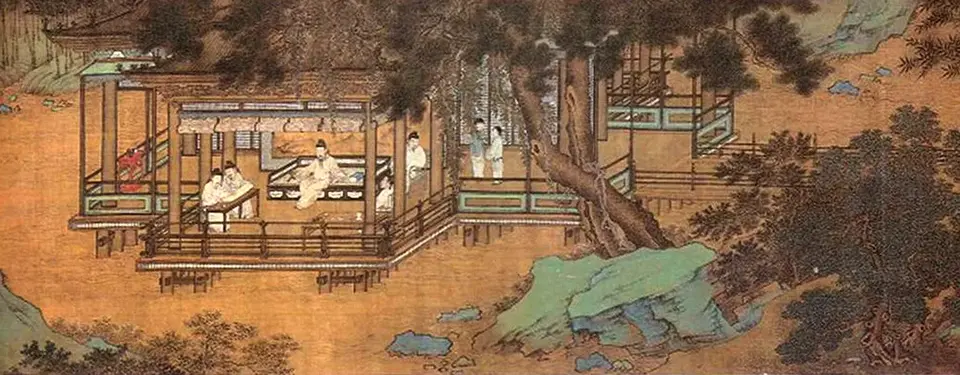
欧阳修
Ouyang Xiu (欧阳修) (1007 – 1072 AD), styled Yongshu (永叔), sobriquet Zuiweng (醉翁) and Retired Scholar Liuyi, posthumously titled Wenzhong (文忠), was a native of Luling in Ji Prefecture (modern Ji'an, Jiangxi Province) and born in Mianzhou (modern Mianyang, Sichuan Province). He was an outstanding writer, historian, and statesman of the Northern Song dynasty, revered as one of the Eight Great Prose Masters of the Tang and Song,…
Ouyang Xiu (欧阳修) (1007 – 1072 AD), styled Yongshu (永叔), sobriquet Zuiweng (醉翁) and Retired Scholar Liuyi, posthumously titled Wenzhong (文忠), was a native of Luling in Ji Prefecture (modern Ji'an, Jiangxi Province) and born in Mianzhou (modern Mianyang, Sichuan Province). He was an outstanding writer, historian, and statesman of the Northern Song dynasty, revered as one of the Eight Great Prose Masters of the Tang and Song, and the undisputed leader and patriarch of the Northern Song Literary Reform Movement. Losing his father at age four, he was raised in poverty by his mother Lady Zheng, who famously taught him to write on the sand using reed stalks. In 1030 AD, he graduated first in provincial examinations and passed the imperial civil examinations with top honors, serving initially as Administrative Assistant to the Western Capital Regent, where he formed deep ties with Yin Zhu and Mei Yaochen to advocate ancient prose reform. During the Qingli era, Ouyang actively championed the Qingli Reforms led by Fan Zhongyan, serving as Director of the Remonstrance Bureau and submitting his renowned Discourse on Factions, which distinguished alliances of gentlemen from cliques of scoundrels. Following the suppression of the reforms, he was banished as Prefect of Chuzhou, where he engaged in benevolent governance and composed the immortal prose masterpiece An Account of the Old Drunkard Pavilion. In 1057 AD, as Hanlin Academician serving as Commissioner of the Metropolitan Examination, he enacted sweeping examination reforms, eradicating the obscure and convoluted Imperial Academy Style while selecting a glittering cohort of genius—including Su Shi, Su Zhe, Zeng Gong, Zhang Zai, and Cheng Hao—thereby establishing an accessible, balanced prose style that ushered in the golden age of Song literature. In statecraft, Ouyang rose to Deputy Commissioner of Military Affairs and Assistant Grand Councilor (Vice Chancellor), guiding central governance with moderation and enjoying the deep trust of Emperors Renzong and Yingzong. In historiography, he co-directed the imperial compilation of the New Book of Tang and single-handedly authored the New History of the Five Dynasties, creating an unprecedented milestone of private dynastic history incorporated into the official Twenty-Four Histories. In epigraphy, his Collected Ancient Records pioneered classical Chinese archaeological study. Retiring in 1071 AD as Junior Preceptor to the Crown Prince, he withdrew to Yingzhou, passing away the following year at age sixty-six. Posthumously awarded Grand Preceptor and Duke of Yan, he was canonized as Wenzhong. With a natural, lucid prose style and expansive magnanimity, Ouyang Xiu was a foundational architect of Song civilization.
Born in Mianzhou, Sichuan; ancestral origin in Luling; father Ouyang Guan was a military judicial clerk who fathered him late in life.
Lost his father at age four; mother Lady Zheng moved with him to Suizhou, using reed stalks to write on sand to teach him literacy.
Ranked first in provincial and metropolitan rounds, passing the palace examination; appointed administrative assistant to Qian Weiyan.
Rebuked censor Gao Ruona for slandering Fan Zhongyan; dismissed from office and banished as Magistrate of Yiling County.
Recalled as Director of the Remonstrance Bureau; aided Fan Zhongyan's reforms and composed the famous treatise Discourse on Factions.
Banished to Chuzhou after the reform collapse; built the Old Drunkard Pavilion and authored An Account of the Old Drunkard Pavilion.
Presided over the metropolitan examinations; suppressed the convoluted Imperial Academy Style and selected Su Shi, Su Zhe, and Zeng Gong.
Presented the completed 225-volume New Book of Tang; promoted to Deputy Commissioner of Military Affairs, then Assistant Grand Councilor.
Retired as Junior Preceptor to the Crown Prince to West Lake in Yingzhou, styling himself Retired Scholar Liuyi.
Passed away at his residence in Yingzhou at age sixty-six; posthumously awarded Grand Preceptor and Duke of Yan, canonized as Wenzhong.
Ouyang Xiu was born in Mianzhou, Sichuan, on the twenty-first day of the sixth lunar month in the fourth year of the Jingde era of Emperor Zhenzong of Song (August 6, 1007 AD). His family belonged to the prominent Ouyang lineage of Luling in Ji Prefecture (modern Yongfeng County, Jiangxi Province). His father, Ouyang Guan, had reached fifty-six years of age when Ouyang Xiu was born, serving as a military judicial clerk in Mianzhou. However, this domestic happiness was brief: in 1010 AD, when Ouyang Xiu was barely four years old, his father passed away. Destitute and lacking family property, his widowed mother Lady Zheng took the young boy to Suizhou (modern Hubei Province) to seek shelter under his uncle Ouyang Ye.
Although his uncle's household maintained modest means, Lady Zheng was the daughter of an educated Jiangnan gentry family, possessing resolute character and profound literary literacy. In the absence of paper and brushes, she gathered reed stalks from local riverbanks, drawing characters upon the sand to teach her son classical characters and texts, an episode immortalized in Chinese cultural memory as teaching with reeds. At the age of ten, while browsing books in the library of a local Suizhou family, Ouyang Xiu discovered a discarded, incomplete copy of Han Yu's Collected Works of Master Changli. Intrigued by the unadorned vigor and ethical majesty of Han Yu's prose, he read through the night and resolved to devote his life to restoring classical prose across the empire.
In 1030 AD (the eighth year of the Tiansheng era), twenty-four-year-old Ouyang Xiu entered the imperial examinations. He triumphed as first candidate in both the prefectural and metropolitan examinations, before passing the palace examination in the highest tier. Appointed as an administrative assistant to Qian Weiyan, Regent of the Western Capital at Luoyang, Ouyang entered a thriving intellectual circle. Qian Weiyan treated talented youths with exceptional warmth, gathering together rising stars such as Yin Zhu, Mei Yaochen, and Fu Bi. In this cultured environment, Ouyang immersed himself in historical discourse and poetry, collaborating with Yin Zhu to advocate for ancient prose and rejecting ornate parallelism in favor of clear, pragmatic expression.
In 1034 AD, having completed his Luoyang term, Ouyang returned to Kaifeng as Collator in the Palace Library, engaging in editorial work on imperial holdings in Chongwen Academy. In 1036 AD, Fan Zhongyan, then Vice Director of the Ministry of Personnel, submitted his celebrated Chart of Officials to Emperor Renzong, fearlessly criticizing Chancellor Lyu Yijian for cultivating personal sycophants and privatizing public appointments. Angered by this indictment, Lyu counter-accused Fan of factional conspiracy, orchestrating Fan's demotion to Prefect of Raozhou. While official censors remained silent, Right Censor Gao Ruona actively published essays denouncing Fan Zhongyan to flatter the chancellor.
Outraged by Gao's treachery, Ouyang Xiu penned a scathing public letter, Letter to Censor Gao, rebuking him: "You have long claimed personal uprightness, yet when crisis arrived you struck a fallen comrade, entirely ignorant of the concept of human shame!" Incensed, Gao Ruona submitted Ouyang's private letter to Emperor Renzong as evidence of disrespect. The emperor summarily stripped Ouyang of rank and banished him as Magistrate of Yiling County in distant Hubei. Facing political disgrace with serene composure, Ouyang focused on good governance: clearing backlogged legal cases, easing corvée burdens, and studying the historical masterpieces of the Spring and Autumn Annals and the Records of the Grand Historian, enriching his philosophical and historiographical vision.
In 1040 AD, following large-scale invasions by the Western Xia state under Li Yuanhao, northern borders faced extreme peril. Emperor Renzong summoned Fan Zhongyan and Han Qi to coordinate frontier defenses and recalled principled officials, appointing Ouyang as Collator in the Chongwen Academy and later Director of the Remonstrance Bureau. In 1043 AD, Emperor Renzong initiated the Qingli Reforms, placing Fan Zhongyan, Han Qi, and Fu Bi in executive office to reform civil personnel, reduce redundant military forces, and strengthen regional administration. As an unyielding champion of reform, Ouyang submitted dozens of frank memorials defending the new policies.
When conservative courtiers launched concerted slanders alleging that the reformers were organizing a sinister faction to dominate the court, Ouyang composed his historic memorial Discourse on Factions in 1044 AD. He boldly argued that while scoundrels unite solely for selfish profit, true gentlemen unite out of shared moral principle. An enlightened monarch should distinguish genuine factions of gentlemen from deceptive cliques of self-serving flatterers, employing the former while expelling the latter. This masterpiece stands as one of the most brilliant theoretical defenses of political integrity in Chinese history.
Nevertheless, the reforms threatened entrenched interests. By 1045 AD, conservative factions headed by Xia Song organized counter-attacks, driving the reformers from power. Ouyang, who vehemently defended Fan Zhongyan, was targeted with fabricated moral scandals and demoted from Drafter of Imperial Decrees to Prefect of Chuzhou (modern Anhui Province). In Chuzhou, Ouyang governed with gentle restraint, allowing the people to recuperate from heavy exactions. Harmonizing his inner grief with the pristine beauty of nature, he constructed the Old Drunkard Pavilion in the Langya Mountains, authoring the immortal prose An Account of the Old Drunkard Pavilion. His famous maxims—that the old drunkard's joy lay not in wine but in the mountains and waters, and that his greatest happiness lay in sharing the joy of his people—radiate the highest humanist ideal of Confucian benevolent administration.
In 1049 AD, Ouyang served successively as Prefect of Yangzhou and Prefect of Yingzhou before being recalled to Kaifeng in 1054 AD as Hanlin Academician and Academician Reader. In 1057 AD (the second year of the Jiayou era), the Northern Song cultural sphere reached a defining historical moment: Ouyang Xiu was appointed Commissioner of the Metropolitan Examination.
At that time, Chinese prose was dominated by the decadent Imperial Academy Style (Taixueti), which, reacting against ornamental parallelism, had swung toward bizarre obscurity and unnatural syntax. Candidates filled their papers with archaic characters and convoluted phrasings detached from realistic meaning. Resolved to overhaul these distortions, Ouyang established strict evaluation criteria: any examination paper utilizing obscure, unnatural Imperial Academy phrasing was summarily rejected, regardless of classical erudition; conversely, papers exhibiting clear logic, balanced syntax, and practical social insight were placed at the forefront.
When results were published, hundreds of candidates accustomed to obscure writing failed, sparking riots in the streets of the capital where disgruntled scholars confronted Ouyang's carriage with shouts and composed satirical mock funeral orations. Ouyang remained serene and steadfast. Through this historic examination, Ouyang selected an unmatched roster of generational genius: Su Shi, Su Zhe, Zeng Gong, Zhang Zai, Cheng Hao, and Zhang Dun. Upon reading Su Shi's magnificent essay on imperial benevolence, Ouyang remarked to Mei Yaochen with delight: "Reading Su Shi's writings, I broke into a joyful sweat; old man that I am, I must step aside and allow this young man to outshine the world!" The 1057 examination established a clear, natural prose standard, uniting five of the Song dynasty's prose masters—Su Xun, Su Shi, Su Zhe, Zeng Gong, and Wang Anshi—under Ouyang's leadership, cementing his stature as the supreme literary patriarch of Northern Song civilization.
Beyond literary leadership, Ouyang Xiu was a towering historian in both official and private traditions. In 1060 AD, the monumental two-hundred-and-twenty-five-volume New Book of Tang, compiled over seventeen years by Ouyang Xiu and Song Qi, was presented to the throne. Ouyang oversaw the overall editorial framework, лично drafting the basic annals, tables, and treatises to ensure stylistic purity and factual consistency. Concurrently, through twenty years of solitary labor, Ouyang independently authored the seventy-four-volume New History of the Five Dynasties. Utilizing the moral judgment of the Spring and Autumn tradition, he probed the institutional breakdown and moral decay of the Five Dynasties, achieving the unprecedented distinction of having a privately authored dynastic history canonized among the official Twenty-Four Histories.
In 1060 AD, Ouyang was elevated to Deputy Commissioner of Military Affairs, and in 1061 AD advanced to Assistant Grand Councilor (Vice Chancellor), joining the inner executive cabinet of the Northern Song empire. Over five years as vice chancellor, serving through the Renzong and Yingzong reigns, he promoted open discussion, reduced administrative interference, and fostered social recuperation. During the delicate ritual debates over imperial ancestral rites for Emperor Yingzong's biological father, Ouyang defended canonical statutes with unyielding poise, demonstrating profound statesmanship.
In 1067 AD, Emperor Shenzong ascended the throne, determined to pursue swift national strengthening. Approaching his sixties, Ouyang viewed the aggressive state-capitalist initiatives of Wang Anshi's New Policies—particularly the compulsory implementation of the Green Sprouts Law—with deep misgiving, submitting repeated petitions to retire. In 1071 AD, Emperor Shenzong granted his request, allowing him to retire with the rank of Junior Preceptor to the Crown Prince. Settling alongside the West Lake of Yingzhou, Ouyang styled himself Retired Scholar Liuyi, explaining that his household possessed ten thousand scrolls of books, one thousand rubbings of ancient inscriptions, one zither, one chessboard, one jug of wine, and one elderly master living in harmony with nature.
On the twenty-third day of the intercalary seventh lunar month in the fifth year of the Xining era (1072 AD), Ouyang Xiu passed away peacefully at his Yingzhou home at age sixty-six. Emperor Shenzong mourned deeply, suspended imperial audiences for a day, and issued an edict conferring upon him the posthumous title of Grand Preceptor and Duke of Yan, bestowing the canonical name Wenzhong. Uniting profound literary reform, monumental historical scholarship, and enlightened statecraft, Ouyang Xiu nurtured the generational flowering of the Song cultural renaissance.
Ouyang Xiu stands as the supreme architect and spiritual general of the Northern Song Literary Reform Movement. Confronted with the superficial parallelism of the early Song West Kun style and the eccentric obscurity of the subsequent Imperial Academy Style, Ouyang embraced Han Yu's classical principles, advocating that literature must serve as the vehicle for moral truth while remaining unadorned, clear, and pragmatic. By implementing these ideals in the 1057 metropolitan examinations, he dismantled ornamental and bizarre styles alike, inaugurating an era of natural, flowing, and accessible classical prose that defined Song literature.
Ouyang Xiu occupies a preeminent rank in classical Chinese historiography. As chief editor, he directed the comprehensive compilation of the New Book of Tang, systematically purging archaic redundancies and enriching institutional treatises. Even more remarkably, through two decades of private dedication, he independently composed the seventy-four-volume New History of the Five Dynasties. Applying the critical praise-and-blame methodology of classical historiography, he analyzed the systemic collapse of the Five Dynasties with acute ethical and political clarity, creating the sole privately compiled dynastic history to be permanently canonized within China's official Twenty-Four Histories.
Ouyang Xiu was the most generous and far-sighted literary patron in Chinese intellectual history. Free from factional jealousy and possessing keen aesthetic judgment, he utilized the 1057 examinations to elevate Su Shi, Su Zhe, Zeng Gong, Zhang Zai, and Cheng Hao, while recommending Wang Anshi, Sima Guang, and Bao Zheng for high office. Under his generous mentorship, five of the Eight Great Prose Masters of the Tang and Song flourished, providing Northern Song civilization with the intellectual titans who forged its cultural and philosophical golden age.
Ouyang Xiu is universally recognized as the founding patriarch of classical Chinese epigraphy (jinshixue). Over decades of passionate collection, he accumulated over a thousand rubbings of bronze inscriptions and stone steles from the pre-Qin period through the Tang and Five Dynasties, personally authoring critical colophons for four hundred items, compiled as Collected Ancient Records. Pioneering the dual-evidence method of cross-examining archaeological stone inscriptions against surviving dynastic chronicles, he rectified numerous historical and geographical errors, founding the discipline of epigraphical archaeology in China.
FIGURES ASSOCIATED WITH THIS DYNASTY