Birth in Zhongshan
Born into an esteemed literati lineage in Wuji County, studying classical scholarship, calendrics, and mathematical calculation from youth.
甄鸾
Zhen Luan, 535–566 (甄鸾), courtesy name Shuzun, was a distinguished mathematician, astronomer, and government official of the Northern Zhou dynasty from Wuji County in Zhongshan Commandery. Celebrated as the pioneer of ancient Chinese military mathematics and administrative calculation, he served successively as Director of Retainers, Junior Grand Master of Retainers, and Grand Administrator of Hanzhong Commandery, earning the…
Zhen Luan, 535–566 (甄鸾), courtesy name Shuzun, was a distinguished mathematician, astronomer, and government official of the Northern Zhou dynasty from Wuji County in Zhongshan Commandery. Celebrated as the pioneer of ancient Chinese military mathematics and administrative calculation, he served successively as Director of Retainers, Junior Grand Master of Retainers, and Grand Administrator of Hanzhong Commandery, earning the nobility title of Founding Count of Wuji County. Zhen Luan possessed profound expertise in Confucian classics, mathematical canons, and astronomical calendrical sciences. He was officially commissioned to compile the Tianhe Calendar, which was promulgated in 566 during the first year of Emperor Wu's Tianhe era and remained in standard imperial use for eighteen years. In mathematics, Zhen Luan authored influential treatises including Wucao Suanjing (Mathematical Manual of the Five Administrative Sections), Wujing Suanshu (Arithmetic of the Five Classics), and Shushu Jiyi (Memoir on Mathematical Arts). His commentaries on historical works such as Zhoubi Suanjing, Jiuzhang Suanshu, and Sunzi Suanjing established authoritative canonical recensions later incorporated into the imperial curriculum. A devoted Buddhist lay scholar, he composed the famous apologetic treatise Xiaodao Lun (Laughing at the Dao) during court debates, striving to preserve Buddhist institutions against imperial suppression.
Born into an esteemed literati lineage in Wuji County, studying classical scholarship, calendrics, and mathematical calculation from youth.
Entered official service in the newly established Northern Zhou state, serving as Director of Retainers on merit of computational and legal proficiency.
Undertook imperial commissions to annotate foundational mathematical treatises including Zhoubi Suanjing and Jiuzhang Suanshu.
Authored Wucao Suanjing and Wujing Suanshu, establishing standardized mathematical rules for military operations and provincial administration.
Completed theoretical calculations and astronomical observational models for a reformed calendar system.
The Tianhe Calendar was promulgated throughout the empire; appointed Grand Administrator of Hanzhong Commandery.
Passed away while serving in office at Hanzhong; interred in the ancestral Zhen family cemetery at Shicun, Wuji County.
Zhen Luan was born into a prominent family in Wuji, Zhongshan Commandery. Surrounded by traditional scholarship during the Northern and Southern dynasties, he read extensively across Confucian canonical literature and mastered the computational and observational disciplines within the Six Arts. During this era of division and warfare, regional dynastic courts urgently required skilled officials capable of managing tax registers, agricultural logistics, grain storehouses, and troop mobilization.
Entering official administration during the late Western Wei and early Northern Zhou transitions, Zhen Luan utilized his computational and legal talents to serve as Director of Retainers and Junior Grand Master of Retainers. His precision and integrity earned him imperial favor and the hereditary title of Founding Count of Wuji County. He was later appointed Grand Administrator of Hanzhong Commandery, where he applied practical mathematical principles to provincial governance, surveying arable land, standardizing grain measurements, and balancing local tax burdens to secure substantial fiscal reserves for the commandery.
Throughout his official career, Zhen Luan dedicated immense energy to the critical edition and annotation of mathematical classics. Prior to his time, ancient texts such as Jiuzhang Suanshu (Nine Chapters on the Mathematical Art), Zhoubi Suanjing (The Arithmetical Classic of the Gnomon and the Circular Paths of Heaven), and Sunzi Suanjing (Sunzi's Mathematical Classic) suffered from transcription errors, omitted rod calculations, and archaic prose. Zhen Luan systematically worked through each mathematical method, adding detailed glosses, computational steps, and explanatory notes.
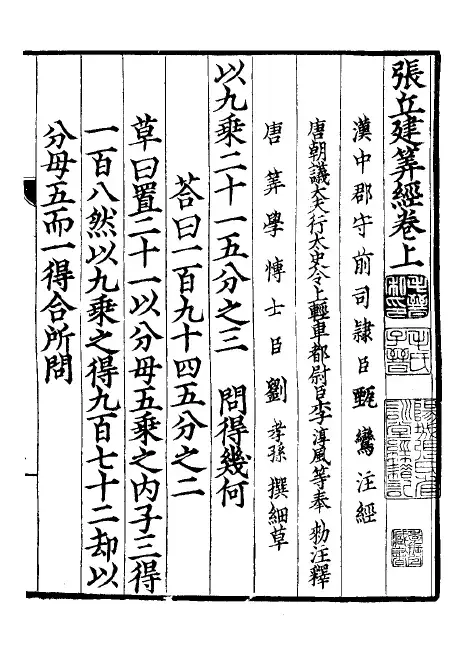
His critical editions restored Zhoubi Suanjing, Jiuzhang Suanshu, Sunzi Suanjing, Xiahou Yang Suanjing, Zhang Qiujian Suanjing, and Haidao Suanjing, ensuring their survival and later adoption by the Tang dynasty Directorate of Education as standard textbooks. Furthermore, Zhen Luan composed Wucao Suanjing (Mathematical Manual of the Five Administrative Sections), categorizing arithmetic into field measurement, military supplies, commercial trade, storage calculation, and fiscal revenues. This work stood as the earliest Chinese manual dedicated specifically to bureaucratic and military mathematics. In Wujing Suanshu, he employed computational formulas to illuminate cosmological, musical, and calendrical passages within the Confucian Five Classics.
Recognizing discrepancies in solar eclipses and seasonal nodal points under inherited Northern Wei calendars, Emperor Wu commissioned Zhen Luan to engineer a reformed astronomical system. Zhen Luan integrated centuries of gnomon measurements with armillary sphere records, refining calculations of the tropical year and lunar motions to formulate the Tianhe Calendar. Promulgated in the first month of 566, the system demonstrated high computational accuracy and governed the imperial calendar for eighteen years until superseded during the Daxiang era.
In his Shushu Jiyi (Memoir on Mathematical Arts), Zhen Luan cataloged fourteen historical reckoning methods, including abacus-like calculation, nine-palace mathematics, and variable-base computations. His detailed description of calculation beads mounted on framed counting boards represents the earliest clear textual record of the proto-abacus in global technological history. In 566, Zhen Luan succumbed to illness while administering Hanzhong Commandery, passing away at the age of thirty-two. He was laid to rest in his family graveyard in Wuji County.
While formulating the Tianhe Calendar and compiling administrative mathematical manuals, Zhen Luan recognized that regional disparities in weights and measures impeded fair taxation and state administration. Drawing upon the ancient Rites of Zhou, he examined standard archaeological bronze measures, conducting rigorous liquid calibrations of Han dynasty bronze vessels (hu) against theoretical cube measurements.
Zhen Luan's precise textual documentation and physical reconstruction of the Zhou market foot (shichi) provided the foundational benchmark for Northern Zhou metrology. Following the reunification of China under the Sui dynasty, his standardized foot was officially instituted as the imperial standard measure (guanchi), leaving a permanent imprint on the history of Chinese metrology.
When Emperor Wu sought to consolidate ideological authority by elevating Daoism and suppressing Buddhism, he convened prominent scholars of Confucianism, Buddhism, and Daoism to debate religious supremacy at court. As a devout Buddhist practitioner, Zhen Luan stepped forward to defend the sangha. He scrutinized Daoist canonical collections and submitted Xiaodao Lun (Laughing at the Dao) in three volumes and thirty-six essays directly to the throne.
The treatise deployed rigorous philosophical refutations and satirical wit to expose contradictions and fabricated immortality claims within contemporary Daoist literature. Although Emperor Wu was enraged and ordered the immediate destruction of the book by fire at court, Zhen Luan's courageous defense galvanized Buddhist clergy and civilian officials, temporarily halting the imperial initiative to eradicate monastic institutions.
FIGURES ASSOCIATED WITH THIS DYNASTY