Cavalry Campaigner
Campaigned as a mounted archer under Li Cunxu and Li Siyuan during Central Plains expeditions.
?–947 CE
张彦泽
Zhang Yanze (张彦泽, d. 947) was a military general of the Later Jin dynasty during the Five Dynasties and Ten Kingdoms period. Born into a Turkic tribal family that had migrated to the Yin Mountains before settling in Taiyuan, he arose from the military ranks. Renowned for his feral ferocity and bloodthirsty cruelty, his eyes were described as yellow and bloodshot, emitting an uncanny gleam in the dark like a predator, striking…
Zhang Yanze (张彦泽, d. 947) was a military general of the Later Jin dynasty during the Five Dynasties and Ten Kingdoms period. Born into a Turkic tribal family that had migrated to the Yin Mountains before settling in Taiyuan, he arose from the military ranks. Renowned for his feral ferocity and bloodthirsty cruelty, his eyes were described as yellow and bloodshot, emitting an uncanny gleam in the dark like a predator, striking fear into all who encountered him. An accomplished mounted archer, he served as a cavalry officer under King of Jin Li Cunxu and general Li Siyuan during the late Tang and Later Tang periods. Following the founding of Later Jin, he married into the family of Emperor Gaozu (Shi Jingtang), securing accelerated promotions to Commander of the Right Husheng Flank, Prefect of Caozhou, Military Commissioner of Zhenguo, and Military Commissioner of Zhangyi. His administrative tenure was marked by brutal tyranny; when his secretary Zhang Shi attempted to dissuade him from murdering his own son, Zhang Yanze executed him through agonizing dismemberment and seized his wife, escaping capital punishment entirely through Shi Jingtang's imperial protection. Under Emperor Modi (Shi Chonggui), Zhang Yanze was appointed Senior Commander of the Right Shenwu Guards and Military Commissioner of Zhangguo. At the Battle of Baituanwei Village in Yangcheng in 945, when Later Jin armies were encircled and dying of thirst, Zhang Yanze adopted the strategy of junior officer Yao Yuanfu, spearheading a headwind charge that shattered the Liao army and forced Yelü Deguang to flee. However, during the Battle of Zhongdu Bridge in 946, following commander Du Chongwei's capitulation, Zhang Yanze defected to the Khitan Liao dynasty. Yelü Deguang dispatched him as the vanguard with two thousand iron cavalry on an emergency dash toward Kaifeng. Zhang Yanze forced the city gates in the dead of night, unleashed his troops to pillage the capital, coerced Emperor Modi into abdication, murdered chief minister Sang Weihan, and executed personal enemies. His atrocities provoked universal outrage; upon arriving in Kaifeng in 947, the Liao emperor bowed to the petitions of court officials and the populace, ordering Zhang Yanze's public execution in the Northern Market, where citizens crushed his skull and consumed his flesh in revenge.
Campaigned as a mounted archer under Li Cunxu and Li Siyuan during Central Plains expeditions.
Following Shi Jingtang's accession, appointed Commander of the Right Husheng Flank and Prefect of Caozhou.
Contributed to the suppression of rebel Fan Yanguang, promoted to Military Commissioner of Zhenguo and Zhangyi.
Tortured his own son and dismembered his remonstrating secretary Zhang Shi, seizing his wife.
Impeached by Wang Zhou for twenty-six capital offenses; shielded from death by Shi Jingtang and lightly reassigned.
Reinstated by Emperor Modi as Grand General of Left Longwu and Senior Commander of Right Shenwu Guards.
Repelled Liao invasions along the Hebei frontier, elevated to Military Commissioner of Zhangguo.
Adopted Yao Yuanfu's plan to lead a headwind assault at Yangcheng, routing eighty thousand Liao troops.
Served as vanguard commander; defected to the Khitans when commander Du Chongwei surrendered at Zhongdu Bridge.
Led two thousand Liao cavalry to breach the Fengqiu Gate at midnight, looting the capital and forcing the emperor's abdication.
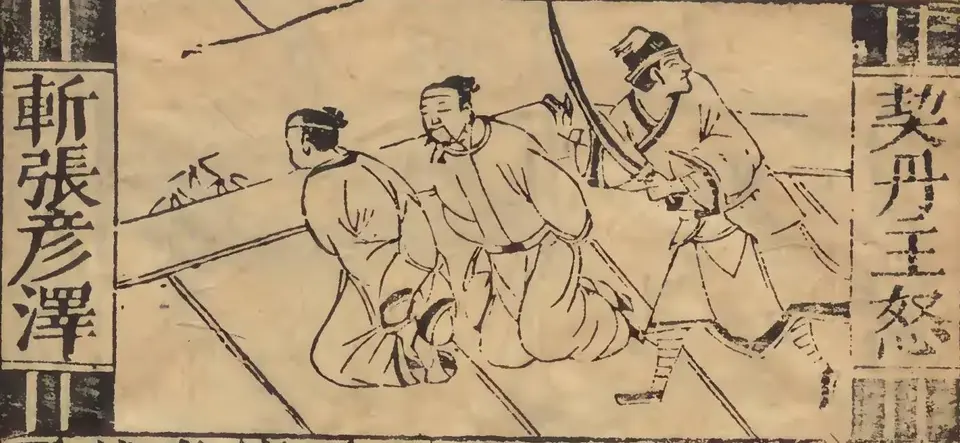
Beheaded at the Northern Market by order of Yelü Deguang; his skull was crushed and his flesh eaten by enraged citizens.
Zhang Yanze was of Turkic lineage, his ancestors having roamed the grasslands of the Yin Mountains before taking up permanent residence in Taiyuan, Hedong. Emerging from the lower military ranks, he was physically imposing and notoriously ferocious by nature. Contemporaries noted that his eyes were yellow and bloodshot, giving off a predatory glow in the darkness of night that unnerved officers and soldiers alike.
During the campaigns of King of Jin Li Cunxu and general Li Siyuan across northern China, Zhang Yanze distinguished himself through exceptional horsemanship and mounted archery. Serving as an elite cavalry commander, he participated in the decisive operations that destroyed the Later Liang dynasty, steadily climbing through field ranks.
When Shi Jingtang governed Hedong as military commissioner, Zhang Yanze allied his family with Shi's house through marriage, securing deep patronal trust. In 936, when Shi Jingtang established the Later Jin dynasty, Zhang was elevated to Commander of the Right Husheng Flank and Prefect of Caozhou. In 937, when Military Commissioner Fan Yanguang of Weibo rebelled, Zhang participated in the punitive campaign, earning promotion to Military Commissioner of Zhenguo and later assuming command of the strategic Zhangyi Circuit headquartered at Jingzhou.
Zhang Yanze's provincial administration was characterized by extreme brutality and uncontrolled temper. While governing Jingzhou, he grew infuriated by the gentle, bookish disposition of his eldest son, subjecting the youth to constant beatings and physical torture. Unable to endure the torment, the son escaped to Qizhou, where local magistrates arrested him and delivered him back to the imperial capital, which returned him to his father.
Enraged by his son's flight, Zhang Yanze prepared to execute him in his courtyard. The administrative secretary of his staff, Zhang Shi, wept bitterly and pleaded on his knees, reminding the general that even ferocious beasts do not devour their own offspring. Rather than relenting, Zhang Yanze turned his wrath upon the secretary. Terrified for his life, Zhang Shi fled the circuit under cover of night. Zhang dispatched twenty cavalrymen to hunt him down, but Zhang Shi found temporary refuge under Military Commissioner Li Zhou of Binning, who arranged for him to be exiled to Shangzhou.
Refusing to drop the grudge, Zhang Yanze repeatedly threatened military mutiny unless the imperial court extradited the secretary back to Jingzhou. When Zhang Shi was finally handed over, Zhang Yanze had him bound to a courtyard pillar, personally supervising the gouging out of his heart, the slitting of his tongue, and the severing of his hands and feet before having him beheaded, subsequently forcing the victim's wife into his own household. Soon afterward, Shi Jingtang replaced Zhang Yanze with Wang Zhou, recalling Zhang to Kaifeng. Wang Zhou submitted a secret memorial detailing twenty-six counts of capital cruelty, while Zhang Shi's elderly father kneeled outside the palace gates demanding justice. Though high ministers universally demanded execution, Shi Jingtang shielded him, claiming he had promised his kin immunity from execution, ultimately imposing only a superficial demotion.
Following Shi Jingtang's death in 942, his nephew Emperor Modi (Shi Chonggui) ascended the throne and restored Zhang Yanze to full military favor, appointing him Grand General of the Left Longwu Guards, Senior General of the Right Wuwei Guards, and Senior Commander of the Right Shenwu Guards. As relations between Later Jin and the Khitan Liao empire disintegrated into open warfare along the northern frontier, Zhang Yanze achieved repeated combat distinctions and was created Military Commissioner of Zhangguo.
In the spring of 945, Liao Emperor Yelü Deguang led eighty thousand cavalry south, encircling the main Later Jin host at Baituanwei Village in Yangcheng. The Jin lines were cut off from all water sources, with soldiers dying of thirst as shallow wells collapsed into mud. A raging dust storm swept from the north, and the Khitans advanced under the wind, hurling fire and arrows into the panicked encampment.
Zhang Yanze summoned his staff to deliberate, with the majority advising defensive retreat behind palisades until the wind shifted. Only junior officer Yao Yuanfu spoke out aggressively: "Our troops are dying of thirst; waiting for the wind means waiting for capture! To charge into the headwind strikes them where they least expect!" Zhang Yanze recognized the tactical opportunity, coordinating with Li Shouzhen and Fu Yanqing to launch a desperate cavalry countercharge directly into the blinding sand. The unexpected shock attack shattered the overconfident Liao formations, routing their elite horsemen. Jin forces pursued the fleeing enemy for tens of li, forcing Yelü Deguang to flee on a baggage camel and lifting the siege of Yangcheng.
In the autumn of 946, the Liao army invaded northern China in full force. The Later Jin court appointed imperial relative Du Chongwei as supreme commander, Li Shouzhen as army supervisor, and Zhang Yanze as vanguard cavalry marshal. Operating across the Hebei plains, Zhang achieved a local triumph at Taizhou, beheading two thousand enemy troops, and subsequently contested Zhongdu Bridge across the Hutu River, setting fire to half the bridge structure to hold off the Khitans.
However, supreme commander Du Chongwei harbored treasonous ambitions, secretly bargaining with the Liao emperor to surrender the army in exchange for being installed as puppet ruler. In December 946, Du Chongwei formally surrendered the imperial army at Zhongdu, and Zhang Yanze promptly followed suit, groveling before the northern conqueror. Delighted by the capitulation of the central strike force, Yelü Deguang ordered Zhang Yanze and Khitan general Fu Zhuer to lead two thousand elite horsemen on a forced march directly toward Kaifeng.
Riding day and night without pause, Zhang Yanze arrived outside the capital at midnight on December 16. Shattering the lock of the Fengqiu Gate with axes, his riders poured into the imperial avenues. In the ensuing panic, Zhang deployed his cavalry before the Mingde Gate and presented Yelü Deguang's letter of surrender to the Empress Dowager, forcing Emperor Modi to strip off his imperial dragon robes and submit in unconditional abdication, sealing the demise of the Later Jin dynasty.
Believing his betrayal earned him paramount standing under the new Khitan regime, Zhang Yanze abandoned all restraint upon entering Kaifeng. He engaged in continuous drunken debauchery, riding through the avenues flanked by hundreds of mounted guards under banners inscribed with the slogan Dedicated Heart to the Sovereign. He transferred the contents of the imperial treasuries into his private mansion, seized Lady Ding, mother of imperial prince Shi Yanxu, and invaded the private estate of official Gao Xun to murder his uncle and younger brother over past grievances.
Zhang Yanze turned his soldiers loose upon the civilian populace, looting homes and slaughtering bystanders across Kaifeng. When drunkenly presiding over captured citizens, he refused to speak, merely raising his head and extending his middle finger, whereupon his guards instantly dragged the victim away for waist-bisection in the street. Learning of chief minister Sang Weihan's unyielding character, Zhang Yanze had him arrested and privately strangled with silk scarves, falsely claiming he had committed suicide.
On New Year's Day of 947, Liao Emperor Yelü Deguang entered Kaifeng. Appalled by the reports of unchecked carnage, the Khitan ruler convened the civilian and military officials and asked the assembled citizenry: "Does Zhang Yanze deserve death?" The entire court kowtowed in unison demanding his death, while tens of thousands of citizens submitted formal petitions listing his atrocities. Realizing that eliminating Zhang Yanze was essential to calming the populace, Yelü Deguang ordered his immediate execution.
On the third day of the first month, as Zhang was dragged toward the execution grounds, hundreds of sons and brothers of his victims followed in white mourning attire, cursing and beating him with walking sticks while Zhang hung his head in silence. Reaching the Northern Market, the executioner broke his wrists to remove his iron manacles before beheading him. The instant his head fell, the enraged multitude rushed forward, smashing open his skull to drink his brain marrow and carving off strips of his flesh to consume raw, avenging his reign of terror.
The Battle of Baituanwei Village at Yangcheng in 945 remains a celebrated tactical breakout in the military annals of the Five Dynasties. Trapped in a waterless perimeter by eighty thousand elite Liao horsemen during a violent dust storm, the Later Jin forces faced total annihilation. Recognizing the tactical validity of Yao Yuanfu's bold proposal to attack into the sandstorm, Zhang Yanze took decisive initiative, leading his armored riders into the teeth of the gale to crash into the Liao command center. His ferocious assault broke the northern coalition's momentum, saving the imperial army and forcing Yelü Deguang into flight.
Following his defection at Zhongdu Bridge in December 946, Zhang Yanze demonstrated lethal mobility as the vanguard commander of the Liao conquest. Bypassing regional garrisons and marching continuously over hundreds of li, he caught the Later Jin court completely off guard. By storming the Fengqiu Gate in the dead of night and securing the palace approaches before morning, he compelled Emperor Modi's immediate surrender with negligible combat losses, providing the Khitans with an effortless conquest of the Central Plains capital.
Zhang Yanze stands as an infamous embodiment of unrestrained military warlordism and moral collapse during the Five Dynasties era. From the torture and dismemberment of his subordinate Zhang Shi to the murder of state ministers, the sacking of Kaifeng, and the arbitrary execution of civilians by street bisection, his conduct alienated every segment of society. Parading through the streets with banners professing loyalty while indulging in depravity, his total lack of political foresight ensured that even his Khitan patrons sacrificed him to placate popular fury, securing his infamy as a reviled historical villain.
Modern historians view Zhang Yanze as the ultimate symbol of the unrestrained militarism, moral bankruptcy, and social breakdown that characterized the Five Dynasties era. Possessing the raw ferocity of an elite steppe warrior, he proved capable of remarkable battlefield initiative at Yangcheng, yet his entire political career was devoid of ethical restraint. He exploited matrimonial ties to escape justice for heinous domestic crimes, betrayed his empire at a critical juncture, and led foreign invaders to sack his own nation's capital. His gruesome end at the hands of the Kaifeng citizenry reflects the enduring historical verdict of a society pushed beyond endurance by warlord tyranny.
FIGURES ASSOCIATED WITH THIS DYNASTY