Birth in Travelling Palace
Born as eldest son of Emperor Shengzong, adopted and nurtured by Empress Qitian.
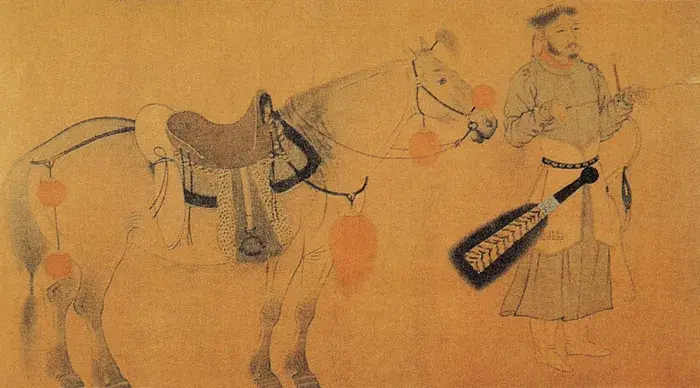
1016 CE–1055 CE
耶律宗真
Yelü Zongzhen (耶律宗真, April 3, 1016 CE – August 28, 1055 CE), courtesy name Yibujin and childhood name Zhigu, was the seventh emperor of the Khitan Liao dynasty, reigning for twenty-four years from 1031 CE to 1055 CE as Emperor Xingzong (Emperor Xingzong of Liao / 辽兴宗). As the eldest son of Emperor Shengzong (Yelü Longxu) and concubine Xiao Noujin, he was raised from infancy by the primary consort Empress Qitian (Xiao Pusage).…
Yelü Zongzhen (耶律宗真, April 3, 1016 CE – August 28, 1055 CE), courtesy name Yibujin and childhood name Zhigu, was the seventh emperor of the Khitan Liao dynasty, reigning for twenty-four years from 1031 CE to 1055 CE as Emperor Xingzong (Emperor Xingzong of Liao / 辽兴宗). As the eldest son of Emperor Shengzong (Yelü Longxu) and concubine Xiao Noujin, he was raised from infancy by the primary consort Empress Qitian (Xiao Pusage). Endowed with an imposing physique, martial prowess in archery, and deep erudition in Confucian learning, music, and painting, he was created Prince of Liang in 1021 CE and designated crown prince in 1025 CE. Upon ascending the throne in 1031 CE, imperial authority was temporarily usurped by his biological mother, Empress Dowager Xiao Noujin, who executed senior ministers and forced Empress Qitian to commit suicide. In 1032 CE, warned by his younger brother Yelü Chongyuan of a plot to depose him, Emperor Xingzong staged a palace coup, confining his mother to the ancestral tombs and inaugurating his personal reign under the Chongxi era. During his reign, he exploited Northern Song's military setbacks against Western Xia to demand territorial revisions, coercing Song into signing the Chongxi Treaty of Increased Tribute in 1042 CE, which expanded annual silver and silk payments while securing diplomatic recognition of Liao as the Northern Court. Between 1044 and 1052 CE, Xingzong personally led three northern campaigns against Western Xia leader Li Yuanhao, ultimately forcing Western Xia to restore tributary vassalage despite suffering severe tactical losses at Mount Helan. Domestically, he codified the 547-article Chongxi Regulations to reform Khitan jurisprudence, patronized Confucian academies, personally presided over civil examinations, and supported the woodblock printing of the Khitan Tripitaka. He died during an imperial inspection tour in 1055 CE at age forty, was posthumously honored as Emperor Shengshen Xiaozhang with the temple name Xingzong, and was entombed at Qingling.
Born as eldest son of Emperor Shengzong, adopted and nurtured by Empress Qitian.
Created Prince of Liang at age six, excelling in horse archery and Confucian study.
Formally installed as imperial heir, participating in state administration with high acclaim.
Emperor Shengzong died; sixteen-year-old Xingzong ascended the throne while his mother seized regency.
Foiled his mother's usurpation plot with Chongyuan's aid, confined her to Qingling, and began personal rule.
Promulgated the comprehensive Chongxi Regulations of 547 articles to standardize Liao law.
Mobilized troops along the southern border, compelling Northern Song to increase annual tribute payments.
Personally led expedition against Western Xia; ambushed during a dust storm and narrowly escaped.
Launched renewed northern offensives, compelling Western Xia to submit and resume tributary status.
Passed away suddenly during a seasonal royal hunt at age forty, entombed in Qingling.
Yelü Zongzhen was born on April 3, 1016 CE, in the traveling camp of Eastern Liaoning, the eldest son of Emperor Shengzong and palace maid Xiao Noujin. Because his biological mother was of humble station and lacked imperial favor, Emperor Shengzong ordered his virtuous primary consort, Empress Qitian (Xiao Pusage), to adopt and rear the infant prince. Empress Qitian showered him with maternal devotion, treating him as her biological son. The young prince exhibited sharp intellect, graceful posture, and composed majesty, winning universal adoration from the sovereign and court dignitaries. In 1021 CE, at the age of six, he was invested as Prince of Liang, commanding the imperial bodyguards.
As he matured, Yelü Zongzhen developed an imposing physique, dignified countenance, and consummate skill in mounted archery. Departing from the traditional Khitan disdain for sedentary scholarship, he harbored a deep passion for Han Chinese classical canons, immersing himself in historical chronicles, poetic composition, stringed music, and landscape painting, distinguishing himself among northern noble youths. In 1025 CE, Emperor Shengzong formally proclaimed him crown prince, directing him to participate in military and civil decisions to master statecraft.
During his tenure in the Eastern Palace, Yelü Zongzhen displayed modesty and reverence toward venerable scholars, attracting Han literati and Khitan aristocrats from both northern and southern administrative divisions. He routinely convened scholarly discussions on classical governance within his residence, paying close attention to hydraulic projects and agricultural expansion across frontier commanderies. Impressed by his administrative maturity, Emperor Shengzong openly lauded him as a worthy successor capable of sustaining dynastic prosperity.
In July 1031 CE, Emperor Shengzong passed away in the Shangjing royal camp after reigning for over three decades. Sixteen-year-old Crown Prince Yelü Zongzhen ascended the throne before the imperial bier under the era name Jingfu. However, before the young sovereign could exercise independent governance, his ambitious biological mother, Xiao Noujin, proclaimed herself Empress Dowager and usurped supreme authority. Harboring bitter jealousy toward Empress Qitian, Xiao Noujin fabricated treason accusations, forcing the beloved empress to commit suicide and purging venerable elder statesmen appointed by Emperor Shengzong.
Empress Dowager Xiao Noujin monopolized state affairs, promoting her brothers Xiao Xiaoxian and Xiao Xiaomu to dominant civil and military commands and plunging court governance into corruption and nepotism. As Yelü Zongzhen reached adulthood and began asserting personal views, the Empress Dowager feared losing her autocratic dominance. She secretly conspired to depose Xingzong in favor of her compliant younger son, Prince Yelü Chongyuan, precipitating an intense crisis within the inner chambers.
Xiao Noujin placed numerous spies and guards around the young sovereign, monitoring his movements and stripping him of the authority to deploy palace guard units. Righteous Khitan elders and Han scholar-officials watched with trepidation, dreading a destructive dynastic civil war. Despite his isolation and danger, Yelü Zongzhen exhibited remarkable political patience and tactical restraint, feigning filial obedience while secretly coordinating with loyalist commanders to strike back.
In the winter of 1032 CE, Prince Yelü Chongyuan, refusing to participate in fratricide, secretly disclosed his mother's usurpation plot to Emperor Xingzong. Shocked and galvanized into action, Xingzong launched a swift preemptive coup, mobilizing palace commander Xiao Xiaoyou and over a thousand elite loyalist bodyguards to surround the Empress Dowager's quarters. Xingzong confiscated the imperial seals, executed the treasonous consort faction including Xiao Xiaoxian, and confined his mother to an isolated palace at Qingling, reclaiming supreme autocratic authority.
Following the restoration of imperial authority, Yelü Zongzhen renamed the era Chongxi, inaugurating his personal reign. To reward Prince Yelü Chongyuan's loyalty, Xingzong created him Imperial Younger Brother and Grand Marshal of All Armed Forces, granting him unprecedented ceremonial honors. The emperor governed with renewed vigor, rehabilitating wronged ministers, revitalizing frontier forces, removing parasitic sycophants, and appointing capable officials to steer the administration back to order.
Having purged the treacherous consort faction, Yelü Zongzhen chose not to execute his biological mother, instead providing seasonal honors and palace stipends in accordance with filial piety. This measured statesmanship stabilized dynastic cohesion and won profound admiration from both Khitan chieftains and Han literati. The dawn of the Chongxi era marked the recentralization of imperial autocracy, providing a secure political foundation for dynamic regional diplomacy.
In 1042 CE, Northern Song became engulfed in devastating border warfare against Western Xia leader Li Yuanhao, suffering crushing military reverses at Haoshuichuan and Dingchuanzhai that left the Shaanxi defenses on the brink of collapse. Perceptive to Song's strategic vulnerability, Yelü Zongzhen mobilized hundreds of thousands of veteran cavalry along the southern frontier along the Baigou River, presenting a terrifying posture of imminent invasion.
Simultaneously, Xingzong dispatched senior diplomats Liu Liufu and Xiao Ying to the Song capital of Kaifeng, demanding the retrocession of ten southern commanderies ceded under the Later Zhou and alleging Song violations of the Shanyuan Treaty. Terrified of a catastrophic two-front conflict, Emperor Renzong of Song dispatched prime envoy Fu Bi to negotiate a settlement. Confronted by overwhelming Khitan military coercion, Song capitulated to Liao terms in the historic Chongxi Treaty of Increased Tribute.
Under the revised treaty, Northern Song agreed to increase its annual tribute by one hundred thousand taels of silver and one hundred thousand bolts of silk, raising annual payments to two hundred thousand silver taels and three hundred thousand silk bolts. Furthermore, Song formally addressed Liao as the Northern Court in diplomatic correspondence while referring to itself as the Southern Court. Through masterful diplomatic brinkmanship without expending a single arrow, Xingzong secured immense fiscal wealth and reaffirmed Liao's primacy in East Asia.
Following the agreement, the southern frontier enjoyed decades of undisturbed peace, and border trade markets flourished vigorously as massive quantities of southern wealth poured into Khitan treasuries. Yelü Zongzhen utilized these resources to reward military units, construct secondary capitals, and sponsor majestic Buddhist complexes, raising state revenues to their historic zenith and cementing parity with the Song empire.
Following the diplomatic settlement between Liao and Song, Western Xia ruler Li Yuanhao felt betrayed by his northern ally, retaliating by launching raids against Khitan tributary tribes along the western frontier and shattering the Liao-Xia alliance. In late 1044 CE, Yelü Zongzhen resolved to crush Western Xia's insubordination, personally leading an army of one hundred thousand cavalry across three fronts to invade Western Xia territory through the rugged passes of Mount Helan.
Li Yuanhao enacted scorched-earth tactics, drawing the northern invasion force deep into the arid western deserts before springing a massive ambush. During the encounter, a fierce sandstorm blinded the Khitan ranks, throwing their cavalry formations into chaos. Western Xia's elite Iron Kite cataphracts launched a savage counterattack, routing the Liao army and slaying prominent commanders, including imperial son-in-law Xiao Hudu. Protected by a small detachment of armored bodyguards, Xingzong narrowly escaped capture and retreated north.
Undeterred by the humiliation at Mount Helan, Xingzong launched two subsequent western expeditions against Western Xia over the ensuing decade, engaging in brutal wars of attrition that crippled Western Xia's economy. Following Li Yuanhao's death and the accession of an infant monarch, Liao forces scored decisive victories in 1052 CE, compelling the Western Xia court to dispatch emissaries suing for peace.
Western Xia formally submitted as a tributary vassal, restoring traditional diplomatic etiquette toward the Khitan emperor. Although Xingzong's three western campaigns incurred heavy troop casualties and material costs, they permanently extinguished Western Xia's ambitions to challenge Liao supremacy over the Ordos steppes, securing the empire's vast northwestern frontiers.
In his later years, Yelü Zongzhen indulged increasingly in luxury and excessive Buddhist patronage, expending treasury reserves on towering pagodas and monastic estates. He placed excessive trust in consort kin such as Xiao Hui, while imperial commanders grew arrogant under protracted peace. His generous treatment of Prince Yelü Chongyuan fostered dangerous hubris, laying the seeds for the Chongyuan Rebellion during the subsequent reign. In late 1055 CE, Xingzong fell gravely ill during a seasonal royal hunt.
On August 28, 1055 CE, Yelü Zongzhen passed away in his royal tent at age forty. Crown Prince Yelü Hongji ascended the throne as Emperor Daozong. The court bestowed the posthumous title Emperor Shengshen Xiaozhang with the temple name Xingzong, interring him in Qingling Mausoleum. Throughout his twenty-four-year reign, he quelled consort plots, outmaneuvered Northern Song, subdued Western Xia, and sustained the majesty of the Khitan empire.
A landmark achievement of Yelü Zongzhen's reign was his modernization of Liao statutory jurisprudence through the codification of the Chongxi Regulations. Recognizing that traditional Khitan customary law was fragmented and perpetuated harsh inequalities between Khitan and Han subjects, Xingzong commissioned Prime Minister Xiao Xiaomu and Southern Chancellor Yelü Hanjianu in 1036 CE to harmonize past imperial decrees into a unified statutory code of 547 articles.
The Chongxi Regulations marked a major leap in northern legal history, integrating procedural precision and Confucian moral doctrines borrowed from Tang and Song jurisprudence. The code mandated equal judicial punishment for Khitan nobles who harmed Han commoners, dismantling tribal legal exemptions and establishing an integrated institutional foundation for governing a diverse multi-ethnic empire.
Upon assuming personal rule, Yelü Zongzhen championed Confucian scholasticism and the imperial civil examination system. He performed sacrificial rites honoring Confucius at the Imperial Academy in Shangjing and established examination halls in Yanjing to recruit Han literati into central ministries. Xingzong personally presided over palace examinations, reading and grading candidate essays before conferring imperial degrees.
Xingzong also supported Khitan script preservation alongside the monumental woodblock printing of the Khitan Tripitaka, mobilizing eminent monks and scholars across the empire. Accomplished in poetry, calligraphy, and music, Xingzong routinely engaged in poetic exchanges with Han scholars, creating an enlightened court environment that rivaled the cultural sophistication of the Central Plains.
In economic governance, Yelü Zongzhen implemented pragmatic relief policies to support agrarian recovery across Yan-Yun and Liaodong. Responding to recurrent droughts and locust swarms, Xingzong ordered the release of over one hundred thousand bushels of grain to feed destitute peasants, exempted afflicted commanderies from seasonal land taxes, and severely penalized corrupt magistrates who extorted unauthorized levies.
The court funded extensive hydraulic repairs on ancient dikes and irrigation canals around Jizhou and Zhuozhou, rehabilitating tens of thousands of acres of arable land. By registering agricultural households and commuting military transport burdens, Xingzong stabilized grain output across the southern administrative circuits, providing the reliable fiscal foundation that sustained Liao's formidable military apparatus.
Emperor Xingzong Yelü Zongzhen was an illustrious mid-Liao monarch whose reign unified martial valor with sophisticated statecraft. Ruling for twenty-four years, he demonstrated decisive courage in crushing his mother's treacherous regency, secured massive diplomatic gains from Northern Song through the Chongxi Treaty, and preserved imperial hegemony over Western Xia.
Tuo Tuo, chief compiler of the History of Liao, evaluated: "Xingzong ascended the throne in youth amidst regency perils. Rising through resolute self-reliance, he confined the dowager empress and governed personally, demonstrating true sovereign capability. He loved learning, understood music, and personally examined scholars, establishing splendid institutional order. In demanding increased tribute from Song, he augmented state revenues without warfare, demonstrating overwhelming geopolitical prestige. Though suffering tactical reverses at Mount Helan, he ultimately subdued Western Xia. Ruling in peace for decades, he was truly a glorious monarch of Liao restoration."
Modern historians emphasize that Yelü Zongzhen's reign marked the golden equilibrium of the tripartite balance among Liao, Song, and Western Xia. His statutory reforms under the Chongxi Regulations accelerated the institutional sinicization of the Khitan state, while his diplomatic triumphs established Northern Court supremacy across the medieval East Asian world.
FIGURES ASSOCIATED WITH THIS DYNASTY