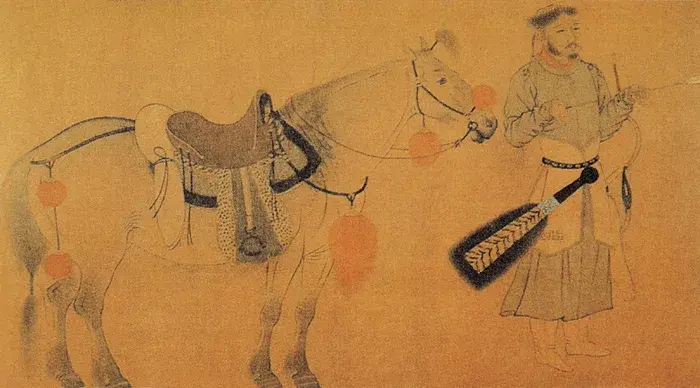
Biography
Prince of Shou'an and Accession after Pacifying the Rebellion
Yelü Jing was born on September 19, 931, into the Khitan royal house as the eldest son of Emperor Taizong (Yelü Deguang) and Empress Jing'an of the Xiao clan, given the Khitan infant name Shulü. Endowed with exalted dynastic status, he displayed a reserved and introspective temperament from childhood and enjoyed his father's deep affection. In 939, during the Huitong era, he was formally created Prince of Shou'an and assigned military commands, gradually winning solid prestige among the imperial bodyguards and tribal aristocrats. However, in 947, Emperor Taizong died abruptly at Shahu Forest during his northward return from conquering the Later Jin dynasty, plunging the Liao court into an acute succession crisis.
Following Taizong's demise, expeditionary commanders and Han courtiers acclaimed his nephew, Emperor Shizong (Yelü Ruan), while Grand Empress Dowager Shulü Ping championed her youngest son, Yelü Lihu, bringing both factions to the verge of civil war along the Huang River. Through the diplomatic mediation of the respected elder statesman Yelü Yuzhi, a compromise was reached acknowledging Shizong's accession. During this perilous standoff, Prince Yelü Jing demonstrated remarkable self-restraint and astute political instincts, refraining from backing either faction. His prudent neutrality earned the trust of Emperor Shizong's administration, allowing him to reside peacefully in his private manor without becoming the target of palace purges.
In the autumn of 951, Emperor Shizong led a massive Khitan expeditionary army south with the intent of invading Later Zhou, halting at Huoshendian near Guihua Prefecture. After conducting sacrificial rites honoring his late mother, Empress Xiao, Shizong hosted a lavish drinking banquet for tribal chieftains and military commanders, during which the court became thoroughly intoxicated and defensive vigilance lapsed. Prince Chage of Taining and Prince Diela, who had long harbored treasonous designs, exploited the nocturnal drunken stupor of the imperial guard to launch a surprise assault upon the royal pavilion, brutally assassinating Emperor Shizong and key ministers, throwing the frontline army into total pandemonium.
During the catastrophe at Huoshendian, Prince Yelü Jing was accompanying the imperial retinue. When the rebels attacked the encampment, Yelü Jing was swiftly shielded by his devoted personal guards, who guided him into the rugged wooded ravines to evade capture. The veteran chancellor Yelü Yuzhi maintained extraordinary composure, dispatching elite troops to secure the Prince of Shou'an while rallying dispersed tribal battalions and Han infantry around the royal tent. Recognizing that as Taizong's eldest son, Yelü Jing possessed unimpeachable dynastic legitimacy, Yelü Yuzhi and Northern Chancellor Yelü Talie escorted him to the central command tent, rallying all loyal forces to crush the regicides.
Yelü Yuzhi and Yelü Jing immediately issued an emergency proclamation denouncing Chage's heinous crime against Heaven and calling upon all loyal Khitan divisions to rally behind the legitimate heir. Moved by enduring reverence for Emperor Taizong's memory, soldiers and tribal contingents abandoned the mutineers in droves to pledge fealty to the Prince of Shou'an. Chage's rebel formation disintegrated within hours, and though he resisted stubbornly, he was swiftly captured alive. Supported by senior commanders, Yelü Jing executed Chage, Diela, and their ringleaders without hesitation, scattering their ashes to vindicate imperial law and stabilizing the imperial center in record time.
With the regicides annihilated, assembled generals and tribal chieftains unanimously petitioned the Prince of Shou'an to assume supreme executive authority. On October 11, 951, Yelü Jing held the traditional Khitan fire-burning enthronement rites at the Huoshendian military camp, ascending the imperial throne as Emperor Tianshun, proclaiming a general amnesty and inaugurating the era name Yingli. Known historically as Emperor Muzong of Liao, his accession not only averted the imminent collapse of the state but permanently restored imperial succession from the Shizong branch back to the direct senior lineage of Emperor Taizong.
The day after his enthronement, Emperor Muzong led his victorious host south to Nanjing (Xijin Prefecture, modern Beijing) to console the regional Han populace and frontier garrisons. Simultaneously, he dispatched envoy Liu Chengxun on a fast courier mission to Taiyuan to inform his ally, Emperor Shizu (Liu Min) of Northern Han, of Shizong's tragic demise and the new emperor's succession. Liu Min promptly dispatched tributary missions bearing thoroughbred steeds and imperial treasures to offer condolences and congratulate the new monarch. In response, Muzong issued an imperial edict formally investing Liu Min as Emperor of Great Han, establishing a fraternal alliance that stabilized the southern frontier.
Upon mounting the throne, Muzong recognized that public confidence remained fragile, prompting him to bestow generous rewards upon the statesmen who had engineered his accession. He elevated chief strategist Yelü Yuzhi to the premier title of Yuyue with supreme executive oversight and made Yelü Talie King of the Southern Division, while continuing to entrust Han Chancellor Gao Xun with vital administrative duties. By distributing generous imperial benefactions and enforcing unbending legal discipline, Yelü Jing restored order to the Khitan military and bureaucratic machinery within months, firmly entrenching his new administration.
Following the enthronement ceremonies, Emperor Muzong deliberately chose to linger at Nanjing for several months rather than immediately returning north to Linhuang Prefecture. He acutely appreciated that the Sixteen Prefectures of Yanyun constituted the financial lifeblood and agricultural grain reservoir of the empire, necessitating personal imperial oversight. While holding court at Nanjing, Muzong frequently received Han civil scholars and military commanders, conferring silk brocades and warhorses while sternly prohibiting Khitan cavalry from plundering Han farms under the guise of pacification. This deliberate display of imperial benevolence pacified regional anxieties and provided indispensable geopolitical stability for his nascent reign.
Purging Dynastic Rebellions and Centralizing Court Authority
During the early Yingli era, the gravest threat facing Emperor Muzong was the chronic factionalism and violent rebellions instigated by princes of the imperial clan. The regicide at Huoshendian had shattered the sanctity of imperial succession, encouraging ambitious kinsmen with private armies to covet the crown. Although Muzong held the moral high ground, his uncles and brothers—including Yelü Lihu, Yelü Louguo, Yelü Dielie, Yelü Wan, Yelü Yansage, and Shizong's younger brother Yelü Xiyin—regularly conspired with disaffected maternal relatives in persistent attempts to overthrow the throne.
In the spring of 952, Xiao Haisi and Xiao Dagan, maternal uncles of the emperor and brothers of Empress Jing'an, secretly conspired to overthrow Muzong and elevate Shizong's brother Yelü Dielie. When loyal attendants uncovered the plot, Muzong responded with incandescent fury, ordering the imperial bodyguards to arrest the conspirators immediately. Once the treason was corroborated, Muzong refused to show clemency despite their close familial ties, ordering Xiao Haisi and Xiao Dagan beheaded and their estates confiscated, ruthlessly nipping in the bud maternal clan ambitions to manipulate imperial succession.
In July of that same year, Emperor Taizong's second son, Prime Minister Yelü Louguo, relying on his battlefield prestige and status as the emperor's biological brother, conspired with palace valets Meigude and Li Ti to launch a coup at the royal villa. Muzong deployed elite ambuscades that ensnared the conspirators, executing Meigude on the spot. Muzong personally interrogated Louguo, castigating him for fratricidal treason, before confining him to the former residence of Xiao Haisi, where Louguo soon died under mysterious circumstances. Muzong's ironhanded resolution signaled that treason would meet with death regardless of fraternal bloodlines.
In October 953, Yelü Wan, son of imperial uncle Yelü Lihu, joined forces with imperial grandson Yelü Dielie in another conspiracy, even attempting to open secret communications with Later Zhou to secure foreign intervention. Relying on Yelü Yuzhi's comprehensive intelligence network, Muzong uncovered the conspiracy before it could be executed, dispatching regiments to surround their estates and capture all conspirators. Taking into account their status as direct imperial descendants of Taizu, Muzong initially commuted their capital sentences to severe floggings and exiled them to remote border garrisons, dismantling the factional infrastructure of dissident princes.
Nevertheless, dynastic ambitions refused to subside. In 959, Prince Xiyin of Zhao, younger brother of the late Emperor Shizong, gathered fugitive Khitan riders to raid the imperial lodge. The plot was betrayed, and Yelü Yuzhi captured Xiyin. An enraged Muzong intended to execute him, but upon fervent intercession from senior elders of the Dongdan princely branch, he commuted the sentence and imprisoned Xiyin in the Linya dungeons. The following year, the emperor's ambitious uncle Yelü Lihu was implicated in another treasonous conspiracy; Muzong cast him into prison, where Lihu eventually perished, extinguishing a perennial source of dynastic instability.
In 960, Prince Yansage of Taiping, Muzong's younger brother, was accused of plotting insurrection. Realizing discovery was imminent, Yansage fled northwest to seek refuge among the Wugu tribes. Muzong dispatched the Northern Division army in relentless pursuit, capturing Yansage, stripping him of all royal titles, and exiling him under heavy guard to the remote Jinshan mountains. Through these systematic purges over his first decade, the most dangerous pretenders to the throne—including Lihu, Louguo, Xiyin, and Yansage—were utterly neutralized, inflicting a crushing blow upon rebel aristocratic factions.
Amidst these relentless purges, Muzong systematically restructured the inner court and centralized royal authority. He clearly recognized that the immense private armies maintained by the traditional Khitan aristocracy constituted the primary breeding ground for palace rebellions. Consequently, he curtailed the independent military retainers of imperial princes and outlawed private political gatherings among nobles. Muzong decreed that courtiers discussing state affairs in private would be charged with treason, establishing an omnipresent surveillance network that forced aristocrats into fearful compliance.
To anchor this centralized autocracy, Muzong relied unreservedly on upright elder statesmen led by Yelü Yuzhi and Yelü Talie. Yelü Yuzhi supervised high administrative affairs, revised Khitan legal codes, and enforced impartiality, while Yelü Talie commanded the Southern Division, securing the Yanyun borderlands. Muzong granted both chancellors absolute executive authority, ensuring that critical state decisions were deliberated and enacted through their joint council. This structural synergy between absolute imperial authority and venerable ministerial administration preserved state continuity through perilous upheavals.
In the process of suppressing these noble revolts, Emperor Muzong systematically restructured the traditional Khitan ordo (palace guard) system. He revoked the hereditary privilege of dissident princes to recruit and maintain private guard units, decreeing that all ordo troops and bonded households belonging to convicted conspirators be transferred directly to imperial control. By absorbing dispersed aristocratic retainers into the royal bodyguards, Muzong vastly expanded the combat strength of the standing palace guard, eliminating the institutional basis for independent princely warlordism.
These uncompromising measures, while accompanied by domestic bloodshed, completely arrested the destructive cycle of aristocratic regicide and fragmentation that had plagued the state since Taizong's death. Muzong's ruthless enforcement of central authority prevented dynastic factionalism from metastasizing into nationwide civil war, safeguarding the territorial integrity and defensive readiness of the Liao Empire during a pivotal period of political transition across China.
Binge Drinking, Dereliction of Duty, and Hunting at Mount Heishan
Once his imperial position was firmly secured and dynastic conspiracies were thoroughly eradicated, Emperor Muzong succumbed to deep-seated political fatigue and acute paranoia. Conscious that many surrounding courtiers and attendants might harbor treasonous designs, he felt isolated and vulnerable within the palace. Gradually despairing of governance, he sought psychological escape by abandoning state duties, immersing himself in unbridled drinking bouts and relentless hunting expeditions. By the middle of his reign, his neglect of administrative affairs had become absolute, leaving court memorials unattended for months on end.
Muzong's most notorious indulgence was his chronic, around-the-clock alcoholism. Extant historical annals document that whenever he hosted banquets or drank privately in his encampment, he imbibed continuously from dusk until dawn. Once completely intoxicated, he collapsed into profound stupor, frequently sleeping well past noon into the late evening. Upon waking, he would resume drinking, creating a perpetual inversion of day and night. When ministers arrived bearing urgent administrative reports, they were routinely turned away for days at a time. Courtiers, commoners, and foreign envoys privately mockingly referred to him as the Sleeping King.
Hand in hand with his dipsomania was his obsessive passion for year-round hunting. While seasonal imperial hunts were an integral part of Khitan nomadic tradition designed to inspect troops and drill horsemen, Muzong's expeditions devolved into manic escapism. Disregarding extreme weather, he spent months and sometimes entire years away from the supreme capital Linhuang, encamped in the dense forests and desolate crags of Mount Heishan, Mount Chishan, and Mount Qiushan in Huai Prefecture, delegating all central administration and imperial correspondence to chancellors like Yelü Yuzhi.
During autumn hunts in the mountains, Muzong routinely commandeered thousands of tribal levies and soldiers to serve as beaters, driving dangerous wildlife toward his blinds across precipitous valleys. In these perilous drives, dozens of hunters were mauled to death or trampled by enraged bears and boars. Horrified by this wanton loss of human life, loyal court diarist Han Jianu repeatedly submitted remonstrances, candidly recording the grim casualty figures in the imperial daily logs. When Muzong discovered these unflinching records, he ordered them expunged; yet when Han Jianu courageously restored the text, Muzong sighed in admiration, conceding that an honest historian must record the truth without fear.
Yet this literary admiration did nothing to restrain Muzong's hunting mania. Boasting of his archery prowess, whenever he felled an enormous bear or stag, he would erect yurts directly upon the frozen wilderness, butchering carcasses and roasting meat to feast his entourage. He frequently maintained these celebratory drinking bouts for seven consecutive days, during which master and retainers lay sprawled across the frozen tundra in drunken oblivion. Even when blizzards froze the tent flaps shut at Mount Heishan, Muzong donned white fox furs and mounted his warhorse to pursue quarry across icy precipices, treating dynastic responsibilities as trivial inconveniences.
This protracted absence from the capital and perpetual drunken slumber created a severe structural vacuum at the apex of imperial power. Ministries functioned without imperial guidance, Han literati found it impossible to obtain imperial audiences, and factional undercurrents began to simmer once more. Only the unwavering loyalty and administrative vigilance of elder statesmen like Yelü Yuzhi, coupled with the flexible pastoral governance inherent in the Khitan seasonal circuit system, preserved basic imperial cohesion, preventing systemic administrative collapse.
While indulging in his bacchanalian pursuits, Muzong exhibited violent hostility toward political remonstrance. When conscientious officials utilized ceremonial tribute presentations to gently urge temperance and attention to state affairs, Muzong would storm away in fury or summarily strip them of their official ranks. He cynically asserted that governing an empire was akin to reining in wild horses—so long as capable ministers held the provinces, an emperor had no cause to burden himself with bureaucratic labor. This passive apathy completely paralyzed institutional reform throughout his reign.
Furthermore, unending intoxication and irregular sleep patterns catastrophically deteriorated Muzong's physical and mental health. Although only in his thirties, he became corpulent, lethargic, and prone to extreme emotional volatility and persecutory delusions. He increasingly distanced himself from seasoned statesmen, entrusting the physical security of his private quarters and daily sustenance entirely to personal valets, eunuchs, and kitchen servants such as Xiaoge, Huage, and Xingu—a catastrophic error that laid the foundation for his gruesome demise.
These grueling wilderness expeditions also imposed unbearable physical and psychological trauma upon his imperial guards and traveling retinue. Through howling subzero blizzards, retainers and falconers were compelled to keep watch in knee-deep snowdrifts for days without relief. Many civil officials unaccustomed to severe steppe winters suffered crippling frostbite and permanent injury. Indifferent to their suffering so long as wine and quarry abounded, Muzong subjected his entourage to unending torment, alienating the very individuals charged with protecting his life.
In retrospect, Muzong's self-imposed isolation at Mount Heishan was both an extreme distortion of traditional Khitan martial practices and a pathological manifestation of existential dread following traumatic palace bloodbaths. The Sleeping King sought to evade the crushing burdens of the crown through alcohol and the chase, never suspecting that the desolate wilderness he treated as a sanctuary would become the execution ground where his life was violently extinguished.
Erratic Cruelty and Nocturnal Assassination at Mount Huailing
Compounded by acute alcoholism and worsening psychiatric paranoia, Emperor Muzong's personality underwent a catastrophic, sadistic degeneration during his final years. He grew notoriously irascible, oscillating unpredictably between sober lucidity and bloodthirsty drunkenness. Yet remarkably, his cruelty exhibited a distinct social boundary: imperial annals note that his tyranny never touched high ministers above, nor commoners below. His horrific outbursts, gruesome mutilations, and executions were directed almost exclusively against the palace attendants, valets, and cooks who attended his personal quarters.
Muzong's abuse of domestic servants escalated to horrifying proportions. At the Heishan encampment, if meals were served a moment too late, if roasted meat retained a trace of blood, or if soups lacked perfect seasoning, Muzong branded the infraction an act of imperial lèse-majesté. He routinely ordered cooks beaten until their teeth shattered, sliced off their ears and noses, or dragged them outside the tent to be dismembered alive. Falconers responsible for royal hunting birds who lost a hawk or damaged a feather were whipped personally by the emperor or tied naked to frozen pines to freeze to death in blizzards.
In December 967, having lost track of a hunted stag in the forests of Mount Heishan, Muzong flew into an irrational fury, blaming the scouting guards. He personally stabbed two attendants to death with his hunting dirk, ordering their corpses dismembered and thrown into the wilderness to be devoured by wolves. In February 968, discovering a speck of dust in his broth, he commanded three royal cooks to have their tongues severed and their abdomens sliced open, chilling his entire entourage to the bone. Attendants serving near the throne trembled continuously in fear of arbitrary execution over minor accidents.
Alongside these executions, Muzong's paranoia spiraled out of control. He frequently woke from drunken nightmares grasping his sword, convinced assassins were lurking within his bedchamber, and decreed that sentries patrolling outside must chant watchwords at the top of their lungs on pain of instant execution. Trusted retainers such as valet Xiaoge, groom Huage, and chief cook Xingu, though longstanding imperial intimates, were repeatedly flogged and branded over inconsequential errors, living in perpetual terror of the emperor's lethal whims.
Historical records indicate that Muzong's sadistic frenzy reached an intolerable apex during his final two years. Throughout 968, if an attendant hesitated in answering, was slow in handing him a blade, or coughed during the night, Muzong would command guards to flay the offender's face with iron scourges or pluck out their beards with red-hot tongs. The inner encampment at Mount Heishan became a terrifying chamber of horrors, driving his personal staff to the desperate realization that assassination was their sole hope of survival.
On March 12, 969, Emperor Muzong arrived at Mount Heishan in Huai Prefecture for a grand hunt. Having bagged an exceptionally large black bear, the jubilant emperor hosted a victory feast within his hunting tent, plying his entourage and favored valets with endless wine. Drinking heavily until past midnight, Muzong became thoroughly intoxicated and was escorted to his sleeping yurt. Awakening in the dead of night parched and ravenous from the wine, he bellowed from his couch demanding that his kitchen staff immediately present hot broth and roast meat.
On duty that night, chief cook Xingu and his assistants found the hearth fires extinguished and were unable to produce piping-hot food on demand. Staggering in drunken rage, Muzong smashed furniture and pointed furiously at Xingu, Xiaoge, and the trembling staff, roaring that at the break of dawn he would have every indolent servant disemboweled, sliced to pieces, and discarded in the snow. Having pronounced this death sentence, the stuporous monarch collapsed heavily back onto his royal couch, soon snoring loudly in deep, unmoving slumber.
This dawn death decree extinguished the last shred of hesitation among the staff. Groom Huage, valet Xiaoge, and cook Xingu gathered three other terrified attendants in an adjoining yurt, realizing that the emperor's promise of execution would be carried out without mercy upon sunrise. Convinced that death was certain unless they struck first, the six men swore a blood pact to assassinate the sleeping tyrant while he was helpless in drunken stupor.
At the third watch of the night, amid a howling blizzard across Mount Heishan, the six conspirators armed themselves with razor-sharp kitchen carving knives and stealthily crept into Muzong's bedchamber. Finding the emperor sprawled upon his couch, snoring loudly and completely oblivious to their presence, they lunged forward simultaneously. Smothering his face with thick felt blankets to stifle his screams, they drove their daggers repeatedly into his throat and abdomen. The brutal monarch perished in suffocating agony at the age of thirty-nine.
The six assassins fled into the swirling snowstorm, leaving the imperial bed soaked in gore. At dawn, attendants entering the yurt discovered the gruesome regicide, plunging the encampment into chaos. Chancellor Yelü Yuzhi immediately mobilized cavalry to seal off Huai Prefecture, capturing all six assassins in the mountain ravines and having them executed according to law. The court acclaimed Emperor Shizong's second son, Yelü Xian (Emperor Jingzong), as the new monarch. Muzong's remains were interred at Huailing and posthumously honored as Emperor Xiao'an Jingzheng, concluding a violent chapter in Liao history.
Major Achievements
Lightening Corvée and Land Taxes, and Promoting Agriculture
In popular historical memory, Emperor Muzong is frequently remembered solely as a bloodthirsty drunkard who brutalized his household staff. Yet comprehensive examination of official historical records reveals an astonishingly enlightened, benevolent record of economic governance and civil administration. Traditional Chinese and Khitan historians, while severely condemning his private vices, uniformly extolled his policy of lightening corvée, reducing taxes, and ensuring popular tranquility, rendering his nineteen-year reign a critical golden age of demographic and agricultural recovery.
Upon his accession, confronted with the severe devastation wrought by the Huoshendian mutiny and Taizong's campaigns against Later Jin, Muzong abandoned the expansionist, predatory warfare that had characterized earlier Khitan reigns. He astutely recognized that ceaseless military incursions depleted Khitan manpower and decimated horse herds, necessitating a prolonged era of rehabilitation. Throughout his nineteen years on the throne, the Liao military never initiated a large-scale, unprovoked southern war of conquest, allowing soldiers to return to their pastures and farms in peace.
In the sphere of fiscal administration, Muzong adhered strictly to principles of moderation, issuing numerous imperial edicts remitting land taxes across the empire. The Sixteen Prefectures under Nanjing (Xijin Prefecture) constituted the economic heartland and grain granary of the realm. During the Yingli era, when severe Hai River floods submerged vast tracts of farmland in Yanyun, Muzong acted immediately, commanding the unconditional remission of all summer and autumn agricultural levies while releasing grain from imperial granaries to feed starving refugees.
To safeguard ordinary subjects against extortion by rapacious aristocrats, Muzong enacted severe protective ordinances. It was customary for Khitan nobles and royal retinues on hunting circuits to intentionally plant road-closure markers low along public highways, tricking merchants and farmers into trespassing so they could confiscate their goods. Upon learning of this predatory practice, Muzong issued a nationwide prohibition, decreeing that any imperial attendant attempting to extort commoners would be executed immediately, restoring security to commercial highways.
Moreover, Muzong implemented targeted developmental policies tailored to the contrasting pastoral and agrarian economies of the empire. In the northern steppe zones, the court safeguarded livestock breeding by strictly prohibiting officials from requisitioning horses and cattle during spring and summer birthing seasons. Across the agricultural plains of Yanyun, Muzong vigorously promoted sericulture and grain cultivation, repaired irrigation canals, and resettled displaced families on reclaimed wastelands, fostering an environment where herds multiplied and harvests flourished.
In judicial administration, while Muzong dealt with his domestic servants with shocking brutality, he enforced remarkable legal restraint and due process toward ordinary subjects. Except in cases of high treason, Muzong repeatedly reviewed provincial capital sentences, forbidding local magistrates from applying arbitrary corporal punishments. All capital verdicts were subject to meticulous appellate review by the Southern Division before execution, affording commoners two decades of uninterrupted judicial protection.
The distinguished Liao statesman Han Jianu provided an authoritative historical assessment of Muzong's domestic achievements. When Emperor Shengzong later inquired which monarch in dynastic history was truly worthy, Han Jianu unhesitatingly named Emperor Muzong. When the surprised emperor pointed out Muzong's drunken brutality, Han Jianu replied that although Muzong was harsh toward attendants, he reduced corvée and lightened taxes so that ordinary people rejoiced in life, noting that no innocent subject had suffered under his public rule. Shengzong fell silent in conviction.
Distinguished modern historians have likewise observed that the Liao Empire's ability to survive repeated violent succession crises and establish the formidable material prosperity of the reigns of Emperor Jingzong, Empress Dowager Xiao, and Emperor Shengzong rested directly upon the economic foundations built under Muzong. His policy of non-interference and fiscal moderation allowed society to heal and accumulate wealth, marking his reign as one of the most prosperous eras for ordinary subjects in Khitan history.
To further shield war-weary commoners, Muzong strictly curtailed the requisitioning of civilian labor. Under customary Khitan law, seasonal imperial migrations and imperial funerals required regional prefectures to conscript thousands of corvée laborers to transport provisions and erect temporary palaces. Muzong abolished unnecessary levies, forbidding officials from drafting farm oxen. Even when constructing his lodge at Mount Heishan, he relied strictly on military engineering units and prisoners, ensuring that civilian agricultural cycles remained undisturbed.
This striking dichotomy defines the ultimate historical paradox of Emperor Muzong. Within the confines of his private yurt, he was an erratic, terrifying despot; beyond his royal tent, he was an enlightened, compassionate ruler who remitted taxes, respected agricultural rhythms, and protected the poor. This stark contrast between private cruelty and public benevolence shatters simplistic stereotypes of dynastic tyrants, illustrating the complex governing dynamics of a semi-nomadic empire balancing steppe traditions with Chinese civil statecraft.
Entrusting Worthy Ministers and Yelü Yuzhi's Administration
Conscious of his aversion to administrative paperwork, Emperor Muzong displayed a pragmatic form of statecraft by placing unreserved trust in virtuous, capable elder statesmen. Throughout his nineteen-year reign, Yuyue Yelü Yuzhi and King of the Southern Division Yelü Talie served as twin pillars upholding the imperial edifice. Muzong never succumbed to paranoid suspicions regarding their military commands, delegating supreme executive decisions to their discretion and achieving the rare historical phenomenon of an empire functioning with extraordinary efficiency despite an absentee monarch.
Yuyue Yelü Yuzhi, nephew of dynastic founder Yelü Helu, was renowned for his integrity, wisdom, and statesmanship, having served three consecutive reigns. Having twice saved the dynasty during succession crises, Yuzhi was granted the supreme Khitan honorific title of Yuyue upon Muzong's accession and tasked with overseeing civil administration and foreign diplomacy. Muzong frequently declared to his court that Yuzhi's word was his own, decreeing that anyone who defied the chancellor's directives would be charged with treason.
During his tenure at the head of government, Yelü Yuzhi reformed the central bureaucratic apparatus, tightened discipline among the imperial bodyguards, and prosecuted corrupt officials while establishing an effective surveillance network against dynastic conspiracies. Yuzhi personally scrutinized all legislative decrees and tax schedules to ensure fairness and moderation. With Yuzhi managing Linhuang while Muzong hunted in the wilderness, imperial administration remained orderly and stable throughout the era.
Equally indispensable was King of the Southern Division Yelü Talie, a brilliant general and nephew of Emperor Taizu. Appointed to command the Southern Division in the early Yingli era, Talie oversaw military, civil, and fiscal administration across Yanyun and the Great Wall frontier. Talie inspected border districts, equalized tax assessments, repaired frontier fortifications, and encouraged agriculture, winning immense admiration from both Khitan nomads and Han farmers, who affectionately celebrated Talie and Yuzhi as the Wealth-Generating Kings.
Talie's governance was especially celebrated for curbing corrupt magnates and protecting smallholders across the Sixteen Prefectures. By treating the Han populace with fairness and providing generous stipends to frontier garrisons, Talie fostered deep loyalty toward the Liao court throughout the northern borderlands. The title Wealth-Generating Kings spread far and wide across China, standing as the highest popular accolade bestowed upon administrators during the turbulent transition from the Five Dynasties to the Song.
Muzong's trust in these two statesmen withstood repeated palace conspiracies. When slanderers attempted to accuse Yuzhi or Talie of amassing excessive military power, Muzong executed the informants on the spot to demonstrate his unswerving confidence. Living in the mountains, Muzong reviewed memorials only once every few months, routinely approving any document bearing the signatures of Yuzhi or Talie. Such unwavering delegation of power remains extraordinarily rare among autocratic rulers.
Beyond empowering Khitan statesmen, Muzong significantly refined the dual Southern and Northern Bureaucracy system. He promoted distinguished Han lineages, including Gao Xun and descendants of Han Zhigu and Zhao Siwen, appointing Gao Xun as Regent of Nanjing to manage Yanyun defense and taxation while respecting traditional Han legal codes and Confucian customs. This institutionalized dual administration anchored Liao rule permanently within northern China.
In personnel recruitment, Muzong encouraged Yelü Yuzhi to look beyond aristocratic lineage to promote talented administrators skilled in law and finance. Magisterial appointments confirmed by Yuzhi were promptly ratified by the emperor and endowed with generous salaries to prevent corruption. Under this harmonious relationship between monarch and ministers, the Liao bureaucracy functioned with clean efficiency, accumulating vast grain reserves and training formidable cavalry divisions that allowed the empire to maintain its supremacy across East Asia.
Forging Alliance with Northern Han and Resisting Zhou and Song
Amidst the dramatic geopolitical realignments of tenth-century China, Emperor Muzong executed an exceptionally composed and resolute defense policy. Confronted with the aggressive unification campaigns launched by Later Zhou Emperor Chai Rong and Northern Song Emperor Zhao Kuangyin, Muzong prioritized the security of the Sixteen Prefectures of Yanyun and preserved Northern Han as an essential buffer state, maintaining a formidable defensive perimeter south of the Great Wall.
When Liu Chong founded the Northern Han regime at Taiyuan in 951, facing immediate destruction from Later Zhou armies, he petitioned the Liao court for tributary protection. Muzong recognized that a loyal vassal state at Taiyuan was vital to shield Yanyun from direct southern assault. He promptly invested Liu Chong as Emperor of Great Han, committing Khitan cavalry to bolster Taiyuan's defenses. Following Northern Han's defeat at the Battle of Gaoping in 954, Muzong dispatched Yelü Talie with tens of thousands of horsemen to relieve the besieged garrison.
As Later Zhou forces advanced on Taiyuan, Yelü Talie led his divisions south through Yanmen Pass, approaching Xinzhou. When Later Zhou vanguard commander Shi Yanchao advanced recklessly, Talie executed an ambush that encircled and killed Shi, routing thousands of Zhou troops. Hampered by severed supply lines, protracted siege warfare, and torrential summer rains that spread disease among his troops, Later Zhou Emperor Shizong was compelled to burn his remaining provisions and retreat, ensuring Northern Han's survival.
When Liu Chong died in 954, his successor Liu Chengjun dispatched envoys seeking confirmation of his title. Muzong received the mission with high imperial honors, investing Liu Chengjun as Emperor of Northern Han and formalizing an alliance in which the monarchs addressed each other as equals and brothers. Over subsequent years, as Later Zhou repeatedly attacked Northern Han, Muzong deployed regional commanders to repel southern armies around Fenzhou and Jinyang, transforming the vassal kingdom into an impregnable bastion shielding Liao's southwestern flank.
In May 959, Emperor Shizong of Later Zhou launched a massive northern expedition to recover the Yanyun territories. Advancing by land and water, Zhou forces captured Yijin, Waqiao, and Yukou passes without serious resistance, securing Yingzhou and Mozhou and threatening Nanjing itself. Hunting at Mount Heishan, Muzong received frantic appeals from Nanjing Regent Xiao Siwen. Undaunted, Muzong astutely recognized that the southern expedition was overextended and reliant on rapid victory, resolving to maintain strategic defense and hold the mountain passes until the invaders exhausted themselves.
Muzong's strategic foresight was dramatically vindicated when Chai Rong fell gravely ill on the frontlines, forcing an abrupt Zhou withdrawal; Chai Rong died shortly after returning to Kaifeng, terminating the northern offensive. When Zhao Kuangyin subsequently seized power and founded the Northern Song dynasty, Muzong ordered Nanjing Regent Gao Xun to fortify the defensive lines north of Waqiao Pass and reinforce mountain garrisons along the Yishui and Juma rivers, establishing an airtight frontier defense.
During the early Kaibao era of Northern Song, Emperor Taizu launched probing assaults against Taiyuan and Khitan border outposts. Muzong maintained his defensive posture, commanding border generals to hold fortified mountain passes while deploying light cavalry to harass Song forward bases between Yizhou and Dingzhou. Recognizing the immense combat strength of the Khitan cavalry and the impregnability of Yanyun fortifications, Song armies were unable to breach the southern border. Throughout Muzong's nineteen-year reign, the Sixteen Prefectures remained completely intact.
In managing relations with Northern Han, Muzong paired geopolitical realism with generous material aid. Because Northern Han suffered chronic financial exhaustion from perpetual warfare, Muzong dispatched yearly shipments of warhorses, sheep, salt, and raw iron from imperial treasuries to sustain the vassal kingdom while strictly forbidding Khitan borderers from raiding Northern Han refugees. This enlightened policy secured unshakeable loyalty from the court at Taiyuan, safeguarding Liao's southwestern frontier throughout his reign.
Historical evidence confirms that during a tumultuous era when centralized Chinese armies overran regional kingdoms across the realm, Emperor Muzong repulsed three catastrophic northern invasions through calculated strategic patience. Avoiding premature confrontations and leveraging deep fortifications, he protected the extensive northern domains of the Khitan Empire with minimal expenditure of blood and treasure, demonstrating profound strategic composure.
Executions of Attendants and the Chronic Sickness of the Sleeping King
Reflecting upon the dramatic thirty-nine years of Emperor Muzong's life, historians are inevitably struck by the profound psychological contradictions that defined his tragic reign. In official Liao historiography, he was honored with the imperial title Emperor Tianshun, granted the temple name Muzong, and awarded the revered posthumous title Emperor Xiao'an Jingzheng; yet in popular folklore, he became universally infamous as the Sleeping King who neglected statecraft for alcohol and slumber. This striking intersection of good governance and terrifying cruelty makes him one of the most enigmatic figures in Chinese imperial history.
Muzong's cruelty was distinguished by its narrow and peculiar focus. Across his nineteen years on the throne, the victims of his arbitrary executions were drawn almost exclusively from the ranks of his personal attendants, eunuchs, and kitchen servants. Detailed records in the History of Liao confirm that dozens of domestic servants were executed under his direct orders. Over minor mishaps such as lost hunting falcons, slightly undercooked roast meat, delayed broth, or inadvertent noises that disturbed his slumber, servants suffered amputation, tongue slicing, disembowelment, and execution, their remains abandoned in the ravines of Mount Heishan.
This relentless brutality directly provoked the terrifying regicide of March 969. Valet Xiaoge, groom Huage, and cook Xingu were intimate household retainers who attended the emperor day and night. Yet the monarch's drunken promise of mass execution at daybreak transformed these terrified servants into desperate assassins. That six humble palace attendants could successfully execute a reigning emperor within his heavily guarded camp remains one of the most chilling ironies in dynastic history.
Yet viewing Muzong simply as an unmitigated tyrant fundamentally distorts historical reality. His cruelty never spilled beyond his private quarters into the halls of government or the homes of ordinary subjects. During his nineteen years, not a single upright minister was executed for offering remonstrance, nor was an innocent commoner put to death by imperial whim. When Han Jianu repeatedly rebuked the emperor to his face and recorded his hunting casualties, Muzong respected his integrity and never harmed him—a degree of tolerance rarely exhibited by autocratic rulers.
To ordinary subjects, Muzong's reign was an era of genuine peace and prosperity. Khitan warriors rested from war, Han farmers enjoyed tax remissions and labor exemptions, flood victims received immediate disaster relief, and strict laws protected commoners from noble extortion. In an era marked by devastation across China, subjects along both sides of the Great Wall enjoyed security and stability. The heartfelt praise bestowed upon Muzong as an exemplary monarch by later Liao courtiers reflected profound gratitude from a populace that had suffered generations of turmoil.
Muzong's life represented the tragic outcome of nomadic autocracy during a volatile period of institutional transition. Having witnessed the arbitrary purges of his grandmother Empress Dowager Shulü Ping, the sudden death of his father Emperor Taizong on campaign, and the gruesome assassination of his cousin Emperor Shizong at Huoshendian, the psychological trauma of dynastic bloodshed scarred him permanently. He drank to numb his terrors, slept to escape the crown, hunted to find physical release, and lashed out at attendants as his mind deteriorated under mounting stress.
By delegating governance completely to incorruptible chancellors like Yelü Yuzhi and Yelü Talie, he achieved the remarkable feat of maintaining an empire that flourished while the sovereign slept. Under the stewardship of these Wealth-Generating Kings, the Liao state accumulated immense reserves of grain and military power, providing the bedrock for the institutional renaissance of Emperor Jingzong and the golden age of Emperor Shengzong. Viewed from this perspective, Muzong's passive reign served as an invaluable protective shield that enabled the empire to consolidate its internal strength.
Following the tragic assassination at Mount Heishan, Muzong was laid to rest in Huailing. In 1052, during the reign of Emperor Xingzong, the court bestowed upon him the posthumous title Emperor Xiao'an Jingzheng. This title affirmed his legitimacy in preserving the senior dynastic lineage of Emperor Taizong while commending his nineteen years of protecting the common people, maintaining social stability, and defending the borders. It remains the definitive historical verdict passed by the Khitan realm upon this complex, deeply human sovereign.
A thorough reading of the History of Liao leaves one with profound reflections. Yelü Jing rose to power with patience and crushed rebellion with decisiveness; he gained historical infamy for drunkenness and slumber, earned enduring gratitude for compassionate governance, and met a violent end at the hands of abused servants. Standing as a contradictory fusion of cruelty and benevolence, he remains an extraordinary figure whose unique life left an indelible mark upon the history of Chinese emperors.