王庭筠
Historical narrative painting (Wang Tingyun)
Image creditsWang Tingyun · Public domainImage source

1156 CE–1202 CE

Historical figure

Wang Tingyun (王庭筠)

王庭筠

Wang Tingyun (1151–1202), courtesy name Ziduan, styled Master of Mount Huanghua and Old Man of Huanghua, was a native of Gaizhou, Liaodong (modern Gaizhou, Liaoning). He was an outstanding man of letters, master calligrapher, painter, lyricist, and court historiographer of the middle to late Jin dynasty. Hailing from a distinguished aristocratic and literary family of Liaodong, Wang was the son of Hanlin Academician Wang…

1156 CE–1202 CEJin Dynasty (金朝)

PROFILE

Wang Tingyun (1151–1202), courtesy name Ziduan, styled Master of Mount Huanghua and Old Man of Huanghua, was a native of Gaizhou, Liaodong (modern Gaizhou, Liaoning). He was an outstanding man of letters, master calligrapher, painter, lyricist, and court historiographer of the middle to late Jin dynasty. Hailing from a distinguished aristocratic and literary family of Liaodong, Wang was the son of Hanlin Academician Wang Zungu and maternal grandson of the Grand Preceptor and Prince of Nanyang, Zhang Hao, with family ties connecting his lineage to the Northern Song calligraphic master Mi Fu. Highly gifted from childhood, he composed verses at age seven and mastered ancient prose at eleven, passing the Jin imperial examinations in 1176 during the reign of Emperor Shizong. Beginning his official service as military judge in Enzhou, Wang acted with uncompromising rectitude and judicial fairness, but was dismissed following false accusations by corrupt local magnates. Refusing to flatter authority, he retreated to Mount Huanghua in Linlü, Xiangzhou, where he built a mountain hermitage and resided in seclusion for over a decade, earning widespread literary renown across northern China. Following the accession of Emperor Zhangzong, who avidly patronized classical Chinese culture, Wang was summoned back to court in 1192. He served as Hanlin Academician in Waiting, drafter of edicts, and imperial compiler, becoming a favored literary adviser and court connoisseur of ancient calligraphy and paintings. Although briefly demoted to Zhengzhou in 1197 due to alleged improprieties during palace examinations, Emperor Zhangzong recalled him shortly thereafter, appointing him Senior Compiler in the Hanlin Academy with enhanced imperial favor. Wang died in office at the Central Capital (modern Beijing) in 1202 at the age of fifty-two. Wang's poetry and prose possessed vigorous energy and the refined spirit of Ouyang Xiu and Su Shi, but he was particularly revered for his calligraphy and ink paintings of withered trees, bamboos, and rocks. Absorbing the calligraphic spirit of Mi Fu while forging an imposing personal style, he was celebrated by contemporaries as the greatest calligrapher of the Jin dynasty, sharing renown with Dang Huaiying as "Dang and Wang." His surviving masterpiece, Secluded Bamboo and Withered Tree, stands as a landmark treasure of East Asian literati painting.

Courtesy Name
Ziduan
Art Name
Master of Mount Huanghua, Old Man of Huanghua, Xiongfeng
Ancestral Home
Gaizhou, Liaodong (present-day Gaizhou, Liaoning)
Date of Birth
1151 (3rd year of Tiande, Emperor Xizong of Jin)
Date of Death
1202 (2nd year of Taihe, Emperor Zhangzong of Jin)
Life Span
52 years
Dynasty
Jin Dynasty
Highest Office
Senior Compiler, Hanlin Academy, Literary Attendant of the Hanlin Academy (Hanlin Academician in Waiting), Associate Drafter of Imperial Edicts, Compiler in the National History Institute
Historical Role
Eminent literary master, calligrapher, painter, lyricist, and Hanlin scholar-official of the Jin Dynasty

LIFE TIMELINE

Relationship graph

BIOGRAPHY

Chronology

  • 1151 (3rd year of Tiande) | Birth in Liaodong | Born into a prominent aristocratic clan in Gaizhou; displayed extraordinary memory from childhood.
  • 1162 (2nd year of Dading) | Acclaimed Prodigy | Recognized as a child prodigy; scholar Wang Xiu of Zhuojun praised him as an exceptional talent of the realm.
  • 1176 (16th year of Dading) | Jinshi Degree | Passed imperial examinations and appointed military judge of Enzhou, administering laws with integrity.
  • 1180 (20th year of Dading) | Seclusion at Huanghua | Resigned following trumped-up charges and retreated to Mount Huanghua, dedicating himself to arts.
  • 1192 (3rd year of Mingchang) | Recalled by Emperor | Summoned to the central court by Emperor Zhangzong to serve as Hanlin Academician in Waiting.
  • 1196 (1st year of Cheng'an) | Court Historiography | Compiled imperial dynastic annals and cataloged private masterpieces in the imperial art collections.
  • 1197 (2nd year of Cheng'an) | Demotion to Zhengzhou | Exiled to Zhengzhou over civil examination disputes, maintaining literary and artistic production.
  • 1199 (4th year of Cheng'an) | Imperial Reinstatement | Restored to imperial favor by Emperor Zhangzong and elevated to Senior Compiler in the Hanlin Academy.
  • 1201 (1st year of Taihe) | Drafting State Edicts | Authored major state proclamations and imperial sacrificial texts with peerless literary refinement.
  • 1202 (2nd year of Taihe) | Demise at Capital | Passed away in office at age fifty-two, deeply mourned by the literati of northern China.

Life and Career

Noble Lineage and Early Academic Brilliance

Wang Tingyun was born in 1151 in Gaizhou, Liaodong, into a family with deep cultural traditions. His father, Wang Zungu, attained the rank of Hanlin Academician and was widely venerated across northern China as the "Master of Liaodong" for his moral integrity and profound erudition. His mother was the daughter of Zhang Hao, Grand Preceptor and Prince of Nanyang, who stood among the paramount founding statesmen of the Jin dynasty. Furthermore, his lineage was connected through marriage with the family of Northern Song calligrapher Mi Fu, immersing Wang from early youth in an environment rich in classical libraries and fine art.

Endowed with exceptional intellect, Wang displayed early mental agility. According to contemporary funerary steles, he began reciting ancient texts alongside his elder brothers at the age of six, grasping core philosophical tenets effortlessly. He began composing poetry at age seven and wrote complete prose essays at eleven, memorizing thousands of characters daily. Wang Xiu, an eccentric and highly respected scholar of Zhuojun who rarely praised others, met the young Wang and immediately declared him a future national treasure.

In 1176, at the age of twenty-six, Wang traveled to the Central Capital to sit for the imperial examinations and attained the Jinshi degree. Entering the imperial civil service, he was appointed court gentleman for ceremonial affairs and assigned as military judge in Enzhou. In Enzhou, Wang worked tirelessly to clear court backlogs, reviewing cases with fairness and overturning multiple false convictions, earning the deep respect of the local population.

Mountain Hermitage and Dedication to the Arts

Around 1180, powerful local magnates and corrupt superiors sought to pressure Wang into countersigning illegal administrative decrees for private gain. Holding fast to moral principles, Wang refused to comply. Spurned by his refusal, local officials framed him on false charges, forcing his dismissal from the provincial administration.

Undaunted by political adversity, Wang packed his books and zither to travel to Mount Huanghua in Linlü, Xiangzhou (modern Linzhou, Henan). Enchanted by the secluded crags and pristine mountain springs, he erected a thatched retreat and styled himself the Master of Mount Huanghua, also adopting the sobriquet Old Man of Huanghua. Living in peaceful seclusion for more than ten years, he embraced a tranquil rural life.

During his decade in the mountains, Wang immersed himself in ancient history, literary composition, and the fine arts. He studied classical prose from the Han, Wei, Jin, and Tang dynasties, elevating the expressiveness of his poetry. In calligraphy, he practiced the stone inscriptions of Wei-Jin masters and the cursive scripts of Mi Fu day and night. Drawing inspiration from the ancient pines, weathered trees, and wild bamboos of Mount Huanghua, he developed a distinctive literati style of ink painting, becoming renowned throughout northern cultural circles.

Imperial Patronage and Cultural Leadership

When Emperor Zhangzong ascended the throne, he inaugurated an era of cultural flowering. Highly proficient in Chinese literature and calligraphic arts, the emperor actively sought out northern Han intellectual luminaries. Having long admired Wang's reputation, Emperor Zhangzong issued an imperial summons in 1192, appointing him Hanlin Academician in Waiting and summoning him to the inner court.

Within the Hanlin Academy, Wang's encyclopedic learning gained immediate prominence. He drafted major imperial edicts and state rituals while serving as compiler in the National History Institute, collaborating with senior scholars on official records of the Liao, Song, and Jin dynasties. Emperor Zhangzong treated Wang with extraordinary favor, frequently inviting him to private palace banquets and consulting him on ancient calligraphy and paintings preserved within the imperial collection. Wang's sharp critical eye made his artistic authentications the definitive standard of his era.

In 1197, during palace examinations, Wang was implicated in accusations of private favoritism and was reassigned as military defense judge of Zhengzhou. Wang accepted the demotion without resentment, fulfilling his duties while composing poetry on the Yellow River. Recognizing his literary stature and personal integrity, Emperor Zhangzong recalled him to the capital in 1199, appointing him Senior Compiler in the Hanlin Academy and entrusting him with the highest imperial drafting responsibilities.

Final Years and Enduring Acclaim

Following his return to the Hanlin Academy, Wang was universally acknowledged as the preeminent cultural leader of the middle Jin dynasty. Northern scholars considered their reputations secured if they received a single preface or commentary from him. For major state announcements addressed to neighboring realms or sacred sacrifice declarations, Emperor Zhangzong consistently insisted that Wang compose the official texts.

However, decades of continuous intellectual labor took a heavy toll on his health. In 1202, Wang died of illness at his official residence in the Central Capital at the age of fifty-two. Emperor Zhangzong was deeply saddened by his passing, and leading literary figures like Yuan Haowen mourned him profoundly. His son, Wang Manqing, inherited his artistic lineage to become a prominent painter of the Jin-Yuan transition, while his nephew, Wang Ruoxu, achieved fame as one of the Jin dynasty's leading literary theorists.

Major Achievements

Master of Calligraphy and Pinnacle of Jin Dynasty Art

Wang Tingyun occupies a preeminent position in the history of Chinese calligraphy. In the early Jin period, calligraphic styles primarily imitated Liao and Northern Song models. Wang revolutionized this tradition, synthesizing the running-cursive elegance of Jin and Tang masters with the dynamic brushwork of Mi Fu to forge an energetic, grand calligraphic aesthetic.

His brush movements were decisive and robust, featuring dramatic variations in balance while maintaining structural harmony. While he and Dang Huaiying were celebrated as "Dang and Wang," critics across the Jin and Yuan dynasties universally acclaimed Wang as the foremost calligrapher of the Jin era. Yuan dynasty masters such as Yu Ji and Jie Xisi traced their inspiration to his surviving works, regarding him as the premier orthodox exponent of northern literati calligraphy.

Pioneer of Literati Monochrome Painting

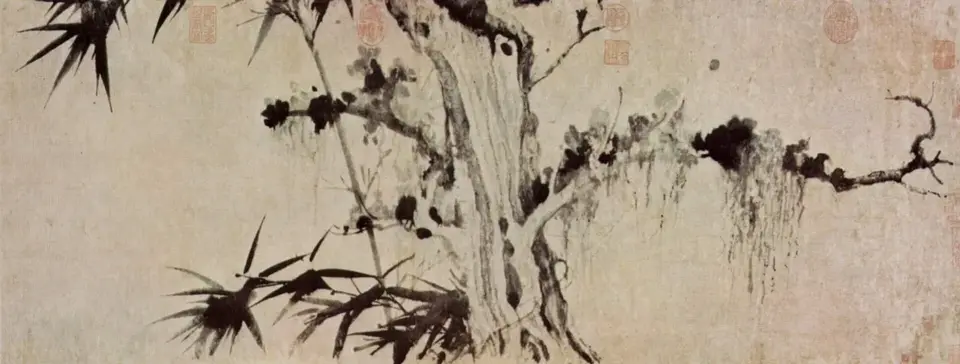
In addition to his calligraphy, Wang forged an original path in literati monochrome ink painting. Building on the expressive traditions of Northern Song artists Wen Tong and Su Shi, he integrated calligraphic line work directly into landscape and botanical compositions, achieving particular fame for his ink renderings of withered boughs, bamboo, and rocks.

His ink bamboos were upright and resolute, with stems resembling antique iron and leaves sharp as daggers; his withered trunks twisted with ancient dignity, evoking the solitude and steadfast virtues of the scholar-official during eras of change. His surviving masterwork, Secluded Bamboo and Withered Tree (preserved in the Fujii Yurinkan Museum in Kyoto, Japan), exhibits spare composition and profound mastery of wet and dry ink tonal contrasts, recognized as an invaluable national treasure of Song-Jin painting.

Custodian of Imperial Letters and Dynastic History

During his decade of central court service as Hanlin Academician in Waiting and Senior Compiler, Wang served as an indispensable architect of Emperor Zhangzong's cultural golden age. He composed influential state decrees and diplomatic dispatches that endowed dynastic records with solemnity and grace, while also contributing to the critical collation of early Jin and Liao historical records.

In cataloging the imperial art collections, Wang applied rigorous textual criticism to rectify centuries of erroneous attributions, establishing orderly documentation for treasures in the imperial palace. In literature, he rejected superficial rhythmic constraints in favor of vigor, clarity, and unadorned directness, redirecting northern literary tastes away from fragile ornamentation toward substantive depth, which paved the way for great successors like Yuan Haowen.
Interpersonal Relations

  • Emperor Zhangzong of Jin: Sovereign patron and fellow connoisseur who extended immense favor to Wang, recalling him twice to the Hanlin Academy as his primary literary counselor.
  • Wang Zungu: Father of Wang Tingyun, Hanlin Academician known for scholarship and integrity, venerated as the "Master of Liaodong."
  • Zhang Hao: Maternal grandfather, founding Grand Preceptor and Prince of Nanyang, who held premier court rank across multiple Jin reigns.
  • Mi Fu: Prominent Northern Song calligrapher and painter whose artistic techniques through family ties profoundly inspired Wang's style.
  • Dang Huaiying: Literary contemporary and fellow calligrapher; the two scholars were jointly celebrated across northern China as "Dang and Wang."
  • Wang Manqing: Son, courtesy name Gongshou, who inherited his father's artistic mastery to become an accomplished literati painter during the Jin-Yuan era.
  • Wang Ruoxu: Nephew, distinguished scholar and literary theorist, deeply influenced by Wang Tingyun's aesthetic criteria.
  • Yuan Haowen: Younger literary giant of the Jin-Yuan era who championed Wang's poetry and calligraphy, praising him as the premier literatus of the Jin dynasty.

Historical Evaluations

  • History of Jin (Jin Shi), Fascicle 126: "Wang Tingyun possessed brilliant intellect and peerless literary talent. Composing poetry at seven and writing essays at eleven, he was hailed as a national prodigy by all who met him. His prose was sweeping and grand, and his calligraphy possessed robust vigor, capturing the true spirit of Mi Fu. Ascending through the examinations, his career experienced vicissitudes, yet his renown reached the imperial throne. When culture flourished at the peak of the Jin realm, Ziduan stood at its very head."
  • Emperor Zhangzong of Jin praised in an imperial poem: "Wang Tingyun's literary flair is radiant and his brushwork divine; he is truly an incomparable Hanlin scholar of our age."
  • Jin-Yuan literary master Yuan Haowen wrote: "The calligraphy and paintings of the Old Man of Huanghua are matchless across generations, possessing wondrous bones and transcendent spirit; with every brushstroke he touches the clouds. In solemnity and elevation of poetry and prose, he stands as the foremost literatus in the hundred-odd years of the Jin dynasty."
  • Yuan dynasty master Zhao Mengfu evaluated his calligraphy: "In the calligraphy of the Jin dynasty, the Old Man of Huanghua, Wang Tingyun, must be ranked first. His running and cursive scripts are lofty and ethereal, capturing the legal discipline of Jin and Tang masters, with no contemporary able to rival him."

Related Entries

  • Secluded Bamboo and Withered Tree
  • Emperor Zhangzong of Jin
  • Dang Huaiying
  • Yuan Haowen
  • Mi Fu

FIGURES ASSOCIATED WITH THIS DYNASTY

Bibliography

  • History of Jin (Jin Shi), Volume 126, Biography 64: Literature II, Biography of Wang Tingyun
  • Collection of Central Plains Poetry (Zhongzhou Ji), Volume 4
  • Collected Works of Master Yishan (Yishan Xiansheng Wenji), Volume 35: Epitaph of Master Huanghua
  • Xuanhe Catalogue of Paintings (Xuanhe Huapu) and Precious Mirror of Painting (Tuhui Baojian), Volume 4: Jin Dynasty