Birth in Western Xia
Born into the prominent Tangut Gule clan, receiving comprehensive bilingual education from youth.
骨勒茂才
Gule Maocai (骨勒茂才, 12th century) was an eminent Tangut scholar, Sinologist, and bilingual lexicographer of the Western Xia dynasty. Living during the reign of Emperor Renzong of Western Xia (mid-to-late 12th century), he hailed from the prominent Tangut aristocratic Gule clan. During an era when the Western Xia actively promoted Confucian governance, bilingual education, and the translation of classical canons, Gule Maocai…
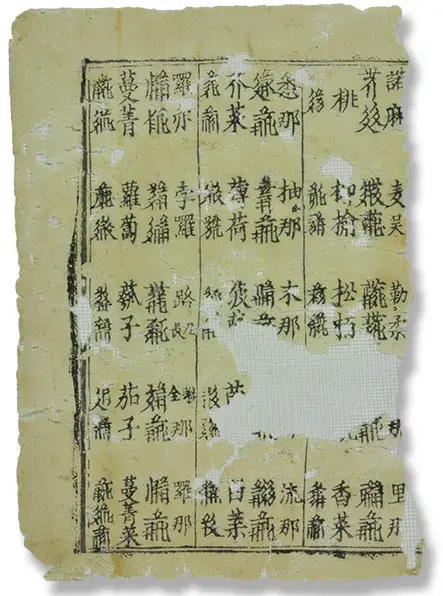
Gule Maocai (骨勒茂才, 12th century) was an eminent Tangut scholar, Sinologist, and bilingual lexicographer of the Western Xia dynasty. Living during the reign of Emperor Renzong of Western Xia (mid-to-late 12th century), he hailed from the prominent Tangut aristocratic Gule clan. During an era when the Western Xia actively promoted Confucian governance, bilingual education, and the translation of classical canons, Gule Maocai mastered both Tangut script and Chinese historical classics, commanding immense prestige in both cultural spheres. Gule Maocai's crowning historical achievement was directing the compilation and publication in 1170 of the world's earliest Tangut-Chinese bilingual glossary, Pearl in the Palm: Tangut-Chinese Bilingual Glossary (Fanhan Heshi Zhangzhongzhu; Tangut: 𗼇𗟲𗌽𗖵𘂁𘂪𘓐𘓐). In his preface, he formulated the celebrated sociolinguistic doctrine: "Comparing Tangut and Chinese scripts, in external form they differ, but in underlying substance they are identical." Employing an innovative four-line bi-directional phonetic and semantic layout, the dictionary became the indispensable key for 20th-century scholars deciphering the extinct Tangut language, possessing monumental value in world linguistic history.
Born into the prominent Tangut Gule clan, receiving comprehensive bilingual education from youth.
Mastered Tangut lexicography and the Confucian Thirteen Classics, assisting in state translation academies.
Completed and published the Fanhan Heshi Zhangzhongzhu, setting the standard for bilingual translation.
Active in imperial and Tangut academies, advancing the standardization of Western Xia dictionaries.
Devoted his late years to textual collation; his glossary became a foundational pillar of Tangut culture.
Gule Maocai lived during the reign of Emperor Renzong (Li Renxiao), the fifth monarch of the Western Xia dynasty. Since Emperor Jingzong (Li Yuanhao) invented the Tangut script in the 1030s, the Western Xia maintained a dual-track linguistic policy employing both Tangut and Chinese. During the Qianyou era under Emperor Renzong, the empire enjoyed peace and cultural flourishing. The court founded imperial colleges, promoted Confucian rites, established Tangut and Chinese academies, and created the Bureau of Tangut-Chinese Translation, translating Chinese classics such as the Analects, Mencius, Classic of Filial Piety, and Sunzi Bingfa into Tangut.
Gule Maocai was born into the influential Tangut Gule clan. Naturally gifted, he received elite education in both Tangut traditions and Chinese classical texts. He not only mastered early Tangut phonological dictionaries such as Yintong (Homophones) and Wenhai (Sea of Writing), understanding the complex structural composition of Tangut characters, but was also deeply versed in Confucian canons, yin-yang cosmology, and Chinese fanqie phonetics, becoming recognized as a preeminent bilingual master.
Through administrative and cultural exchanges, Gule Maocai acutely observed the practical difficulties faced by both peoples when learning each other's languages: "Chinese learning Tangut find it hard to progress without instruction; Tanguts learning Chinese fail to comprehend due to lack of phonetic guides."
To eliminate linguistic barriers and foster interethnic harmony, Gule Maocai resolved to compile an accessible, portable bilingual reference work. Dedicating years of research, drawing upon spoken vernacular expressions alongside official terminology, he completed Pearl in the Palm: Tangut-Chinese Bilingual Glossary in 1170. His four-line layout enabled both Chinese and Tangut speakers to achieve self-taught proficiency, leading to the dictionary's wide adoption across government offices and schools.
Following its publication, Pearl in the Palm was celebrated by the Western Xia imperial court. Gule Maocai spent his later years collating state archives, legal codes, and Buddhist translations. Due to the catastrophic destruction of Western Xia records during the Mongol conquest in 1227, details regarding Gule Maocai's official appointments and death were lost to Chinese official histories, yet his monumental linguistic achievement survived through the sands of Khara-Khoto.
Gule Maocai's Pearl in the Palm: Tangut-Chinese Bilingual Glossary is one of the earliest bilingual dictionaries in world history. Divided into three major sections—Heaven, Earth, and Man—spanning nine thematic categories, it systematically records thousands of vocabulary items covering astronomy, geography, bureaucracy, kinship, agriculture, and daily social conversation.
Its genius lies in its four-line comparative layout: the first line presents the Tangut character; the second line provides its phonetic transcription in Chinese characters; the third line gives its Chinese translation; and the fourth line offers the phonetic transcription of the Chinese translation in Tangut characters. This bi-directional phonetic and semantic design enabled Chinese speakers to read Tangut while allowing Tangut speakers to pronounce Chinese, achieving a level of lexicographical sophistication surpassing contemporary medieval European dictionaries.
In his remarkable preface to the dictionary, Gule Maocai articulated a forward-looking cultural philosophy: "Comparing Tangut and Chinese scripts, in external form they differ, but in underlying substance they are identical. Though the words are different, the fundamental principles are one."
He demonstrated that while writing systems possess distinct graphic forms, the moral truths, practical knowledge, and universal order they convey are shared across humanity. He urged mutual respect and mutual language learning, offering a humanist vision that helped sustain the multicultural society of the Western Xia.
In 1909, Russian explorer Pyotr Kozlov excavated a treasure trove of Western Xia manuscripts from the ruins of Khara-Khoto (in modern Ejin Banner, Inner Mongolia), including a printed woodblock edition of Gule Maocai's Pearl in the Palm. At that time, the Tangut language had been extinct for seven centuries, regarded worldwide as an undecipherable dead script.
Relying on Gule Maocai's word-by-word Chinese transcriptions and definitions, Chinese scholars Luo Zhenyu, Luo Fucheng, and Wang Jingru, alongside international Sinologists, unlocked the phonetic system, morphology, and grammar of the Tangut language. Contemporary Tangutologist Li Fanwen's monumental Tangut-Chinese Dictionary was founded upon Gule Maocai's lexical framework. Gule Maocai is revered worldwide as the intellectual pioneer of modern Tangutology.
FIGURES ASSOCIATED WITH THIS DYNASTY