Birth in Liangzhou
Born in Guzang, Wuwei; praised by Yan Zhong as possessing the strategic minds of Zhang Liang and Chen Ping.
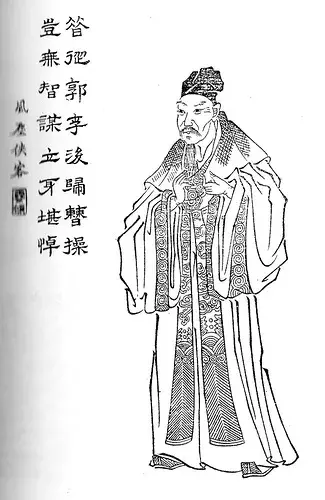
贾诩
Jia Xu (贾诩, 147 – August 11, 223), courtesy name Wenhe (文和), was a native of Guzang in Wuwei (modern Liangzhou District, Wuwei, Gansu). He was a preeminent military strategist, political planner, and founding grand minister of the Cao Wei dynasty during the late Han and Three Kingdoms era, rising to Grand Commandant and receiving the enfeoffment of Marquis of Weishou District. Renowned from his youth for profound insight and…
Jia Xu (贾诩, 147 – August 11, 223), courtesy name Wenhe (文和), was a native of Guzang in Wuwei (modern Liangzhou District, Wuwei, Gansu). He was a preeminent military strategist, political planner, and founding grand minister of the Cao Wei dynasty during the late Han and Three Kingdoms era, rising to Grand Commandant and receiving the enfeoffment of Marquis of Weishou District. Renowned from his youth for profound insight and tactical genius, he was famously acclaimed by contemporary scholar Yan Zhong as possessing the peerless strategic brilliance of Zhang Liang and Chen Ping. Jia Xu began his career as an Gentleman upon recommendation as Filially Pious and Incorrupt, later appointed as Colonel Who Subdues Bandits under Dong Zhuo's general Niu Fu. In 192, following Dong Zhuo's assassination, Liangzhou generals contemplated abandoning their commands to flee into hiding; Jia Xu intervened decisively, persuading Li Jue and Guo Si to marshal their forces and counterattack Chang'an, routing Lu Bu, executing Wang Yun, and throwing the empire into widespread warlordism. While serving under Li Jue, he covertly shielded Emperor Xian and court ministers, subsequently resigning to serve warlord Zhang Xiu at Wan City, where his ambushes twice inflicted devastating defeats upon Cao Cao. In 199, on the eve of the Battle of Guandu, Jia Xu rejected Yuan Shao's emissaries and counseled Zhang Xiu to submit to Cao Cao. Following his allegiance to Cao Cao, Jia Xu became an indispensable strategic counselor in the prime minister's inner staff. During the stalemate at Guandu, he urged Cao Cao to seize the decisive initiative, facilitating the raid on Wuchao. In 211, during the Battle of the Wei River, he devised the famous "blotted letter stratagem" to sow lethal discord between Ma Chao and Han Sui, securing the pacification of Guanzhong. When Cao Cao vacillated over naming an heir, Jia Xu's subtle allusion to Yuan Shao and Liu Biao convinced him to install Cao Pi as crown heir. Following Cao Pi's enthronement in 220, Jia Xu was appointed Grand Commandant, reaching the summit of the Three Excellencies. Adept in the art of self-preservation, he lived quietly behind closed doors, avoiding factional alliances. He died peacefully in 223 at seventy-seven, posthumously honored as Marquis Su, and was later enshrined in Emperor Wen's ancestral temple.
Born in Guzang, Wuwei; praised by Yan Zhong as possessing the strategic minds of Zhang Liang and Chen Ping.
Recommended as Filially Pious and Incorrupt; appointed Colonel under Dong Zhuo's son-in-law Niu Fu.
Convinced Li Jue and Guo Si to counterattack Chang'an, crushing Lu Bu and seizing the imperial court.
Departed Chang'an to serve warlord Zhang Xiu, engineering tactical ambushes that twice routed Cao Cao at Wan City.
Persuaded Zhang Xiu to reject Yuan Shao and submit unconditionally to Cao Cao, winning immense trust.
Urged Cao Cao to abandon caution and strike decisively, leading to the destruction of Yuan Shao's grain depot at Wuchao.
Counseled Cao Cao to rest troops and pacify Jingzhou rather than invade Dongwu; Cao Cao disregarded his advice and suffered defeat.
Engineered the blotted-letter scheme that fractured the alliance between Ma Chao and Han Sui, conquering Guanzhong.
Indirectly advised Cao Cao to name Cao Pi as heir through pointed allusions to Yuan Shao and Liu Biao.
Cao Pi ascended the throne, elevating Jia Xu to Grand Commandant and Marquis of Weishou District.
Passed away on August 11 at seventy-seven after counseling against southern invasions; posthumously honored as Marquis Su.
Jia Xu was born in 147 in Guzang County, Wuwei Commandery, located along the Hexi Corridor of Liangzhou. Liangzhou was a frontier march where Han and non-Han tribes intermingled amid chronic border turbulence. In his youth, Jia Xu maintained a quiet, reserved demeanor and shunned popular vanity. Local scholars failed to appreciate his talents, but Yan Zhong, an eminent scholar of Hanyang, recognized his extraordinary gifts and remarked: "This man is no ordinary mortal; his strategic brilliance rivals Zhang Liang and Chen Ping of the Western Han!"
Jia Xu began his administrative career after being nominated as Filially Pious and Incorrupt, receiving an appointment as Gentleman. Soon afterward, he resigned due to illness and rode westward toward Liangzhou. Reaching Qian County, he and dozens of fellow travelers were intercepted by rebel tribesmen of the Di ethnic group. The Di warriors bound the travelers, preparing to butcher them. As his companions wept in despair, Jia Xu addressed the chieftain with absolute composure: "I am the maternal grandson of Lord Duan (Duan Jiong, the famed Han grand commander whose military campaigns terrified frontier tribes). If you kill me, Lord Duan will mobilize the imperial army to exterminate your clan; if you preserve my life, my family will reward you with lavish gold!"
The Di tribesmen held Duan Jiong in awe. Terrified by his warning, the chieftain slaughtered a sheep to feast Jia Xu, swore an alliance, and escorted him safely out of their territory, while all his fellow travelers were executed. Jia Xu's agility in exploiting psychological leverage and surviving extreme peril emerged early in his life.
In 189, following Emperor Ling's death, warlord Dong Zhuo marched his Liangzhou cavalry into Luoyang and seized imperial authority. Dong Zhuo recruited regional talent, appointing Jia Xu as Assistant to the Minister of Ceremonies, later advancing him to Commandant of Pingjin and Colonel Who Subdues Bandits, stationing him in Shan County to counsel Dong Zhuo's son-in-law, General Niu Fu.
In May 192, Minister over the Masses Wang Yun conspired with General Lu Bu to assassinate Dong Zhuo and exterminate his clan in Chang'an. Shortly thereafter, Niu Fu was murdered by mutinous soldiers in Shan County, throwing the remaining Liangzhou troops into disarray. Colonels Li Jue, Guo Si, and Zhang Ji panicked, preparing to disband their detachments and flee in disguise back to Liangzhou.
At this existential crossroads, Jia Xu analyzed the balance of power and intervened boldly: "Generals, you must not act rashly! We hear that the capital seethes with vengeance against all Liangzhou men. If you abandon your troops and flee alone, even a humble village constable could arrest you. It is far better to rally your forces, march west, and counterattack Chang'an! If we succeed, we can uphold the Son of Heaven to command the realm; if we fail, it will not be too late to scatter into the hills!"
Li Jue and Guo Si adopted Jia Xu's advice, marching westward under the banner of avenging Dong Zhuo. As they advanced, thousands of scattered Liangzhou veterans joined them, swelling their ranks to over one hundred thousand soldiers. Breaching Tong Pass, they besieged Chang'an for eight days, overran the capital with inside assistance, drove Lu Bu into flight, and forced Wang Yun to commit suicide. Following their victory, Li Jue sought to reward Jia Xu with a marquisate. Jia Xu firmly declined: "This was merely a scheme to save our lives; what merit is there to reward!" When Li Jue offered to appoint him Vice Director of the Imperial Secretariat, Jia Xu again refused, stating that he lacked public prestige. He consented only to serve as Secretariat Minister in charge of official appointments.
During Li Jue and Guo Si's misrule in Chang'an, the warlords plundered the capital region and grew increasingly suspicious of one another. Jia Xu utilized his moral influence to mediate conflicts between rival commanders; when Li Jue contemplated harming Emperor Xian, Jia Xu intervened to shield the sovereign and secretly protected prominent ministers such as Yang Biao and Zhang Xi. In 195, as Li Jue and Guo Si fought pitched battles through the burning streets of Chang'an and Emperor Xian fled eastward to Luoyang, Jia Xu surrendered his seals and departed.
Leaving Chang'an, Jia Xu sought temporary refuge with fellow provincial general Duan Wei in Huayin. Duan Wei feared Jia Xu's superior intellect and watched him with concealed suspicion. Perceiving his danger, Jia Xu accepted an invitation from warlord Zhang Xiu in Wan City. When asked why he was leaving Duan Wei's lavish hospitality, Jia Xu replied: "Duan Wei is suspicious by nature; staying will invite assassination. When I leave, he will be relieved and will treat my family kindly. Meanwhile, Zhang Xiu lacks military advisors; upon my arrival, he will revere me as his mentor!" Upon reaching Wan City, Zhang Xiu welcomed Jia Xu with filial deference, while Duan Wei indeed cared solicitously for Jia Xu's family in Huayin.
In 197, Cao Cao led a massive expedition south to besiege Wan City. Persuaded by Jia Xu, Zhang Xiu initially surrendered. However, Cao Cao took Zhang Xiu's widowed aunt (Lady Zou) as his concubine and secretly bribed Zhang Xiu's bodyguard Hu Che'er, intending to assassinate Zhang Xiu. Humiliated and fearful, Zhang Xiu consulted Jia Xu. Jia Xu devised a surprise night assault: Zhang Xiu requested permission to relocate armored troops directly through Cao Cao's central camp under the pretext of moving wagons. That night, Zhang Xiu launched a sudden raid, catching Cao Cao completely unprepared. Cao Cao's eldest son Cao Ang, nephew Cao Anmin, and heroic bodyguard Dian Wei were slain, and Cao Cao barely escaped with his life.
In 198, Cao Cao besieged Zhang Xiu again at Rang County. Receiving intelligence that Yuan Shao was threatening the capital of Xuchang, Cao Cao began an orderly withdrawal. Zhang Xiu personally led his cavalry in pursuit. Jia Xu warned him: "Do not pursue; pursuing will lead to certain disaster!" Disregarding the counsel, Zhang Xiu attacked and was ambushed by Cao Cao's crack rear guards, suffering a crushing defeat. As Zhang Xiu returned in remorse, Jia Xu urged: "Mount your horses and pursue immediately; pursuing now will yield complete victory!" Zhang Xiu was bewildered: "You told me not to pursue when I was fresh, and now you urge me to attack after a defeat?" Jia Xu replied: "Military situations change instantaneously; ride swiftly and you shall conquer!" Zhang Xiu rallied his scattered forces, charged the retreating column, and routed Cao Cao's rearguard, capturing vast stores of supplies.
When Zhang Xiu asked for an explanation, Jia Xu expounded: "Cao Cao is a master of war. Though forced to withdraw, he personally commanded elite veterans to protect his rear; your troops could not overcome Cao Cao, hence your initial defeat. Once he repelled you, he assumed our army would not dare attack again and raced forward, leaving ordinary officers to guard the rear. While those officers are brave, they cannot match your veteran cavalry; thus your second attack was assured of victory!" His profound grasp of military psychology dazzled contemporary commanders.
In 199, as the conflict between Yuan Shao and Cao Cao approached a climax at Guandu, Yuan Shao sent envoys to Wan City offering noble titles and marriage alliances to enlist Zhang Xiu's support against Cao Cao. Tempted by the proposal, Zhang Xiu received the envoy. Sitting beside him, Jia Xu suddenly rebuked the envoy: "Return and tell Yuan Benchu: if he cannot even accommodate his own brother, how can he embrace the great scholars of the realm!" The terrified envoy withdrew.
Zhang Xiu was terrified, protesting: "Yuan Shao is mighty while Cao Cao is weak; why reject Yuan Shao?" Jia Xu analyzed the geopolitical chessboard: "Submitting to Cao Cao is the only wise path! First, Cao Cao upholds the Son of Heaven, commanding the realm with political legitimacy. Second, Yuan Shao possesses overwhelming forces; joining him with a modest army will earn us contempt, whereas Cao Cao is hard-pressed and will welcome our submission with boundless gratitude. Third, a leader with the ambitions of an imperial hegemon invariably casts aside private grudges to demonstrate virtue to the four seas. Cao Cao will forgive the past losses at Wan City to attract talent from across the empire!"
Zhang Xiu embraced Jia Xu's reasoning and led his army to surrender to Cao Cao in Xuchang. Cao Cao was ecstatic, riding miles outside the city to receive Jia Xu, taking his hand and exclaiming: "The man who establishes my moral prestige throughout the empire is you, Wenhe!" Cao Cao appointed Jia Xu as Commandant of the Capital, enfeoffed him as Marquis of Jiting, named him Army Advisor, and cemented a matrimonial alliance with Zhang Xiu's house.
In 200, the Battle of Guandu entered a protracted, exhausting stalemate. Cao Cao's supplies were depleted, his soldiers exhausted, while Yuan Shao built earthen ramparts to rain arrows into the central camp. Cao Cao asked Jia Xu: "Our armies have stood deadlocked for months; how can we shatter them?" Jia Xu analyzed: "Your Excellency surpasses Yuan Shao in intelligence, courage, management of men, and decisiveness. You hold these four advantages yet have not prevailed because you seek complete safety in all aspects! At this supreme moment of survival, victory requires bold decisiveness in an instant!"
Cao Cao was enlightened. Shortly thereafter, Yuan Shao's strategist Xu You defected, revealing the location of the enemy supply depot at Wuchao. When other generals hesitated, Jia Xu urged immediate action. Cao Cao led five thousand elite cavalry on a night raid to burn Wuchao, causing Yuan Shao's hundred-thousand-strong host to disintegrate and securing Cao Cao's mastery over northern China.
In 208, following the conquest of Jingzhou, Cao Cao planned to sail down the Yangtze River to destroy Sun Quan. Jia Xu advised patience and consolidation: "Your Excellency has defeated the Yuan clan and pacified the Han River, covering the realm in military glory. If you rest your soldiers, soothe the people of Jingzhou, and encourage agriculture, Jiangdong will submit without combat. Risking a major naval confrontation across the river is perilous." Eager for quick conquest, Cao Cao disregarded the warning, suffering a catastrophic defeat at Red Cliffs. Afterward, Cao Cao frequently expressed remorse for ignoring Jia Xu's counsel.
In 211, western warlords Ma Chao and Han Sui mobilized over one hundred thousand cavalry to seize Tong Pass. The ferocious western cavalry repeatedly frustrated Cao Cao's crossings. In the stalemate along the Wei River, Ma Chao proposed ceding territory west of the Yellow River in exchange for peace.
Cao Cao consulted Jia Xu, who smiled and proposed: "Feign acceptance of their terms to slacken their vigilance, and then employ an estrangement stratagem to drive them into mutual destruction!" Cao Cao followed the plan. He rode alone to meet Han Sui between the lines, discussing childhood memories of Chang'an while avoiding military matters, leaving Ma Chao suspicious. Subsequently, Cao Cao sent Han Sui a personal letter with key sentences deliberately blotted out and amended. Suspecting Han Sui of covert collusion, Ma Chao demanded to inspect the letter; seeing the alterations, Ma Chao concluded Han Sui was hiding a conspiracy. The alliance collapsed into fratricidal warfare, allowing Cao Cao to launch a coordinated offensive that crushed the western cavalry and secured Guanzhong.
In 217, Cao Cao wrestled with dynastic succession between his eldest son Cao Pi and his brilliant younger son Cao Zhi. Cao Cao favored Cao Zhi, triggering intense factional rivalry. Cao Cao dismissed his attendants and summoned Jia Xu to a private chamber, inquiring: "I wish to establish my heir; what is your counsel?" Jia Xu remained silent, staring at the ceiling in thought. Perplexed, Cao Cao asked: "I consult you, why do you not answer?" Jia Xu replied calmly: "I was not ignoring Your Majesty, but contemplating something." Cao Cao pressed: "What were you contemplating?" Jia Xu smiled: "I was simply reflecting upon Yuan Benchu and Liu Jingsheng, fathers and sons!"
The response struck like a thunderbolt. Yuan Shao and Liu Biao had both displaced their elder sons for younger favorites, precipitating the destruction of their states. Cao Cao laughed heartily, realized the fatal hazard of displacing seniority, and officially confirmed Cao Pi as Crown Prince of Wei.
In 220, following Cao Cao's death, Cao Pi succeeded as King of Wei. Remembering Jia Xu's pivotal advice in securing his heirship, Cao Pi elevated Jia Xu to Grand Commandant, placing him at the summit of the Three Excellencies, advancing his fief to Marquis of Weishou District with eight hundred households. Later that year, Cao Pi accepted the abdication of Emperor Xian, founding the Cao Wei dynasty.
During the early Huangchu reign, Cao Pi asked Jia Xu: "I intend to unify the realm; should we first conquer Eastern Wu or Shu Han?" Jia Xu advised caution: "He who conquers must master military strength; he who builds an empire must elevate moral virtue. Your Majesty has accepted the mandate; your priority should be soothing the Central Plains with benevolence and civil administration. Liu Bei possesses heroic resolve while Zhuge Liang manages governance brilliantly; Sun Quan is discerning while Lu Xun is an exceptional military mind. They occupy natural river barriers and cannot be conquered swiftly. I counsel cultivating civil virtue and waiting for internal fractures to appear before striking." Cao Pi rejected his advice and launched large-scale campaigns against Eastern Wu, suffering heavy casualties at Jiangling and Ruxu.
Having navigated the treacherous courts of Dong Zhuo, Li Jue, Zhang Xiu, Cao Cao, and Cao Pi, Jia Xu calculated human nature without a single misstep. Aware that he was an outsider from Liangzhou rather than a member of Cao Cao's original Qiao clan retinue, he recognized that his superior intelligence was feared by colleagues. To safeguard his family, he adopted strict ascetic reclusion in his declining years. Holding the supreme office of Grand Commandant, he kept his gates closed to private visitors and strictly forbade his children from marrying into imperial or aristocratic houses, choosing spouses solely from humble, ordinary families. Courtiers admired his consummate wisdom in political retreat.
On August 11, 223, the legendary strategist passed away at his home in Luoyang at seventy-seven. Emperor Wen suspended court in mourning, bestowed the posthumous title Marquis Su, and buried him with highest state honors. His eldest son Jia Mu inherited the marquisate and served as Commandant of Imperial Carriages. In 243, during the reign of Cao Fang, Jia Xu was granted the supreme posthumous honor of enshrinement in Emperor Wen's ancestral temple, celebrated as an immortal architect of the Wei empire.
In 192, following Dong Zhuo's assassination, the Liangzhou military apparatus faced complete annihilation. Jia Xu intervened decisively, persuading Li Jue and Guo Si to abandon flight and counterattack Chang'an.
His counsel resulted in the defeat of Lu Bu, the execution of Wang Yun, and the capture of the imperial court. This event prevented the restoration of centralized Han authority, accelerating the fragmentation of China into rival warlord regimes. Jia Xu's bold calculation illustrated the supreme impact an individual strategist could exert over imperial destiny.
In 199, as Yuan Shao and Cao Cao prepared for their decisive clash at Guandu, the geopolitical balance heavily favored Yuan Shao.
Jia Xu publicly rebuffed Yuan Shao's envoys and convinced Zhang Xiu to surrender Wan City unconditionally to Cao Cao. Jia Xu understood that Cao Cao commanded imperial legitimacy through the emperor and possessed the magnanimity required to overlook personal enmity. His counsel removed a vital southern threat to Cao Cao's flank and provided an elite military detachment that altered the strategic equation at Guandu.
Throughout Cao Cao's campaigns to unify northern China, Jia Xu's tactical brilliance repeatedly determined the outcome of crucial engagements.
During the deadlock at Guandu, he urged Cao Cao to strike decisively at Wuchao. In 211, confronting the formidable western cavalry at the Wei River, he devised the "blotted letter stratagem" to drive Ma Chao and Han Sui into mutual destruction, dissolving an army of one hundred thousand warriors without a protracted siege. Jia Xu's operational art embodied the pinnacle of Sunzi's doctrine of indirect warfare and psychological maneuvering.
In 217, when Cao Cao hesitated between Cao Pi and Cao Zhi over the succession, court factions were on the verge of dangerous fragmentation.
Understanding that direct intervention invited execution, Jia Xu uttered the famous quip that he was "reflecting upon Yuan Shao and Liu Biao." By alluding to the tragic destruction of warlords who discarded their elder heirs, he instantly resolved Cao Cao's hesitation, ensuring Cao Pi's installation as Crown Prince and anchoring the orderly transfer of imperial authority.
Operating across decades of violent chaos under multiple despotic rulers, Jia Xu calculated human psychology with immaculate accuracy, never suffering a personal or strategic defeat.
In his final years as Grand Commandant, he recognized the perils of imperial paranoia. He lived behind closed gates, shunned political alliances, and married his children to commoners, completely neutralizing court jealousy and dying peacefully at seventy-seven. His life stands as a classic textbook exemplar of intellectual mastery and self-preservation amid dynastic upheaval.
FIGURES ASSOCIATED WITH THIS DYNASTY