Birth in the Northern Frontier
Born into a hereditary tribal chieftain lineage in Shuozhou; acquired exceptional archery and equestrian prowess during youth.
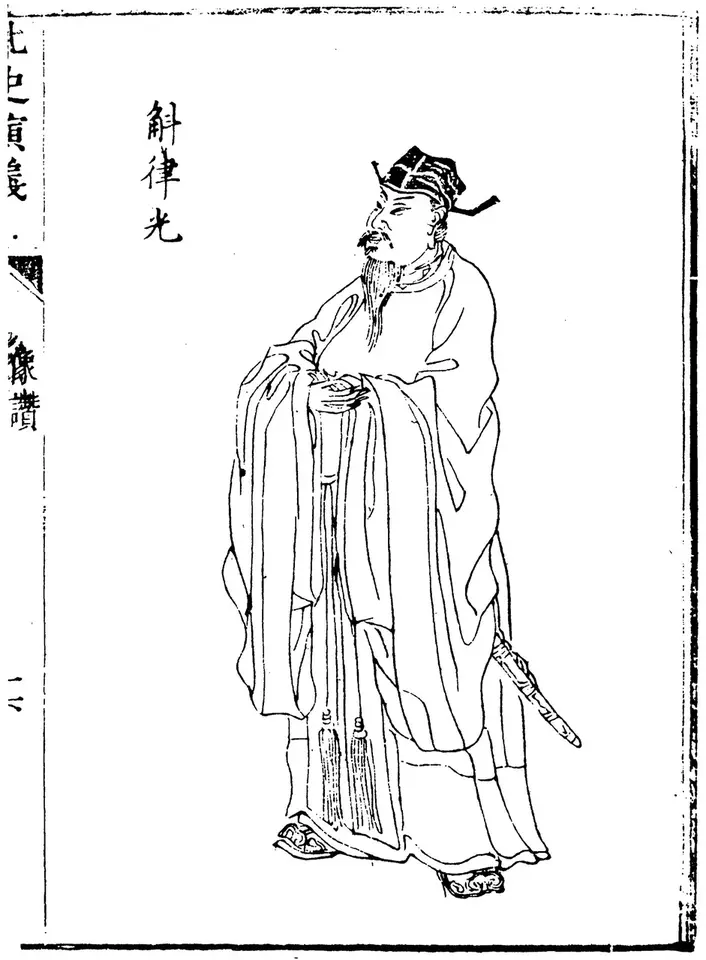
斛律光
Hulu Guang (斛律光, 515–572), courtesy name Mingyue (明月), was a prominent Tiele general, military strategist, and premier pillar of Northern Qi during the Northern and Southern Dynasties period. He was the eldest son of Hulu Jin, Chancellor of Northern Qi. Renowned from his youth for matchless mounted archery, he earned the title of the Eagle-Felling Commander after dropping a soaring giant raptor with a single shot during an…
Hulu Guang (斛律光, 515–572), courtesy name Mingyue (明月), was a prominent Tiele general, military strategist, and premier pillar of Northern Qi during the Northern and Southern Dynasties period. He was the eldest son of Hulu Jin, Chancellor of Northern Qi. Renowned from his youth for matchless mounted archery, he earned the title of the Eagle-Felling Commander after dropping a soaring giant raptor with a single shot during an imperial hunt at Huan Bridge. Serving six successive rulers from Gao Huan to Gao Wei, he spent decades guarding frontier garrisons, campaigning northward against the Kumo Xi and Göktürks, and repeatedly repelling the formidable armies of Northern Zhou. At the Battle of Mangshan, he led five thousand shock cavalry to crush an invading force of one hundred thousand troops, slaying the enemy commander Wang Xiong. He later conducted successful campaigns around Yiyang and the northern Fen River, defeating Yuwen Xian and Wei Xiaokuan while constructing over two hundred li of defensive long walls and dozens of border garrisons. Reaching the peak of bureaucratic honors, he was appointed Left Chancellor and inherited the princely title Prince of Xianyang. Despite his illustrious status, he lived with austere simplicity, distributed all imperial spoils among his soldiers, and maintained strict discipline. His uncompromising integrity earned him the bitter enmity of court favorites Zu Ting, Mu Tipan, and Lu Lingxuan, who capitalized on a psychological warfare smear concocted by Northern Zhou strategist Wei Xiaokuan. In 572, Emperor Gao Wei fell into the intrigue, luring Hulu Guang into the Hall of Cool Breeze, where he was assassinated, precipitating the rapid collapse of Northern Qi.
Born into a hereditary tribal chieftain lineage in Shuozhou; acquired exceptional archery and equestrian prowess during youth.
Accompanied his father Hulu Jin on campaign against Western Wei at age seventeen, shooting and capturing Yuwen Tai's senior secretary Mo Xiaohui; promoted to Commander by Gao Huan.
While hunting with Gao Cheng at Huan Bridge, brought down a soaring giant raptor with a single arrow; lauded by courtiers as a true eagle shooter and given the moniker Eagle-Felling Commander.
Served as vanguard under Emperor Wenxuan Gao Yang, routing the Kumo Xi nomadic tribes and capturing extensive herds; appointed Governor of Jin Province.
Led five thousand cavalry and infantry on a surprise night raid against Northern Zhou frontier forts at Tianzhu, Xin'an, and Niutou, defeating Wang Jingjun and taking over a thousand captives.
Created Duke of Julu Commandery; Emperor Xiaozhao Gao Yan arranged the marriage of Hulu Guang's eldest daughter to Crown Prince Gao Bainian, elevating Hulu Guang to Right Assistant Director of the Department of State Affairs.
Supervised twenty thousand troops west of Zhiguan, erecting Xunzhang Fortress, constructing over two hundred li of border walls, and establishing thirteen fortified garrisons.
Rushed fifty thousand cavalry to relieve Luoyang against a hundred thousand Northern Zhou troops under Yuchi Jiong and Yuwen Xian, slaying enemy pillar general Wang Xiong in combat; advanced to Grand Commandant.
Dispatched with thirty thousand troops to break the siege of Luoyang, routing Yuwen Xian at Dinglong and Anye and beheading general Liang Jingxing; promoted to Right Chancellor.
Defeated Northern Zhou commanders Pu Tunwei and Wei Xiaokuan north of the Fen River, captured four frontier outposts, and camped at Zimo to request imperial rewards for his troops; promoted to Left Chancellor and Duke of Qinghe.
Framed by Zu Ting, Mu Tipan, and Lu Lingxuan utilizing Wei Xiaokuan's subversive street ditties; lured into the Hall of Cool Breeze by Gao Wei and strangled by palace assassins at age fifty-eight.
Hulu Guang, originally named Hulu Mingyue, belonged to the hereditary Tiele tribal nobility of Shuozhou along the northern steppes. His father Hulu Jin was an indispensable founding pillar of Eastern Wei and Northern Qi, enjoying profound trust from Chancellor Gao Huan. Raised amidst nomadic equestrian traditions, Hulu Guang developed extraordinary archery accuracy and composure, displaying severe moral dignity and military discipline from an early age.
During the disintegration of Northern Wei, the seventeen-year-old Hulu Guang accompanied his father alongside Gao Huan on a western campaign into the Guanzhong region. Across opposing battle lines, Western Wei commander Yuwen Tai's senior administrative secretary Mo Xiaohui was galloping along the front ranks directing troop formations. Hulu Guang urged his warhorse forward into a sprint, bent his recurve bow, and released an arrow that struck Mo Xiaohui squarely. Charging through the dust, he seized the wounded officer from his saddle and dragged him back to Eastern Wei lines. The capture of an enemy chancellor's chief aide by a seventeen-year-old youth astonished the entire army. Gao Huan praised his extraordinary daring and immediately promoted him to Military Commander.
During the Wuding era of Eastern Wei, Gao Huan's eldest son Gao Cheng directed the central government as Prince of Bohai. Recognizing Hulu Guang's singular martial reliability, Gao Cheng appointed him Commander of Personal Guards, subsequently promoting him to General Who Pacifies Bandits and General of the Guards. In the fifth year of Wuding (547), he was enfeoffed as Viscount of Yongle County. On one occasion, while accompanying Gao Cheng on an imperial hunt near Huan Bridge along the Zhang River, an enormous bird was observed soaring above the cloud canopy beyond standard arrow range. Hulu Guang calmly drew his heavy bow to full draw and released. The arrow transfixed the neck of the flying creature, which spun like a falling chariot wheel and plummeted to the ground. Examining the fallen quarry, courtiers discovered a massive gray eagle. Gao Cheng marveled at the feat, while the chancellor's secretary Xing Zigao praised him as an authentic eagle shooter. Soldiers throughout the armies began venerating him as the Eagle-Felling Commander.
In the eighth year of Wuding (550), Gao Huan's second son Gao Yang founded the Northern Qi dynasty. Hulu Guang was granted Equal Ceremonial Honors with the Three Excellencies and created Viscount of Xi'an County. In the early Tianbao period, northern nomadic Kumo Xi bands exploited dynastic transitions to raid frontier settlements. In the third year of Tianbao (552), Emperor Wenxuan Gao Yang personally launched a northern punitive expedition, placing Hulu Guang in command of the cavalry vanguard. Hulu Guang executed a rapid deep strike into the steppes, smashing Kumo Xi formations and capturing vast herds of camels, cattle, and sheep. Following the triumphal return, he was appointed Governor of Jin Province, commanding the defensive perimeter of southern Shanxi.
Along the border separating Northern Qi from Western Wei, the western regime maintained fortified outposts at Tianzhu, Xin'an, and Niutou, using them to harbor deserters and stage raids against Qi agrarian villages. In the seventh year of Tianbao (556), having scouted lax defensive routines, Hulu Guang led five thousand picked foot and horse soldiers on a silent nocturnal forced march. Falling upon the three outposts before dawn, he captured all three garrisons, defeated Western Wei commander Wang Jingjun, and seized over five hundred captives and a thousand head of livestock.
In the ninth year of Tianbao (558), Hulu Guang launched another strike, capturing four key western fortresses along the Fen River valley, eliminating threats to southern Shanxi and earning appointment as Governor of Shuo Province. In 559, Northern Zhou commander Cao Huigong raided the border with ten thousand cavalry. Hulu Guang intercepted and killed Cao Huigong, compelled the defender of Baigu to flee, and established an entrenched garrison at Wenhou. In 560, Emperor Xiaozhao Gao Yan elevated him to Duke of Julu Commandery and arranged the marriage of Hulu Guang's eldest daughter to Crown Prince Gao Bainian, subsequently appointing Hulu Guang Right Assistant Director and Grand Tutor to the Crown Prince.
Along the rugged border formed by the Yellow, Luo, and Fen Rivers, Northern Qi and Northern Zhou engaged in constant border warfare. In the fourth month of the second year of Heqing (563), Hulu Guang led twenty thousand troops west of Zhiguan Pass to construct Xunzhang Fortress. Utilizing natural precipices, he oversaw the erection of over two hundred li of border stone walls, studded with thirteen fortified garrisons that anchored northern defenses against Guanzhong incursions. The following spring, Northern Zhou general Da'xi Chengxing invaded Pingyang with heavy forces; upon learning that Hulu Guang held the field, the invasion column withdrew without fighting. Hulu Guang pursued aggressively, penetrating deep into Zhou territory and taking over two thousand prisoners, earning promotion to Minister of Works.
In the winter of the third year of Heqing (564), Emperor Wu of Northern Zhou, Yuwen Yong, mobilized a massive force of one hundred thousand troops led by Pillar General Yuchi Jiong, Prince of Qi Yuwen Xian, and Pillar General Wang Xiong to besiege the strategic city of Luoyang. Severing transport corridors, the besiegers threatened to conquer the central plains. Emperor Wucheng Gao Zhan ordered Hulu Guang and Prince of Lanling Gao Changgong to lead fifty thousand elite horsemen in forced marches to relieve the city, precipitating the Battle of Mangshan.
Across the plains of Mangshan west of Luoyang, the massive Northern Zhou army pressed heavily against the Qi lines. Hulu Guang remained resolute at the head of his elite central cavalry. During the clash, the renowned Zhou commander Wang Xiong drove his spear-wielding vanguard directly toward Hulu Guang's command banner, striking down several Qi officers. Hulu Guang stood his ground, drew his bow, and shot Wang Xiong directly through the neck. Fatally wounded, Wang Xiong fled back to his camp and expired that night. Deprived of their chief vanguard general, the Zhou forces fell into confusion. Hulu Guang and the Prince of Lanling launched an immediate general counterattack, breaking the Zhou lines into complete rout. Qi forces decapitated over three thousand enemy soldiers, captured the entire baggage train, and erected a towering victory monument of enemy corpses. In recognition, Emperor Wucheng appointed Hulu Guang Grand Commandant and Duke of Guanjun County, later elevating his second daughter to Crown Princess and subsequently Empress of Gao Wei.
In the summer of the third year of Tiantong (567), following the death of his venerable father Hulu Jin, Hulu Guang and his brother Hulu Xian resigned from their official posts to observe mourning. However, border alarms compelled the court to recall the brothers within days, restoring their full commands. Hulu Guang was named Grand Protector, inherited the title Prince of Xianyang, and succeeded as Chief of the First Lineage Tribe before advancing to Grand Tutor.
In the winter of 567, Northern Zhou armies encircled Luoyang once again, choking off grain convoys. In the first month of the first year of Wuping (570), Emperor Gao Wei commanded Hulu Guang to march west with thirty thousand troops. Reaching Dinglong, he encountered Zhou generals Yuwen Jie, Liang Shiyan, and Liang Jingxing entrenched across the vital defile of Lulujiao. Clad in full armor, Hulu Guang charged in the vanguard. The moment weapons clashed, the Zhou line collapsed, suffering over two thousand casualties. Advancing directly to Yiyang, Hulu Guang confronted the main army of Yuwen Xian and Tuoba Xianjing for a hundred days. To restore logistical communication, he oversaw the rapid construction of Tongguan and Fenghua fortresses directly before the enemy.
During the planned withdrawal of Qi forces toward Anye, Yuwen Xian pursued with fifty thousand troops. Hulu Guang turned his cavalry abruptly and executed a devastating counter-charge. The Zhou pursuit column disintegrated, resulting in the capture of high-ranking commanders Yuwen Ying, Yueqin Shiliang, and Han Yan. Yuwen Xian then deployed thirty thousand troops at Lulujiao to block the retreat. Hulu Guang combined forces with subordinate commanders to strike the obstruction, killing general Liang Jingxing and seizing over a thousand warhorses. For these operations, he was named Right Chancellor and Governor of Bing Province.
In the winter of the first year of Wuping (570), Hulu Guang implemented an expansive operational strategy near the strategic fortress of Yubi. Marching fifty thousand troops into the region, he erected Huagu and Longmen fortresses, cutting external links to the stronghold. Confronting him, Yuwen Xian and Tuoba Xianjing remained locked behind defensive walls, unwilling to challenge Hulu Guang in open battle. Hulu Guang exploited their passivity to besiege Dingyang and build the southern Fen fortress, establishing administrative prefectures that brought over ten thousand frontier households under Northern Qi governance.
In the second year of Wuping (571), Hulu Guang directed the construction of thirteen strategic garrisons across the southwest, including Pinglong, Weibian, and Tongrong, steadily constricting the Guanzhong approaches. Northern Zhou generals Pu Tunwei and Wei Xiaokuan responded with over ten thousand troops to attack Pinglong. Hulu Guang met them north of the Fen River, completely routing the invasion and capturing or killing over a thousand soldiers, forcing Wei Xiaokuan to retreat. He was rewarded with the title Duke of Zhongshan Commandery.
Immediately thereafter, imperial orders directed Hulu Guang to advance along the Pingyang highway with fifty thousand troops. He took the Zhou strongholds of Yaoxiang and Biting, capturing nine commandants and several thousand soldiers. When Zhou general Hegan Guanglüe besieged Yiyang that same month, Hulu Guang marched through the night to reinforce the city, breaking the siege, capturing four border outposts, and taking another thousand captives.
However, as the victorious army approached the outskirts of the capital at Zimo, imperial edicts ordered the immediate dispersal of all troops without entry into the capital. Knowing that the soldiers had fought for years without compensation, Hulu Guang believed that abrupt demobilization without imperial bounties would incite mutiny. He submitted a confidential memorial requesting commissioners to convey formal rewards while halting the army at Zimo. Misled by sycophants, Emperor Gao Wei viewed the proximity of the army with suspicion, hastily summoning Hulu Guang to a palace audience before scattering the troops. Hulu Guang was appointed Left Chancellor and Duke of Qinghe Commandery.
Standing at the apex of imperial prestige, Hulu Guang saw his eldest daughter as empress, two other daughters married as crown princesses, and three sons wedded to imperial princesses. His brother Hulu Xian commanded You Province and held the Göktürks at bay. Conscious of the perilous envy surrounding his lineage, Hulu Guang lived with extreme frugality, prohibited corruption among his family, closed his gates to private callers, and avoided interference in palace matters.
Nevertheless, late Northern Qi governance was consumed by corruption under Emperor Gao Wei, who was dominated by the blind chancellor Zu Ting, the sycophant Mu Tipan, and the palace nanny Lu Lingxuan. Hulu Guang despised their predatory greed. Once, when Zu Ting rode his horse past the curtained hall where Hulu Guang was working, the general severely reprimanded his arrogance. Later, upon hearing Zu Ting boasting in the ministerial offices, Hulu Guang remarked that the presence of blind scoundrels in high office would destroy the state. Meanwhile, Mu Tipan sought to marry Hulu Guang's concubine-born daughter and was rejected; when Gao Wei granted thousands of acres of military pastures at Jinyang to Mu Tipan, Hulu Guang openly protested at court that alienating state cavalry pastures undermined imperial defense. Consequently, Zu Ting, Mu Tipan, and Lu Lingxuan formed an alliance to eliminate him.
At this critical juncture, Northern Zhou strategist Wei Xiaokuan, having suffered repeated defeats against Hulu Guang, recognized that removing the general was essential for the conquest of the east. Wei Xiaokuan composed satirical ditties prophesying that a peck would fly to heaven and a bright moon would illuminate Chang'an, playing on the characters of Hulu and Mingyue to imply dynastic ambition. The verses were covertly circulated in the streets of Ye. Zu Ting expanded the rhymes to implicate the blind chancellor and gossiping matriarch, and Lu Lingxuan brought the rumors to the emperor, warning of the immense military authority wielded by the Hulu house. When court official Han Changluan dismissed the rumors as baseless, Gao Wei initially let the matter drop.
However, Zu Ting and He Hongzhen pressed the vacillating emperor, arguing that harboring intent to purge a powerful commander required swift execution to prevent rebellion. Soon after, a disaffected clerk named Feng Shiran submitted a false report alleging that Hulu Guang's pause at Zimo was an aborted coup and that the Hulu residence concealed illegal armor and weapons while plotting with frontier garrisons. Terror-stricken, Gao Wei resolved to murder his general.
In the seventh month of the third year of Wuping (572), Gao Wei dispatched an envoy presenting a prized western horse to Hulu Guang, inviting him to join an imperial excursion to the Eastern Mountains the next morning. Unsuspecting, Hulu Guang arrived at the palace to express gratitude. As he entered the private chamber of the Hall of Cool Breeze, palace assassin Liu Taozhi leaped from behind a screen and struck him from behind with an iron chain. Falling to the floor, Hulu Guang shouted bitterly that Liu Taozhi had made a career of slaying loyal servants, but that he had never betrayed his sovereign or state. Liu Taozhi and three accomplices then strangled him with a bowstring. He died at the age of fifty-eight.
Following the murder, Gao Wei ordered the extermination of the Hulu clan, slaughtering his sons and brothers while deposing Empress Hulu. In Chang'an, Emperor Wu of Northern Zhou celebrated the death of his foremost adversary by declaring a nationwide amnesty. Five years later, Northern Zhou armies swept eastward to capture Ye and extinguish Northern Qi. Standing before Hulu Guang's former estate, Emperor Wu posthumously honored him as Pillar of State and Duke of Chong, remarking to the fallen courtiers that had Hulu Guang remained alive, Northern Zhou troops could never have set foot in the capital.
During the critical Battle of Mangshan in 564, Hulu Guang demonstrated supreme battlefield command and peerless personal valor. Facing an invading host of one hundred thousand troops encircling Luoyang, he coordinated with the Prince of Lanling to strike the enemy center. In the thick of combat, when enemy champion Wang Xiong threatened to break the Qi line, Hulu Guang displayed master archery by felling the opposing commander with a single shot. Exploiting the ensuing panic, he unleashed fifty thousand cavalry in a general counter-offensive that shattered the northern invasion force, securing imperial control over the central plains for years.
Hulu Guang combined dynamic battlefield mobility with permanent defensive architecture. Recognizing the vulnerabilities of the southwest border along the Fen and Yellow Rivers, he surveyed the terrain and directed the construction of over two hundred li of border long walls fortified by thirteen strategic garrison fortresses. Later, during operations around Yubi and Dingyang, he constructed forward fortresses under the eyes of the enemy, severing communication lines and establishing administrative outposts that stabilized the frontier while drawing tens of thousands of local households into the Northern Qi realm.
Hulu Guang maintained deep devotion to his troops throughout his military career. While on campaign, he refused to enter his tent until camp perimeters were fully entrenched, and declined to eat until all soldiers had received their rations. Spoils and imperial rewards were distributed evenly among his men rather than hoarded. Despite rising to the highest ranks of nobility, he maintained strict personal simplicity, lived without surplus wealth, and refused all forms of political bribery, embodying the finest traditions of northern frontier generalship.
Throughout the degenerate political decline of late Northern Qi, Hulu Guang maintained unyielding moral defiance against corrupt court factions. He publicly condemned the appropriation of state pastures by court sycophants and rebuffed matrimonial overtures from treacherous favorites. However, his unbending martial integrity alienated the inner court, rendering him vulnerable to Wei Xiaokuan's psychological stratagems. His murder in the Hall of Cool Breeze dismantled the ultimate military bulwark protecting Northern Qi, leading directly to the conquest of the dynasty by Northern Zhou within five years.
FIGURES ASSOCIATED WITH THIS DYNASTY