Ascending the Throne
Following the demise of his father Duan Zhixing, Duan Zhilian succeeded to the imperial throne of Dali.
段智廉
Duan Zhilian (段智廉) was the nineteenth emperor of the Dali Kingdom and the son of Emperor Xuanzong Duan Zhixing. Following the death of his father in the sixth year of the Qingyuan era of the Southern Song dynasty (1200), Duan Zhilian ascended the imperial throne of Dali. The following year, he adopted the era name Fengli, later changing it to Yuanshou. Throughout his five-year reign, he steadfastly upheld the foundational…
Duan Zhilian (段智廉) was the nineteenth emperor of the Dali Kingdom and the son of Emperor Xuanzong Duan Zhixing. Following the death of his father in the sixth year of the Qingyuan era of the Southern Song dynasty (1200), Duan Zhilian ascended the imperial throne of Dali. The following year, he adopted the era name Fengli, later changing it to Yuanshou. Throughout his five-year reign, he steadfastly upheld the foundational national policy of revering Buddhism and honoring Buddhist monks, while maintaining peaceful diplomatic allegiance toward the Song court. In 1202, he dispatched an official diplomatic mission to the Southern Song capital of Lin'an to pay tribute and request a complete set of the Buddhist Chinese canon, the Tripitaka. The Song court granted 1,465 volumes of scripture, which were ceremoniously transported back to Dali and housed in the landmark Wuhua Tower. Duan Zhilian died in 1205 and was succeeded by his younger brother Duan Zhixiang.
Following the demise of his father Duan Zhixing, Duan Zhilian succeeded to the imperial throne of Dali.
Promulgated the Fengli era name, adhering to established administrative norms and appeasing prominent local clans.
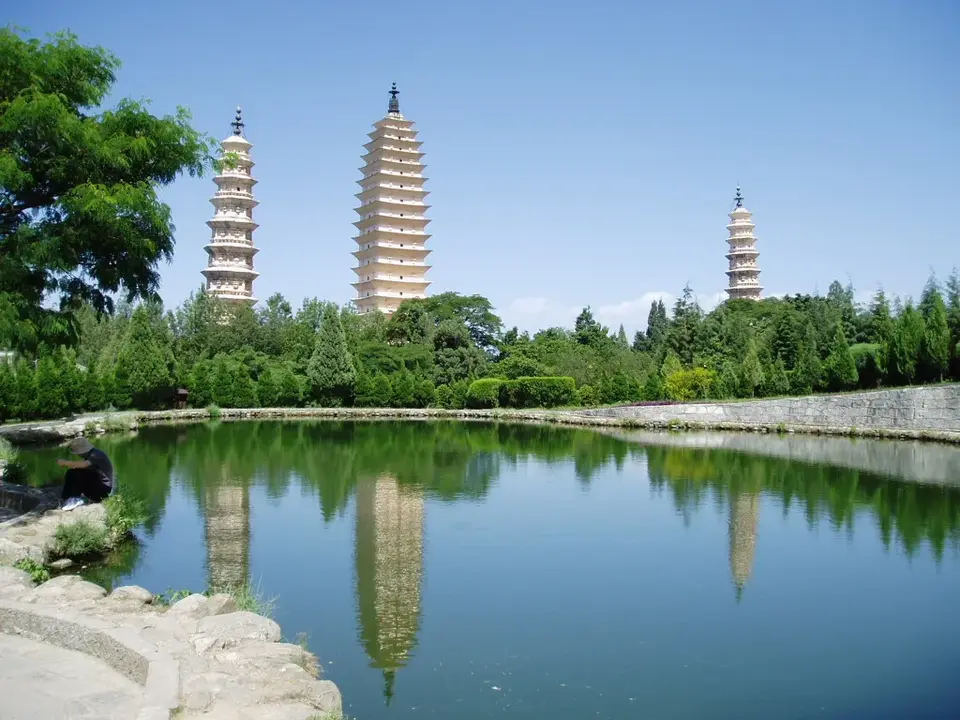
Changed the era name to Yuanshou and sent an envoy mission to the Southern Song to acquire 1,465 volumes of the Chinese Tripitaka, which were subsequently preserved in Wuhua Tower.
Passed away after a reign of five years; granted the temple name Yingzong and the posthumous name Emperor Hengtian, succeeded by his younger brother Duan Zhixiang.
Duan Zhilian was born into the imperial royal clan of the Dali Kingdom as the son of Emperor Xuanzong Duan Zhixing. Ever since Duan Siping founded the kingdom in 937, the Duan imperial house had deeply venerated Buddhism, while governance relied heavily on power-sharing with the influential Gao aristocratic clan. Exposed to Buddhist doctrine and administrative traditions from early youth, Duan Zhilian observed state rituals closely. In the sixth year of the Qingyuan era of the Southern Song (1200), following the passing of Duan Zhixing after a twenty-eight-year reign, Crown Prince Duan Zhilian formally assumed imperial authority as the nineteenth monarch of Dali.
Upon his accession, the regional political structure of Dali remained stable. In 1201, Duan Zhilian declared the new era name Fengli. Facing the entrenched political dominance of the Gao prime ministerial lineage, the emperor maintained a conciliatory and balanced approach, observing customary legal codes and preserving domestic tranquility. In internal affairs, he embraced the ancestral tradition of fostering Buddhist scholarship, practicing administrative restraint, and cultivating cordial relations with local tribal chieftains across the Erhai basin.
In 1202, Duan Zhilian changed his reign title to Yuanshou. His overall reign was relatively brief, spanning five years. In 1205, the emperor passed away in the royal palace at Dali. Following his demise, the imperial court bestowed upon him the temple name Yingzong and the posthumous title Emperor Hengtian. Due to the lack of surviving adult male heirs, the imperial throne passed smoothly to his younger brother Duan Zhixiang, who inaugurated a lengthy and prosperous thirty-five-year reign.
In the second year of the Jiatai era of the Southern Song (1202), Duan Zhilian sent a high-ranking diplomatic mission to the Song capital at Lin'an. Alongside formal tribute, the Dali delegation presented a petition requesting the bestowal of the official Chinese Buddhist canon. The Southern Song court granted imperial permission, conferring a massive collection of 1,465 volumes of the Tripitaka. Upon the safe return of the delegation to Dali, the scriptures were installed in the monumental Wuhua Tower within the capital. This event stood out as one of the most prominent cultural and religious interactions between the Southern Song dynasty and the Dali Kingdom during the early thirteenth century.
Throughout his tenure, Duan Zhilian continued his father's active patronage of monastic institutions and scholarly clerics. By respectfully housing holy Buddhist scriptures and honoring spiritual teachers, he reinforced the sacred legitimacy of the Duan dynasty among the multi-ethnic communities of the southwestern frontier. Concurrently, by sustaining peaceful coexistence with the Gao clan ministers, he averted civil strife and ensured the steady transition of power that enabled subsequent economic and cultural development under his successor.
In regional historical chronicles, Duan Zhilian is evaluated as a conscientious and peaceable sovereign who preserved institutional stability during a brief reign.
The Brief History of Nanzhao (Nanzhao Yeshi) records: "Emperor Yingzong Hengtian Duan Zhilian ascended the throne in the sixth year of Qingyuan. The following year he changed the era name to Fengli, and later to Yuanshou. In the second year of Jiatai, he sent envoys to the Song to obtain 1,465 volumes of the Tripitaka, which were placed in Wuhua Tower. He reigned for five years, and his younger brother Zhixiang succeeded him."
The Qing scholar Ni Tui in the Chronological Records of Yunnan (Dianyun Li Nian Chuan) likewise commended the Duan monarchs for their dedicated devotion to Buddhist learning and their continuous pursuit of harmonious relations with the Central Plains dynasties, recognizing the acquisition of the Tripitaka as an enduring cultural legacy.
Modern historians assess that although Duan Zhilian reigned for only five years, his successful acquisition and preservation of the Chinese Buddhist scriptures deepened the cultural integration between the southwestern borderland and central Chinese civilization, providing essential continuity for the political equilibrium of the Dali Kingdom.
FIGURES ASSOCIATED WITH THIS DYNASTY