Born at Xijian in Dali to a declined noble family. | Born at Xijian in Dali to a declined noble family.
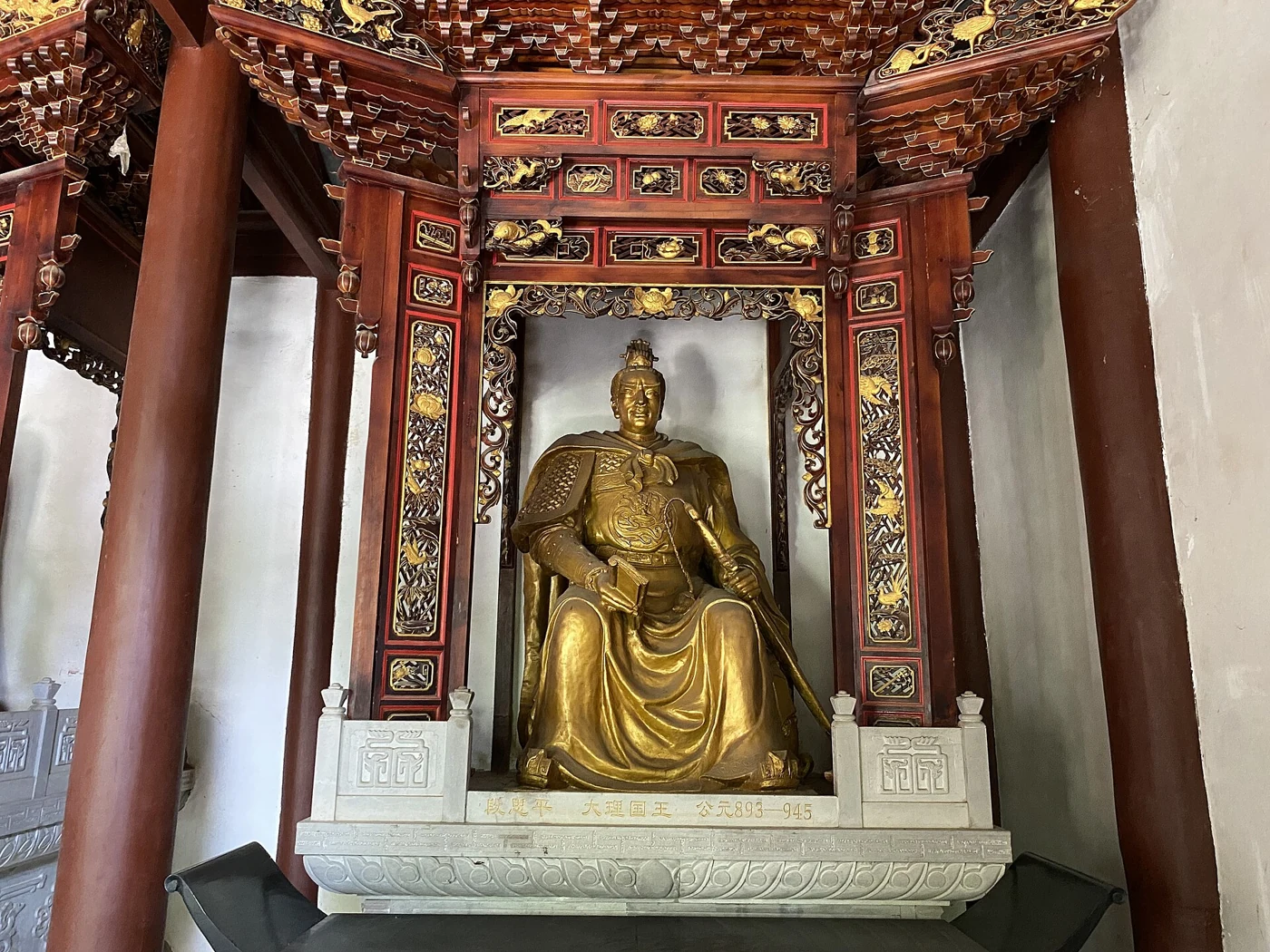
Founding emperor of the Dali Kingdom
Duan Siping
段思平
Duan Siping (893–944), a member of the Bai ethnic group from Xijian in Dali (present-day Xizhou, Yunnan) with ancestral roots in Guzang, Wuwei (present-day Wuwei, Gansu), was a sixth-generation descendant of Duan Zhongguo (also known as Duan Jianwei), Grand Counselor (Qingpingguan) of the Nanzhao kingdom in the Tang dynasty, and the founding emperor of the Dali Kingdom (reigned 937–944). Born into an impoverished family, he…
Dali Kingdom
PROFILE
Duan Siping (893–944), a member of the Bai ethnic group from Xijian in Dali (present-day Xizhou, Yunnan) with ancestral roots in Guzang, Wuwei (present-day Wuwei, Gansu), was a sixth-generation descendant of Duan Zhongguo (also known as Duan Jianwei), Grand Counselor (Qingpingguan) of the Nanzhao kingdom in the Tang dynasty, and the founding emperor of the Dali Kingdom (reigned 937–944). Born into an impoverished family, he rose through the military to become Military Commissioner (Jiedushi) of Tonghai. Out of resentment at the brutal oppression of the Dayining regime, he began organizing an uprising in the Erhai region in 929; after seven years of preparation, he allied with the thirty-seven Wuman tribes of eastern Yunnan, took Dali in December 936, and overthrew the Dayining regime. In 937 he founded the Dali Kingdom with its capital at Yangjumie City (present-day Dali City), adopting the era name Wende. On taking the throne he freed slaves, reduced taxes, remitted corvée labor for three years, abolished slavery, and established the feudal landlord system of land ownership, reunifying the region after the division and warfare since the late Nanzhao period. He died of illness in 944 while touring Dengzhou; his temple name was Taizu and his posthumous title Shensheng Wenwu Emperor. He was succeeded by his son Duan Siying.
- Dynasty / polity
- Dali Kingdom
- Period
- Dali Kingdom
- Date of Birth
- 893 CE(2nd year of the Jingfu era, Tang)
- Date of Death
- 944 CE(9th year of the Tianfu era, Later Jin)
- Era / Dynasty
- Dali Kingdom
- Ethnicity
- Bai
- Place of Origin
- Xijian of Dali (present-day Xizhou Town, Dali City, Yunnan); ancestral home Guzang, Wuwei (present-day Wuwei, Gansu)
- Identity / Occupation
- Founding emperor of the Dali Kingdom
- Year of Death
- 944
- Reign
- 937–944
- Predecessor
- Not applicable (founding ruler)
- Era Names
- Wende, Shenwu
- Temple Name
- Taizu
- Posthumous Name
- Shensheng Wenwu Di ("Sacred, Martial, Cultured Emperor")
- Successor
- Duan Siying
- Major Achievements
- Founded the Dali Kingdom; carried out sweeping reforms and promoted production
LIFE TIMELINE
Rose through merit to Military Commissioner of Tonghai. | Rose through merit to Military Commissioner of Tonghai.
Fled the persecution of Yang Ganzhen and organized his uprising beyond the Erhai. | Fled the persecution of Yang Ganzhen and organized his uprising beyond the Erhai.
BIOGRAPHY
Biography
A Declined Noble Family
According to historical sources such as the Nanzhao Yeshi, Baigu Tongji Qianshu, and Dian Zaiji, Duan Siping was a sixth-generation descendant of Duan Zhongguo, Grand Counselor of the Meng clan of Nanzhao, and the son of Duan Baolong, an official of the Busie rank. Although his ancestors had been a distinguished official family, by the time of his birth the family had fallen into decline.
Duan Siping was born in 893, when the power of the Meng clan of Nanzhao was waning and palace coups followed one another. In his childhood he lived in poverty, and as he grew older he herded sheep in the mountains for a living. His official-family upbringing cultivated his statecraft and military talents, while a life of impoverished labor gave him the chance to mix with the common people and understand their hardships. Outstanding in martial skill and ability, he was first promoted to the rank of Mulan and later, through accumulated merit, rose to Military Commissioner of Tonghai, becoming a general governing a region.
Seizing Power
At that time the Nanzhao regime was on its last legs and had been successively replaced by Zheng Maisi's Dachanghe Kingdom, Zhao Shanzheng's Datianxing Kingdom, and Yang Ganzhen's Dayining Kingdom. These regimes were all short-lived, and each succession was accompanied by slaughter, leaving the people destitute and seething with resentment. Having lived through the three short-lived regimes of Zheng, Zhao, and Yang, Duan Siping understood well the importance of winning the support of the various ethnic groups.
In 929, to escape persecution by Yang Ganzhen, Duan Siping temporarily left the Erhai region and went elsewhere to organize and mobilize for an uprising. Over the following seven years he made painstaking preparations: he obtained a "sacred halberd" in a peasant's home in Bodacun, Piandian; a "sacred steed" at Yejing Lake in Xiangyun; and went east to "borrow troops from the Hei Cuan." Knowing that the elite troops he had built up at Tonghai were still no match for the Yang brothers, he allied with other prominent Bai clans, secretly contacted the thirty-seven tribes of eastern Yunnan, and borrowed troops from the Hei Cuan and other tribes while mobilizing the populace for an uprising. His slogan "Halve your grain taxes; remit your corvée for three years" struck at the abuses of the day, voiced the demands of the people burdened by heavy taxes and labor, and won an enthusiastic response.
Founding the Kingdom and Taking the Throne
Duan Siping won the support of the thirty-seven tribes of eastern Yunnan and, at the same time, the approval of the two great "white barbarian" (Baiman) aristocratic clans of the Erhai region, the Gao and Dong. When he marched, Gao Fang responded first, and Dong Yingluo (Dong Jialuo) served as his strategist.
On February 4, 937 (the second year of Tianfu of the Later Jin), the large-scale uprising led by Duan Siping broke out. Having assembled his younger brother Duan Siiliang, the prefect Gao Fang, and reinforcements from the thirty-seven tribes of eastern Yunnan, and after meticulous organization and planning, his armies took Taihe City, destroyed the Dayining Kingdom, and founded the Dali Kingdom, with the capital at Yangjumie City (present-day Dali City) and the era name Wende.
Governing Dali
After founding the Dali Kingdom, Duan Siping adjusted the class and ethnic relations inherited from Nanzhao rule: he affirmed and fostered the economic and political standing of the rising Bai feudal lords—for example, he enfeoffed Gao Fang as Marquis of Yue, confirming his clan's existing lands in the Erhai region and granting him Juqiao (present-day Jinning, Yunnan) as a hereditary fief; he appointed Dong Jialuo as chancellor, granting him Chengji (present-day Yongsheng) as a hereditary fief; and the manors of other Bai feudal lords in the Erhai region were likewise expanded. For village-community farmers among the Bai and Yi of the Erhai region, he reduced grain taxes and remitted corvée for three years while confirming their existing landholdings; slaves who were "convicted and without descendants" were all pardoned and freed; and the subject tribes were released from the collective slavery they had suffered under Nanzhao and exempted from slave-style corvée. The Dali regime thereby stabilized.
Final Years and Death
In the ninth year of Tianfu of the Later Jin (944), Duan Siping died of illness while touring Dengzhou. His son Duan Siying succeeded him. His temple name was Taizu and his posthumous title Shensheng Wenwu Emperor.
Omens of Childhood
Legend has it that when Duan Siping was herding cattle on Cangshan Mountain, one of the oxen suddenly spoke: "Siping shall be king!" The horses grazing at the foot of the mountain and the chickens at his home likewise cried out, "Siping shall be king!" When these words reached Yang Ganzhen, King of Dayining, he ordered Duan Siping's arrest, but the men he sent always found Siping absent—for upon hearing the news, Duan Siping had fled north overnight.
The Walnut Divination
Legend tells that a walnut seller gave Duan Siping a sack of walnuts. Siping cracked open the largest one and found the two characters "Qing Xi" inside the shell. His strategist Dong Jialuo explained: "'Qing' stands for the twelfth month, and 'Xi' for the twenty-first day—the day you shall become king." Delighted, Duan Siping promised that if he became king he would halve the taxes and remit corvée labor for three years.
The Interpreted Dream
Legend has it that before attacking Dayining, Duan Siping asked Dong Jialuo to interpret his dream. Dong Jialuo said: "The character for 'husband' with its head removed becomes 'heaven'—an omen of the Son of Heaven; a jade vase with a chipped mouth lacks one dot from 'jade,' making the character 'king'—an omen of kingship; a broken mirror casts no reflection—an omen of having no rival." Siping's worries turned to joy, and he led his troops into battle that very afternoon. Another legend holds that when he faltered before a pass bristling with weapons, a beautiful woman rose from the river, showed him the crossing routes, and declared: "After you win the state, change its name to Dali."
Duan Siping was a native of Xilian, present-day Xizhou, in Dali, his ancestral home at Guzang in Wuwei, a sixth-generation descendant of the Southern Zhao's chief minister Duan Zhongguo, that is Duan Jianwei, and founder of the Dali kingdom, reigning from 937 to 944. Poor in his youth and resentful of the harsh rule of the Dayining regime, he raised the people of the Erhai region in revolt in 929, only to be suppressed by Yang Ganzhen. On 21 December 936, joining with the thirty-seven Wuman tribes of eastern Yunnan, he took Dali and overthrew Dayining; in 937 he founded the Dali kingdom with the era name Wende and its capital at Yangjumie, present-day Dali city.
In power he carried out a series of changes: freeing slaves, lightening taxes, remitting labor service for three years, abolishing slavery and establishing feudal lordship over land, reuniting the tribes and disorders that had followed the end of the Southern Zhao. These measures restored order about the Erhai, reviving farming and trade, and Dali long remained comparatively stable in consequence. In 944 he died while inspecting Dengzhou, granted the posthumous name Shen Sheng Wen Wu Di and the temple name Taizu, his son Duan Siying succeeding him.
A Bai chieftain, Duan Siping led a rising of the peoples of Yunnan and completed the passage from slavery to feudalism, advancing the politics, economy and culture of the region. The Dali kingdom, including the Later Dali, passed through twenty-two generations over more than three hundred years until the Mongols destroyed it in 1253, one of the longest-lived local regimes in the history of the southwest.
The Dali kingdom covered roughly the whole of present-day Yunnan and some adjoining areas, its population of many peoples, the social organization and Buddhist faith of the Bai, Yi and others holding an important place in its political life. The Duan family long supplied its kings until power passed to the Gao and the state entered its Later Dali phase.
Relations between Dali and the Song were chiefly embassies and trade, the two keeping peace over a long period, aided by their comparative geographical isolation.
He reigned seven years, in which Dali's institutions were broadly established; his son Duan Siying was soon deposed amid internal strife, and the state's politics thereafter long lay in the hands of powerful ministers.
The words "holy, divine, martial and cultured" in his posthumous name carry both sacral and military senses, in keeping with Dali's Buddhist foundations.
The founding of Dali ended decades of division and disorder in Yunnan after the fall of the Southern Zhao. That state fell in 902, and the region saw in turn the short-lived Changhe, Tianxing and Yining regimes until Duan Siping overthrew Dayining and founded Dali. Its institutions combined Tang forms with local tribal tradition: the official titles of chief minister and adviser appear alongside the hereditary standing of tribal chiefs, a dual structure born of the region's long political experience.
Dali's relations with the central dynasties were distant before the Song; after its founding the two exchanged a number of embassies, the Song court generally treating Dali as not a vassal, while its horses and medicines entered the interior through trade. The relationship matched the geography: communications between Yunnan and the plains were constrained by mountains and rivers, and neither side had a strong wish for political integration.
The Buddhist tradition of Dali held an important place in its political culture, a considerable number of its kings taking monastic vows down the generations, continuing the faith of the Southern Zhao period. Duan Siping founded the state by force of arms, and the "holy and divine" together with the "martial and cultured" elements in his posthumous name reflect the double character, religious and military, of its founder.
The Dali kingdom lasted more than three hundred years; though its power passed to the Gao and the state entered the Later Dali phase, the Duan royal line was never broken — a contrast with the frequent dynastic changes of the central plains. The comparative isolation and closure of Yunnan were important conditions for its endurance.
Tomb and memorial sites survive about Dali in Yunnan, and the Bai people have long honored him, the related legends and shrines forming part of local memory. The inscriptions, pagodas and documents left from the Dali period are important materials for the region's history, the stone record of the alliance between the Duan house and the thirty-seven tribes being especially valued by scholars.
The continuity from the Southern Zhao to Dali is a main thread in the local history of Yunnan: founded by the forebears of the Yi and Bai peoples, that state's institutions and culture were not broken at its fall but passed through the Changhe, Tianxing and Yining regimes to Duan's Dali. Duan Siping himself came of a family of Southern Zhao chief ministers, a descent showing the continuity between his state and the old Southern Zhao aristocracy.
Dali's territory and its neighbors form the basic frame of its history: to the east the Song's Guangnan West circuit, to the south Pagan and Chenla, to the west the Tibetans. Contact was chiefly embassies, trade and religious exchange, with little large-scale warfare, so that Yunnan stayed comparatively settled for centuries.
Dali's economy was chiefly agricultural and pastoral; the farmland and waterworks about the Erhai, established under the Southern Zhao, were maintained after the Duan founding. The region's salt wells and horse trade held a place in its economy, sustaining long-standing exchange with the surrounding areas.
Records of him come chiefly from Yunnan local works such as the Unofficial History of the Southern Zhao, the Record of Yunnan and the Baigu Tongji, all compiled late and mixing legend with history, to be checked against inscriptions and gazetteers. Surviving material from the Dali kingdom, such as the stone record of the alliance between the Duan and the thirty-seven tribes, offers direct corroboration of events around its founding.
The capital Yangjumie lay in the area of present-day Dali, its site and such Buddhist structures as the three pagodas of Chongsheng temple remaining important historical remains in Yunnan. The thirty-seven tribes of eastern Yunnan on which Duan Siping relied in founding the state afterward became an important part of its political structure, their chiefs enjoying considerable standing in the realm.
Dali's administration grew more complete after Duan Siping, with prefectures, commanderies and tribes arranged in layers alongside the local tribal organization. This coexistence of state and tribe let the kingdom reconcile central and local traditions in government, one institutional basis for its long continuance in Yunnan.
In Song sources the state is called Dali or Yunnan, the Song court generally combining loose control with trade. Duan rule in Yunnan lasted into the Yuan, which set up the Yunnan province there; members of the Duan family still served as chief administrators of Dali, their local influence persisting into the early Ming.
The Duan family's local influence in Yunnan lasted several centuries, its genealogy and record appearing in various local sources.
Dali was later destroyed by the Yuan, and Yunnan was from then on brought into the central dynasty's provincial system.
Major Activities
Political
On taking the throne, Duan Siping first honored the pledges made before the uprising: freeing slaves, reducing taxes, and remitting corvée for three years. He also thoroughly abolished the old institutions of the era of strife among the six great clans and reformed harsh laws, "expelling the wicked ministers of the Yang clan, duly punishing the gravest offenders, honoring the upright and loyal, changing the institutions, and removing the cruel ordinances." He abolished slavery, established and promoted the feudal landlord system of land ownership, and reunified the region that had been split by warfare among various peoples and tribes since the late Nanzhao period.
Economic
On the foundation of the new feudal institutions and restored social order, Duan Siping devoted himself to good governance and production. Proclaiming that "the state takes the people as its foundation, and the people take food as heaven," he ordered weapons stored away and warhorses pastured, built irrigation works, opened farmland, and spread the use of iron farm implements and the advanced farming techniques of the Han people, while also encouraging stockbreeding and handicrafts, so that the economy of the Dali Kingdom recovered and grew rapidly within a short time.
Personal Relations
- | Relation | Person |
- |---| --- |
- | Father | Duan Baolong |
- | Mother | A Yuan |
- | Younger brother | Duan Siliang |
- | Son | Duan Siying |
Historical Assessment
During his reign Duan Siping carried out sweeping reforms, built a complete set of feudal institutions, and won the allegiance of near and far, reunifying the region after the division and warfare since the last years of Nanzhao. He made extensive enfeoffments and was a devout Buddhist; in his eight years on the throne he built temples every year and cast ten thousand Buddha statues. As an outstanding leader of the Bai people and a statesman, he successfully led the great uprising of the peoples of Yunnan, overthrew Yang Ganzhen's rule, destroyed the slave system, founded the Dali Kingdom, completed the transition to feudal serfdom, and promoted the political, economic, and cultural development of Dali and of Yunnan as a whole. The Dali Kingdom (including the Later Dali) endured for twenty-two generations and more than three hundred years.
Through the measures he took to govern and stabilize the state, Duan Siping won the deep affection of the people. After his death, many Bai villages in Dali and Eryuan enshrined him as their village patron deity (benzhu), building temples and statues in his honor. The villagers of Heyang Village in Yinqiao Township, Dali, revere him especially: every year on the tenth day of the eighth lunar month, the Benzhu Festival, they hold grand ceremonies in his honor.
Duan Siping is the ancestor of Duan Yu, one of the protagonists of Jin Yong's novel Demi-Gods and Semi-Devils (Tianlong Babu). In wuxia fiction he is commonly portrayed as the greatest master of the Dali Kingdom and the creator of the Six Meridians Divine Sword, said to have devised three supreme arts—Kurong Chan Gong, One Yang Finger, and the Six Meridians Divine Sword—but these claims have no historical basis. Likewise fictional are the novelistic details that he was versed in Buddhism, founded the Tianlong Temple, and made Buddhism the state religion of Dali.
FIGURES ASSOCIATED WITH THIS DYNASTY
Bibliography
Bibliographic information is not yet available for this entry.