Birth in the Imperial Court
Born in Pingcheng as the eldest son of Emperor Taiwu and Lady Helan.
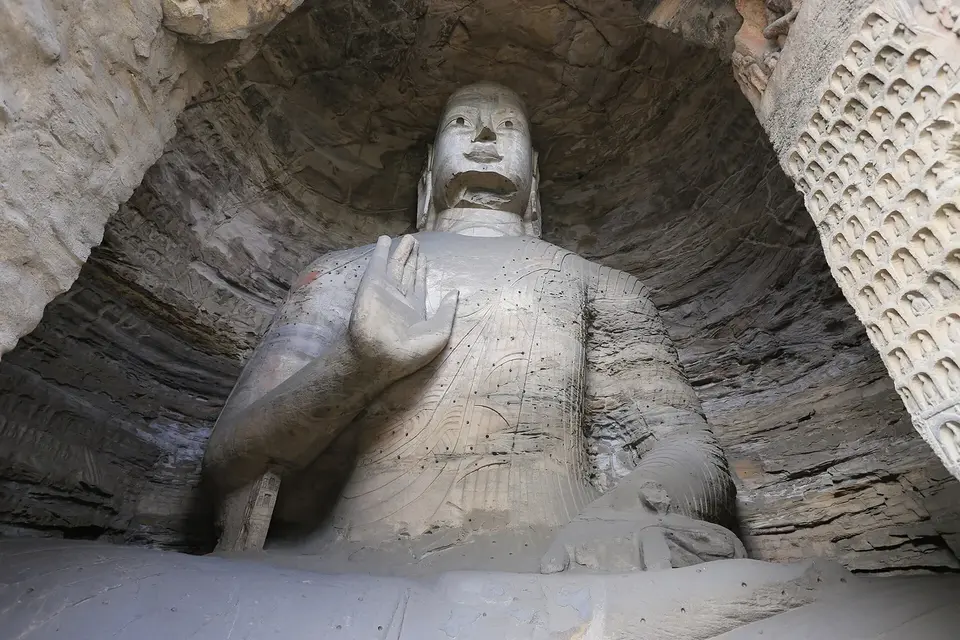
拓跋晃
Tuoba Huang (拓跋晃, 428–451 AD, Xianbei name Tianzhen), hailing from Pingcheng in Dai Commandery (modern Datong, Shanxi Province), was the eldest son and Crown Prince of Emperor Taiwu (Tuoba Tao) of the Northern Wei dynasty, born to Empress Jing'ai (Lady Helan). The father of Emperor Wencheng (Tuoba Jun), he was initially honored as Crown Prince Jingmu before being posthumously elevated by his son in 452 AD to Emperor Jingmu…
Tuoba Huang (拓跋晃, 428–451 AD, Xianbei name Tianzhen), hailing from Pingcheng in Dai Commandery (modern Datong, Shanxi Province), was the eldest son and Crown Prince of Emperor Taiwu (Tuoba Tao) of the Northern Wei dynasty, born to Empress Jing'ai (Lady Helan). The father of Emperor Wencheng (Tuoba Jun), he was initially honored as Crown Prince Jingmu before being posthumously elevated by his son in 452 AD to Emperor Jingmu with the temple name Gongzong, interred at Jinling. Endowed with acute intellect, photographic memory, and deep devotion to Confucian classics and Buddhist teachings, he repeatedly served as regent during his father's distant military campaigns, governing with penetrating perception, agrarian diligence, and profound humanitarian wisdom. At the tender age of five in 432 AD, Tuoba Huang was invested as Crown Prince and placed in nominal charge of the Imperial Secretariat. Between the Taiyan and Taipingzhenjun eras, as Emperor Taiwu campaigned against Northern Yan, Northern Liang, and the Rouran Khaganate, Tuoba Huang presided over the capital administration in Pingcheng, arbitrating civil administration and exposing fraudulent memorials submitted by ministers like Li Shun. In agrarian governance, he introduced a groundbreaking mutual-aid farming regulation pairing cattle-owning households with impoverished manual laborers, instituting cadastral records and border-post markers to stimulate cereal yields while curtailing commercial speculation and alcoholism. During the 443 AD campaign at Luhun Valley, his tactical acumen accurately deduced that chaotic dust plumes over the enemy camp signified a panicked Rouran retreat, advocating an immediate offensive that history vindicated. In 446 AD, when Emperor Taiwu initiated a brutal imperial campaign to exterminate Buddhism, Tuoba Huang opposed the policy. Unable to dissuade his stubborn father, the regent utilized administrative procedures to intentionally delay the distribution of imperial extermination decrees, granting monastic communities vital time to hide scriptures, sacred statues, and escape slaughter, thereby preserving northern Chinese Buddhist civilization. Upright and uncompromising, Tuoba Huang despised the illicit abuses of chief eunuch Zong Ai. Fearing exposure, Zong Ai fabricated treason charges against the Crown Prince's trusted aides Qiu Nidousheng and Ren Pingcheng. Emperor Taiwu executed the aides in a fit of rage and purged the Eastern Palace, plunging Tuoba Huang into inconsolable grief and causing his untimely death in 451 AD at age twenty-four. Historians celebrate him as a wise and benevolent prince whose tragic demise mirrored that of Western Han Crown Prince Liu Ju.
Born in Pingcheng as the eldest son of Emperor Taiwu and Lady Helan.
Invested as Crown Prince at age five; oversaw Secretariat matters during the campaign against Northern Yan.
Served as regent during the western offensive against Northern Liang, exposing deceptive reports regarding Guzang.
Accompanying the northern expedition, deduced that dust plumes over the Rouran camp indicated panic.
Opposed anti-Buddhist purges; intentionally delayed imperial edicts to allow monks to conceal texts and escape.
Implemented mutual-aid cattle-and-labor farming policies, dramatically expanding cultivated lands across the realm.
Stationed at the southern desert perimeter to deter Rouran raids while Emperor Taiwu led southern campaigns.
Framed by eunuch Zong Ai; his aides were executed, and he died of grief at age twenty-four, being posthumously elevated to Emperor Jingmu (Gongzong) in 452 AD.
Tuoba Huang was born in the first year of the Shenjia era as the eldest son of Emperor Taiwu, his mother being Lady Helan of the prestigious Helan lineage (posthumously honored as Empress Jing'ai). From infancy, Tuoba Huang exhibited remarkable intellectual brilliance and photographic memory, retaining every historical chronicle or legal precedent heard with lifelong precision. As he matured, he developed an ardent passion for Confucian canonical texts and dynastic histories, mastering classical statecraft and governance principles. Awed by his son's extraordinary talents, Emperor Taiwu placed supreme hopes upon him to consolidate the northern empire.
In the first month of 432 AD, Emperor Taiwu held an imperial ceremony in the Taiji Hall of Pingcheng, officially investing the five-year-old Tuoba Huang as Crown Prince. In the sixth month of that same year, when Emperor Taiwu led armies east to subjugate Northern Yan at Helong, he placed young Tuoba Huang in charge of the Imperial Secretariat, assigning senior ministers to guide the prince in administrative routines.
In 439 AD, Emperor Taiwu resolved to launch an all-out offensive against Northern Liang. Before departing, the Emperor appointed Privy Attendant and Prince of Yidu Mu Shou to assist Crown Prince Tuoba Huang in managing the capital administration, ordering all imperial departments to submit to the regent's authority.
During the western expedition, ministers including Li Shun argued against invading Guzang, claiming the Northern Liang capital was an arid wasteland devoid of water and fodder, creating immense anxiety in the capital. When Emperor Taiwu reached Guzang, he discovered bubbling freshwater springs converging into rushing streams outside the gates. Emperor Taiwu dispatched a courier carrying an imperial letter to the prince: "Outside the western gates of Guzang, abundant springs converge into a river, irrigating vast meadows without dry ground. I send this decree specifically to dispel your doubts!" Reviewing the letter, Tuoba Huang was outraged by Li Shun's deceit, declaring to his palace courtiers: "Li Shun displayed such blatant falsehood toward the throne; where is his loyalty? Had the Emperor not marched, our grand enterprise would have been ruined. How can such ministers face their sovereign!" The prince's sharp discernment earned universal respect across the bureaucracy.
In 443 AD, Rouran nomadic cavalry launched aggressive incursions along the northern borders. Emperor Taiwu mounted a massive punitive counteroffensive across the Gobi Desert, bringing Crown Prince Tuoba Huang along to participate in military deliberations.
Advancing into Luhun Valley (in modern central Mongolia), Northern Wei vanguards encountered the main forces of the Rouran ruler, Chilian Khagan. Vast yellow dust clouds surged across the steppe, obscuring the enemy encampment. Observing the terrain from an elevated ridge, Tuoba Huang urged his father: "The Rouran did not anticipate our rapid advance! The rising dust is caused by panicked soldiers scattering in disorder. We must launch an immediate, all-out cavalry charge while their ranks are shattered, delivering a decisive crushing blow!"
However, Director of the Masters of Writing Liu Jie forcefully objected, arguing that dense dust indicated hidden ambushes and cautioning that open engagement risked encirclement. Swayed by Liu Jie's hesitation, Emperor Taiwu delayed the assault, allowing Chilian Khagan to withdraw under cover of darkness. Northern Wei forces pursued them to the Shi River without overtaking the enemy.
Shortly thereafter, captured Rouran scouts confessed: "Our khagan had no prior knowledge of the Wei advance. When the vanguard appeared, the entire camp fell into wild panic. Chilian Khagan fled north day and night, halting only after confirming there was no pursuit!" Emperor Taiwu was filled with bitter regret for ignoring Tuoba Huang's counsel. From that moment forward, whenever major military or dynastic affairs arose, the Emperor routinely consulted Tuoba Huang.
Presiding over long-term capital regency, Tuoba Huang governed with administrative precision and deep compassion for rural producers. Seeking to overcome northern grazing traditions that neglected farming, he formulated revolutionary agrarian mutual-aid regulations around the capital.
Recognizing that disparity in livestock ownership left impoverished peasants incapable of plowing fertile lands, Tuoba Huang instituted an equitable exchange system pairing cattle-owning households with labor-rich, cattle-poor families: a cattle-owning family plowed twenty-two mou of land for a cattle-poor household, while the laboring family provided manual weeding across seven mou in return; for impoverished households containing only the elderly or children, cattle owners plowed seven mou, while the dependents weeded two mou. These exchanges were calculated on the basis of a five-member subsistence household and recorded in official cadastral ledgers.
To enforce administrative diligence, Tuoba Huang introduced the innovative practice of engraving farmers' names on wooden boundary stakes at the edge of each plot, enabling inspectors to evaluate individual agricultural productivity. Simultaneously, he enacted strict prohibitions against peasant merchants abandoning agriculture, gambling, theatrical diversions, and excessive drinking. These measures led to a massive expansion of cultivated fields and full granaries, providing the economic foundation for Emperor Taiwu's unification of northern China.
In 450 AD, when Liu Song Emperor Wen launched a massive invasion against Huatai, Emperor Taiwu led elite forces south to the Yellow River, entrusting Tuoba Huang with independent command of frontier armies stationed along the southern desert rim. The prince held the perimeter with absolute vigilance, successfully deterring Rouran cavalry from exploiting the capital's vulnerability.
Tuoba Huang's most celebrated historical achievement lies in his heroic defense of northern Buddhist culture. Influenced by Daoist celestial master Kou Qianzhi and Minister Cui Hao, Emperor Taiwu viewed Buddhism with hostile suspicion.
In 446 AD, during an expedition to Chang'an, Emperor Taiwu discovered weapons, fermenting equipment, and hidden valuables inside Buddhist temples, triggering the catastrophic "Anti-Buddhist Purge." The Emperor decreed that all Buddhist monasteries, stupas, and scriptures across the empire be demolished and burned, ordering the summary execution of monks regardless of age.
Crown Prince Tuoba Huang, a devoted student of Buddhist compassion and ethics, recognized that Buddhism provided essential spiritual harmony between Han and nomadic populations. Defying imperial wrath, he submitted urgent memorials imploring his father to revoke the death decrees. When Emperor Taiwu obstinately refused, Tuoba Huang leveraged his supervisory authority over the Imperial Secretariat to safeguard the faith.
Knowing that official decrees required imperial dispatch through administrative couriers, Tuoba Huang intentionally delayed paperwork, deliberately slowing down the delivery of anti-Buddhist edicts to provincial commanderies. Using this precious grace period, he dispatched clandestine couriers to warn major monasteries throughout Pingcheng, Guanzhong, and the central plains. Warned in advance, monks packed sacred scriptures, hidden relics, and bronze statues, fleeing into remote mountain valleys before imperial soldiers arrived. Through his daring moral intervention, the spiritual seeds and canonical heritage of northern Buddhism were preserved, laying the direct foundation for the dramatic Buddhist revival under Emperor Wencheng.
Tuoba Huang's uncompromising moral righteousness brought him into direct conflict with corrupt elements at court. Palace Attendant Zong Ai was an arrogant, vicious eunuch whose flagrant crimes had earned Tuoba Huang's open contempt and severe reprimands. Fearing that the principled Crown Prince would execute him once on the throne, Zong Ai harbored murderous hatred.
Within the Eastern Palace, palace aides Qiu Nidousheng and Ren Pingcheng were trusted confidants of Tuoba Huang. As they gathered evidence of Zong Ai's treasonous extortions to present to the throne, Zong Ai struck first. Exploiting Emperor Taiwu's volatile, suspicious temper in his old age, Zong Ai falsely accused Qiu Nidousheng and Ren Pingcheng of treasonous conspiracy, alleging that the Eastern Palace was plotting a coup d'état to seize the throne.
Blind with rage, Emperor Taiwu bypassed rigorous judicial inquiry, ordering Qiu Nidousheng and Ren Pingcheng publicly decapitated in Pingcheng's marketplace in the fifth month of 451 AD, executing dozens of Eastern Palace staff in a bloody purge.
Devastated by the butchery of his innocent staff and heartbroken by his father's estrangement, Tuoba Huang succumbed to profound grief and physical collapse. Confined to his bed, he wasted away in sorrow. On July 29, 451 AD, Crown Prince Tuoba Huang passed away at the age of twenty-four. Citizens throughout Pingcheng wept openly in the streets. He was buried at Jinling with the posthumous title Crown Prince Jingmu.
Shortly after his death, Emperor Taiwu uncovered the truth, realizing that his son was entirely blameless and weeping in agonizing remorse. In 452 AD, terrified of retribution, Zong Ai assassinated Emperor Taiwu and subsequently murdered Prince of Nan'an Tuoba Yu. Loyal generals Yuan He and Lu Li staged a coup, executing Zong Ai and enthroning Tuoba Huang's eldest son Tuoba Jun as Emperor Wencheng. Emperor Wencheng posthumously elevated his beloved father to Emperor Jingmu with the temple name Gongzong. Historians in the Book of Wei and History of the Northern Dynasties lamented his radiant virtue and tragic early demise, ranking him alongside the celebrated martyrs of Chinese imperial history.
Invested as Crown Prince at age five, he repeatedly governed the capital as regent during campaigns against Northern Yan and Northern Liang.
He exposed ministerial deceptions regarding western geography and managed imperial dockets with penetrating clarity, winning universal bureaucratic respect.
Accompanying the northern expedition against the Rouran in 443 AD, he discerned that dust plumes over the enemy camp signified panicked flight.
His recommendation for an immediate offensive was confirmed by captured scouts, earning Emperor Taiwu's lifelong military respect and strategic consultation.
He instituted the mutual-aid cattle-and-labor farming regulation pairing livestock owners with manual laborers to cultivate fallow lands.
He introduced cadastral records, carved names on boundary stakes, and banned speculative commerce, dramatically increasing agricultural acreage across northern China.
During Emperor Taiwu's brutal anti-Buddhist extermination campaign, Tuoba Huang risked his position to delay imperial edicts.
His administrative stalling granted monastic communities time to conceal scriptures and sacred statues, heroically rescuing thousands of monks and preserving Buddhist civilization.
Possessing fierce personal integrity, he opposed corrupt eunuch Zong Ai, ultimately suffering fatal slander and execution of his staff.
Dying of grief at twenty-four, he was posthumously elevated to Emperor Jingmu (Gongzong), leaving an enduring legacy of Confucian benevolence and administrative wisdom.
FIGURES ASSOCIATED WITH THIS DYNASTY