Born in Julu
Born into the prominent Wei lineage of Julu; displayed remarkable intelligence in youth, practiced equestrian archery on the frontier, and subsequently committed himself to classical scholarship.
魏收
Wei Shou (魏收, 507–572), courtesy name Boqi (伯起) and childhood moniker Fozhu, was a native of Xiaquyang County in Julu Commandery (modern Jinzhou, Hebei Province). He was the son of Wei Zijian, General of Chariots and Cavalry in the Northern Wei. As one of the most prominent historians, literati, and senior court ministers of the Northern Dynasties, Wei Shou possessed precocious intellect and dedicated himself to classical…
Wei Shou (魏收, 507–572), courtesy name Boqi (伯起) and childhood moniker Fozhu, was a native of Xiaquyang County in Julu Commandery (modern Jinzhou, Hebei Province). He was the son of Wei Zijian, General of Chariots and Cavalry in the Northern Wei. As one of the most prominent historians, literati, and senior court ministers of the Northern Dynasties, Wei Shou possessed precocious intellect and dedicated himself to classical scholarship and belles-lettres from early youth. Entering bureaucratic service under the Northern Wei, he successively served as Erudite of the National University, Attendant Gentleman of the Cavalier, and Vice Director of the Secretariat. Highly favored by Emperor Jiemin, he was entrusted with recording the Imperial Diary and compiling the state history. Later, while serving as deputy envoy under Wang Xin on a diplomatic mission to the Southern Liang Dynasty, his opulent literary talents astounded Emperor Wu of Liang and the literary elite of Jiankang. With the founding of the Eastern Wei and Northern Qi dynasties, Wei Shou gained the profound trust of Gao Huan and his son Gao Yang (Emperor Wenxuan). He rose steadily through the administrative ranks, ultimately attaining the prestigious positions of Secretariat Director, Gentleman Compiler, Lord Specially Advanced, Right Vice Director of the Department of State Affairs, and Junior Tutor to the Crown Prince. In 551 (the 2nd year of the Tianbao era), he received imperial orders to oversee the grand compilation of the Book of Wei (Wei Shu), the official dynastic history of the Northern Wei. Over three grueling years, he integrated archives, private genealogies, and regional records into a monumental 130-volume work. However, his candid and pungent appraisals of prestigious lineages provoked intense outcry among prominent Northern aristocratic clans, leading to the infamous "Polluted History" (Huishi) controversy. With steadfast imperial protection and scholarly rigor, Wei Shou underwent three rounds of comprehensive review and revision, establishing the definitive edition that survives among China's Canonical Twenty-Four Dynastic Histories. In literature, he was celebrated alongside Wen Zisheng and Xing Shao as one of the "Three Talents of the Northern Realm," and later shared preeminence with Xing Shao in the duo known as "Elder Xing and Younger Wei." He passed away in 572 and was posthumously bestowed the offices of Minister of Works and Left Vice Director of the Department of State Affairs, along with the honorable posthumous name "Wenzhen."
Born into the prominent Wei lineage of Julu; displayed remarkable intelligence in youth, practiced equestrian archery on the frontier, and subsequently committed himself to classical scholarship.
Served as Erudite of the National University; narrowly escaped death in the evening dusk during the brutal Heyin Massacre orchestrated by Erzhu Rong; recommended by Li Shenjun to become Editorial Secretary to the Minister of Education.
Commissioned by Emperor Jiemin to draft the text for the imperial Fengshan sacrifice, completing it spontaneously without revision; promoted to Attendant Gentleman of the Cavalier to compile the Imperial Diary and assist in dynastic history.
Following Gao Huan's entry into Luoyang, drafted official decrees; requested reassignment to the staff of Prince Yuan Zan after speaking candidly regarding the status of the Chancellor of State.
Dispatched as deputy envoy alongside Wang Xin to the Southern Liang; earned great renown across Jiankang for refined poetic exchanges; briefly imprisoned in the Censorate upon return due to rival factions before being exonerated.
Recommended by Sima Ziru to join Chancellor Gao Huan's supreme command in Jinyang as Central-External Master of Records, managing vital military proclamations.
Drafted the abdication decrees and inaugural amnesty provisions when Gao Yang established Northern Qi; appointed Secretariat Director and Gentleman Compiler, enfeoffed as Baron of Weichang.
Commissioned by imperial edict to direct the compilation of the Northern Wei dynastic history; organized scholars including Fang Yanyou and Xin Yuanzhi to assemble state archives in Yecheng.
Presented the finished 130-volume Book of Wei to the throne; aroused bitter hostility from powerful aristocratic clans over lineage assessments, triggering the nationwide "Polluted History" dispute.
Elevated to Lord Specially Advanced, Right Vice Director of the Department of State Affairs, and Junior Tutor to the Crown Prince; supervised the revision of the Northern Qi legal code and state rituals.
Convened court scholars under imperial decree during the reign of Emperor Fei to cross-examine and refine genealogical records, revising the draft three times to reach the definitive edition.
Died in his Yecheng residence at age 66; posthumously honored as Minister of Works and Left Vice Director of the Department of State Affairs, with the posthumous title "Wenzhen."
Wei Shou traced his lineage to Marquis Wei Wuzhi from the early Han Dynasty, with his family maintaining prominent standing across northern China for centuries. His father, Wei Zijian, attained the grand rank of General of Chariots and Cavalry and possessed formidable classical erudition. At fifteen, Wei Shou accompanied his father to frontier outposts. Immersed in martial border culture, the young Wei Shou favored horsemanship and archery, aspiring to secure rank through battlefield exploits. However, Zheng Bo, a prominent gentleman from Xingyang, teased him publicly for abandoning Confucian scholarship in favor of weapons. Humiliated by this rebuke, Wei Shou renounced frivolity and shut his gates for intensive reading. Devoting himself to ancient histories, philosophical works, and Han literature, his prose matured rapidly, winning high renown throughout the northern capital of Luoyang before his twentieth year.
Wei Shou began his official career as Erudite of the National University under the Northern Wei. In 528, the ambitious chieftain Erzhu Rong launched the horrific Heyin Massacre, slaughtering more than two thousand imperial kinsmen and high-ranking officials on the riverbanks. Standing among the doomed assembly, Wei Shou managed to conceal himself beneath heaps of corpses and official rolls. As twilight descended and soldiers hurried their inspection, he slipped away under the cover of darkness. In the aftermath, Minister of Personnel Li Shenjun recognized Wei Shou's extraordinary literary and administrative talent, recommending him to serve as Editorial Secretary to the Minister of Education.
In 531, Emperor Jiemin (Yuan Gong) ascended the throne. An avid lover of letters, the emperor contemplated reviving the ancient Fengshan sacrificial rites and summoned Wei Shou to draft the ceremonial treatise. Wei Shou picked up his brush and composed several thousand polished characters on the spot, without a single erasure. Standing beside the monarch, Supervising Secretary Jia Sitong remarked that even the famed Cao Zhi could not have matched such swift brilliance. Deeply impressed, the emperor promoted Wei Shou to Attendant Gentleman of the Cavalier, placing him in sole charge of the Imperial Diary and enlisting him in compiling the state annals. Before reaching his thirtieth year, Wei Shou was already functioning as Vice Director of the Secretariat.
In 532, Gao Huan entered Luoyang, deposed Emperor Jiemin, and enthroned Emperor Xiaowu. Bestowed the supreme post of Great Chancellor and Grand Pillar of Heaven, Gao Huan sought to decline the latter title to avoid unfavorable historical comparisons with Erzhu Rong. Wei Shou was commanded to draft the gracious decree granting Gao Huan's request. When Emperor Xiaowu contemplated elevating Gao Huan to Chancellor of State, he privately asked Wei Shou regarding the exact prestige of this archaic office. Wei Shou replied forthrightly that a Chancellor of State stood above the Three Excellencies, holding undivided sway over all state affairs and reducing the monarch to a figurehead. Shaken by this revelation, Emperor Xiaowu abandoned the plan. Realizing that he had inadvertently stepped into the tense rivalry between the sovereign and the regent, Wei Shou felt deeply insecure and feigned illness to resign his position. Later appointed to serve Prince Yuan Zan, he composed the Rhapsody on the Garden Bamboo (Tingzhu Fu) to articulate his anxiety amidst dangerous court currents. Celebrated alongside Wen Zisheng and Xing Shao as the "Three Talents of the Northern Realm," Wei Shou maintained vigilant caution, resigning repeatedly whenever political intrigue escalated.
In 534, Wei Shou was appointed Cavalier Regular Attendant with General Access and designated deputy envoy to the Southern Liang Dynasty, serving alongside chief envoy Wang Xin. Southern Liang culture represented the apex of literary refinement and parallel prose (pianwen). When Emperor Wu of Liang received the northern delegation in the grand hall of Jiankang, Wang Xin impressed the court with his dignified presence, while Wei Shou dazzled observers with his luxuriant erudition and rhetorical quickness. Engaging in poetic exchanges with prominent southern luminaries including Xu Ling and Yu Jianwu, the two envoys demonstrated unmatched compositional skill. Emperor Wu sighed with admiration, observing to his courtiers that following in the footsteps of earlier legendary envoys Lu Yuanming and Li Xie, the emergence of Wang Xin and Wei Shou proved the inexhaustible intellectual vitality of the Northern Dynasties.
Nevertheless, Wei Shou's impulsive and bohemian temperament caused significant diplomatic scandal. During his stay in the guest pavilions of Jiankang, he purchased several local maids for personal gratification and even summoned the maidservants acquired by his subordinates to his private quarters, resulting in severe reprimands for the Liang reception officials. While southern intellectuals venerated his prose, they criticized his private conduct. On his northward return journey, Wei Shou reflected on the vast landscapes and cultural differences between north and south, composing the renowned Rhapsody on an Official Mission (Pinyou Fu), a masterpiece celebrated across both empires. Upon returning to Luoyang, the influential Right Vice Director Gao Longzhi demanded precious curiosities brought back from the south. Wei Shou's haughty refusal incensed Gao Longzhi, who ordered Palace Attendant Censor Gao Zhongmi to frame Wei Shou and Wang Xin, confining them in the Censorate for several months before political patrons secured their release.
Soon after, Northern Wei fractured into Eastern and Western branches, with Gao Huan establishing his supreme military headquarters in Jinyang to govern Eastern Wei. Aware of Wei Shou's unique administrative and literary prowess, senior minister Sima Ziru recommended him to Gao Huan, who summoned him to serve as Central-External Master of Records. The office required drafting military proclamations and secret dispatches under urgent timelines. Gao Huan initially found Wei Shou's ornate style slightly overly elaborate for concise military matters and temporarily replaced him with Chen Yuankang. Wei Shou experienced periods of disfavor, even enduring physical corporal punishment during moments of bureaucratic friction.
However, during a banquet in Jinyang, Sima Ziru remonstrated with Gao Huan, asserting that Wei Shou was an imperial drafter of the highest caliber whose brush should be preserved for epochal state declarations rather than trivial clerical memos. Gao Huan took the advice to heart. Whenever grand proclamations to the entire realm, imperial edicts, or stern communications with the Southern Liang were required, other scholars stood paralyzed, while Wei Shou wielded his brush with effortless majesty, crafting stirring texts filled with commanding authority. Thenceforth, Gao Huan relied on Wei Shou as his foremost ideological voice.
In 550, Gao Huan's son, General Gao Yang, resolved to usurp the Eastern Wei throne and establish the Northern Qi Dynasty. Wei Shou and fellow confidant Cui Jishu worked throughout the nights in the inner palace, drafting the abdication memorials, the grand bestowal of the Nine Bestowals (Jiu Xi), the general amnesty declarations, and the structural charters for the new dynasty. Wei Shou's prose conferred an aura of cosmic inevitability and imperial dignity upon the regime change, earning Gao Yang's profound trust. Following his coronation as Emperor Wenxuan, the sovereign appointed Wei Shou as Secretariat Director and concurrently Gentleman Compiler, enfeoffing him as Baron of Weichang. Occupying the commanding heights of the Secretariat, Wei Shou shaped the monumental decrees and sacrificial protocols of the nascent dynasty.
In 551, Emperor Wenxuan issued a formal imperial edict commissioning Wei Shou to direct the overall compilation of the official Northern Wei dynastic history. Since the founding of Northern Wei by Emperor Daowu, the empire had unified northern China and carried out far-reaching sinicization under Emperor Xiaowen. However, its historical archives had suffered devastating disruptions. Early compiling endeavors under Cui Hao had ended in the brutal Historical Incident of Cui Hao, resulting in the destruction of priceless imperial diaries and records; subsequent continuations by Gao Yun and Li Biao remained fragmented.
Appreciating the profound gravity of his mission, Wei Shou secured imperial permission to recruit exceptional talent, assembling veteran scholar-officials such as Fang Yanyou, Xin Yuanzhi, Diao Rou, Pei Angzhi, and Gao Xiaogan at the history bureau in Yecheng. He gathered regional gazetteers, court announcements, family genealogies, and scattered stone inscriptions from across the former Northern Wei domains. Wei Shou laboured tirelessly, resolving chronological discrepancies and formulating comprehensive rubrics for administrative and geographical records.
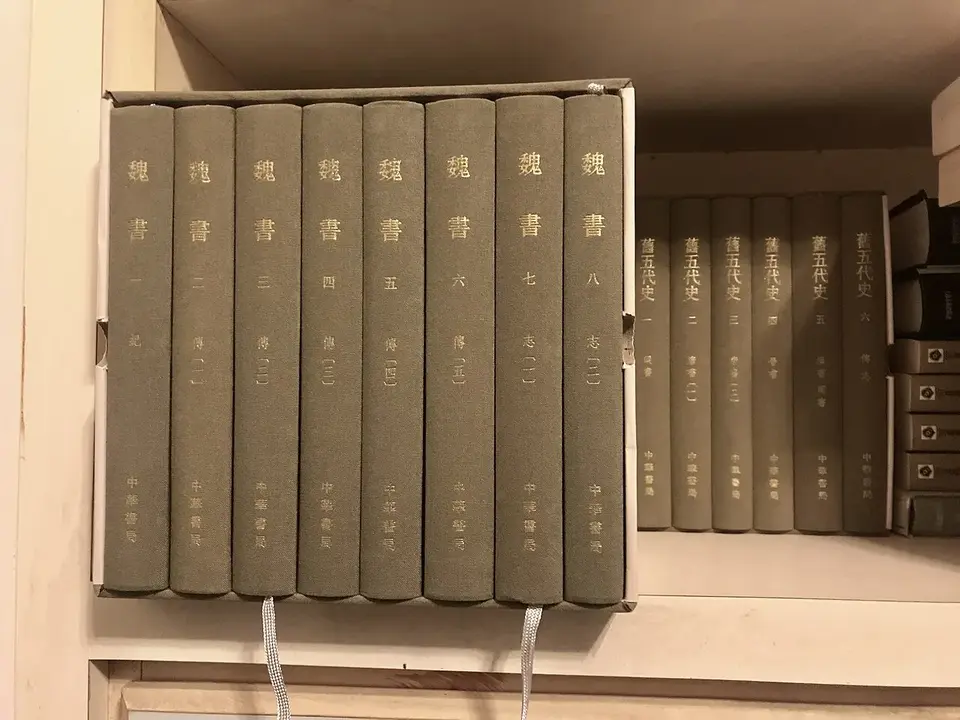
Demonstrating immense stamina and historiographical insight, Wei Shou wove together the dramatic narrative of how the Tuoba Xianbei originated from northern steppe confederacies, established their capital in Pingcheng, conquered competing kingdoms, relocated to Luoyang, and implemented sweeping administrative and agrarian reforms. After three years of intensive effort, the monumental work was completed in 554, designated as the Book of Wei (Wei Shu). Spanning 130 fascicles, it contained 12 Basic Annals, 92 Biographies, and 20 Treatises (grouped into 10 subject treatises). Emperor Wenxuan studied the completed manuscript overnight with immense admiration, granting Wei Shou rich gifts of gold, fine silks, and thoroughbred horses, while commanding that the work be promulgated throughout the realm.
The nationwide publication of the Book of Wei immediately ignited fierce controversy across northern society, precipitating the most famous historiographical dispute in Chinese history, known as the "Polluted History" (Huishi) affair. In the Northern Dynasties, aristocratic lineage status dictated political power and social survival. Powerful clans such as the Cuis of Qinghe, Lus of Fanyang, and Lis of Zhaojun regarded the portrayal of their forebears in dynastic records as a matter of ancestral honor and existential consequence. Wei Shou's proud and caustic personality exacerbated tensions, as he once boasted publicly that with a single stroke of his brush, he could elevate someone to the heavens or banish them to the abyss.
In drafting individual biographies, Wei Shou was accused of letting personal grudges and political expediency color his historical judgments. He exposed ancestral misdeeds and downplayed the achievements of families who had snubbed him; conversely, for allies like Yang Xiuzhi, who had aided his research, Wei Shou sanitized the record, obscuring documented corruption charges against Yang's father Yang Gu by attributing his dismissal to routine administrative business. Furthermore, to legitimize the Northern Qi imperial house, Wei Shou tread cautiously regarding Gao Huan's humble beginnings, and accepted substantial gifts from Erzhu Wenlue, leading critics to claim that he had softened Erzhu Rong's historical villainy.
Outraged by these portrayals, prominent nobles including Lu Cao, Li Shu, and Wang Songnian condemned the Book of Wei as a work of self-serving distortion, branding it a "polluted history." Thousands of aristocratic youths gathered in Yecheng, submitting impassioned petitions demanding that the text be recalled and Wei Shou prosecuted. Emperor Wenxuan convened a palace debate where Li Shu confronted Wei Shou directly. Wei Shou defended his text tenaciously, arguing that his accounts were firmly anchored in official registries and genuine historical testimonies. Viewing the aristocratic mobilization as a challenge to imperial authority, Emperor Wenxuan arrested and flogged several leading protesters, resulting in the jailhouse death of a prominent noble. Yet discontent simmered unabated across the empire.
Recognizing that an unresolved controversy would permanently taint his life's masterwork, Wei Shou petitioned the court following Emperor Wenxuan's death to reopen the bureau for collective verification. During the reigns of Emperor Fei (Gao Yin) and Emperor Xiaozhao, Wei Shou invited eminent scholars to review lineage documents, openly inviting families to provide corroborating stone rubbings and ancestral genealogies. He painstakingly revised the manuscript three times, excising biased phrasings and incorporating authentic historical achievements. Through these meticulous revisions, the Book of Wei emerged as a balanced, comprehensive, and indispensable historical record.
Following the stabilization of the historical enterprise, Wei Shou's stature at the Northern Qi court reached its apex. In 557, he was elevated to Lord Specially Advanced and Right Vice Director of the Department of State Affairs, concurrently appointed Junior Tutor to the Crown Prince. As Vice Director, he functioned among the top tier of executive governance. He was tasked with presiding over the codification of the state's Five Rituals (auspicious, guest, military, celebratory, and funerary rituals) and played an active part in refining the twelve-chapter Northern Qi Code (Qi Lu), standardizing court etiquette and administrative jurisprudence.
Under subsequent rulers Emperor Xiaozhao and Emperor Wucheng (Gao Zhan), Wei Shou remained venerated as an indispensable elder statesman. Although briefly subjected to factional censure and reassigned outward during the Daning era, Emperor Wucheng quickly recalled him to the capital, reassuring him of imperial gratitude for his decades of loyal service to the ruling house. He was granted the rank of Opening Office Equal to the Three Excellencies and served as Secretariat Director. In his twilight years in Yecheng, Wei Shou lived quietly, yet emperors frequently sought his counsel whenever grand state rituals or military strategies against the southern Chen Dynasty were contemplated.
In 572, Wei Shou fell ill and passed away at his Yecheng estate at the age of sixty-six. Emperor Houzhu (Gao Wei) mourned his demise, lamenting the loss of a grand scholar who had shaped dynastic charters, written the official dynastic history, and harmonized state rituals. By imperial decree, he was posthumously awarded the high ranks of Minister of Works and Left Vice Director of the Department of State Affairs, with the illustrious posthumous name "Wenzhen."
Wei Shou's crowning intellectual legacy lies in his single-handed leadership in compiling the 130-volume Book of Wei, an enduring masterpiece of Chinese biographical historiography. Prior to his work, the tumultuous warfare of the Sixteen Kingdoms and Northern Dynasties had scattered archival sources, while Cui Hao's execution had rendered early Tuoba history perilous to touch. Wei Shou shouldered this enormous responsibility, marshaling court diaries, military ledgers, ancestral tablets, and local stone inscriptions to construct a unified historical narrative spanning more than a century of Tuoba Xianbei ascendance.
The Book of Wei introduced revolutionary thematic treatises, most notably the Treatise on Topography (Dixing Zhi), which mapped northern administrative shifts; the Treatise on Buddhism and Daoism (Shilao Zhi), which marked the first inclusion of religious history in a canonical dynastic history; and the Treatise on Bureaucrats and Clans (Guanshi Zhi), which provided an authoritative account of the sinicization of Xianbei tribal names and bureaucratic institutions under Emperor Xiaowen. Despite the intense "Polluted History" controversy of his own era, subsequent generations of historians have affirmed that Wei Shou preserved an invaluable treasury of primary historical materials that would otherwise have been lost to posterity.
Beyond his historiographical stature, Wei Shou stood as a pivotal titan in the evolutionary journey of Northern Dynasties literature. Under the Eastern Wei and Northern Qi, northern writing moved away from rustic simplicity, absorbing the complex tonal prosody and decorative elegance of southern parallel prose while retaining northern vigor. Early in his career, Wei Shou rose to equal prominence with Wen Zisheng and Xing Shao, hailed universally as the "Three Talents of the Northern Realm." Following Wen Zisheng's death, Wei Shou and Xing Shao stood as undisputed arbiters of northern letters, celebrated as "Elder Xing and Younger Wei."
While Xing Shao championed the lighter lyrical grace of Shen Yue, Wei Shou favored the sweeping rhetorical grandeur of Ren Fang. Wei Shou possessed extraordinary talent for grand rhapsodies (fu), exemplified by his Rhapsody on the Garden Bamboo, Rhapsody on the Southern Hunt, and Rhapsody on an Official Mission. His works combined muscular northern momentum with intricate southern ornament, dismantling southern prejudices regarding northern literary deficiency. His complete literary works, later collected in the Anthology of Lord Specially Advanced Wei (Wei Tejin Ji), provided an essential evolutionary bridge between northern literature and the vibrant golden age of Sui and Tang literature.
Wei Shou made lasting institutional contributions to medieval Chinese governance through his work in ritual codification and legal reform. At the inception of the Northern Qi, administrative ceremonial was plagued by a chaotic fusion of Xianbei tribal customs and militaristic practices. Serving as Lord Specially Advanced and Right Vice Director of the Department of State Affairs, Wei Shou collaborated with leading Confucian scholars to compile and supervise the Five Rituals, harmonizing traditional Wei-Jin ceremonial standards with practical governance needs to establish standardized rituals for court audiences, sacrifices, and the investiture of the crown prince.
Concurrently, Wei Shou played an instrumental role in shaping the Northern Qi Code (Qi Lu). Drawing upon classical legal traditions from Han, Wei, and Jin, he advocated integrating Confucian moral tenets directly into statutory law. He eliminated archaic and barbaric punishments inherited from the late Northern Wei, establishing the "Ten Abominations" (Shi E) as supreme statutory crimes. This refined legal framework served as the direct precursor to the Sui Dynasty's Kaihuang Code and the Tang Dynasty's immortal Tang Code with Commentary (Tanglu Shuyi), exercising an enduring impact on the historical evolution of traditional Chinese law.
FIGURES ASSOCIATED WITH THIS DYNASTY