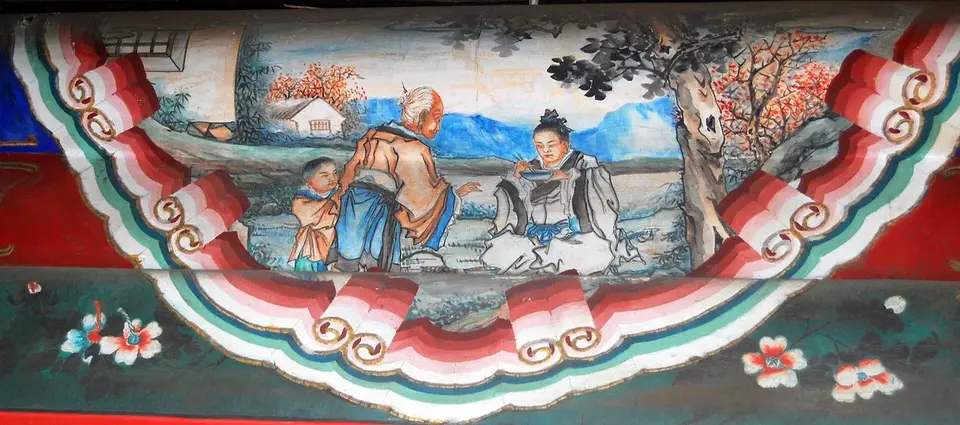
Succession of Ma Yin
Following Liu Jianfeng's assassination, Ma Yin is acclaimed leader, crushes Deng Chunü, and is appointed Acting Military Commissioner of Wu'an.
907 CE–951 CE
楚
The Chu (楚; 907–951 CE), historically designated as Southern Chu or Ma Chu, was one of the Ten Kingdoms that divided southern China during the Five Dynasties and Ten Kingdoms period, and the sole sovereign regional kingdom in Chinese history to establish its administrative center in Hunan. With its capital at Tanzhou (subsequently elevated to Changsha Prefecture), the realm endured across six successive monarchs spanning forty-four years (fifty-six years if calculated from Ma Yin's initial…
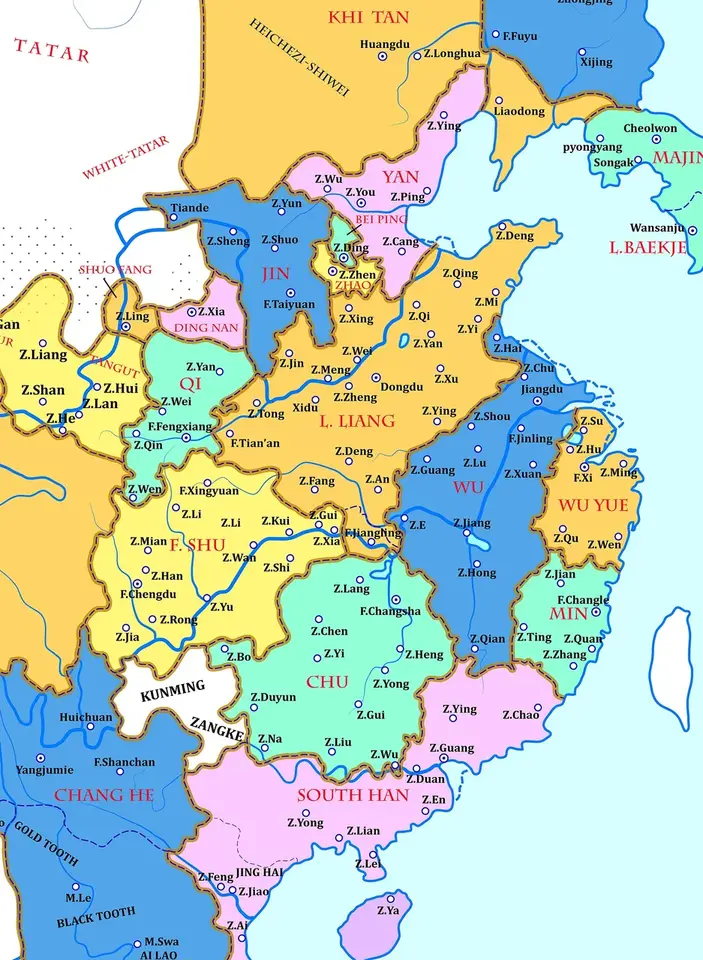
The Chu (楚; 907–951 CE), historically designated as Southern Chu or Ma Chu, was one of the Ten Kingdoms that divided southern China during the Five Dynasties and Ten Kingdoms period, and the sole sovereign regional kingdom in Chinese history to establish its administrative center in Hunan. With its capital at Tanzhou (subsequently elevated to Changsha Prefecture), the realm endured across six successive monarchs spanning forty-four years (fifty-six years if calculated from Ma Yin's initial assumption of military command in 896 CE). The regime was founded by Ma Yin, formerly an officer under the Cai warlord Sun Ru during the late Tang Dynasty. Pacifying rival warlords across the Sanxiang region, Ma Yin unified Hunan and twenty-four prefectures north of the Nanling Mountains, organizing five major military circuits: Wu'an, Wuping, Jingjiang, Wuzhen, and Zhaozhou. In 907 CE (the first year of the Kaiping era), Emperor Taizu of Later Liang (Zhu Wen) invested Ma Yin as Prince of Chu; in 927 CE (the second year of the Tiancheng era), Emperor Mingzong of Later Tang formally invested him with bamboo tallies as King of the Kingdom of Chu (Chu Guo Wang). Ma Yin elevated Tanzhou to Changsha Prefecture, erected imperial-style palatial halls, established the Tiance Mansion, and instituted civil ministries, creating a de facto sovereign kingdom. Throughout his reign, Ma Yin maintained a national strategy of "serving the Son of Heaven above, comforting the scholars and commoners below, and preserving borders to rest the people." Adopting the brilliant financial counsel of chief minister Gao Yu, the regime promoted sericulture, cotton, and tea (Tea Trading Office) cultivation. It pioneered the casting of heavy lead and iron coinage alongside the creation of official trade logistics agencies (Huituowu), transporting Hunan tea northward to the Central Plains in exchange for warhorses and northern silks, generating millions in state revenue and elevating Changsha into the preeminent commercial and tea emporium of southern China. However, Ma Yin's late decree mandating fraternal succession ("from elder brother to younger brother") triggered destructive succession wars known as "the Colts Contending for the Trough" (Zhongju Zhengcao). Prolonged fratricidal strife exhausted state treasuries; in 951 CE (the first year of the Guangshun era of Later Zhou / the ninth year of the Baoda era of Southern Tang), Southern Tang armies captured Changsha, Ma Xichong surrendered, and the Ma Chu kingdom was extinguished.
Following Liu Jianfeng's assassination, Ma Yin is acclaimed leader, crushes Deng Chunü, and is appointed Acting Military Commissioner of Wu'an.
Ma Yin's armies defeat Lei Man, Liu Shizheng, and regional magnates, fully unifying Hunan and twenty-four prefectures.
Zhu Wen usurps the Tang throne, founding Later Liang; he invests Ma Yin as Palace Attendant, Prefect of the Secretariat, and Prince of Chu.
Ma Yin is commissioned Grand General of Tiance and opens the Tiance Mansion in Tanzhou, recruiting the Eighteen Scholars.
Adopting Gao Yu's strategy, the regime mints lead and iron coins and establishes the Huituowu, transforming Tanzhou into China's foremost tea market.
Emperor Mingzong of Later Tang grants bamboo tallies creating Ma Yin King of Chu; Tanzhou becomes Changsha Prefecture, and the Tiance Mansion is founded.
Ma Yin dies after mandating fraternal succession; Ma Xisheng succeeds, listens to slander, and murders chief minister Gao Yu.
Ma Xisheng dies; Ma Xifan succeeds, builds the Nine Dragon Hall and Huichun Garden, and exhausts state treasuries.
Ma Xifan pacifies the Xizhou tribal uprising under Peng Shichou and casts the Bronze Pillar of Xizhou to seal a lasting frontier covenant.
Ma Xifan dies; generals enthroned Ma Xiguang, provoking Ma Xi'e to rebel at Langzhou, triggering fratricidal civil war.
Ma Xi'e leads tribal forces to storm Changsha, strangles Ma Xiguang, and assumes the throne amid drunken misrule.
Ma Xichong overthrows Ma Xi'e; Southern Tang general Bian Hao marches on Changsha; Ma Xichong surrenders, terminating the state.
During the early Qianning era of late Tang, the Hunan region was engulfed in destructive multi-sided civil warfare among rival warlords, including Deng Chunü, Military Commissioner of Wu'an; Liu Shizheng, Military Commissioner of Jingjiang;
and Lei Man, Military Commissioner of Wuzhen, leaving the imperial court powerless to intervene.
Ma Yin was originally a cavalry officer from Cai Prefecture in Huaiwei, serving under Sun Ru during his southern incursions.
Following Sun Ru's death in battle, Ma Yin assisted general Liu Jianfeng in gathering their surviving troops, marching across Jiangxi into Hunan, slaying Deng Chunü, and seizing Tanzhou.
In 896 CE (the third year of the Qianning era), Liu Jianfeng was assassinated by a disgruntled subordinate, and the assembled officers unanimously elevated Ma Yin to assume command of the Wu'an Circuit.
Entering Tanzhou, Ma Yin received formal commission from the Tang court as Prefect of Tanzhou and Acting Military Commissioner of Wu'an, followed the next year by full commission as Military Commissioner.
Employing gifted statesmen and generals including Yao Yanzhang, Gao Yu, and Xu Dexun, Ma Yin launched coordinated campaigns, systematically destroying regional warlords including Jiang Xun in Shaozhou, Lei Man in Langzhou, Liu Shizheng in Guiguan, and local magnates in Heng, Yong, and Chen prefectures, completely unifying Hunan.
In 907 CE (the first year of the Kaiping era of Later Liang), Zhu Wen usurped the Tang throne to establish the Later Liang dynasty; Ma Yin promptly submitted memorials of allegiance.
Emperor Taizu of Later Liang invested Ma Yin as Palace Attendant, Prefect of the Secretariat, and Prince of Chu, transforming him from a provincial military commander into an invested vassal king.
In 908 CE, Ma Yin dispatched general Lu Shizhou southward to conquer six prefectures in Lingnan—including Zhaozhou, Hezhou, and Wuzhou—expanding Chu territory across Hunan, northeastern Guangxi, and northern Guangdong.
Facing powerful neighboring states—including Yang Wu, Southern Han, and Jingnan (Nanping)—Ma Yin adhered to a disciplined foreign policy: he scrupulously honored the central Five Dynasties as imperial sovereigns, presenting regular tributary missions to secure political legitimacy and trade rights, while maintaining domestic tranquility through light taxation and military restraint.
Economically, the Chu state enacted innovative policies tailored to regional resources, vigorously expanding tea plantations and cotton weaving, permitting peasants to process and trade tea freely in exchange for grain and cloth.
Ma Yin instituted the unique monetary policy of circulating heavy lead coins ("Kaiyuan Tongbao") and iron coins ("Qianfeng Quanbao"), enforcing an economic closed loop: foreign merchants had to exchange gold and silks for local lead and iron money upon entry, but could not export the heavy currency, forcing them to spend all earnings on Hunan tea, textiles, and timber.
Consequently, merchants from across China flocked to Changsha. The realm expanded south to Guilin, Yanzhou, and Liuzhou, and north to Yuezhou and Langzhou, governing twenty-four prefectures as a flourishing southern economic powerhouse.
In 927 CE (the second year of the Tiancheng era), Emperor Mingzong of Later Tang dispatched imperial envoys to invest Ma Yin as King of the Kingdom of Chu.
Ma Yin erected palaces, instituted the Tiance Mansion, and appointed Left and Right Chancellors alongside the Six Ministries, fully developing an autonomous governmental apparatus.
In 930 CE (the first year of the Changxing era), Ma Yin fell mortally ill.
Because his eldest son Ma Xizhen chose a Daoist reclusive life, Ma Yin instituted a strict fraternal succession code: "Succession must pass among the brothers;
when an elder brother dies, authority must pass to the next brother." He placed a ceremonial sword before the throne, swearing: "Whoever violates this decree, may Heaven abandon him and ministers execute him!" Passing away in the eleventh month of that year, he was succeeded by his second son, Ma Xisheng.
Frivolous and foolish, Ma Xisheng listened to palace slander and executed chief economic architect Gao Yu, stripping the state of its paramount strategic brain.
In 932 CE, Ma Xisheng died of sudden illness, and his younger brother Ma Xifan succeeded as King Wenzhao. Reigning for fifteen years, Ma Xifan repelled incursions by Southern Han and upland tribes; however, he was excessively extravagant.
In Changsha, he constructed the palatial Nine Dragon Hall with gilded dragon horns and aloeswood rafters, erected the Tiance Mansion to house literati, created the Tiance Eighteen Scholars for perpetual banqueting, and built the lavish Huichun Garden, exhausting state reserves and provoking popular resentment.
Following Ma Xifan's death during the Qianyou era of Later Han, court commanders ignored the fraternal succession code, bypassing elder brother Ma Xi'e to enthrone the gentle thirty-fifth son, Ma Xiguang.
Infuriated, Ma Xi'e rebelled at Langzhou, enlisting upland Meishan tribal warriors to launch an all-out assault upon Changsha. Brothers drew weapons against brothers as princely factions clashed, a tragedy remembered as "the Colts Contending for the Trough."
In the winter of 950 CE (the third year of the Qianyou era), Ma Xi'e's allied army besieged Changsha; treacherous officers opened the gates, and the city fell. Ma Xiguang was captured and strangled. Ma Xi'e proclaimed himself King of Chu, but governed with drunken cruelty, alienating his generals.
In 951 CE, his younger brother Ma Xichong launched a palace coup, detaining Ma Xi'e at Mount Heng and styling himself Acting Military Commissioner.
Internal slaughter left the twenty-four prefectures exhausted and undefended.
Observing this fatal opportunity, Emperor Yuanzong of Southern Tang (Li Jing) dispatched General Bian Hao in the tenth month of 951 CE (the first year of the Guangshun era of Later Zhou) with over ten thousand elite troops from Yuanzhou directly to the walls of Changsha.
Incapable of defense, Ma Xichong opened the gates and surrendered, delivering state seals. Southern Tang forces secured Mount Heng, captured Ma Xi'e, and escorted the entire Ma royal clan to Jinling (Nanjing), terminating the forty-four-year Ma Chu dynasty.
In 952 CE, former Chu commanders Liu Yan, Wang Kui, and Zhou Xingfeng revolted at Langzhou (Changde), annihilating the Southern Tang occupation forces and regaining control over Hunan as autonomous Military Commissioners of Wuping until 963 CE (the fourth year of the Jianlong era), when Emperor Taizu of Song pacified the region, returning Hunan to unified imperial rule.
The administrative structure of Chu evolved from a late Tang military circuit headquarters into an autonomous princely kingdom.
Following his formal investiture as King of Chu in 927 CE, Ma Yin designated Changsha Prefecture as his capital and patterned administrative organs upon Central Plains imperial institutions: he appointed Left and Right Chancellors to supervise executive policy, instituted the Six Ministries (Personnel, Revenue, Rites, War, Justice, Works), commissioned Directors of the Bureau of Military Affairs (Shumishi), and appointed Area Commanders-in-Chief (Dubushu) to direct military operations.
Constrained by formal vassal status under northern dynasties, Ma Chu adopted the institutional innovation of utilizing the "Tiance Mansion" (Tiance Fu) as its supreme executive command center.
In 939 CE, Shi Jingtang of Later Jin granted Ma Xifan the title Grand General of Tiance; the Ma rulers subsequently expanded the Tiance Mansion, staffing it with administrative adjutants and the "Eighteen Scholars" to deliberate on state policy.
The Tiance Mansion functioned simultaneously as the inner executive bureau and the supreme instrument of autocratic royal authority.
At the provincial level, Chu retained the military commissioner system, administering five major circuits and twenty-four commanderies: Wu'an Circuit (headquartered at Changsha, governing Tan, Heng, Yong, Dao, and Shao prefectures), Wuping Circuit (headquartered at Langzhou, governing Lang, Li, Chen, and Xu prefectures), Jingjiang Circuit (headquartered at Guizhou, governing Gui, Liu, Yan, and Xiang prefectures), along with Wuzhen and Zhaozhou circuits.
The mountainous tracts of western Hunan were inhabited by diverse ethnic federations, including the Meishan and Wuxi Man tribes.
Ma Yin enacted a policy of loose rein (jimi), remitting their taxes, presenting lavish gifts to upland chieftains, and appointing indigenous clan leaders as hereditary local magistrates, preserving decades of frontier peace.
In later reigns, however, rival Ma princes hired upland tribal warriors to participate in civil wars, devastating the metropolitan basin.
The founding elite of Chu originated from military officers of the Cai army with limited scholarly training.
To restrain military lawlessness, Ma Yin patronized Confucian education, establishing the Hongwen Academy and prefectural schools in Changsha and employing northern refugee scholars—such as Li Honggao and Xu Zhongya—to direct administration.
The court instituted civil examinations to select native talent, providing generous official stipends.
Under later reigns, however, royal princes and garrison commanders acted with absolute lawlessness, reducing civil scholars to ornamental literary retainers and leaving state institutions vulnerable to military mutiny.
The armed forces of Chu comprised the elite Wu'an palace guards and regional garrison armies, totaling over one hundred thousand men divided into infantry, cavalry, and riverine navy.
Given the geographical realities of Lake Dongting and the Xiang, Zi, Yuan, and Li river systems, Chu developed a massive riverine navy, constructing naval fortresses on Lake Dongting and building multi-decked tower ships (louchuan) and swift assault vessels (mengchong), deploying tens of thousands of trained marines who repeatedly defeated invading fleets from Yang Wu and Jingnan along the Yangtze.
In land warfare, Ma Yin maintained the Jingjiang infantry and armored cavalry.
Although Hunan did not breed warhorses, Ma Yin exchanged tea and silver with the Later Tang and Later Jin for tens of thousands of northern cavalry mounts, forging an elite equestrian strike force that proved decisive in pacifying southern Hunan and containing Southern Han.
The essence of Chu foreign policy lay in "serving the Central Plains to secure regional borders." Ma Yin established the ancestral rule never to declare empire or adopt independent reign titles, maintaining unbroken vassal allegiance to the central dynasties.
From Later Liang and Later Tang to Later Jin and Later Han, Chu dispatched regular maritime and overland embassies bearing tribute, securing royal investitures and military protection.
Toward neighboring regional kingdoms, Chu pursued an astute strategy of checks and balances: to the north, it alternated between war and peace with Jingnan to safeguard Yuezhou;
to the east, it maintained diplomatic and commercial links with Yang Wu and Southern Tang, while fortifying mountain passes against western incursions; to the south, it maintained a strategic armed standoff with Southern Han over Guizhou and Lianzhou.
Through this brilliant multi-directional balance, Ma Chu secured half a century of flourishing independence amid the ferocious wars of the Five Dynasties.
Relying on the interconnected waterways of Lake Dongting and the Xiang, Zi, Yuan, and Li rivers, the Chu navy repeatedly crushed Yang Wu and Jingnan fleets at Liuyang River Mouth and Langkou, securing Hunan's northern riverine frontier for decades.
Chu occupied a singular economic position among the Ten Kingdoms, deriving its immense prosperity from the industrialization of the tea trade.
Adopting the counsel of chief adviser Gao Yu, Ma Yin decreed: "Let the people manufacture tea freely, permit them to sell tea to northern merchants, and levy taxes upon it to enrich state revenue." Chu abolished the oppressive state tea monopoly, encouraging peasant cultivation across northern and central Hunan.
The court established "Huituowu" (official trade and transport warehouses) in major commercial hubs including Bianjing (Kaifeng), Luoyang, and Yangzhou, dispatching fleets of transport barges to convey Hunan tea northward across the Yellow River and into the northern steppes.
Chu exchanged tea for northern warhorses, silk fabrics, and iron weapons, deriving annual revenues exceeding a million cash from tea duties. Tanzhou emerged as China's premier tea redistribution center, drawing northern merchants who resided continuously in Changsha.
To protect domestic wealth from external draining and resolve severe copper shortages, Ma Yin instituted a revolutionary monetary reform devised by Gao Yu: he banned the domestic circulation of copper coins, casting cumbersome lead coins ("Kaiyuan Tongbao") and iron coins ("Qianfeng Quanbao"), alongside large-denomination bronze coins ("Tiance Fu Bao") minted at Guizhou.
Lead and iron coins were heavy and considered worthless beyond Chu's borders.
Foreign merchants entering Chu with gold, silver, and silks to purchase tea and rice received payment exclusively in local lead and iron money; unable to export the heavy metal out of the country, they were forced to spend all proceeds within Chu purchasing local linen cloth, timber, and cinnabar.
This unique monetary barrier prevented domestic capital flight and channeled massive trade profits into Hunan, enabling Chu to achieve unmatched economic affluence.
Ma Chu fostered lasting advances in Hunan's agriculture and textile industries. Ma Yin decreed that "those paying taxes may substitute silk and cloth for coinage," prompting farming households to acquire spinning wheels and looms, spurring household textile production.
Archaeological excavations in Changsha confirm that Chu cultivated kapok and mastered cotton ginning, spinning, and weaving, establishing the earliest foundations of the cotton textile industry in the middle Yangtze.
Furthermore, Ma Yin constructed the historic "Guitang Waterworks," irrigating tens of thousands of acres around Changsha.
He organized civilian and military farming colonies (tuntian) to construct polders along the Xiang and Zi rivers, turning Hunan from a marshy frontier into a bountiful agricultural breadbasket, laying the foundation for its later reputation as the agricultural empire where "when Hunan and Hubei ripen, all under Heaven has enough."
Encouraged by tax policies permitting silk payment in lieu of cash, sericulture and kapok cotton weaving flourished across Hunan. Meanwhile, the Changsha and Hengyang kilns produced glazed stoneware and celadon, while state mines in Chenzhou and Changsha extracted vast quantities of high-grade cinnabar, lead, and iron.
Although originating from humble military stock, the Ma rulers treated displaced scholar-officials with lavish generosity. During the chaotic transitions of Later Liang and Later Tang, prominent Central Plains literati fled southward into Hunan.
Ma Yin and Ma Xifan retained scholars with handsome stipends; Ma Xifan established the "Eighteen Scholars" at the Tiance Mansion—including Li Honggao, Xu Zhongya, Liao Kuangtu, Tuoba Heng, and Li Hongyu—to oversee the compilation of local gazetteers, historical records, and classical collations.
The literary style of Chu favored ornate, parallel prose (pianli); works composed by Li Honggao, such as the Rhapsody on Longevity at Tiance Mansion and the Illustrated Classic of Changsha Prefecture, demonstrated exceptional erudition.
The court sponsored the carving and printing of Buddhist sūtras and Confucian classics, promoting early woodblock printing technology throughout the region.
The rulers of Ma Chu patronized both Daoism and Buddhism. Ma Yin favored Daoism, erecting temples across Mount Yuelu and Mount Daowu and honoring Daoist hermits from Mount Heng as State Preceptors.
Ma Xifan was a devout Buddhist, constructing magnificent monastic complexes in Changsha including Kaifu Temple, Baon Temple, and Baotuo Temple; Kaifu Temple housed over a thousand monks and remains an active historical landmark in Changsha today.
In folk religion, the populace maintained ancient Chu-Yue shamanistic and sacrificial traditions, celebrating Nuo exorcism rites and ancestor worship.
Ma Yin respected local customs, building shrines to ancient generals like Ma Yuan (General Fubo), weaving ancestral cults into instruments of regional social solidarity.
At Lushan Monastery at the foot of Mount Yuelu in Changsha, Chan master Zhixuan established study halls for impoverished Confucian scholars and dispatched monks to northern capitals to acquire classical texts, laying the direct institutional foundation for the later Yuelu Academy.
Chu society integrated northern Han migrants with indigenous Wuxi Yao, Miao, and Tujia communities across twenty-eight prefectures, blending Tang ritual traditions with vibrant southern folk customs, lacquerware craftsmanship, and distinctive court attire.
Ma Yin (Prince Wumu), Ma Xisheng (Prince of Hengyang), Ma Xifan (Prince Wenzhao), Ma Xiguang (Deposed Prince), Ma Xi'e (Prince Gongxiao), Ma Xichong (Final Ruler).
| Ruler | Temple / Posthumous Title | Reign Period | Core Achievements and Political Role |
|---|---|---|---|
| Ma Yin | Prince Wumu | 907–930 CE | Founding sovereign. Pacified Hunan warlords, established five circuits and twenty-four prefectures; served Central Plains dynasties, promoted tea trade and lead-iron coinage, making Changsha an emporium; instituted fraternal succession on his deathbed. |
| Ma Xisheng | Prince of Hengyang | 930–932 CE | Second son of Ma Yin. Governed with suspicion and executed chief minister Gao Yu; lived extravagantly, slaughtering fifty chickens daily for feasts, dying suddenly after two years. |
| Ma Xifan | Prince Wenzhao | 932–947 CE | Fourth son of Ma Yin. Created Grand General of Tiance by Later Jin; established the Eighteen Scholars, but constructed the Nine Dragon Hall and Huichun Garden, exhausting state finances. |
| Ma Xiguang | Deposed Prince | 947–950 CE | Thirty-fifth son of Ma Yin. Elevated by court generals; gentle and pious, his accession sparked rebellion by his elder brother Ma Xi'e; strangled in the Ciguang Monastery when Changsha fell. |
| Ma Xi'e | Prince Gongxiao | 950–951 CE | Son of Ma Yin and Governor of Langzhou. Stormed Changsha with Meishan tribal levies and assumed the throne; governed with drunken cruelty before being overthrown and detained by his brother. |
| Ma Xichong | Final Sovereign | 951 CE | Son of Ma Yin. Staged a coup detaining Ma Xi'e; facing Southern Tang invasion under Bian Hao, surrendered without resistance, extinguishing Ma Chu. |
Historical records evaluate Ma Chu by praising Ma Yin's benevolent statecraft and economic wisdom, while condemning the destructive succession wars that destroyed the kingdom.
In the New History of the Five Dynasties (Xin Wudai Shi, Chapter 66), Ouyang Xiu wrote: "Ma Yin arose from among the ranks; encountering the decline of Tang, he came to possess Hunan, which was truly heroic.
Serving the Central Plains, he presented lavish annual tribute without interruption, thereby preserving his borders. But when his sons fell into discord, slaughtering their own kinsmen like colts contending for a trough, how could they escape extinction?"
In the Old History of the Five Dynasties (Jiu Wudai Shi, Chapter 133), Xue Juzheng observed: "Yin was strict and resolute, governing with discipline, reclaiming wilderness, and establishing local administrations; that Hunan households enjoyed decades free from war was entirely Yin's achievement.
Yet in his declining years, he failed to arrange succession prudently;
his descendants indulged in arrogance, causing decades of peaceful labor to collapse in a single morning." In the Spring and Autumn Annals of the Ten Kingdoms (Shiguo Chunqiu, Chapter 67), Wu Renchen remarked: "King Wumu rose through martial prowess, taking advantage of chaos to secure Changsha.
Gao Yu's stratagems—taxing tea, minting coins, and promoting trade—made Southern Chu the wealthiest of the southern regimes. Alas, his descendants turned on one another, creating domestic feud; Bian Hao capitalized on their exhaustion to destroy them—how swift was their ruin!"
During its forty-four years, Ma Chu exerted an enduring impact on regional development. Institutionally, it pioneered the Tiance Mansion model to harmonize vassal allegiance with independent governance.
Economically, Gao Yu's monetary barrier and tea logistics represented a unique innovation in medieval trade, accelerating the development of long-distance inter-regional commerce.
Ma Chu's hydraulic engineering transformed the Dongting Lake plains into a national breadbasket, while its cotton weaving laid the earliest foundations for textile industries in central China.
Though the fratricidal wars of the princes brought devastation to Changsha, the development of the Sanxiang rivers remains an enduring pillar of Hunan's historical heritage.
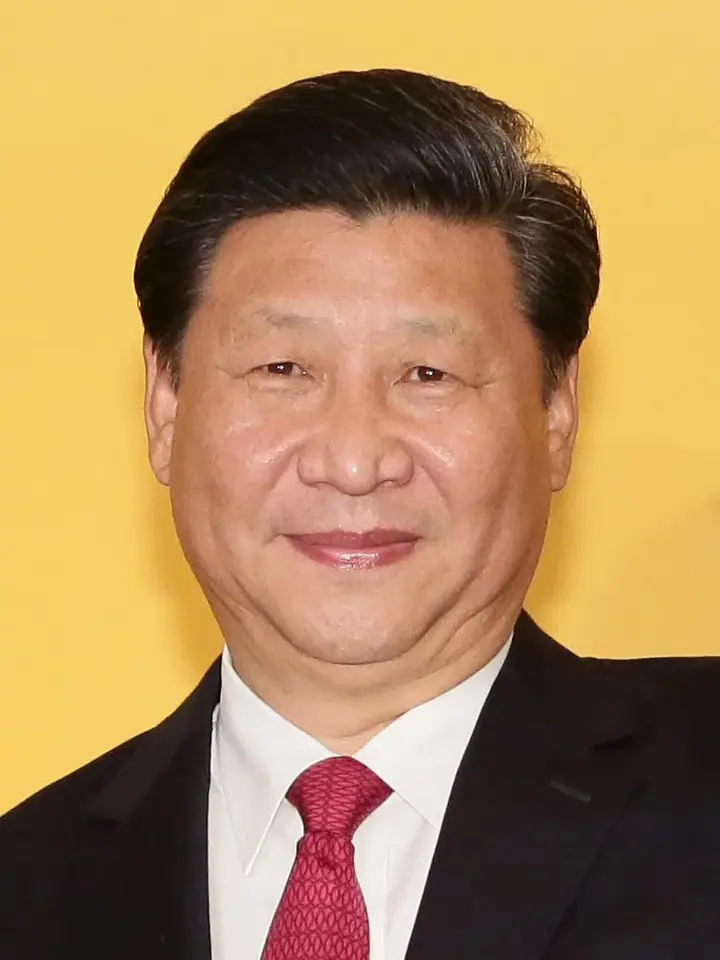 Ma Chu (楚)
Founding Monarch of Southern Chu (南楚开国君主)
Ma Yin (马殷, 852–930), courtesy name Batu, was a native of Yanling in Xu Prefecture (modern Yanling, Henan Province) and the founding monarch of Southern Chu (reigned 896–930) during the Five Dynasties and Ten Kingdoms period, posthumously honored as King Wumu. Born into a modest family and initially employed as a carpenter, he joined the military amid the turbulent late Tang rebellions. He served under warlords Qin Zongquan and Sun Ru before marching south with Liu Jianfeng into Jiangnan, eventually securing control of Tanzhou. Following Liu Jianfeng's assassination in 896, Ma Yin was unanimously acclaimed as commander by the troops. Through consecutive military campaigns, he subdued rival regional warlords, unified Hunan, and absorbed several prefectures in Lingnan. In 907, he was invested as King of Chu by Later Liang, and in 927 received the grand investiture of King of Chu State from Later Tang. During his thirty-four-year reign, Ma Yin strictly maintained a national policy of honoring the central court while nurturing the local population, avoiding external expansion and ensuring peace across his realm. He relied heavily on strategist Gao Yu to execute astute economic reforms, including the minting of lead and iron currency to insulate the local monetary economy, actively encouraging tea cultivation and foreign trade, and establishing a monopoly on Xie salt transport. These policies transformed previously impoverished Hunan into one of the most affluent commercial hubs of Jiangnan. Emulating Emperor Taizong of Tang, he established the Tiance Mansion and appointed eighteen scholars, welcoming prominent literati fleeing the northern chaos and laying enduring foundations for regional scholarship and administration.
 Ma Chu (楚)
Third ruler of the Southern Chu Kingdom
Ma Xifan (马希范, 899–May 30, 947), courtesy name Baogui (宝规), was a native of Yanling, Xuzhou (许州鄢陵, present-day Yanling County, Henan Province), born in Changsha, Tanzhou. He reigned for sixteen years (932–947) as the third ruler of the Southern Chu Kingdom during the Five Dynasties and Ten Kingdoms period, remembered by the posthumous title King Wenzhao. Ma Xifan was the fourth son of Ma Yin, the founding King Wumu of Chu. Serving initially as Military Commissioner of Zhennan at Langzhou, he succeeded to the Chu throne in 932 following the death of his older brother Ma Xisheng, adhering to Ma Yin's dynastic principle of fraternal succession. In the early phase of his reign, Ma achieved major military and administrative successes. Confronted with a dangerous tribal uprising in 939 led by Xizhou Prefect Peng Shichou, Ma mobilized elite forces to crush the rebel strongholds and concluded the famous Xizhou Covenant in 940, casting the five-thousand-pound Bronze Pillar of Xizhou at Huixiping to establish long-term peace across western Hunan. He maintained diplomatic vassalage to the northern Later Tang and Later Jin dynasties, being invested as Supreme General of Tiance and King of Chu, while successfully repelling border incursions from the Southern Han kingdom. In the latter half of his reign, however, Ma Xifan succumbed to extreme extravagance, megalomania, and fiscal exhaustion. He constructed dozens of lavish pleasure palaces, most notably the Nine Dragons Hall, which was framed with rare agalloch eaglewood timber and coated with massive gold and silver plates. To finance these exorbitant expenditures, he imposed oppressive commercial levies, sold bureaucratic titles, and impoverished ordinary households. Within the royal household, he treated his siblings with paranoia, driving his brother Ma Xiwang to death in confinement. Upon his death in 947, he bypassed his eldest surviving brother Ma Xie to pass the crown to his maternal younger brother Ma Xiguang, igniting the fratricidal civil war known as the Contention of the Steeds that directly led to the conquest of Southern Chu by the Southern Tang kingdom.