Confucian Studies and Retreat to Tianzhu
Mastered the Five Classics and astrology in his youth; foreseeing dynastic collapse, he withdrew to Mount Tianzhu to practice Daoist arts.
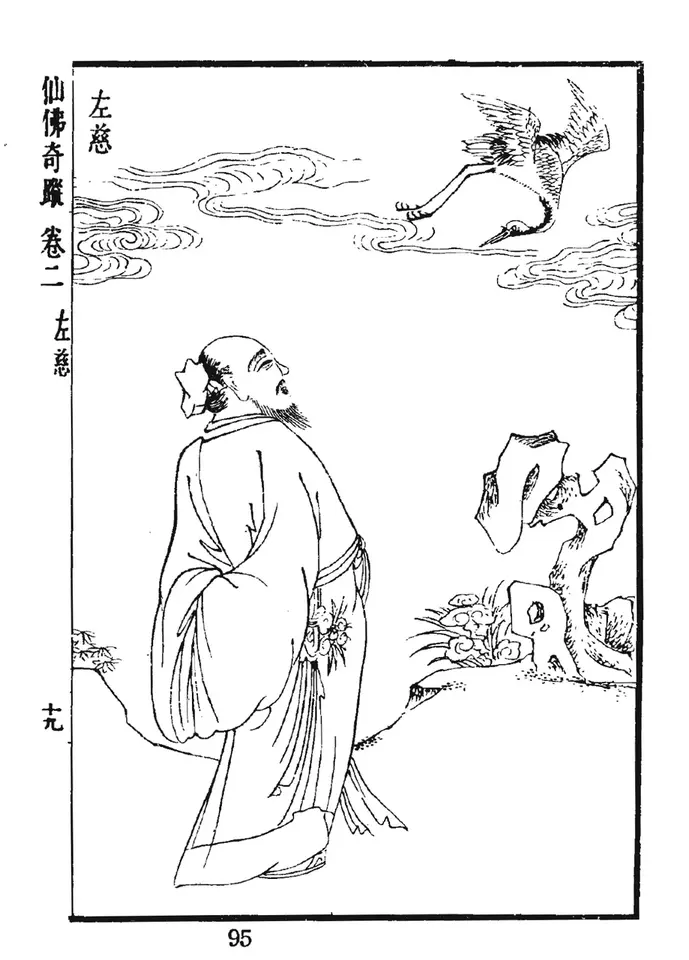
左慈
Zuo Ci (左慈, birth and death dates unrecorded in standard histories), courtesy name Yuanfang, styled Master Wujiao (Master Black Horn), was a native of Lujiang Commandery in Yangzhou during the late Eastern Han dynasty. He was a preeminent figure among early Daoist fangshi (masters of esoteric arts and alchemy) and a founding patriarch of the Golden Elixir (Jindan) tradition. In his youth, Zuo Ci was thoroughly educated in the…
Zuo Ci (左慈, birth and death dates unrecorded in standard histories), courtesy name Yuanfang, styled Master Wujiao (Master Black Horn), was a native of Lujiang Commandery in Yangzhou during the late Eastern Han dynasty. He was a preeminent figure among early Daoist fangshi (masters of esoteric arts and alchemy) and a founding patriarch of the Golden Elixir (Jindan) tradition. In his youth, Zuo Ci was thoroughly educated in the Confucian Five Classics, including the Book of Songs and Book of Documents, while mastering astrology, the calendar, and Qimen Dunjia divination. Observing the catastrophic breakdown of dynastic order and the bloody conflicts among rival warlords at the end of the Han dynasty, he resolved that political rank and worldly riches were transient hazards, retreating into the seclusion of Mount Tianzhu (Mount Qianshan) and Mount Gezao to pursue Daoist cultivation, longevity arts, and grain abstinence (bigu). According to tradition, he received sacred alchemical manuals including the Grand Clarity Scripture of Elixirs and the Nine Cauldrons Scripture of Elixirs in ancient cavern shrines. During the Jian'an era, warlord Cao Cao systematically gathered renowned esoteric practitioners to his court in Ye to prevent them from inciting rebellion among the populace. Suspecting Zuo Ci's claims of fasting to be subversive deception, Cao Cao had him locked in a secure stone chamber without food or water for an entire year. To the astonishment of the court, Zuo Ci emerged with unblemished health and youthful vigor. Standard dynastic records in the Book of the Later Han and contemporary memoirs detailed numerous celebrated legends of Zuo Ci confounding Cao Cao at public banquets—angling for live Songjiang perch from a bronze water basin, retrieving fresh ginger instantly from distant Shu, dividing wine with a hairpin, and dissolving into walls or transforming into a ram to evade pursuit. Beyond his legendary folklore persona, Zuo Ci occupies an indispensable place in the intellectual history of Chinese Daoism and alchemy. Traveling south through Jingzhou and Jiangnan, he transmitted three volumes of the Grand Clarity Scripture of Elixirs along with the Nine Cauldrons Scripture and Golden Liquid Scripture to his primary disciple, Ge Xuan (the Immortal Ge). Ge Xuan transmitted these teachings to Zheng Yin, who in turn passed them to the great Jin dynasty Daoist master Ge Hong, establishing the definitive lineage of southern alchemical Daoism that shaped Six Dynasties religion. Synthesizing internal breathing, sexual cultivation, and external alchemy, Zuo Ci's defiance of mortal tyrants was later immortalized in Luo Guanzhong's classic novel Romance of the Three Kingdoms, establishing him as one of the most iconic and rebellious wizard figures in Chinese culture.
Mastered the Five Classics and astrology in his youth; foreseeing dynastic collapse, he withdrew to Mount Tianzhu to practice Daoist arts.
Fasted in mountain grottos, reputedly discovering the Nine Cauldrons and Golden Liquid scriptures; styled Master Wujiao.
Summoned by Cao Cao to Ye and locked in a sealed stone room without sustenance for twelve months; emerged completely unharmed.
Conjured live Songjiang perch and Shu ginger during a royal banquet; escaped execution by walking into walls and transforming among sheep.
Traveled south to visit Governor Liu Biao, miraculously feeding and intoxicating ten thousand troops from a single flask of wine.
Imparted the Grand Clarity and Nine Cauldrons alchemical scriptures to Ge Xuan in Jiangnan, establishing the southern alchemical lineage.
Retired to Mount Huoshan (Tianzhu) to refine the nine-cycle golden elixir; historical traditions record his corpse-free deliverance as an immortal.
Zuo Ci was a native of Lujiang Commandery (with its commandery seat around modern Qianshan, Anhui Province) during the late Eastern Han dynasty. Situated at the junction of the Huai River plain and the rugged Dabie Mountains, Lujiang boasted Mount Tianzhu (anciently revered as Mount Huoshan and the Southern Sacred Peak), a renowned spiritual sanctuary for hermits and fangshi since antiquity.
Gifted with exceptional intellect, Zuo Ci received a rigorous Confucian education in his youth, studying the Book of Songs, Book of Documents, and Book of Changes. He acquired profound expertise in celestial astrology, calendar computation, five-phase numerology, and the esoteric art of Qimen Dunjia. However, during the Zhongping era of Emperor Ling, the Yellow Turban Rebellion erupted across northern and central China, followed by the tyranny of Dong Zhuo in Luoyang and ruthless warfare among regional warlords.
Observing the alignment of the stars, Zuo Ci perceived that the mandate of the Han imperial house was crumbling and that catastrophic devastation was inevitable. He sighed deeply, remarking: "In times of great chaos, high offices make personal preservation hardest, while vast wealth invites premature doom. The fleeting glory and luxury of the mortal world are lethal poisons, never to be coveted!"
Consequently, Zuo Ci rejected imperial summons from local officials, renounced his secular family property, and ventured alone into the deep forests of Mount Tianzhu. Building a thatched hermitage beside rushing mountain streams, he gathered medicinal herbs, practiced bigu (abstinence from grain), and engaged in embryonic breathing, absorbing cosmic qi at dawn. Dressing his head in a simple black cloth scarf, he became known across the region as Master Wujiao (Master Black Horn).
During his reclusive cultivation in the Qianshan range, Zuo Ci pursued advanced methods of physical and spiritual transcendence. According to ancient Daoist records preserved in Tao Hongjing's Declarations of the Perfected and Ge Hong's Inner Chapters of Baopuzi, Zuo Ci expanded his focus from dietary austerity to the profound mysteries of laboratory alchemy.
In the early Jian'an era, learning that the sacred caverns of Mount Juqu (Mount Maoshan) in Jiangnan communicated through subterranean passages with Mount Emei and Mount Luofu, Zuo Ci traveled south. He undertook a rigorous three-month ritual purification before ascending the mountain. In a concealed grotto, he received ancient alchemical manuals: three volumes of the Grand Clarity Scripture of Elixirs, one volume of the Nine Cauldrons Scripture of Elixirs, and one volume of the Golden Liquid Scripture of Elixirs.
These texts systematically codified the operational procedures, ritual altars, and chemical proportions for sublimating cinnabar, mercury, realgar, and lead to produce elixirs of physical immortality. Returning to his stone grotto on Mount Tianzhu, Zuo Ci erected alchemical furnaces according to these classical scriptures. Through years of furnace experiments, he mastered proto-chemical metallurgical techniques alongside hypnotic illusion and physical concealment.
In his Biographies of Immortals, Ge Hong praised Zuo Ci's spiritual prowess: "Possessing divine arts in his youth, he could command spirits and ghosts, transform all manners of physical objects, master breath circulation and grain fasting, maintaining a youthful countenance despite advanced years." His mastery of bigu gave him exceptional lightness of body, while his elusive magic spread his fame across the Huai River basin and reached the warlords of the north.
Following his pacification of the northern warlords, Cao Cao assumed the chancellorship in 208 CE, taking the title King of Wei and establishing his administrative capital at Ye. Cao Cao was both fascinated by longevity techniques and intensely suspicious of religious charlatans, fearing that charismatic wanderers might incite popular rebellions. To neutralize this danger, Cao Cao adopted a policy of gathering all prominent esoteric masters—including Gan Shi, Zuo Ci, Xi Jian, and Dongguo Yannian—under close surveillance at Ye.
Upon Zuo Ci's arrival at court, Cao Cao viewed his claims of supernatural longevity with cynicism. Cao Cao reasoned that all mortals must consume grain to survive, and that Zuo Ci's boast of perpetual fasting was subversive fraud. To unmask him, Cao Cao ordered Zuo Ci imprisoned in a heavily guarded, windowless stone chamber. Armed soldiers patrolled the entrance night and day, forbidding the delivery of a single grain of rice or drop of water for an entire year.
Twelve months later, Cao Cao commanded the iron doors opened. To the shock of the court, Zuo Ci emerged with glowing, youthful skin, radiant energy, and steady gait, entirely unchanged by his year of sensory deprivation and starvation. Astonished and alarmed, the paranoid Cao Cao concluded that a man who could survive twelve months without sustenance possessed unnatural powers that posed an unacceptable threat to the state, secretly resolving to execute him.
Sensing Cao Cao's hidden murderous intent, Zuo Ci engaged the warlord in a legendary battle of wits during public state gatherings.
As formally documented in the Book of the Later Han, Cao Cao hosted a lavish banquet for high officials at the Bronze Sparrow Terrace in Ye. Surveying the feast, Cao Cao lamented: "Today our assembly is complete, and delicacies of earth and mountain abound, yet we lack a dish of raw fish mince made from the perch of the Songjiang River in Wu." Seated among the guests, Zuo Ci replied with a smile: "That is easily obtained." Zuo Ci requested a large bronze basin filled with water, baited a slender bamboo rod with a hook, and cast his line into the basin. Within moments, he jerked the rod, hauling out a three-foot-long, thrashing fresh Songjiang perch.
Cao Cao clapped in surprise, then challenged him: "A single fish cannot satisfy my hundreds of guests; two would be ideal." Zuo Ci cast his line again, promptly pulling out another giant, plump perch. Cao Cao ordered the fish prepared and distributed to the assembly. Cao Cao then remarked: "Now we have perch, but unfortunately lack ginger from the Shu commanderies to flavor it." Zuo Ci answered: "That too is trivial." Fearing he would purchase ginger locally, Cao Cao cautioned: "I previously sent an envoy to Chengdu to purchase Shu brocade; if you go there, instruct him to buy an extra two bolts." Zuo Ci departed, returning in less than the time required for a meal with fresh, aromatic Sichuan ginger. He informed Cao Cao: "I met your commissioner in the Chengdu silk shop and instructed him to purchase two additional bolts." Over a year later, the commissioner returned to Ye with the extra brocade, confirming to Cao Cao that on that exact day, a Daoist had conveyed the king's command in the Chengdu marketplace.
Cao Cao's dread and hostility grew rapidly. Shortly afterward, Cao Cao rode into the countryside with over a hundred officials, and Zuo Ci approached with a single jar of wine and a small strip of dried meat. Zuo Ci personally poured wine and carved dried meat for the entire entourage; every officer drank to intoxication and ate their fill. Baffled, Cao Cao sent agents into Ye, discovering that all commercial wine and dried meat in the city's taverns had vanished overnight.
Furious at this public insolence, Cao Cao ordered his guards to seize and execute Zuo Ci on the spot. As armored soldiers charged the banquet hall, Zuo Ci stepped backward into the solid brick wall, vanishing into thin air. Cao Cao placed a bounty on his head. When citizens spotted him in the crowded marketplace, the entire crowd of hundreds of onlookers suddenly assumed Zuo Ci's exact likeness, making arrest impossible.
Later, search parties spotted Zuo Ci atop Mount Yangcheng in Henan, pursuing him toward a pasture where he vanished into a flock of hundreds of grazing sheep. Unable to locate him, the pursuers shouted under Cao Cao's instructions: "The King of Wei will not harm the master! He merely wished to test your divine arts and desires an audience in friendship." Hearing this, an old ram knelt on its front forelegs, stood upright like a human, and uttered: "Why must you all be in such a frantic hurry!" The soldiers cried: "This ram is Zuo Ci!" and lunged forward, but instantly all several hundred rams in the flock knelt upon their forelegs, stood upright, and chanted in unison: "Why must you all be in such a frantic hurry!" leaving the soldiers empty-handed and bewildered.
Having broken free from Cao Cao's grip, Zuo Ci journeyed south to seek refuge in Jingzhou. The regional governor, Liu Biao, suspicious of reports that Zuo Ci was an illusionist who deceived the masses, plotted to capture and behead him.
Perceiving Liu Biao's hostile intent, Zuo Ci approached the governor as he was parading tens of thousands of armored troops outside Xiangyang to display his military strength. Zuo Ci bowed courteously before the commander's tent, saying: "Seeing Your Excellency's soldiers laboring in the field, this humble Daoist has brought modest provisions to feast your troops." Liu Biao scoffed: "You are a solitary wanderer, while my army counts tens of thousands; how can your meager gifts suffice?"
Zuo Ci presented a single small jug of wine and a tiny package of dried meat. Liu Biao's guards attempted to lift the gifts, but ten muscular warriors could not budge the tiny parcel from the earth. Zuo Ci stepped forward, casually picked up the meat, carved it into paper-thin slices, and instructed soldiers to distribute them with cups of wine. Miraculously, all ten thousand troops and one thousand aristocratic guests consumed three full cups and savory meat, feasting to absolute repletion; yet the jug remained full and the meat undiminished. Stunned by this divine display, Liu Biao abandoned all thoughts of execution, treating Zuo Ci with profound deference.
Recognizing that Liu Biao was a passive warlord incapable of greatness, Zuo Ci crossed the Yangtze River into Eastern Wu. In Jiangnan, he accepted the exceptionally gifted young noble Ge Xuan (later celebrated as Immortal Ge) as his close disciple. Zuo Ci transmitted his complete alchemical archive—including three scrolls of the Grand Clarity Scripture of Elixirs, the Nine Cauldrons Scripture, and the Golden Liquid Scripture—instructing Ge Xuan that these celestial methods must only be passed to individuals of pure virtue.
Ge Xuan mastered the teachings and later transmitted them to Confucian scholar Zheng Yin, who in his old age bequeathed them to his nephew Ge Hong. Ge Hong consolidated these texts into the Inner Chapters of Baopuzi, creating the definitive foundation of medieval Chinese laboratory alchemy and religious medicine.
During the reign of Sun Quan in Eastern Wu, having fulfilled his spiritual transmission, Zuo Ci bade farewell to Ge Xuan and retired permanently to Mount Tianzhu (Mount Huoshan). According to the Biographies of Immortals, after years of refining the nine-cycle divine elixir, Zuo Ci achieved corpse-free deliverance, ascending into the heavens as a transcendent immortal. Blending esoteric illusion with philosophical defiance, Zuo Ci remains a towering milestone in the history of Daoism and the folklore of the Three Kingdoms.
Zuo Ci retreated to Mount Tianzhu and Mount Juqu, uncovering ancient scriptures including the Grand Clarity and Nine Cauldrons alchemical texts.
He transmitted this core corpus to Ge Xuan, providing the direct textual and experimental foundation upon which Ge Hong constructed the Golden Elixir philosophy of Baopuzi.
Summoned to the court of Cao Cao, Zuo Ci underwent strict solitary confinement in a sealed stone room without sustenance for twelve months.
His emergence in perfect health provided the most famous empirical demonstration of grain abstinence (bigu) in official dynastic history and Daoist literature.
At royal banquets in Ye, Zuo Ci demonstrated legendary feats—angling for Songjiang perch, procuring Sichuan ginger, and dissolving into flocks of rams.
His encounters with Cao Cao symbolized the witty resistance of Daoist masters against tyrannical political authority, inspiring popular folklore for centuries.
In Jingzhou, Zuo Ci miraculously fed ten thousand troops with a single flask of wine and dried meat, neutralizing Governor Liu Biao's hostility.
Crossing the Yangtze into Jiangnan, he bridged northern and southern esoteric traditions, establishing a profound cultural footprint across Six Dynasties China.
FIGURES ASSOCIATED WITH THIS DYNASTY