Born in Fanyang
Born into a distinguished aristocratic family in Qiu County, Zu Ti was generous, unrestrained, and dedicated to extensive classical and historical studies.
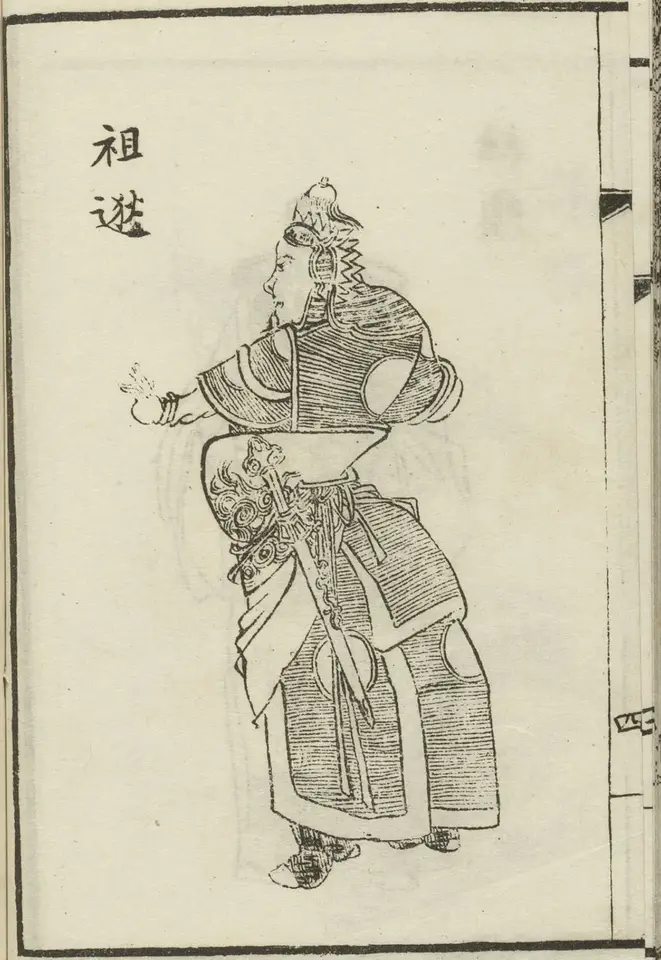
祖逖
Zu Ti (祖逖, 266–321), courtesy name Shiya, was a native of Qiu County, Fanyang Commandery, and an illustrious patriotic general and commander-in-chief of the Northern Expeditions during the Eastern Jin Dynasty. Born into a prominent aristocratic clan of northern China, he formed a deep friendship in his youth with Liu Kun, famously rising at midnight to practice swordsmanship upon hearing the cock crow. When northern China…
Zu Ti (祖逖, 266–321), courtesy name Shiya, was a native of Qiu County, Fanyang Commandery, and an illustrious patriotic general and commander-in-chief of the Northern Expeditions during the Eastern Jin Dynasty. Born into a prominent aristocratic clan of northern China, he formed a deep friendship in his youth with Liu Kun, famously rising at midnight to practice swordsmanship upon hearing the cock crow. When northern China descended into chaotic warfare at the end of the Western Jin, Zu Ti led hundreds of refugee families southward across the Huai and Yangzi rivers, walking on foot and sharing his rations with the sick and elderly. In 313, he submitted strategic memorials urging the imperial court to recover the lost Central Plains, leading his private troops across the Yangzi River from Jingkou and striking his oar midstream to swear an oath of reconquest. Despite meager logistical support from an indifferent imperial court, Zu Ti forged weapons, subdued local warlords, fortified Qiaocheng, and deployed brilliant stratagems to rout the formidable armies of Later Zhao rulers Shi Le and Shi Hu, successfully liberating vast territories south of the Yellow River. His benevolence, agricultural rehabilitation, and upright governance earned him immense civilian devotion, while his martial prestige maintained regional balance until his untimely death from grief at Yongqiu amid rising court factionalism.
Born into a distinguished aristocratic family in Qiu County, Zu Ti was generous, unrestrained, and dedicated to extensive classical and historical studies.
Declined local appointments to serve as Executive Assistant in Sizhou, sharing quarters with Liu Kun and rising at cockcrow to practice swordsmanship.
During the War of the Eight Princes, he served sequentially under Sima Jiong, Sima Yi, and Sima Chi in various military and administrative secretariats.
Accompanied Sima Yue in the campaign against Sima Ying; after defeat at Dangyin, he returned to Luoyang and later observed filial mourning for his mother.
Following the catastrophic fall of Luoyang, he led hundreds of clan and village families southward, being chosen as their travel leader, and was appointed Inspector of Xuzhou at Sikou.
Petitioned Sima Rui for a northern campaign; granted the titles General of Inspiring Might and Inspector of Yu Province, he crossed the Yangzi River and vowed to liberate the Central Plains.
Advanced to Luzhou and Qiaocheng, executing the rebellious local strongman Zhang Ping through a stratagem and pacifying Fan Ya to secure the gateway to Yuzhou.
Campaigned against the turncoat Chen Chuan and decisively defeated Shi Hu's relieving army of fifty thousand troops in Henan.
Used the famous sandbag ruse to break Tao Bao's morale at Pengpi Fortress, liberating most territories south of the Yellow River and rising to General Who Calms the West.
Stricken by grief over court suspicions, the dispatch of Dai Yuan to curtail his authority, and impending rebellion by Wang Dun, he died of illness at Yongqiu at age fifty-six.
Zu Ti was born into the prestigious Zu clan of Fanyang Commandery, a northern lineage whose ancestors had continuously held high-ranking offices with two-thousand-bushel salaries. In his youth, Zu Ti exhibited a magnanimous, open-hearted temperament, paying little heed to petty formalities while prioritizing moral duty and righteousness. He frequently distributed family assets to aid impoverished relatives and neighbors, earning high esteem throughout his home region. As he matured, he applied himself earnestly to scholarly pursuits, mastering classical texts and historical chronicles with aspirations to bring order and peace to the realm.
In 289, while residing in Yangping Commandery, Zu Ti was recommended as Filial and Incorrupt by the commandery and subsequently as a Promoted Scholar by the Director of Retainers, but he declined both nominations. Soon after, he accepted an appointment as Executive Assistant in Sizhou, where he served alongside the equally ambitious Liu Kun. The two formed a profound intellectual and personal bond, frequently discussing state affairs late into the night. On one occasion, hearing a rooster crow in the dead of night, Zu Ti awoke Liu Kun, remarking that the sound was a heaven-sent summons to duty rather than an ill omen; both men arose, drew their swords, and practiced martial arts beneath the stars, giving rise to the famous Chinese idiom "dancing at cockcrow" (wenji qiwu).
In 291, the devastating War of the Eight Princes erupted within the Western Jin ruling house, shattering the foundations of imperial authority. Recognizing Zu Ti's talents, multiple imperial princes sought his services; he served sequentially under Sima Jiong the Prince of Qi, Sima Yi the Prince of Changsha, and Sima Chi the Prince of Yuzhang, occupying posts such as Senior Administrator, Libationer, and Household Provisioner to the Crown Prince. In 304, Zu Ti accompanied Sima Yue the Prince of Donghai on a campaign against Sima Ying the Prince of Chengdu, but the imperial army suffered a crushing defeat at Dangyin, forcing Zu Ti to flee back to Luoyang. Following this disaster, several imperial princes attempted to recruit him, but he declined their summons. He was appointed Administrator of Jiyin, but the death of his mother intervened, and he retired from public office to complete the requisite mourning rites.
In 311, troops of the Han-Zhao state sacked Luoyang, capturing Emperor Huai and plunging northern China into chaos. Zu Ti promptly organized hundreds of clan members and regional families to flee southward toward the Huai River basin. During this arduous journey, Zu Ti walked on foot while yielding his family carts and horses to the elderly, the sick, and the infirm, generously sharing his own provisions and medicines with destitute refugees. Demonstrating unflinching composure in the face of bandit ambushes and harsh terrain, he was unanimously chosen as leader of the migrant host. Upon arriving at Sikou (modern Xuzhou, Jiangsu), he was welcomed by Sima Rui, the Prince of Langya who governed Jiangnan, and appointed Inspector of Xuzhou, subsequently serving as Military Libationer stationed at Jingkou (modern Zhenjiang).
In 313, Emperor Min ascended the throne in Chang'an and ordered Sima Rui to dispatch troops to relieve the old capitals. However, Sima Rui and the emigrant southern aristocracy were absorbed in consolidating territorial power in Jiangnan, showing little genuine interest in recovering the north. Recognizing that the northern populace suffered severely under foreign rule and yearned for liberation, Zu Ti remonstrated forcefully with Sima Rui, arguing that the collapse of the Jin house resulted from princely infighting rather than popular rebellion. He insisted that if capable commanders were deployed northward, regional loyalists and local leaders across the Central Plains would rally in support.
Sima Rui, unwilling to openly reject an imperial appeal for national restoration, granted Zu Ti the title General of Inspiring Might and Inspector of Yu Province, yet provided merely one thousand rations and three thousand bolts of cloth, furnishing neither armored gear nor forged weaponry. Undeterred by the court's indifference, Zu Ti led more than one hundred families of his loyal followers across the Yangzi River from Jingkou. Reaching the middle of the river, Zu Ti struck his oar against the current and swore a solemn oath: "If Zu Ti cannot clear the Central Plains and recover our homeland, may my life vanish like this rushing river!" Landing on the northern bank, he encamped at Huaiyin, established iron-forging kilns to manufacture weapons, recruited displaced patriots, and quickly assembled a disciplined fighting force of two thousand soldiers.
At that time, the border regions of Henan and Anhui were dominated by fortified garrisons (wubao) held by autonomous local warlords. Magnates such as Zhang Ping and Fan Ya controlled thousands of armed men in Qiaocheng, formally accepting imperial appointments while maintaining de facto independence. In 317, Zu Ti advanced to Luzhou and sent his staff officer Yin Yi to negotiate submission. However, Yin Yi's haughty demeanor provoked Zhang Ping to execute him and offer armed resistance. Unable to breach the fortress immediately, Zu Ti devised a stratagem that induced Zhang Ping's lieutenant Xie Fu to assassinate Zhang Ping and surrender. Shortly afterward, Fan Ya launched a nocturnal assault on Zu Ti's main encampment, but Zu Ti maintained resolute command, personally counterattacking and securing Qiaocheng, thereby opening the vital offensive corridor into Yuzhou.
In 318, Sima Rui formally declared himself Emperor Yuan of Eastern Jin at Jiankang. Meanwhile, the power of Later Zhao ruler Shi Le expanded across northern China, and in 319, Shi Hu led fifty thousand elite cavalry southward to relieve the besieged warlord Chen Chuan. Zu Ti intercepted and routed Shi Hu's force in Henan, throwing Later Zhao troops onto the defensive. In 320, Zu Ti dispatched his general Han Qian to seize the eastern bastion of Pengpi Fortress, confronting Later Zhao veteran commander Tao Bao for over forty days. Zu Ti instructed his troops to fill hundreds of cloth bags with yellow sand to feign surplus sacks of grain, while intentionally letting a few genuinely loaded carts be captured by enemy scouts. Fooled into believing Jin forces were abundantly supplied, Later Zhao troops lost heart. Zu Ti then laid an ambush along the Bian River, capturing Later Zhao's grain convoys and compelling Tao Bao to flee under cover of night, thereby bringing the vast majority of territories south of the Yellow River back under Jin authority.
Having liberated Henan, Zu Ti governed with prudence, encouraging agriculture, supervising sericulture, clearing abandoned fields, and prohibiting soldiers from plundering civilian communities. He rewarded meritorious warriors generously, while adopting an astute, conciliatory policy toward border garrison leaders who had been forced to submit nominally to Later Zhao. Zu Ti permitted them to feign loyalty to Shi Le and occasionally staged simulated raids on their walls to shield them from northern retribution. In return, these fortresses provided the Jin army with timely intelligence, granting Zu Ti constant battlefield initiative. Acknowledging Zu Ti's formidable prowess, Shi Le refrained from further southern incursions, dispatched envoys to repair the ancestral tomb of Zu Ti's mother at Chenggao, and proposed bilateral border markets, which Zu Ti permitted to enrich his logistics and acquire northern warhorses.
However, Zu Ti's remarkable military triumphs provoked deep jealousy and apprehension among high-ranking nobles and Emperor Yuan in Jiankang. In 321, seeking to curb and divide Zu Ti's authority, Emperor Yuan appointed his court confidant Dai Yuan as General Who Conquers the West and Commander of Military Affairs in Six Provinces, stationed at Hefei. Zu Ti was profoundly distressed to see his hard-won gains subjected to an incompetent overseer, and rumors soon reached him that powerful warlord Wang Dun was preparing an armed rebellion against the capital. Realizing that domestic factional conflict would dismantle a decade of northern recovery, Zu Ti succumbed to severe emotional grief and fell gravely ill. Even in sickness, he supervised the fortification of Hulao Pass to guard against northern cavalry incursions. Before the defensive walls could be completed, Zu Ti passed away in his military camp at Yongqiu at the age of fifty-six.
At a catastrophic historical juncture when the Western Jin collapsed and the northern heartland fell under foreign conquest, Zu Ti undertook the monumental responsibility of military restoration. Despite receiving no weapons and provisions for merely one thousand men from the southern court, he relied on personal prestige and organizational genius to smelt iron, forge armaments, and assemble a disciplined strike force in Huaiyin. His heroic act of striking his oar midstream inspired countless displaced Han Chinese refugees with the determination to liberate their ancestral homes.
Advancing into Henan, Zu Ti employed a sophisticated blend of diplomacy and military pressure to dismantle fragmented local garrisons. He successfully neutralized Zhang Ping and Fan Ya, endured severe logistical scarcity to garrison Qiaocheng, and pressed relentlessly northward. Over years of hard campaigning, he repeatedly repulsed massive counteroffensives by Shi Hu's elite cavalry, extending Eastern Jin's frontier from the Huai River to the banks of the Yellow River and reversing the prolonged cycle of retreat that followed the Yongjia Disaster.
In combat against Later Zhao, Zu Ti demonstrated consummate operational and tactical acumen. During the 320 confrontation at Pengpi Fortress against Tao Bao, when both forces faced acute food shortages, Zu Ti executed a brilliant psychological campaign. By transporting hundreds of sand-filled sacks disguised as polished rice and deliberately abandoning grain carts in front of enemy scouts, he induced the Later Zhao garrison to believe Jin forces enjoyed endless provisions, completely demoralizing the enemy. An ambush at the Bian River waterways severed Later Zhao's true supply lines, compelling Tao Bao to abandon his bastion overnight.
Toward border garrisons caught between hostile powers, Zu Ti showed remarkable political subtlety. Sympathizing with local chieftains forced to surrender hostages to Later Zhao, he permitted them to maintain superficial allegiance to Shi Le and orchestrated sham skirmishes against their outposts to protect them from northern suspicion. Deeply touched by his benevolence, these garrisons covertly served as intelligence outposts for Zu Ti, ensuring that Jin armies retained complete situational awareness in every major engagement.
Zu Ti recognized that true national recovery required civil stabilization and economic revitalization alongside military triumph. Upon securing Henan, he instituted light taxes, prohibited troops from seizing civilian goods, promoted agricultural farming, and established military agricultural colonies (tuntian) to achieve self-sufficiency. Deeply moved by the devastation of war that had left skeletons scattered across the plains, Zu Ti personally ordered all exposed remains to be gathered, buried, and ritually honored.
Zu Ti led an austere personal life, accumulating no private fortune and sharing all imperial gifts and official salaries with his troops and destitute civilians. During a regional banquet in Yuzhou where local elders wept tears of joy and praised him as their reborn parent, Zu Ti composed impromptu songs and danced alongside the gathered villagers. Under his enlightened governance, the ravaged landscapes of Henan revived swiftly, drawing back thousands of displaced households to resume peaceful agricultural lives.
The formidable military power and peerless moral prestige cultivated by Zu Ti in the north served as an indispensable deterrent safeguarding the fragile Eastern Jin court at Jiankang. Warlord Wang Dun, who commanded massive military forces in the upper Yangzi and harbored treasonous ambitions, once sent messengers to test reactions throughout the empire. Zu Ti fiercely denounced the emissary, warning that if Wang Dun dared commit treason, Zu Ti would immediately march his veteran northern legions southward to crush him, effectively forestalling Wang Dun's rebellion for years.
Only after Zu Ti's sudden death at Yongqiu did Wang Dun openly celebrate the removal of the only military commander capable of opposing him, promptly launching his rebellion against the capital. Later historians universally lauded Zu Ti not only as a peerless commander on the northern battlefield, but also as an indispensable bulwark whose personal authority preserved the precarious survival of the Eastern Jin dynasty.
FIGURES ASSOCIATED WITH THIS DYNASTY