Birth in Sichuan
Born on the southern bank of Ba County, Chongqing, exhibiting precocious intelligence and disdain for rigid orthodoxy.
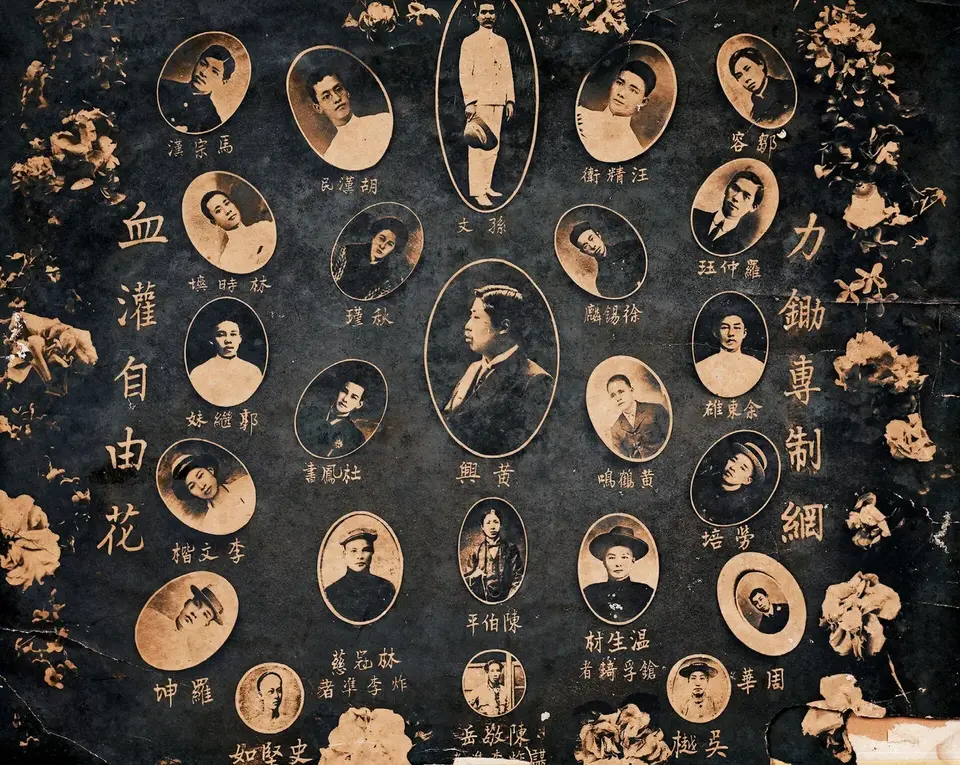
邹容
Zou Rong (1885–1905), originally named Shaotao, courtesy name Weidan, was a native of Ba County, Chongqing Prefecture, Sichuan Province, and a renowned democratic revolutionary thinker, propagandist, and martyr of the late Qing dynasty. In his youth, he traveled to Japan to study, absorbing Western Enlightenment philosophies from Jean-Jacques Rousseau and Montesquieu, actively engaging in student anti-Qing patriotic…
Zou Rong (1885–1905), originally named Shaotao, courtesy name Weidan, was a native of Ba County, Chongqing Prefecture, Sichuan Province, and a renowned democratic revolutionary thinker, propagandist, and martyr of the late Qing dynasty. In his youth, he traveled to Japan to study, absorbing Western Enlightenment philosophies from Jean-Jacques Rousseau and Montesquieu, actively engaging in student anti-Qing patriotic activities. Returning to Shanghai in 1903, he joined the Patriotic Learning Society and formed a close bond with Zhang Binglin (Zhang Taiyan). Styling himself "The Vanguard of the Revolutionary Army," he authored and published the twenty-thousand-word manifesto The Revolutionary Army, eloquently calling for the overthrow of Qing autocratic rule and the creation of an independent "Republic of China," which sparked the internationally publicized Subao Case. Zou surrendered voluntarily to the International Settlement police, enduring brutal imprisonment with unyielding defiance until dying in prison at age twenty. Following the founding of the Republic of China, Sun Yat-sen posthumously honored him as General of the Army, revered as an immortal pioneer of the 1911 Revolution.
Born on the southern bank of Ba County, Chongqing, exhibiting precocious intelligence and disdain for rigid orthodoxy.
Entered preliminary civil examinations; boycotted the test after clashing with the examiner over pedantic prompts.
Following the collapse of the Hundred Days' Reform, penned verses mourning Tan Sitong, vowing to pursue systemic reform.
Traveled to Chengdu for preparatory overseas examination, reading modern translated scientific and political texts.
Traveled to Japan at personal expense, enrolling in the Tokyo Dobun Shoin, identifying with Rousseau's philosophy.
Expelled from Japan after participating in an incident cutting off the queue of an imperial student supervisor.
Published The Revolutionary Army with a preface by Zhang Binglin, igniting nationwide revolutionary agitation.
Following Qing suppression of the newspaper Subao, Zou voluntarily surrendered to the International Settlement police.
Defended revolutionary principles before the Shanghai Mixed Court; sentenced to two years' imprisonment.
Died of severe illness and maltreatment in Tilanqiao Prison two months before completing his sentence, aged twenty.
In 1885 (the eleventh year of the Guangxu reign), Zou Rong was born into an affluent merchant household on the southern bank of the Yangtze River in Ba County, Chongqing Prefecture, Sichuan Province. His ancestors had originally hailed from Macheng in Hubei Province, migrating to Sichuan during the early Qing resettlement to engage in commerce. Zou's father, Zou Zifan, was a prosperous silk and textile merchant.
Zou was intellectually precocious and fiercely independent from early childhood. In 1891, at age six, he entered a private family academy alongside his elder brother Zou Yundan. Endowed with a tenacious temperament, by age eleven he had mastered the Four Books and Five Classics, reciting ancient histories such as the Records of the Grand Historian and Book of Han with effortless ease. However, Zou despised the rigid eight-legged essay system and orthodox neo-Confucian moralizing, admiring instead loyal champions like Yue Fei, Wen Tianxiang, and ancient wandering knights.
In 1897, twelve-year-old Zou sat for the preliminary county civil service examinations under parental pressure. Observing that the examination prompts were pedantic fragments designed to suppress independent thought, he engaged in a furious public dispute with the chief examiner, castigating the examination system as destructive to human intellect, threw down his writing brush, and stormed out of the hall. Despite facing severe corporal punishment at home, he swore never again to submit to imperial examination servitude.
In 1898, the Hundred Days' Reform was crushed by conservative factions, and six reform martyrs, including Tan Sitong, were executed in Beijing. Thirteen-year-old Zou was deeply shaken, penning elegiac verses mourning Tan and pledging to carry forward the banner of transformation.
In 1901, the provincial government organized competitive examinations in Chengdu for Japanese study scholarships. Sixteen-year-old Zou journeyed to Chengdu, where he interacted with reformist intellectuals and read modern translations produced by the Jiangnan Arsenal along with Yan Fu's translation of Thomas Huxley's Evolution and Ethics. This intellectual encounter convinced him that China could achieve national salvation only by discarding monarchical autocracy in favor of modern constitutional governance.
In the spring of 1902, overcoming staunch family opposition, Zou traveled to Japan at personal expense, gaining admission to the Tokyo Dobun Shoin. In Tokyo, he immersed himself in translated European Enlightenment masterpieces, notably Rousseau's The Social Contract and Montesquieu's The Spirit of the Laws. Deeply affected by radical democratic thought, he joined Chinese student political circles. Delivering impassioned speeches at student assemblies, his rhetorical brilliance earned him renown as the foremost orator among young Chinese radicals in Tokyo.
In early 1903, Tsarist Russia reneged on treaty agreements to withdraw troops from northeastern China, attempting permanent occupation of Manchuria. Simultaneously, reports emerged that Guangxi Governor Wang Zhichun planned to employ French troops to suppress internal rebellion. Outraged Chinese students in Tokyo organized mass anti-Russian and anti-French patriotic rallies, with Zou marching at the vanguard.
Qing Minister to Japan Cai Jun and imperial student supervisor Yao Wenfu enacted repressive measures to monitor and report patriotic students to Beijing authorities. Infuriated by this betrayal, Zou, accompanied by comrades Zhang Ji and Liu Chengyu, forced his way into Yao's residence in March 1903. Restraining the supervisor, Zou drew shears and severed Yao's queue, the physical symbol of Qing subjugation, hanging the braid from the rafters of the Chinese Student Association Hall. The sensational event incensed the Qing legation, which pressured Japanese police to issue deportation orders against Zou and his companions.
In April 1903, Zou returned to China, arriving in Shanghai. At that moment, the Shanghai Patriotic Learning Society and the Chinese Educational Association served as epicenters of anti-imperial radicalism. Zou joined the society, earning the admiration of scholars Zhang Binglin (Zhang Taiyan), Cai Yuanpei, and Wu Zhihui. Despite an age difference of sixteen years, Zou and Zhang Taiyan developed an immediate, unbreakable revolutionary bond.
Witnessing the Qing court's subservience to foreign imperialist powers while brutally oppressing the populace, Zou channeled his political passion into writing. Working through sleepless nights, he synthesized his democratic ideals into a twenty-thousand-word manifesto titled The Revolutionary Army.
Signing the work as "The Vanguard of the Revolutionary Army," Zou opened his treatise with a stirring declaration: "Revolution is the universal law of evolution; revolution is the universal justice of the world!" He justified the moral imperative of dismantling imperial despotism and formulated an explicit constitutional blueprint for establishing an independent "Republic of China." Zhang Taiyan composed a passionate preface, hailing the manuscript as a world-shaking clarion call. In June 1903, The Revolutionary Army was printed by Shanghai's Datong Book Company. Simultaneously, editor Zhang Shizhao featured Zhang Taiyan's preface and excerpts from the book on the front page of Subao, igniting nationwide political agitation.
Terrified by this revolutionary storm, Empress Dowager Cixi and Liangjiang Governor-General Duanfang dispatched secret imperial arrest warrants, ordering that Zhang Taiyan and Zou Rong be seized and executed by slow slicing. Qing officials colluded with Shanghai International Settlement police to raid the Subao offices in late June, arresting Zhang Taiyan. Although Zou had been safely relocated to an underground sanctuary, upon learning that Zhang was imprisoned alone and that authorities threatened to round up innocent students, eighteen-year-old Zou chose martyrdom. On July 24, 1903, he walked into the settlement police station and surrendered voluntarily, displaying legendary courage.
Following the arrests, the Qing court pressured Western diplomats to extradite Zou and Zhang into imperial territory for secret execution. However, facing public outrage and defending jurisdictional sovereignty, foreign consuls refused extradition, requiring that the case be tried publicly before the Shanghai Mixed Court.
Throughout the hearings, Zou and Zhang mounted a defiant defense, transforming the courtroom into a national podium denouncing autocratic misrule and defending democratic liberty. Zou testified with composure that every sentence of The Revolutionary Army flowed from his conscience and that he welcomed death for the nation's awakening. In May 1904, the Mixed Court delivered its verdict, sentencing Zhang to three years' imprisonment and Zou to two years, followed by expulsion from the settlement.
Confined together within Tilanqiao Prison, Zhang and Zou exchanged verses expressing philosophical defiance. Zhang penned Presented to Zou Rong in Prison: "Zou Rong, my younger brother, let down your hair across the seas; with swift shears severed the braid, dried beef for rations; once a hero enters prison, heaven and earth grieve; facing death, clasp hands together." Zou responded in matching rhyme: "The knight's head has not yet fallen, a solitary bark in the nocturnal ravine; life and death are ordinary matters, merely a mayfly between heaven and earth!"
However, the dank, unhygienic conditions of the prison and intentional maltreatment by wardens broke Zou's physical health. In the spring of 1905, just two months shy of his scheduled release, he contracted severe pneumonia without medical care. In the late hours of April 3, 1905, Zou Rong passed away in prison at the age of twenty.
News of his martyrdom sparked nationwide grief. The Qing government forbade proper burial, attempting to discard his remains in the wilderness. Revolutionary poet Liu San (Liu Jiping), braving execution, bribed prison guards in disguise, retrieved Zou's body under cover of darkness, and secretly interred the young martyr on the rural banks of the Huangpu River in Huajing.
Zou Rong's supreme historical contribution was authoring The Revolutionary Army at age eighteen. This political treatise functioned not only as an explosive polemic against dynastic absolutism, but also as modern China's earliest systematic theoretical manifesto for establishing a democratic republican constitutional order.
In the book, Zou integrated Western Enlightenment principles of natural rights, freedom, equality, and fraternity with the pressing imperatives of national survival. Defining revolution from an evolutionary philosophical perspective, he proclaimed: "Sweep away thousands of years of despotic systems, cast off thousands of years of servile bonds, exterminate corrupt autocratic rulers, and wash clean centuries of humiliation, so that the Chinese mainland becomes clean earth and the descendants of the Yellow Emperor all become Washingtons!"
Crucially, Zou discarded the constitutional monarchist delusions championed by Kang Youwei and Liang Qichao, becoming the first Chinese theorist to formulate a concrete institutional framework for a "Republic of China." He stipulated that the post-dynastic state must be named the "Republic of China," governed through a national parliament and provincial assemblies, with equal civil rights for men and women, universal suffrage, freedom of speech and press, separation of powers, and judicial independence. This visionary blueprint anticipated the 1912 Provisional Constitution of the Republic of China by nine years. Published in hundreds of thousands of copies, The Revolutionary Army became the foundational political textbook of the 1911 Revolution.
The 1903 Subao Case in Shanghai marked a historic turning point in modern Chinese journalism, political thought, and jurisprudence, with Zou Rong and Zhang Taiyan serving as its intellectual core.
Supported by chief editor Zhang Shizhao, Subao published Zou's The Revolutionary Army alongside Zhang Taiyan's treatise Refuting Kang Youwei's Letter on Revolution, which openly denounced Emperor Guangxu by name. This unprecedented event marked the first time in imperial Chinese history that scholars publicly criticized the reigning emperor in the press, shattering the sacred taboo of monarchical infallibility.
Following imperial crackdowns, Zou's voluntary surrender elevated the crisis into an international cause. During the public Mixed Court proceedings, Zou dismantled imperial legal arguments through fearless testimony. The extensive press coverage across treaty ports and overseas communities propagated republican revolutionary ideals far beyond the reach of imperial censorship, decisively shifting Chinese intellectual sentiment from monarchical reform to armed republican revolution.
Beyond anti-monarchical agitation, The Revolutionary Army offered a profound critique of servile psychology nurtured under centuries of imperial absolutism. Zou insisted that national liberation required a thorough transformation of the Chinese collective consciousness to build independent citizens.
He argued that Chinese subjugation stemmed internally from submissive mentalities inculcated by authoritarian rulers. Consequently, he advocated popular educational enlightenment, the abolition of foot-binding and opium consumption, and universal equality between men and women.
Zou's youthful martyrdom transformed his life into an enduring national legend. Tens of thousands of patriotic youths carried copies of The Revolutionary Army into revolutionary insurrections. From the founding of the Tongmenghui and the Yellow Flower Mound Uprising to the gunfire of the Wuchang Uprising, revolutionaries marched beneath the constitutional vision that Zou had drafted, ultimately bringing two millennia of imperial monarchy to an end.
FIGURES ASSOCIATED WITH THIS DYNASTY