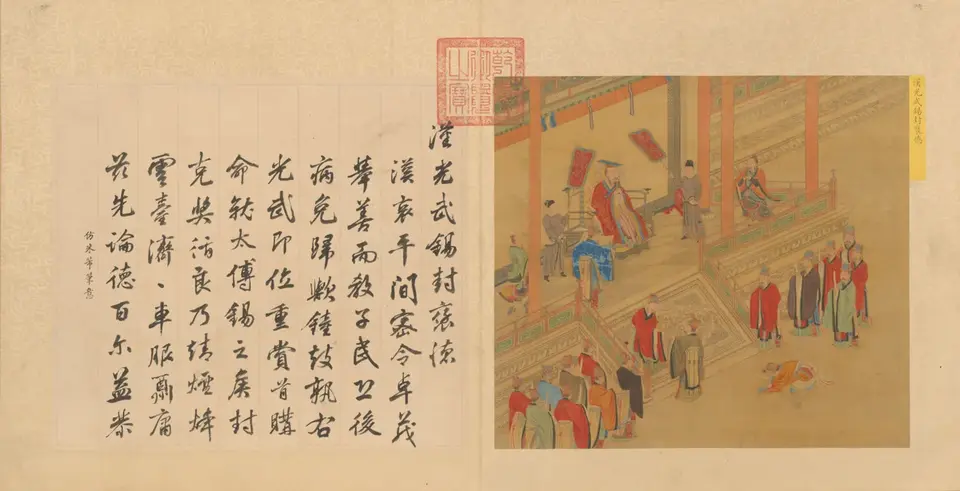
Biographical Narrative
Classical Studies and Chancellery Service
Zhuo Mao was born into an official family in Wan County; both his grandfather and father served as commandery administrators. Endowed with a gentle, modest, and magnanimous nature, Zhuo treated others with warm sincerity, winning affection even from peers whose temperaments and abilities differed from his own. During the reign of Emperor Yuan of Han, Zhuo journeyed to Chang'an to study under the renowned Erudite Jiang Sheng, mastering the Classic of Poetry, the Book of Rites, as well as astral calculations and mathematical methods. His deep grasp of classical rites and institutional history earned him the esteemed title of universal scholar among contemporary scholars in the capital.
During the reign of Emperor Cheng of Han, Chancellor Kong Guang, hearing of Zhuo's exceptional virtue and integrity, recruited him as a clerk in the chancellery. Kong Guang repeatedly praised Zhuo before court grandees as a venerable man of consummate virtue. Later, selected for his profound knowledge of the classics, Zhuo was made an Imperial Attendant and served within the palace as a Gentleman of the Yellow Gates.
While serving in the capital, Zhuo was once traveling by carriage when an ordinary citizen halted him, claiming that the horse pulling Zhuo's carriage was his own lost horse. When Zhuo politely inquired how long the animal had been missing, the man replied over a month. Although Zhuo had owned the horse for several years and knew the man was mistaken, he unhesitatingly unhitched the horse and handed it over, pulling the empty carriage home on foot while gently remarking that if the man found out it was not his horse, he could return it to the chancellery. Several months later, the man recovered his actual horse elsewhere. Overcome with shame, he hurried to the chancellery, knocked his head on the ground, and returned Zhuo's horse. Zhuo not only refrained from reprimanding him, but also treated him hospitably with wine and food.
Benevolent Governance in Mi County
Zhuo Mao was subsequently appointed Magistrate of Mi County in Henan Commandery. Upon his arrival, he introduced administrative reforms emphasizing moral suasion over penal coercion. Subordinate clerks, accustomed to harsh legalism, secretly mocked his methods, and neighboring magistrates ridiculed him as incapable of practical administration. The Administrator of Henan Commandery even dispatched a supervising assistant to oversee his magistrate's office. Undeterred by external skepticism, Zhuo treated the supervisor with courteous respect and continued to govern strictly according to Confucian ethics, showing paternal solicitude to commoners and never uttering abusive words.
On one occasion, a resident reported in secret that a local precinct officer had accepted a personal gift of rice and meat. Zhuo dismissed his attendants and probed gently, asking whether the officer had extorted the gift, whether it was given to solicit official favors, or whether it had been offered out of personal goodwill. The villager admitted he offered the gift out of fear of official power. Zhuo instructed him with patient warmth that humans are distinguished from beasts by mutual affection and ritual respect, and that friendly neighborly exchange was natural as long as officials did not abuse their authority. Laws provide the broad framework, while rites harmonize human hearts; ruling solely by strict law would turn family members against each other. The resident retired enlightened, and county clerks redoubled their devotion to duty.
Within several years of Zhuo's moral leadership, Mi County experienced an extraordinary moral renaissance: lost items left on the roadside were ignored by passersby, and litigation vanished. During the reign of Emperor Ping, a severe locust plague devastated more than twenty neighboring counties in Henan, leaving farmlands desolate. Remarkably, when the swarms reached the borders of Mi County, they dispersed without harming the crops. After personal on-site verification, the commandery administrator expressed boundless admiration for Zhuo's miraculous moral governance.
Retirement under Usurpation and Gengshi
During Wang Mang's regency, six agricultural assistant directorships under the Grand Minister of Agriculture were established to encourage farm production. On account of his exemplary governance, Zhuo was promoted to Assistant of the Capital Agricultural Section. As he departed Mi County, officials, elders, and children wept by the roadside in deep sorrow. When Wang Mang usurped the throne in 8 CE, Zhuo refused to serve the new regime, pleading illness to retire to his native Wan County. Though Wang Mang repeatedly summoned him, Zhuo accepted only a nominal advisory title, refusing all substantive responsibilities.
In 23 CE, Liu Xuan established the Gengshi regime in Wan and later relocated to Chang'an. Seeking venerable figures of moral renown, Emperor Gengshi appointed Zhuo as an Attendant Gentleman and Libationer. Upon arriving in the capital, Zhuo witnessed undisciplined generals, lawlessness, and administrative breakdown. Convinced that the regime would collapse rapidly, he firmly resigned on grounds of advanced age and infirmity, returning to live in quiet seclusion.
Grand Tutor of the Eastern Han and State Honors
In 25 CE, Emperor Guangwu ascended the throne in Hebei, founding the Eastern Han dynasty. Having witnessed the destruction of rituals and ethics during decades of war, the emperor sought a venerable elder of universal moral authority to restore societal mores. Shortly after his accession, Emperor Guangwu issued an imperial search for Zhuo Mao. Hearing of the restoration, the elderly Zhuo traveled from Henan to pay court to the emperor at Heyang.
Delighted by his arrival, Emperor Guangwu issued an edict proclaiming that Zhuo had practiced pristine self-cultivation and steadfast righteousness, achieving what ordinary men could not accomplish. The emperor appointed Zhuo Grand Tutor, ennobled him as Marquis of Baode with two thousand households, and granted him cushions, a walking staff, a fine carriage, and gifts of silk and clothing. Zhuo's elder son Zhuo Rong was appointed Grand Palace Grandee, and his second son Zhuo Chong was made an Imperial Attendant of the Yellow Gates. In 28 CE, Zhuo passed away peacefully in Luoyang. Emperor Guangwu deeply mourned his demise, attending his burial in plain mourning attire and granting prime funerary honors. In 60 CE, Emperor Ming included Zhuo Mao among the Thirty-Two Generals of Yuntai.