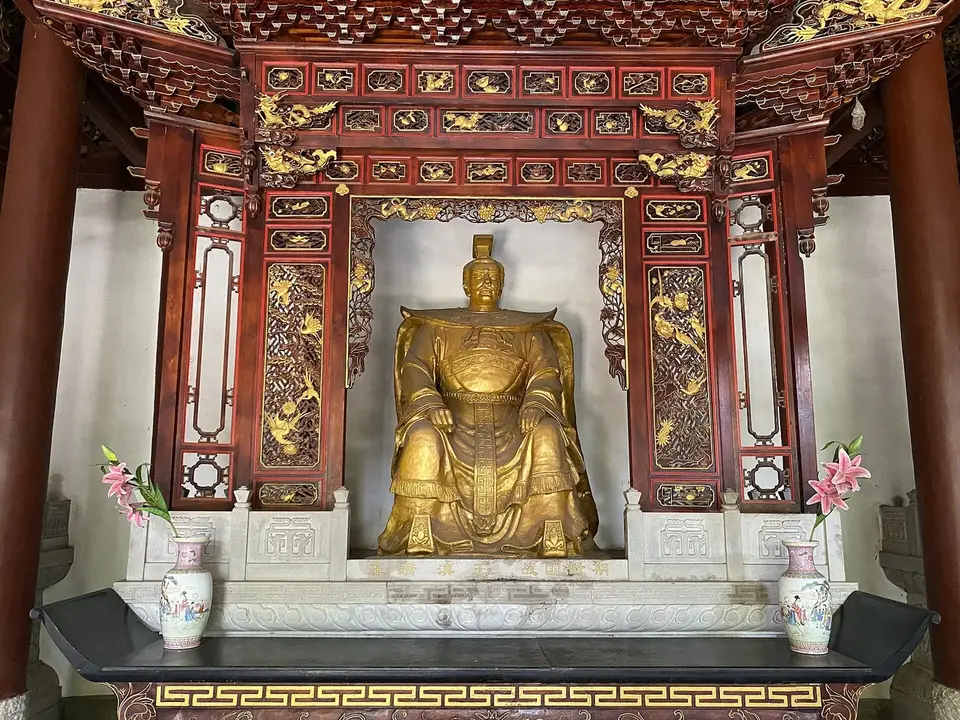
Biography
Lineage and Imperial Command for the Western Expedition
Zhuang Qiao traced his lineage to the royal house of Chu, being a direct descendant of King Zhuang of Chu (Xiong Lu), one of the Five Hegemons of the Spring and Autumn period. The royal lineage of Chu bore the ancestral surname Mi and clan name Xiong; over generations, one branch adopted the posthumous title of King Zhuang as their lineage name, forming the prominent Zhuang clan that enjoyed immense social standing and political influence in Chu. Living during the mid-to-late Warring States period, an era characterized by intense interstate warfare, Zhuang Qiao was trained in traditional military arts and chariot tactics, developing into a capable commander within Chu's royal guard and frontier garrisons.
During this period, the State of Qin, invigorated by Shang Yang's legalist reforms, pursued aggressive eastward expansion, continually encroaching upon Chu's territories. After King Huai of Chu was deceived, detained in Qin, and died in exile in Xianyang, his son ascended the throne as King Qingxiang of Chu. Early in King Qingxiang's reign, Qin generals Sima Cuo and Bai Qi repeatedly invaded Chu along the Han River basin, threatening Chu's western stronghold of Yan and the capital at Ying. Seeking to counter this existential geopolitical threat, the Chu court adopted a grand strategy of strategic reorientation toward the southwestern interior. The court aimed to conquer the barbarian marches west of Ba and Qianzhong commanderies, thereby establishing a deep strategic rear, securing fertile agricultural lands, and gaining access to vital copper, timber, and manpower reserves to offset territorial losses on the central plains.
Under these circumstances, King Qingxiang entrusted this mission of continental expansion to General Zhuang Qiao. Around the early years of King Qingxiang's reign, Zhuang Qiao took command of an expeditionary force comprising Chu royal guards, riverine fleets from the Jianghan plain, and archers from Jianghuai, embarking on a long march westward along the Yangtze River. This well-equipped army carried Chu's imperial aspirations into the southwestern frontier.
Advance to Lake Dian and Pacification of the Southwest
Zhuang Qiao's army sailed westward from the Jianghan plain, navigating the turbulent rapids of the Three Gorges into the rugged mountainous regions west of Ba and Qianzhong. At that time, this terrain was treacherous, characterized by steep ravines and pervasive tropical ailments, inhabited by dozens of independent tribal polities and chiefdoms, including Qielan, Yelang, Mimo, and Dian. Zhuang Qiao maintained strict military discipline while implementing a dual strategy of diplomatic conciliation and armed deterrence. Tribes that submitted peacefully were treated with restraint and rewarded with gifts, whereas those that resisted from mountain strongholds were suppressed by Chu's disciplined crossbowmen and coordinated formations.
After years of arduous campaigning across mountainous ranges, Zhuang Qiao's army traversed the high passes of the Yunnan-Guizhou Plateau and reached the Lake Dian basin (modern Kunming and Jinning District, Yunnan Province). The soldiers encountered an expansive, fertile landscape: Lake Dian stretched across an area of three hundred square li, surrounded by thousands of square li of fertile plains, endowed with a temperate climate and abundant water, suitable for sedentary agriculture and sustained human settlement.
Confronted by the indigenous tribes of the Dian basin, Zhuang Qiao refrained from pillage and indiscriminate destruction. Instead, he presented Chu's formidable military presence alongside civil ceremonial envoys to invite peaceful submission. Impressed by the discipline of the Chu army and reassured by their restraint, the local tribal chieftains and clan heads acknowledged his authority. Leveraging his military prestige and diplomatic skill, Zhuang Qiao pacified the surrounding territories and formally declared them subordinate to the State of Chu, establishing Chu's sovereign claim over the Dian region.
Qin Severance of the Return Route and Founding of the Dian Kingdom
Having pacified the Lake Dian region and established administrative outposts, Zhuang Qiao prepared to lead his principal commanders eastward back to Ying to report his triumph to King Qingxiang and arrange for civil administrators to assume governance over the territory. However, just as the expedition prepared for its eastward journey, catastrophic military developments unfolded in the Chu heartland.
In the twenty-second year of King Qingxiang of Chu (277 BCE), King Zhaoxiang of Qin ordered General Bai Qi and Zhang Ruo to launch an all-out assault against Chu. The Qin armies overran Chu's Wu and Qianzhong commanderies. Soon after, Qin captured the Chu capital of Ying and burned the royal ancestral tombs at Yiling, forcing King Qingxiang to flee eastward and relocate his capital to Chen (modern Huaiyang, Henan Province). With Qin forces occupying Qianzhong and Wu, the Three Gorges river route and the overland passes along the Yuan and Xiang rivers were blocked. All communications between Zhuang Qiao's army and the central Chu court were cut, stranding the expeditionary force thousands of li away in the southwestern wilderness.
Faced with this strategic catastrophe, the army was seized with anxiety. Zhuang Qiao demonstrated remarkable political resolve and leadership. Recognizing that attempting to force a passage eastward through heavily fortified Qin lines would result in annihilation, and observing that the Lake Dian region possessed fertile land and abundant resources capable of sustaining an independent realm, Zhuang Qiao made a fateful decision. He resolved to abandon the eastward march, settle his troops permanently around Lake Dian, and establish an independent regional monarchy, founding the ancient Kingdom of Dian with its royal seat near modern Jinning District in Kunming.
Adopting Local Customs and Governing the Dian Realm
Following his accession as King of Dian, Zhuang Qiao confronted the delicate challenge of enabling a minority of Chu soldiers to coexist peacefully with the indigenous Dian population over the long term. Rather than relying on armed force to impose foreign customs, Zhuang Qiao implemented a policy of accommodation described in classical histories as "altering his dress, adopting their customs, and becoming their leader."
Leading by personal example, Zhuang Qiao discarded Chu aristocratic robes, wide sashes, and jade ornaments, donning the short tunics, topknots, and leather attire favored by local inhabitants for mountain labor and hunting. In everyday life, communal rituals, and social interactions, he respected indigenous traditions and learned local dialects. By adopting this approachable posture, Zhuang Qiao dismantled the fear and suspicion that local clans harbored toward outsiders. Deeply impressed by his generosity and wisdom, the Dian chieftains embraced him as their supreme king.
Simultaneously, Zhuang Qiao adapted Chu administrative structures, military conscription, and legal codes to the indigenous tribal confederacy, transforming loose tribal alliances into an organized early state. He encouraged his soldiers to intermarry with local Dian women, forging marital and cultural ties between the Chu newcomers and indigenous inhabitants. Under his enlightened governance, the Kingdom of Dian achieved political stability and economic prosperity, emerging as the most powerful and culturally dynamic state on the Yunnan-Guizhou Plateau. Zhuang Qiao passed away peacefully in Dian, and his royal lineage ruled the kingdom for centuries.
Major Achievements
Opening Southwestern Communication and Establishing Frontier Geopolitics
Zhuang Qiao's expedition and founding of the Dian Kingdom marked a major milestone in the history of China's southwestern frontier. Prior to his arrival, the Central Plains civilization and the Southwestern Barbarians were separated by steep mountain ranges and impassable gorges. Although private merchants occasionally transported Shu cloth and bamboo canes along footpaths, formal diplomatic contacts and official communication were non-existent. Indigenous tribes existed in isolated and fragmented communities.
Supported by state military organization, Zhuang Qiao led a substantial force across treacherous mountain ranges, opening an official corridor extending from the Jianghan plain through the borders of Ba and Shu, the Wu River basin, the upper Yuan River, and across the Wumeng Mountains into the Lake Dian basin. This route mapped out the geopolitical connection linking the middle Yangtze with the Yunnan-Guizhou Plateau in transmitted histories. It broke the isolation of the southwestern frontier and provided a practical precedent for the construction of Qin's Five-Foot Way and the opening of the Southwestern Barbarian Road under Han Emperor Wu.
Furthermore, Zhuang Qiao's establishment of the Kingdom of Dian anchored the geopolitical center of the southwestern plateau in the Lake Dian basin. His state integrated peripheral tribes such as the Mimo, Laojin, and Ailao into a stable regional entity. This geopolitical arrangement shaped imperial administration in Yunnan under subsequent dynasties. When Emperor Wu launched his campaign against the southwestern tribes in 109 BCE, the Han court was able to incorporate Dian smoothly, creating Yizhou Commandery while confirming Zhuang Qiao's descendant as King of Dian with a royal gold seal. Zhuang Qiao's pioneering efforts established the historical bond that permanently integrated Yunnan into the multi-ethnic Chinese empire.
Transmitting Central Plains Civilization and Fostering Dian Bronze Culture
Zhuang Qiao's arrival in Dian went beyond military conquest and state-building; it catalyzed a technological and cultural transformation across the southwestern frontier. His expeditionary host included numerous Chu artisans, blacksmiths, bronze casters, weavers, and agricultural specialists, who introduced the advanced productive techniques of the middle Yangtze directly to Lake Dian.
In agriculture, Zhuang Qiao introduced iron farming implements, including iron plowshares, hoes, and spades, alongside ox-drawn plowing techniques. He promoted intensive wet-rice cultivation and terracing, utilizing Lake Dian's hydrological resources to construct irrigation channels. Primitive slash-and-burn farming was replaced by settled agriculture, transforming the Lake Dian basin into a fertile granary and providing an economic foundation for Dian society.
In metallurgy and the decorative arts, Chu bronze-casting, gold-inlay techniques, and lacquerwork fused with indigenous animal-combat motifs and tribal shamanic iconography, fostering the celebrated Dian Bronze Culture. Archaeological excavations at the Shizhaishan royal cemetery in Jinning have yielded remarkable bronze artifacts, including cowrie-shell containers, bronze drums, umbrella-holding figurines, and openwork plaques depicting sacrificial and hunting rituals. These artifacts exhibit the vitality of southwestern pastoral and hunting traditions while reflecting the intricate openwork and serpentine motifs characteristic of Chu art. This bronze culture stands as a testament to the cultural integration sparked by Zhuang Qiao's arrival.
Historical Identity and Textual Debates
In traditional historiography and modern academic research, Zhuang Qiao's life and identity have been the subject of extensive textual analysis and scholarly debate, centering on the exact chronology of his expedition and whether he was identical to the rebel leader Zhuang Jiao mentioned in pre-Qin philosophical texts.
Regarding the chronology of his march, both the Records of the Grand Historian and the Book of Han state that the expedition commenced "during the reign of King Wei of Chu." However, Qing dynasty philologist Qian Daxin noted in Critical Examination of the Twenty-Two Histories that King Wei died in 329 BCE, whereas Qin's capture of Qianzhong occurred in 277 BCE, fifty-two years later. It is implausible that an expedition dispatched by King Wei would have had its return route blocked half a century after his death. Modern historians cross-referencing the Hereditary House of Chu in the Records of the Grand Historian and excavated Warring States bamboo slips generally conclude that "King Wei" was a copyist error for "King Qingxiang," establishing that Zhuang Qiao's campaign took place in the 280s and 270s BCE.
Another major scholarly debate concerns the relationship between Zhuang Qiao and the rebel leader Zhuang Jiao referenced in texts such as the Xunzi and Han Feizi. Xunzi paired "Robber Zhi and Zhuang Jiao" as major rebels of the era, while Han Feizi recorded that Zhuang Jiao led an uprising that fractured Chu. Modern scholars have proposed two primary interpretations: one group, including Wen Yiduo and Guo Moruo, argued that Zhuang Qiao was originally a popular insurgent leader who later accepted Chu court amnesty, was appointed a general, and was dispatched on the southwestern expedition; another group, based on lineage practices, contends that multiple members of the royal Zhuang lineage bore similar names, meaning that the rebel leader and the general who founded Dian were distinct individuals. This ongoing debate illuminates the social complexity and lineage dynamics of late Warring States Chu.