Palace Birth
Born in the Forbidden City in Beijing as the fourth son of the Chenghua Emperor by Consort Shao.
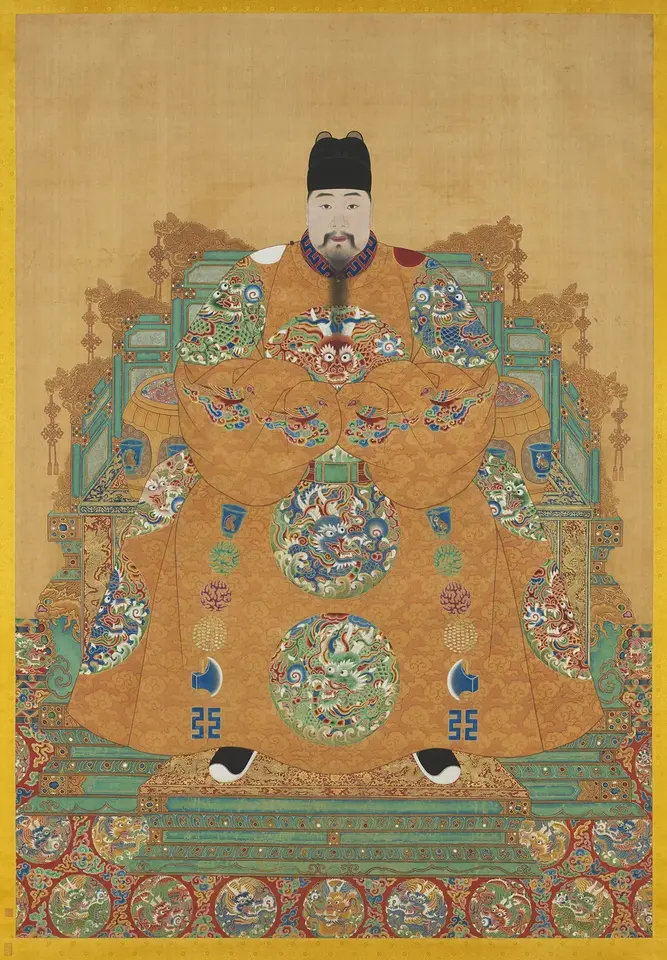
朱祐杬
Zhu Youyuan (朱祐杬, 1476–1519) was an imperial prince of the Ming Dynasty, the fourth son of Emperor Xianzong (Zhu Jianshen) and the younger brother of Emperor Xiaozong (Zhu Youcheng) by Consort Shao (posthumously Empress Xiaohui). Initially created Prince of Xing, he received the posthumous title "Xian," being historically known as Prince Xian of Xing; during the reign of his son, the Jiajing Emperor, he was posthumously…
Zhu Youyuan (朱祐杬, 1476–1519) was an imperial prince of the Ming Dynasty, the fourth son of Emperor Xianzong (Zhu Jianshen) and the younger brother of Emperor Xiaozong (Zhu Youcheng) by Consort Shao (posthumously Empress Xiaohui). Initially created Prince of Xing, he received the posthumous title "Xian," being historically known as Prince Xian of Xing; during the reign of his son, the Jiajing Emperor, he was posthumously elevated to Emperor with the temple name Ruizong and the posthumous title Emperor Xian. In July 1487 (23rd year of the Chenghua reign), Zhu Youyuan was created Prince of Xing by the Chenghua Emperor. In 1494 (seventh year of the Hongzhi reign), he completed his capping ceremony and departed Beijing to take up residence at his designated princely seat in Anlu Subprefecture, Huguang (modern Zhongxiang, Jingmen, Hubei Province). Zhu Youyuan was renowned for intellectual brilliance, personal modesty, and classical refinement, excelling in poetry, prose, and cursive calligraphy. During his twenty-five years in Anlu, he led an austere life dedicated to Confucian self-cultivation, strictly restraining his household guards from oppressing local commoners or seizing peasant farmlands, earning a stellar reputation as one of the most virtuous regional princes of the mid-Ming era. On July 13, 1519 (fourteenth year of the Zhengde reign), Zhu Youyuan died of illness in Anlu at the age of forty-four, receiving the posthumous title Prince Xian of Xing from Emperor Wuzong. In 1521, Emperor Wuzong died without an heir, and Zhu Youyuan's only surviving son, Zhu Houcong, was chosen to ascend the imperial throne as the Jiajing Emperor. The Jiajing Emperor subsequently engaged in a fierce three-year political struggle with the civil bureaucracy led by Senior Grand Secretary Yang Tinghe, known as the Great Rites Controversy (Daliyi). Overcoming bureaucratic opposition, the Jiajing Emperor posthumously elevated his father to Emperor with the temple name Ruizong and installed his spirit tablet in the Imperial Ancestral Temple above Emperor Wuzong. His original princely tomb at Jiulonggang in Anlu was expanded into the majestic Xianling Mausoleum, inscribed as a UNESCO World Heritage site in 2000.
Born in the Forbidden City in Beijing as the fourth son of the Chenghua Emperor by Consort Shao.
Formally created Prince of Xing by the Chenghua Emperor prior to the emperor's passing.
Departed Beijing to establish his princely seat at Anlu Subprefecture in Huguang.
Governed his household with modesty and integrity, patronizing classical letters and arts.
Princess Consort Jiang gave birth to Zhu Houcong (the future Jiajing Emperor).
Passed away in Anlu at age forty-four; Emperor Wuzong granted the posthumous title Prince Xian.
Emperor Wuzong died without heir; Zhu Houcong ascended the throne, initiating the Great Rites Controversy.
Elevated to Emperor Ruizong; spirit tablet placed in Imperial Ancestral Temple; tomb expanded to Xianling.
Zhu Youyuan was born on July 22, 1476, in the Forbidden City in Beijing, the fourth son of Emperor Xianzong. His biological mother, Consort Shao (posthumously honored as Empress Xiaohui), was renowned in the inner palace for her classical literacy, dignified comportment, and calligraphic skill. Raised under her attentive care, Zhu Youyuan exhibited exceptional scholarly talent and respectful propriety from early youth.
In July 1487, during the final days of Emperor Xianzong's reign, the twelve-year-old prince was invested with the title Prince of Xing. Following the accession of his elder brother Zhu Youcheng as the Hongzhi Emperor, the court provided the imperial princes with comprehensive instruction under senior academicians of the Hanlin Academy. Zhu Youyuan applied himself diligently to Confucian philosophy, historical chronicles, and literary anthologies, developing a distinguished reputation for elegant prose and cursive calligraphy that won the praise of the Hongzhi Emperor.
In 1494, upon celebrating his capping ceremony, Zhu Youyuan married Lady Jiang, daughter of military officer Jiang Xiao. That same year, the young couple departed Beijing to assume residence at their designated princely seat in Anlu Subprefecture, Huguang (modern Zhongxiang, Hubei).
Situated in the heart of the fertile Jianghan Plain along the Han River, Anlu was an agricultural and cultural center. In Anlu, Zhu Youyuan scrupulously observed ancestral dynastic laws restricting royal princes from meddling in local government. He constructed a modest study within his palace, spending his days reading classical commentaries, playing musical instruments, and composing poetry. Living an austere and disciplined life, he rejected ostentatious palace expansions and forbade his escort guards from extorting local merchants or encroaching on peasant farmlands. He treated local prefects and magistrates with the hospitality due to honored teachers. During his twenty-five years in Anlu, his estate maintained an unblemished record of virtue, celebrated across the empire as a model princely household.
On September 16, 1507, Princess Consort Lady Jiang gave birth to a son, Zhu Houcong, who would later reign as the Jiajing Emperor.
On July 13, 1519, Zhu Youyuan passed away in his Anlu palace from illness at the age of forty-four.
Emperor Wuzong mourned his uncle, suspending imperial court business for three days and dispatching officials to organize sacrificial ceremonies and construct a noble tomb at Mount Chunshu (Jiulonggang) north of Anlu city. Adhering to dynastic posthumous statutes, the court conferred the honorific title "Xian" (denoting wisdom, virtue, and rectitude), making him Prince Xian of Xing. In December 1519, his fourteen-year-old son Zhu Houcong was officially appointed to administer the affairs of the princely estate, preparing to inherit the peerage.
In April 1521, Emperor Wuzong died suddenly in Beijing without leaving an heir. In accordance with ancestral dynastic statutes governing succession ("fraternal succession when father-to-son succession fails"), Senior Grand Secretary Yang Tinghe and Empress Dowager Zhang selected Zhu Houcong, as the closest agnatic cousin, to inherit the imperial throne. On May 27, 1521, Zhu Houcong was crowned the Jiajing Emperor.
Upon ascending the throne, the young emperor immediately clashed with the civil bureaucracy. Yang Tinghe and traditional ritualists insisted that to maintain dynastic legal continuity, the Jiajing Emperor must formally be adopted as the posthumous son of the Hongzhi Emperor, addressing Hongzhi as "Imperial Father" and demoting his biological father Zhu Youyuan to "Imperial Uncle Prince Xian of Xing." The fifteen-year-old monarch adamantly rejected this arrangement, arguing that he had ascended the throne by imperial patent to inherit the dynasty in his own right, not as an adopted son, and declaring that filial piety demanded honoring his biological parents.
This dispute triggered the protracted and acrimonious Great Rites Controversy (Daliyi). Supported by rising scholars like Zhang Cong and Gui E, the Jiajing Emperor engaged in a relentless struggle against the cabinet and censorate. In August 1524, over two hundred high-ranking civil officials staged a kneeling demonstration outside Zuoshun Gate. The emperor responded with brutal floggings and arrests, crushing bureaucratic resistance and cementing absolute imperial authority over dynastic ritual.
Having prevailed in the ritual debates, the Jiajing Emperor promulgated decrees in 1524 elevating Zhu Youyuan to the rank of Emperor with the title "Imperial Father Emperor Gongmu Xian," while elevating Lady Jiang to Empress Dowager. In 1538, the emperor further augmented his father's honorific title, conferring the temple name Ruizong and installing his spirit tablet in the Imperial Ancestral Temple (Taimiao) in Beijing ahead of Emperor Wuzong.
To ensure that his father's resting place matched the highest imperial standards, the Jiajing Emperor committed vast imperial treasuries to reconstruct and expand the original princely tomb at Jiulonggang in Anlu (renamed Chengtian Prefecture). The complex was built according to the layout of the Ming Tombs in Beijing, covering more than one hundred and eighty hectares. It featured winding sacred ways, the Dragon Scales Canal, Jinshui bridges, outer and inner red gates, imposing soul towers, and double-walled burial tumuli. In 1539, following the death of Empress Dowager Jiang, the emperor personally escorted her bier south to be interred alongside Emperor Ruizong.
The Xianling Mausoleum survives as the most architecturally unique and intact single imperial mausoleum of the Ming Dynasty, embodying the ideological climax of the Great Rites Controversy. In 2000, Zhongxiang Xianling was inscribed on the UNESCO World Heritage List, recognized as a global masterpiece of royal funerary architecture.
As a unique figure in Ming history who was posthumously elevated from regional prince to ancestral emperor of the Imperial Ancestral Temple, Zhu Youyuan's lifelong personal modesty won imperial acclaim, while his posthumous imperial elevation profoundly altered mid-Ming autocracy.
The History of Ming recorded: "Zhu Youyuan, Prince Xian of Xing, was the fourth son of Xianzong. Enfeoffed in the 23rd year of Chenghua. Relocated to Anlu in the 7th year of Hongzhi. The Prince was studious and skilled in poetry, living with modest restraint. He died in the 14th year of Zhengde. Posthumously named Xian. When Shizong ascended the throne, he was elevated to Emperor with the temple name Ruizong, buried at the Xianling Mausoleum."
Early Qing historian Tan Qian commented in State Deliberations: "Prince Xian was modest, simple, and solemn, spending thirty years in his fief without a single documented fault. When destiny decreed that Shizong succeed the throne, the emperor resolved the Great Rites Controversy, elevating his father at Xianling and placing his tablet in the Imperial Ancestral Temple. The Prince's virtuous character truly fostered the revival of Ming fortunes."
Modern historians recognize that Zhu Youyuan's exemplary parenting and Confucian scholarly atmosphere provided the foundation for the young Jiajing Emperor's intellect. The Great Rites Controversy surrounding his posthumous status marked a crucial institutional transformation, enabling the Ming monarchy to break bureaucratic dominance through filial ethics and reassert absolute autocratic control. His resting place, the Xianling Mausoleum in Zhongxiang, remains an architectural wonder of global significance.
FIGURES ASSOCIATED WITH THIS DYNASTY