Birth in Jiaxing
Born into the prominent Zhu lineage of Biyifang, Jiaxing; his great-grandfather Zhu Guozuo was Grand Secretary of the Eastern Hall.
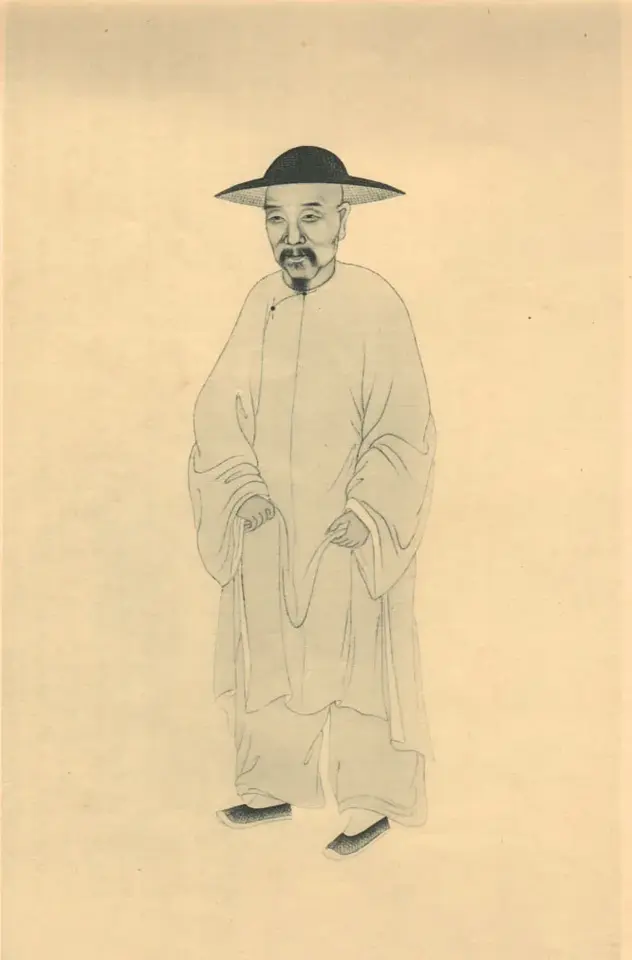
朱彝尊
Zhu Yizun (1629–1709), courtesy name Xichang, art name Zhucha, and late sobriquet Xiushui, was a native of Xiushui County, Jiaxing Prefecture, Zhejiang Province. He was an outstanding literary master, classical bibliographer, poetic theorist, and renowned bibliophile of the early Qing dynasty, celebrated as the founding patriarch of the Zhexi Ci School and paired with northern poetic leader Wang Shizhen as "Zhu in the South…
Zhu Yizun (1629–1709), courtesy name Xichang, art name Zhucha, and late sobriquet Xiushui, was a native of Xiushui County, Jiaxing Prefecture, Zhejiang Province. He was an outstanding literary master, classical bibliographer, poetic theorist, and renowned bibliophile of the early Qing dynasty, celebrated as the founding patriarch of the Zhexi Ci School and paired with northern poetic leader Wang Shizhen as "Zhu in the South and Wang in the North." Born into the illustrious family of Ming Grand Secretary Zhu Guozuo, his lineage declined during the Ming-Qing transition, forcing him to spend decades traveling across China as an itinerant secretary amidst civil war. In 1679, he passed the special Boxue Hongci examination as a commoner, placing twentieth in the first class, and was appointed examining editor in the Hanlin Academy to compile the official History of Ming (Ming Shi), later serving in the Southern Study. Zhu possessed encyclopedic mastery across the classics, histories, poetry, song lyrics, epigraphy, and bibliography. In song lyrics (ci), he reformed the vulgarity and coarse bombast of late Ming poetry, inheriting the ethereal elegance of Southern Song masters Jiang Kui and Zhang Yan to edit the 30-volume Ci Zong, laying the foundation for the Zhexi Ci School's century-long dominance. In poetry, his verse was renowned for erudition and structural majesty, preserved in the celebrated collection Baoshuting Ji. In classical bibliography, he devoted thirty years to compiling the 300-volume Jingyi Kao (Critical Examination of Classical Exegesis), creating the supreme masterpiece of premodern Chinese classical bibliography. In urban geography, his Rixia Jiuwen founded the modern study of Beijing historical topography. His private library, Baoshuting (Book-Basking Pavilion), housed over eighty thousand rare volumes, crowning southeastern collections. He passed away in Jiaxing in 1709 at age eighty-one.
Born into the prominent Zhu lineage of Biyifang, Jiaxing; his great-grandfather Zhu Guozuo was Grand Secretary of the Eastern Hall.
Amidst regional drought and peasant revolts, renounced examination essays under his uncle Zhu Maowan to focus on the Zuo Zhuan, Chu Ci, and Wen Xuan.
As Qing armies crossed the Yangzi River, married into the household of Feng Zhending in Gui'an, taking refuge in rural villages.
Participated in the Ten Prefectures literary gathering at South Lake in Jiaxing, befriending Wu Weiye, You Tong, Xu Qianxue, and Mao Qiling.
Traveled to Guangdong as a tutor for Magistrate Yang Yongjian, subsequently joining the staff of Provincial Administration Commissioner Cao Rong.
Traveled to Shanxi, visiting Mount Wutai and Yanmen Pass, later staying in Jinan, Shandong, where he formed a lifelong friendship with Wang Shizhen.
Summoned as a commoner to sit for the special Boxue Hongci examination, passed with high honors, and was appointed Hanlin examining editor to compile the History of Ming.
Served as associate examiner for the Jiangnan provincial examination, composing solemn oaths to eliminate bribery and select genuine talent.
Summoned to serve in the Southern Study, granted the privilege of riding a horse within the Forbidden City, and advised on state papers.
Impeached by censors for carrying private transcripts of Ming archival records outside the academy for printing; demoted one rank and reassigned to the Historiography Institute.
Completed the 42-volume urban historical geography Rixia Jiuwen with financial assistance from Xu Qianxue, concurrently drafting Jingyi Kao.
Retired to Jiaxing, erecting the Baoshuting library to house over eighty thousand rare volumes collected during his travels.
Died peacefully at Baoshuting at age eighty-one, leaving instructions to be buried in simple commoner's robes.
Zhu Yizun was born on October 7, 1629, into the prominent Zhu lineage of Biyifang, Xiushui County, Jiaxing Prefecture. His great-grandfather Zhu Guozuo was the first-ranked zhuangyuan of 1592 and Grand Secretary of the Eastern Hall under the Wanli Emperor, while his grandfather Zhu Daqi rose to Minister of the Court of Judicature and Revision. Surrounded by ancestral honors, Zhu entered private school at age five, demonstrating extraordinary precocity and memorizing classical canons at first reading.
However, during Zhu's childhood, factional strife, peasant uprisings, and natural disasters eroded the Ming empire, plunging the Zhu family into financial decline. In 1641, Zhejiang suffered catastrophic droughts and locust plagues, leaving the household destitute and repeatedly lacking grain. In 1642, Ming frontier defenses collapsed at Songshan. Observing national ruin, his tutor and uncle, Zhu Maowan, realized that formulaic examination essays were useless, instructing Zhu to abandon civil examination prose and immerse himself in the Zuo Zhuan, Elegies of Chu, Strategies of the Warring States, and the Selections of Refined Literature (Wen Xuan), instilling in him a commitment to empirical history and classical rhetoric.
In the spring of 1645, Qing armies swept south of the Yangzi River, triggering widespread loyalist resistance. Unable to afford marriage expenses due to acute poverty, the seventeen-year-old Zhu entered an uxorilocal marriage into the family of Feng Zhending, educational official of Gui'an County, marrying his eldest daughter Feng Fuzhen. That summer, warfare ravaged Jiaxing and Huzhou, scattering both families. Zhu fled with his father-in-law to rural Fengcun, while his biological mother, Lady Tang, died of exhaustion during flight. Zhu supported his family by transcribing manuscripts, and his collected works, Baoshuting Ji, began its chronological recording during this turbulent year.
In 1649, Zhu escorted his father to Meihuili. Living in destitution, Zhu frequently pawned his only padded cotton robe to purchase wine for visiting scholars. He formed an intimate literary brotherhood with fellow townsman Shen Jin, celebrated across the region as "Zhu and Shen." In 1650, southeastern scholars convened the historic Ten Prefectures literary gathering at South Lake in Jiaxing. Eminent masters including Qian Qianyi, Wu Weiye, You Tong, and Xu Qianxue attended; the twenty-two-year-old Zhu delivered striking verses that dazzled the assembly, earning the friendship of Wu Weiye and You Tong and rising to regional literary prominence.
Driven by poverty, Zhu departed Jiaxing in 1656 at age twenty-eight, embarking on more than two decades of itinerant secretarial service. He first traveled to Gaoyao, Guangdong, as a family tutor for Magistrate Yang Yongjian. The following year, he entered the secretarial staff of Guangdong Provincial Administration Commissioner Cao Rong. A prominent bibliophile and epigrapher of the Ming-Qing transition, Cao formed an unbreakable intellectual bond with Zhu, sharing his vast collection of rare Song and Yuan editions and introducing Zhu to epigraphic rubbings and classical bibliography.
Over the next twenty years, Zhu traveled across southern, central, and northern China. In 1664, he traveled to Taiyuan, Shanxi, ascending Mount Wutai and inspecting the fortifications of Yanmen Pass. Later residing in Jinan, Shandong, he examined ancient Han-Tang steles across Licheng and Qufu. The rugged northern landscape dispelled the delicate salon mannerisms typical of southern verse, endowing his poetry with heroic frontier gravity. In Jinan, he formed a deep friendship with northern poetic arbiter Wang Shizhen, their mutual acclaim giving rise to the celebrated pairing "Zhu in the South and Wang in the North."
In 1679, the Qing court convened the special Boxue Hongci examination to co-opt Han intellectuals. Prominent ministers recommended Zhu, then fifty years old. Traveling to Beijing as a commoner, Zhu composed brilliant poetic rhapsodies in the Baohe Palace, placing twentieth in the first class, and was appointed examining editor in the Hanlin Academy by imperial decree.
Assigned to the Historiography Institute as an official compiler of the History of Ming, Zhu collaborated with Xu Yuanwen and Ye Fang'ai to supervise the project. Adhering to the classical ethos of fearless historiographical truth, he drafted biographies for the founding Taizu and Jianwen reigns, verifying loyalist martyrdoms with scrupulous care. In 1681, he was appointed associate examiner for the Jiangnan provincial examination. Traveling south, he drafted his famous Oaths to River Deities and Oaths to Examination Deities, publicly swearing to eliminate patronage and select only genuine talent, transforming regional examination ethics and selecting scholars of impeccable integrity.
In 1683, the Kangxi Emperor, deeply admiring Zhu's immense learning, summoned him to serve in the Southern Study as Daily Imperial Lecturer. Zhu was granted the rare privilege of riding a horse within the Forbidden City and given living quarters within the imperial walls, dining frequently with the monarch.
However, Zhu's unbending academic focus alienated court factionalists. In 1684, hostile censors impeached Zhu for bringing rare archival records out of the Historiography Institute to employ private scribes for copying, alleging an intent to publish unauthorized texts. The Kangxi Emperor demoted Zhu by one rank and stripped him of his Southern Study post, ordering him to remain within the Historiography Institute as an ordinary compiler. Accepting this reversal with philosophical serenity, Zhu secluded himself in his capital study, the Guteng Shuwu, utilizing private patrons to draft his masterworks Rixia Jiuwen and Jingyi Kao.
In 1692, at age sixty-four, Zhu retired from official service and returned to Jiaxing. West of his ancestral home, he excavated ponds and constructed the Baoshuting (Book-Basking Pavilion), erecting a three-story library to house more than eighty thousand rare woodblock volumes amassed during his travels.
During his nearly two decades of retirement, Zhu collated texts and instructed young scholars. In 1705, during his southern tour, the Kangxi Emperor summoned Zhu aboard the imperial barge, conversing on governance and presenting him with an imperial calligraphic plaque reading "Investigating Classics, Cultivating Virtue." On November 14, 1709, the great scholar passed away peacefully at Baoshuting at age eighty-one. He left instructions that he be buried in plain commoner's clothing, maintaining his uncorrupted independence to the very end.
Zhu Yizun occupies a paramount position in Chinese lyric poetry as the founding patriarch of the Zhexi Ci School, the most enduring poetic movement of the Qing dynasty.
Since the Ming dynasty, the song lyric genre had declined, with writers ignoring musical prosody and lapsing into either vulgar sentimentality or unbridled noise. Chen Weisong's bold early Qing style, while vigorous, often lacked refined restraint. In response, Zhu collaborated with Wang Maolin to compile the 30-volume anthology Ci Zong, selecting over 2,200 lyrics by masters from the Tang, Five Dynasties, Song, Jin, and Yuan periods. In his preface, Zhu established the aesthetic banner of Southern Song masters Jiang Kui and Zhang Yan, advocating pure, ethereal elegance, deep refinement, and strict adherence to classical metrics. He demanded that lyricists align their words precisely with ancient musical registers while expressing personal and dynastic melancholy with subtle restraint. Under his leadership, prominent Zhejiang poets—including Li Liangnian, Li Fu, Shen Haori, and Zha Shenxing—coalesced into the Zhexi Ci School, elevating Qing lyrics to equal standing with the Song masters.
In poetry, Zhu was paired with northern spirit-and-tone leader Wang Shizhen as "Zhu in the South and Wang in the North," standing as the twin arbiters of early Qing poetry.
Zhu forcefully championed scholar's poetry (xueren zhi shi), attacking late Ming vacuity and asserting that true poets must possess deep canonical erudition and epigraphic literacy. His verse synthesized the spirit of pre-Qin and Han-Wei poetry with the dense intellectual power of Song masters Du Fu, Su Shi, Huang Tingjian, and Lu You, enriched by his travels across northern frontier passes. Epic travel poems such as Crossing the Dayu Ridge, Song of the Black Valley, and Record of Yungang Stone Buddha Temple were celebrated for desolate historical grandeur. His lifetime poems were compiled into the 80-volume Baoshuting Ji, establishing the definitive model for scholarly poets in the Qing dynasty.
In canonical bibliography, Zhu's 300-volume Jingyi Kao, completed after thirty years of labor, stands as the supreme monument of Chinese classical bibliographical scholarship.
Since Emperor Wu of Han established chairs for the Five Classics, canonical commentaries had accumulated by the tens of thousands, yet wars and dynastic collapses caused widespread textual loss and authorial confusion. Supported by patrons Xu Qianxue and Chen Tingjing, Zhu surveyed imperial and private libraries across the empire, compiling the 300-volume compendium. The work cataloged thousands of canonical treatises from pre-Qin times through the early Qing, recording titles, volume counts, extant editions, biographical sketches of authors, and historical colophons. Siku Quanshu Zongmu Tiyao praised the work, designating Zhu as the supreme historian of classical literature across thousands of years.
The work organized canonical texts across thirteen primary disciplines—including Changes, Documents, Poetry, Zhou Rites, Etiquette and Ceremonies, Book of Rites, Annals, Filial Piety, General Exegesis of the Five Classics, Four Books, Music, Erya, and Mencius—evaluating variant editions and transmission lineages with scientific precision, serving as an indispensable guide for all subsequent classical scholarship.
While serving at court, Zhu pioneered the modern study of Beijing historical geography and urban archaeology by authoring the 42-volume Rixia Jiuwen.
Utilizing confidential archives in the Southern Study and the Historiography Institute, Zhu surveyed dynastic records from the Song, Liao, Jin, Yuan, and Ming dynasties while conducting comprehensive on-site fieldwork across Beijing. He explored every urban alley, ancient rampart, imperial garden, ancestral temple, and suburban monastery, taking direct rubbings of more than a thousand ancient steles. He classified materials across urban walls, palaces, metropolitan boundaries, offices, temples, local products, and folklore, correcting centuries of erroneous hearsay. The work was later expanded under imperial decree during the Qianlong reign into the celebrated 160-volume Rixia Jiuwen Kao, remaining a foundational classic of world urban historiography.
In official Qing historiography, Zhu served as an intellectual anchor during the early compilation of the History of Ming, demonstrating unwavering commitment to historical truth.
Within the Historiography Institute, Zhu drafted biographies for the founding Ming emperors and early loyalist martyrs. When conservative court factions attempted to distort late Ming records to serve Manchu political sensibilities, Zhu insisted that history must preserve authentic fact, refusing to invent virtue or conceal evil. In reconstructing the loyalist officials who died defending the Jianwen Emperor during the Jingnan civil war, he consulted private family archives and unofficial records, preserving the memories of early Ming martyrs and safeguarding the moral integrity of dynastic historiography.
Zhu was one of the most prominent private bibliophiles and textual preservationists of the Qing dynasty, his Baoshuting library crowning southeastern China.
Beginning with his marriage into the Feng family, Zhu spent decades collecting rare ancient texts. Wherever he traveled, he expended his stipends on rare editions, borrowing and copying manuscripts from collectors. His collection grew to over eighty thousand volumes, filled with rare Song and Yuan woodblocks and Ming hand-copied manuscripts. Within Baoshuting, he established a scientific cataloging system and opened his library freely to scholars, transforming his estate into an intellectual sanctuary that nurtured a generation of evidential researchers.
In antiquarian archaeology, Zhu was a foundational pioneer of the Qing epigraphic movement, authoring the six-volume Jinshi Wenzi Bawei.
Throughout his travels, Zhu collected thousands of stone rubbings dating from the Han, Wei, Northern and Southern Dynasties through the Song and Yuan. In his colophons, he looked beyond calligraphic aesthetics to employ historical phonology and institutional research, cross-referencing bureaucratic titles, administrative boundaries, calendar cycles, and taboo names. He pioneered the scientific method of using stone inscriptions to verify official histories and using dynastic histories to annotate steles, directly inspiring later epigraphic masters such as Qian Daxin and Ruan Yuan.
FIGURES ASSOCIATED WITH THIS DYNASTY