Imperial Birth
Born in the imperial palace in Nanjing as the second son of Emperor Jianwen, invested as Prince of Run.
朱文圭
Zhu Wengui (朱文圭, 1401–1457) was an imperial prince of the Ming dynasty. He was the second son of Emperor Jianwen (Zhu Yunwen) and Empress Xiaominrang Lady Ma, known in Ming annals as "Commoner Jian" (Jian Shuren), who suffered one of the most tragic fates in Chinese history through fifty-five continuous years of solitary confinement. Born in 1401, Zhu Wengui was initially invested as the Prince of Run. In the sixth lunar…
Zhu Wengui (朱文圭, 1401–1457) was an imperial prince of the Ming dynasty. He was the second son of Emperor Jianwen (Zhu Yunwen) and Empress Xiaominrang Lady Ma, known in Ming annals as "Commoner Jian" (Jian Shuren), who suffered one of the most tragic fates in Chinese history through fifty-five continuous years of solitary confinement. Born in 1401, Zhu Wengui was initially invested as the Prince of Run. In the sixth lunar month of 1402, Zhu Di, Prince of Yan, breached the Jinchuan Gate of Nanjing; Emperor Jianwen vanished, and Empress Ma immolated herself in the burning palace. Captured as an infant of barely two years old, Zhu Wengui was spared death due to his tender age, but was stripped of his princely rank and locked behind the high walls of Guangyangshe in Zhongdu (Fengyang) to prevent future loyalist restoration movements. During his confinement, he was completely isolated from the outside world, denied literacy, and grew up ignorant of even common farm animals such as horses, cattle, and dogs, surviving through the reigns of Yongle, Hongxi, Xuande, Zhengtong, and Jingtai. In 1457, following the Wrestling of the Heavenly Gate (Duomen Zhi Bian), Emperor Yingzong (Zhu Qizhen) was restored to the imperial throne. Having endured seven years of house arrest in the Southern Palace himself, Yingzong felt deep empathy and overruled ministerial protests to issue an edict releasing fifty-seven-year-old Zhu Wengui, granting him a residence, servants, and concubines to live out his twilight years. However, having lived his entire life in dark isolation, Zhu Wengui succumbed to illness shortly after his release. He was posthumously honored as "Prince Runhuai" by the Southern Ming court.
Born in the imperial palace in Nanjing as the second son of Emperor Jianwen, invested as Prince of Run.
Nanjing fell and palace burned; two-year-old Zhu Wengui was captured and demoted to Commoner Jian, confined in Fengyang.
Passed his youth within the narrow confines of Fengyang high walls under strict guard, forbidden outside contact.
Reached forty years of age in complete social isolation through successive reigns of Hongxi, Xuande, and Zhengtong.
Following his restoration, Emperor Yingzong issued an edict releasing him from high walls, granting land and household.
Died of illness a few months after gaining freedom, unable to adapt to the outside world, aged fifty-seven.
The Southern Ming Hongguang court rehabilitated his princely status, conferring the posthumous title Prince Runhuai.
Zhu Wengui was born in 1401 within the Forbidden City of Nanjing. His father Zhu Yunwen was the second emperor of the Ming dynasty, and his mother Lady Ma was empress. When Zhu Wengui was born, his elder brother Zhu Wenkui had already been invested as crown prince; Emperor Jianwen created two-year-old Zhu Wengui Prince of Run. At that time, the Jingnan civil war initiated by his granduncle Zhu Di in the north was raging fiercely, casting a dark shadow over the imperial capital.
On the thirteenth day of the sixth lunar month in 1402, Yan forces breached the capital defenses after Prince of Gu Zhu Hui and Duke of Cao Li Jinglong surrendered the Jinchuan Gate. Yan soldiers flooded into the Forbidden City as towering fires consumed the halls. Emperor Jianwen vanished without a trace, while Empress Ma and Crown Prince Zhu Wenkui died in the inferno. Infant Zhu Wengui, wailing in a side pavilion amidst smoldering ruins, was discovered by soldiers and delivered before Zhu Di.
Confronted with his two-year-old grandnephew, Zhu Di hesitated to execute an innocent toddler. However, to permanently eradicate any threat to his throne from Jianwen's lineage, Zhu Di stripped Zhu Wengui of his princely status, degraded him to "Commoner Jian," and banished him to Zhongdu (Fengyang), confining him within the high-walled compound of Guangyangshe designed specifically for disgraced imperial clansmen.
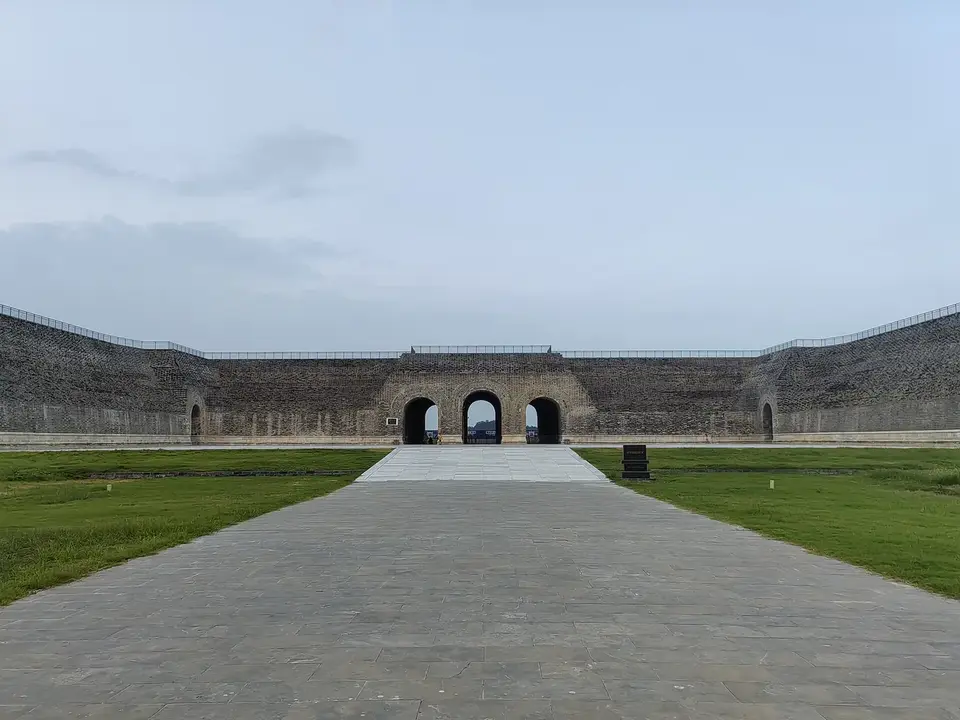
The High Walls of Fengyang (Fengyang Gaogiang) constituted a cold prison for fallen imperial royalty. Behind towering masonry ramparts, heavy iron doors remained locked year-round, except for a small feeding aperture, while heavily armed garrison troops and secret police maintained continuous surveillance.
Beginning at the age of two, Zhu Wengui was locked inside this isolated enclosure. Throughout fifty-five continuous years, he never set foot beyond the courtyard gates. Court directives strictly forbade guards from teaching him characters or speaking about current events. Growing up in silence and darkness, Zhu Wengui was stripped of normal human social development. Outside, history marched onward: Emperor Chengzu died, Emperor Renzong acceded, Emperor Xuanzong suppressed the rebellion of Zhu Gaoxu, Emperor Yingzong was captured at Tumu, and Emperor Jingtai defended Beijing. Five successive emperors occupied the dragon throne while Zhu Wengui remained a living phantom within his cell. Kept from natural landscapes, he reached his fifties unable to distinguish common animals such as cattle, horses, sheep, chickens, or dogs.
In the first lunar month of 1457, Emperor Yingzong (Zhu Qizhen), who had been deposed and confined in the Southern Palace of the Forbidden City for seven years by his brother Emperor Jingtai, was restored to the throne through a palace coup led by Shi Heng, Xu Youzhen, and Cao Jixiang.
Having tasted the bitter despair of solitary confinement himself, Emperor Yingzong underwent a profound moral transformation. Discussing imperial family history with Grand Secretary Li Xian, Yingzong remarked with deep emotion: "Emperor Jianwen's son remains imprisoned behind the high walls of Fengyang; more than fifty years have elapsed. What crime could an infant in swaddling clothes have committed to suffer such monstrous injustice? I wish to release him and treat him with generous leniency. What is your counsel?" Deeply moved, Li Xian knelt and praised the emperor: "Your Majesty's boundless benevolence moves heaven and earth; even the virtue of Yao and Shun could not exceed this!"
When several senior ministers and royal kinsmen warned that freeing Jianwen's descendant might ignite political turmoil, Emperor Yingzong dismissed their fears, stating firmly: "He who holds the Mandate of Heaven cannot be unseated by human machinations! He is already a white-haired elder; even if set free, what storms could he possibly raise?"
In the spring of 1457, Emperor Yingzong issued a special imperial rescript terminating Zhu Wengui's fifty-five-year imprisonment, permitting him to reside freely in Fengyang. The emperor granted him an estate, fertile farmland, generous monthly grain stipends, servant attendants, and concubines purchased from local households so that he might produce offspring and live out his days in comfort.
When imperial attendants unlocked the rusted gates and guided Zhu Wengui into the open air, the fifty-seven-year-old man was bent, gaunt, and completely silver-haired. Shielding his eyes against the blinding sunlight, he stared bewildered at open streets, unable to articulate his thoughts in coherent speech, regarding common draft animals and flying birds as mythical monsters.
Although he attained freedom and imperial provisions, half a century of sensory deprivation and confinement had irrevocably shattered his physical constitution and nervous system. Abruptly exposed to the bustling outside world, Zhu Wengui contracted a severe pulmonary illness within a few months and passed away quietly in the autumn of 1457 at the age of fifty-seven. Hearing of his demise, Emperor Yingzong mourned his tragic life and commanded local authorities to provide an honorable burial.
Zhu Wengui's life remains the most extreme embodiment of early Ming dynastic paranoia and the ruthless mechanisms deployed to secure autocratic succession.
From a two-year-old toddler to a fifty-seven-year-old elder, he spent fifty-five years behind prison bars across five imperial reigns—Yongle, Hongxi, Xuande, Zhengtong, and Jingtai. Standing as one of the longest continuous imprisonments of an imperial heir in world history, his life reveals the profound cruelty inflicted upon familial bloodlines in the pursuit of absolute power.
The liberation of Zhu Wengui in 1457 is celebrated by historians as an extraordinary act of humanity that broke through dynastic taboos.
By releasing Commoner Jian, Emperor Yingzong dismantled a severe political prohibition that had stood unchallenged since the Yongle reign, demonstrating moral empathy and political confidence. This compassionate breakthrough directly anticipated Emperor Yingzong's deathbed decree abolishing the brutal custom of burying imperial concubines alive upon a monarch's death, marking a crucial moral milestone in Ming dynastic ethics.
History of Ming (Ming Shi, Volume 118, Biographies of Imperial Princes, Sons of Emperor Huidi) records: "Prince of Run, Wengui, was the second son of Huidi. Enfeoffed in the first year of Jianwen. When Chengzu entered, he was reduced to commoner status and confined at Guangyangshe in Fengyang, designated 'Commoner Jian.' In the first year of Tianshun, Yingzong was restored, and remembering his own past in the Southern Palace, said to Li Xian: 'In the misery of confinement, none surpasses Commoner Jian.' He then issued an edict releasing him, granting him liberty of residence, farmland, and concubines. He was fifty-seven years of age, and died shortly thereafter."
Ming historian Wang Shizhen praised in Four Categories of Manuscripts from Yanzhou: "The release of Commoner Jian by Emperor Yingzong reflected the compassion of Yao and Shun. Extending the seven years of his own confinement in the Southern Palace to empathize with over fifty years behind high walls, no ruler in antiquity surpassed Yingzong in extending his heart to another."
Qing historian Gu Yingtai reflected in Major Events of Ming History: "Commoner Jian entered the high walls as an infant of two and grew old therein, unable to distinguish horse from ox—a misery unheard of across centuries. Yingzong took pity and freed him; though his life was short thereafter, it offered solace to his departed ancestors."
FIGURES ASSOCIATED WITH THIS DYNASTY